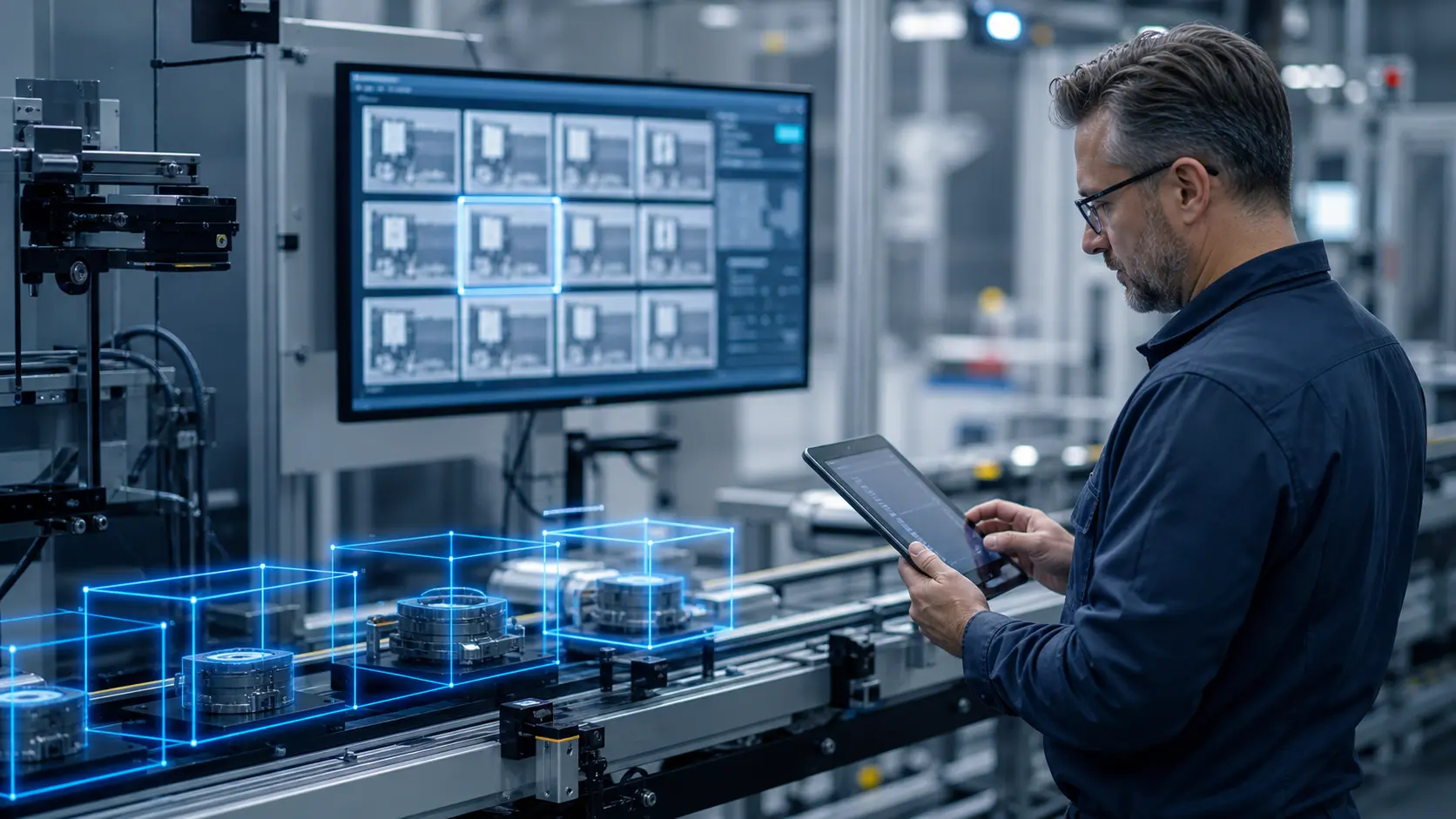
👁️ Computer vision is the AI capability that lets machines see, interpret, and act on visual data. This guide explains how it works in plain English, which tasks it handles, where it creates real business value in 2026, and the honest limitations you need to know before deploying it.
Last Updated: August 31, 2026
When a factory camera flags a hairline crack on a circuit board moving at 500 units per minute, that is computer vision. When a hospital AI highlights a suspicious region on a radiology scan before the radiologist reviews it, that is computer vision. When your phone unlocks by recognizing your face in under a second, that is also computer vision. Computer vision is the branch of artificial intelligence that enables machines to extract meaning from visual data — images, video, documents, and camera feeds — and act on that understanding. In 2026, it is one of the most commercially mature and ROI-proven areas of AI deployment across every major industry.
This guide covers what computer vision is and how it differs from other AI categories, how it actually works inside the machine in plain English, the main task types it handles, real 2026 use cases with named organization examples and outcome data, the leading platforms and tools, honest limitations, and a decision framework to help you determine when your organization actually needs it. If you are exploring how computer vision connects to multimodal AI models that process vision alongside text and audio, that guide covers the combined architecture in depth — this article focuses on how vision systems work as a standalone capability and where they create value independently.
The numbers make the case clearly. According to Fortune Business Insights, the global computer vision market was valued at $20.75 billion in 2025 and is projected to reach $24.14 billion in 2026 — with growth to $72.80 billion by 2034. Grand View Research puts the 2026 figure higher at $28.2 billion, growing at a 20.1% CAGR through 2033. The range across analysts reflects different scope definitions, but the direction is unambiguous: computer vision is no longer an emerging technology. It is production infrastructure in manufacturing, healthcare, retail, logistics, and automotive — and the question for most organizations in 2026 is not whether to adopt it, but how to deploy it correctly.
📖 New to AI terminology? Visit the AI Buzz AI Glossary — 95+ essential AI terms explained in plain English, each linking to a full in-depth guide.
👁️ 1. What Is Computer Vision? A Plain-English Definition
Computer vision is a field of artificial intelligence that trains machines to interpret and understand visual information from the world — images, video frames, camera feeds, scanned documents — in the same way that human eyes and brains process what we see. The goal is not simply to store or display images, but to extract structured meaning from them: identifying objects, detecting anomalies, tracking movement, reading text, and making decisions based on what the machine “sees.”
Plain-English definition: Computer vision teaches machines to look at a photo or video and answer useful questions about it — “What objects are in this image?”, “Is this product defective?”, “Where is the pedestrian in this frame?”, “What does this handwritten form say?” — automatically, at scale, and without human review of every individual image.
Computer vision is distinct from other AI categories in an important way. Large language models (LLMs) process text — they predict what word or sentence comes next based on patterns in language. Computer vision models process pixels — they learn to recognize patterns in spatial, visual data. The two capabilities are increasingly combined in multimodal AI systems, but computer vision as a standalone capability predates large language models by decades and has a far longer track record of proven enterprise ROI.
It is also worth distinguishing computer vision from machine vision, a term used primarily in industrial settings. Machine vision typically refers to purpose-built hardware-and-software systems installed on production lines — cameras, lighting rigs, and inspection software working together. Computer vision is the broader AI discipline that powers machine vision, but also extends to general-purpose applications like medical imaging analysis, autonomous vehicles, retail analytics, document processing, and security surveillance. In 2026, the two terms are increasingly used interchangeably as general-purpose AI vision platforms have displaced custom hardware solutions in many industrial contexts.
⚙️ 2. How Computer Vision Works — Plain English
Modern computer vision is powered primarily by convolutional neural networks (CNNs) — a class of deep learning models specifically designed to process grid-structured data like images. Understanding how CNNs work at a conceptual level is enough to make informed decisions about deploying computer vision in your organization. No mathematics required. For a deeper foundation on how neural networks work at the architecture level, see the deep learning guide.
A CNN processes an image in three conceptual stages. In the first stage — the feature extraction stage — the network applies a series of mathematical filters across the image, scanning for low-level patterns like edges, corners, color gradients, and textures. Think of it like running a magnifying glass across a photo and noting every place where colors change sharply or shapes appear. The network learns which patterns matter through training — it has seen millions of example images with labels (“this is a crack,” “this is a healthy cell,” “this is a stop sign”) and has adjusted its internal filters to detect the patterns that reliably distinguish one label from another.
In the second stage — the pattern combination stage — the detected low-level features are combined into higher-level concepts. Edges become shapes. Shapes become objects. A network trained on medical images learns that a specific combination of density, shape, and boundary sharpness indicates a tumor. A network trained on manufacturing data learns that a specific surface texture pattern indicates a weld defect. This hierarchical feature learning — from pixels to edges to shapes to objects — is what makes CNNs powerful: they automatically discover which visual patterns matter, rather than requiring a human engineer to manually specify rules. In 2026, Vision Transformers (ViTs) increasingly supplement CNNs for tasks requiring understanding of relationships between distant parts of an image — particularly in medical imaging and satellite analysis — but CNNs remain the dominant architecture for real-time industrial applications where inference speed is critical.
In the third stage — the decision stage — the extracted and combined features are passed to a classification or detection layer that produces the final output: a label, a bounding box, a segmentation map, or a confidence score. For a quality inspection system, this might be a binary output — “pass” or “fail.” For a medical imaging system, it might be a highlighted region with a confidence percentage. For an autonomous vehicle, it might be coordinates and labels for every object in the field of view, updated 30 times per second.
| CV Task Type | What It Does | Business Example | Leading 2026 Models |
|---|---|---|---|
| Image Classification | Assigns a label to the entire image — “what is this?” | Classify a product photo as “defective” or “acceptable” | ResNet, EfficientNet, ViT |
| Object Detection | Identifies and locates specific objects inside an image with bounding boxes | Detect pedestrians, vehicles, and cyclists in real time for autonomous driving | YOLOv10, RT-DETR, DINO |
| Image Segmentation | Labels every individual pixel in an image by category — more precise than bounding boxes | Outline the exact boundary of a tumor in a medical scan for surgical planning | Mask R-CNN, SAM 2 (Meta) |
| Optical Character Recognition (OCR) | Reads and extracts text from images, scanned documents, and handwritten forms | Extract line items from a scanned supplier invoice for automatic entry into ERP | Google Document AI, Azure Form Recognizer |
| Pose Estimation | Maps the position of body joints and limbs in real time from camera footage | Monitor worker ergonomics on a factory floor to flag unsafe lifting postures before injury occurs | MediaPipe, OpenPose, YOLOv8-Pose |
| Anomaly Detection | Learns what “normal” looks like and flags deviations — without needing labeled defect examples | Detect unusual patterns in semiconductor wafer images without prior defect labeling | PatchCore, CFlow-AD, custom ViT |
| Video Analytics | Tracks objects and events across video frames over time — adds temporal understanding to image capabilities | Track customer dwell time and traffic patterns in a retail store to optimize shelf placement | ByteTrack, DeepSORT, AWS Rekognition Video |
🏢 3. Computer Vision in Business: Real 2026 Use Cases and ROI
Computer vision is one of the few AI application categories where enterprise deployments consistently outperform their business cases — because production conditions in manufacturing, logistics, and healthcare are more controlled and repeatable than the open-ended language tasks that challenge text-based AI. A camera above a conveyor belt sees the same objects in roughly the same positions every day. That repeatability is precisely what modern vision models are built for. Visual quality control in manufacturing is the largest enterprise computer vision deployment category by both deployment count and revenue.
Manufacturing — Visual Inspection and Defect Detection
Nearly 75% of manufacturers now run some form of AI-powered inspection, according to Datature’s 2026 Enterprise Vision AI Adoption Report. AI vision systems achieve 90–95% accuracy on defect detection versus 70–80% for human inspectors, reducing scrap rates by up to 30% in typical industrial deployments. Toyota implemented visual inspection automation across multiple production lines and reported a 32% reduction in defect rates in the first year of deployment. Inline defect detection on production lines now operates at 500+ units per minute — a throughput that manual inspection cannot match at any comparable cost. EU GMP Annex 1 pharmaceutical compliance rules, effective 2026, now require 100% vial inspection capable of detecting particles under 50 microns — a specification that mandates computer vision deployment for any compliant pharmaceutical manufacturer.
Healthcare — Medical Imaging and Clinical Support
Computer vision in healthcare is moving from research to regulated deployment at scale. Healthcare AI applications include pathology slide analysis for cancer screening, radiology image flagging for priority review, and surgical tool tracking in operating rooms. The FDA’s 2026 Clinical Decision Support guidance now compels computer vision suppliers in healthcare to prove algorithm robustness across diverse patient demographics and document training data provenance under 21 CFR Part 11 — making regulatory compliance a procurement requirement, not an afterthought. Predictive maintenance powered by computer vision delivers 30–50% downtime reduction with ROI typically realized in 12–15 months across industrial healthcare equipment, according to Pravaah Consulting’s 2026 analysis.
Retail — Inventory, Loss Prevention, and Customer Analytics
Retail computer vision in 2026 operates across three distinct functions. Shelf monitoring systems analyze real-time camera feeds to detect out-of-stock items and trigger replenishment alerts before a customer notices the empty shelf. Self-checkout loss prevention uses object recognition at point of sale to verify that scanned items match bagged items — reducing shrinkage without additional staff. Customer flow analysis tracks traffic patterns and dwell time to optimize store layouts and promotional placement. Approximately 58% of US logistics facilities have now implemented computer vision systems for package tracking and warehouse automation, according to Business Research Insights 2026 data.
Automotive — ADAS and Safety Systems
The automotive sector now uses vision-based inspection systems in nearly 74% of US production facilities. More significantly, Advanced Driver Assistance Systems (ADAS) camera shipments are expected to reach 240 million units in 2026 — up from 200 million in 2025 — driven by regulatory mandates making forward-collision warning compulsory across major markets. Volkswagen’s ID.7 electric vehicle uses infrared-based gaze tracking to comply with Euro NCAP’s 2025 driver-monitoring rule, demonstrating that computer vision has moved from optional feature to regulatory compliance requirement in automotive.
🏭 Exploring AI in your industry? Browse the AI Buzz Industry Guide — 35+ in-depth sector guides covering how AI is transforming healthcare, finance, HR, legal, retail, manufacturing, and more.
🛠️ 4. Leading Computer Vision Platforms in 2026
The computer vision platform landscape in 2026 divides into three tiers: cloud AI services that provide pre-built vision APIs (fastest to deploy, least customizable), end-to-end vision AI platforms that handle data labeling, model training, and deployment (most flexible for custom use cases), and open-source frameworks that give maximum control at the cost of requiring internal ML expertise. The right choice depends on your technical capacity, data sensitivity requirements, and the specificity of your use case.
Edge deployment has become a dominant consideration in platform selection. According to Datature’s 2026 research, edge inference now accounts for over 50% of new computer vision model deployments — driven by sub-10ms latency requirements in manufacturing, data sovereignty rules in healthcare, and the prohibitive cost of streaming high-resolution video to cloud APIs at production scale. Organizations running edge AI inference for computer vision report 30–40% energy cost savings and latency under 10 milliseconds versus cloud-only pipelines. 97% of US CIOs have included edge AI in their 2025–2026 technology roadmaps.
| Platform | Tier | Best For | Key Strength | Edge Support |
|---|---|---|---|---|
| AWS Rekognition | Cloud API | Teams needing fast deployment of standard vision tasks — object detection, facial analysis, text extraction | No ML expertise required; integrates directly with AWS ecosystem | ⚠️ Via AWS Panorama |
| Google Cloud Vision AI | Cloud API | Document intelligence, OCR, image labeling integrated with Google Workspace | Best-in-class OCR and Document AI; strong multilingual support | ⚠️ Via Edge TPU |
| Microsoft Azure AI Vision | Cloud API | Microsoft 365 / Azure-centric enterprises needing vision + Azure OpenAI integration | Deep Microsoft ecosystem integration; strong compliance tooling for regulated industries | ✅ Via Azure IoT Edge |
| NVIDIA Metropolis | Edge Platform | Real-time industrial inspection and smart city / surveillance applications requiring sub-10ms latency | Leading edge inference performance; Jetson hardware ecosystem | ✅ Native edge-first |
| Roboflow | End-to-End Platform | Teams with custom datasets who need data labeling, training, and deployment in one platform | Best-in-class data labeling tools; fast custom model training pipeline | ✅ Via Roboflow Inference |
| Landing AI (LandingLens) | End-to-End Platform | Manufacturing QC teams without deep ML expertise — designed for domain experts, not data scientists | Low-code industrial inspection; purpose-built for production-line deployment | ✅ Supported |
| YOLOv10 / Ultralytics (Open Source) | Open Source | Teams with ML engineers who need maximum control over model architecture, training data, and deployment environment | State-of-the-art real-time object detection; no licensing cost; fully self-hostable | ✅ Optimized for edge |
⚠️ 5. Honest Limitations: What Computer Vision Cannot Do in 2026
Computer vision deployments consistently outperform business cases in controlled environments — but the gap between a successful demo and a reliable production system is almost entirely an environmental engineering problem, not a model quality problem. The biggest challenge in 2026 is not model accuracy. It is deploying models reliably in messy real-world environments where lighting variation, partial occlusion, hardware inconsistency, and novel edge cases create constant failure modes. A model trained on images taken under controlled lighting conditions frequently degrades significantly when lighting changes seasonally, when a different camera model is installed, or when a new product variant appears that the training data did not include.
The 2026 Computer Vision Reality: Between 70–85% of enterprise AI projects fail to meet ROI expectations (NTT DATA, 2024). The primary cause in computer vision deployments is not model quality — it is data quality. Models trained on insufficient, unrepresentative, or low-diversity datasets fail in production regardless of their benchmark scores. A model that achieves 98% accuracy on a benchmark dataset can fail at 60% accuracy on your specific factory floor if the training data did not match your conditions.
Specific named limitations that matter for enterprise buyers in 2026:
- Bias across demographic or environmental variation: Vision models trained predominantly on certain image types perform poorly on underrepresented classes. Facial recognition systems have documented accuracy gaps across skin tones. Medical imaging models trained on data from high-income country hospitals perform poorly on imaging equipment common in other settings. The FDA now mandates demographic robustness documentation for healthcare CV systems precisely because this failure mode causes disproportionate harm.
- No native causal reasoning: Computer vision models identify patterns — they do not understand causes. A defect detection model that flags a surface discoloration cannot tell you whether the discoloration is caused by a chemical contamination, a lighting artifact, or a harmless material variation without additional context or a hybrid system.
- Privacy and surveillance risk at scale: Real-time video analytics capable of tracking individuals across a camera network raises significant privacy obligations under GDPR, CCPA, and the EU AI Act’s biometric identification provisions. Facial recognition in public spaces is banned in several EU jurisdictions. Any computer vision deployment involving faces or crowd tracking requires a privacy impact assessment and legal review.
- Adversarial vulnerability: Computer vision models can be fooled by adversarial inputs — physical stickers, patterns, or lighting modifications that are invisible to humans but cause the model to misclassify objects with high confidence. This is a documented concern in autonomous vehicle safety and physical security applications.
- Data labeling cost: Custom computer vision models require large volumes of labeled training data. Labeling is expensive, time-consuming, and introduces human error. Anomaly detection approaches that learn “normal” without requiring defect labels reduce this burden, but are not applicable to all use cases.
🤔 6. Computer Vision Decision Framework: Does Your Business Actually Need It?
Computer vision is not the right tool for every business problem involving images. Many teams deploy it prematurely — before they have sufficient labeled data, before the deployment environment is characterized, or for use cases where a simpler rule-based system would be more reliable and cheaper. The decision framework below is designed to help you identify whether computer vision is genuinely appropriate for your use case or whether a simpler approach will serve you better.
| If You Are… | Recommended Approach | Suggested Platform | Readiness Signal |
|---|---|---|---|
| A manufacturer running manual inspection at 300+ units/hour with a documented defect escape rate above 2% | ✅ Computer vision — this is the highest-ROI use case. Start with anomaly detection to avoid labeling costs. | LandingLens or NVIDIA Metropolis | ✅ Strong — clear ROI case |
| A retailer wanting to reduce stockouts by monitoring shelf availability across 50+ stores in real time | ✅ Computer vision — shelf monitoring is a proven, deployable use case. Evaluate managed retail CV platforms first. | Trigo, Focal Systems, or AWS Rekognition | ✅ Strong if camera infrastructure exists |
| A hospital processing 10,000+ radiology images per month with radiologist review bottleneck | ✅ Computer vision for triage flagging — but only with FDA-cleared or CE-marked systems and mandatory radiologist review of all AI outputs | Aidoc, Viz.ai, or Nuance AI | ⚠️ Only with cleared tools + HITL |
| A finance team processing 5,000+ scanned invoices monthly with manual data entry taking 2+ hours per day | ✅ CV-powered OCR and document intelligence — clear ROI, well-solved problem. Use a managed platform, not a custom build. | Google Document AI or Azure Form Recognizer | ✅ Fastest ROI path |
| A small business wanting to “use AI” to improve product photos on an e-commerce site | ❌ Computer vision is overkill. Use a dedicated AI photo editing tool or multimodal model (GPT-4o, Gemini) for image enhancement. | Adobe Firefly, Canva AI, or DALL-E | ❌ Wrong tool for this task |
| A logistics company with 3 warehouses wanting to automate package barcode scanning and routing | ✅ Computer vision for barcode/label reading — but evaluate off-the-shelf scanning systems before a full CV deployment. Simpler rule-based systems may suffice. | AWS Rekognition or dedicated barcode hardware | ⚠️ Check simpler options first |
| A team wanting to monitor employee behavior or facial recognition in a US office for attendance or security | ⚠️ Requires legal review before any deployment. Biometric surveillance in workplaces triggers Illinois BIPA, Texas CUBI, and multiple state laws. Significant liability risk. | Consult legal counsel first | 🔴 Legal risk — do not proceed without advice |
| A developer who wants to build a custom vision model but has fewer than 500 labeled images | ⚠️ Insufficient data for reliable custom model training. Use few-shot foundation models or collect more data before training. Consider synthetic data augmentation. | Meta SAM 2, Roboflow for data labeling | ⚠️ Collect more data first |
🏁 7. Conclusion: Computer Vision Is Mature — Deployment Is the Hard Part
Computer vision is one of the most ROI-proven categories of enterprise AI in 2026. The technology works. The benchmarks are real. The use cases — manufacturing inspection, medical imaging, retail analytics, document intelligence, autonomous vehicle safety — are in production at scale across thousands of organizations globally. The market growing from $24 billion in 2026 toward $72 billion by 2034 reflects genuine, measurable economic value being created by these systems, not speculative demand.
The challenge in 2026 is no longer “can computer vision solve this problem?” — it is “can our organization deploy it reliably, with sufficient data quality, in our specific environment, with appropriate governance controls?” The organizations delivering the strongest ROI from computer vision are those that start with a clearly defined, high-volume, visually repetitive task with a measurable baseline, invest in data quality before model quality, and treat deployment environment engineering as a first-class concern. For a deeper look at how computer vision fits into the broader AI perception stack — including how it integrates with text and audio in multimodal systems — see the multimodal AI explained guide. For the governance and compliance requirements that apply when computer vision is used in consequential decisions, the AI governance framework guide covers the accountability structures you need in place before deployment.
📌 8. Key Takeaways
| Takeaway | |
|---|---|
| ✅ | Computer vision enables machines to extract structured meaning from visual data — images, video, and documents — through convolutional neural networks and vision transformers trained on labeled examples. |
| ✅ | The global computer vision market is valued at $24.14 billion in 2026 and projected to reach $72.80 billion by 2034, driven by manufacturing inspection, autonomous vehicles, healthcare imaging, and retail analytics. |
| ✅ | AI vision systems achieve 90–95% defect detection accuracy versus 70–80% for human inspectors — reducing scrap rates by up to 30% in manufacturing deployments (industry benchmarks, 2025–2026). |
| ✅ | Edge inference now accounts for over 50% of new computer vision deployments in 2026 — driven by sub-10ms latency requirements, data sovereignty rules, and cost of cloud video streaming at production scale. |
| ✅ | The primary failure mode in CV deployments is data quality — not model quality. Between 70–85% of enterprise AI projects fail to meet ROI expectations (NTT DATA, 2024), most due to insufficient or unrepresentative training data. |
| ✅ | Biometric surveillance deployments in US workplaces trigger Illinois BIPA, Texas CUBI, and multiple state biometric privacy laws — legal review is mandatory before any facial recognition deployment. |
| ✅ | FDA’s 2026 Clinical Decision Support guidance mandates algorithm robustness across diverse demographics and training data provenance documentation under 21 CFR Part 11 for all healthcare CV systems. |
| ✅ | The highest ROI computer vision deployments in 2026 share three characteristics: a clearly defined, high-volume task; a measurable baseline for comparison; and investment in deployment environment engineering as a first priority over model accuracy. |
🔗 Related Articles
- 📖 Multimodal AI Explained: Models, Use Cases and Safety (2026)
- 📖 Deep Learning Explained: How Neural Networks Power Modern AI (2026)
- 📖 Edge AI Explained: How AI Works Without the Internet
- 📖 AI in Manufacturing: Smart Factories, Predictive Maintenance, and Quality Control
- 📖 Physical AI Explained: How Robots, Drones, and Smart Machines Use AI
👁️ Frequently Asked Questions: What Is Computer Vision?
1. What is computer vision in simple terms?
Computer vision is the branch of AI that enables machines to extract meaning from images, video, and visual data — answering questions like “what is in this photo?” or “is this product defective?” automatically. It powers applications from facial recognition to medical imaging to factory inspection. See our deep learning guide for how the underlying neural networks learn to see.
2. What is the difference between computer vision and image recognition?
Image recognition is one specific task within computer vision — it classifies what is in an image. Computer vision is the broader field that includes object detection, segmentation, pose estimation, anomaly detection, OCR, and video analytics. Image recognition answers “what is this?” while object detection answers “where is it?” and segmentation answers “which exact pixels belong to it?”
3. Which industries use computer vision the most in 2026?
Manufacturing leads — nearly 75% of manufacturers now run AI-powered inspection. Automotive uses CV in 74% of US production facilities and across all new ADAS systems. Healthcare deploys it for radiology triage, pathology analysis, and surgical tool tracking. Retail uses it for shelf monitoring, self-checkout, and customer analytics. Our AI in Manufacturing guide covers the manufacturing use cases in depth.
4. Is computer vision the same as multimodal AI?
No — computer vision is a standalone capability focused on visual data. Multimodal AI combines computer vision with language and audio processing in a single unified model. GPT-4o and Gemini 2.5 Pro are multimodal — they use vision as one input type among several. A factory inspection camera running YOLOv10 is a pure computer vision system. See the multimodal AI explained guide for how the two relate.
5. What are the biggest risks of deploying computer vision in 2026?
Three primary risks: data quality failure (models trained on insufficient data fail in production — 70–85% of enterprise AI projects miss ROI targets), regulatory exposure (biometric surveillance in US workplaces triggers multiple state laws; healthcare CV systems require FDA-cleared tools under 2026 guidance), and environmental mismatch (models degrade when lighting, hardware, or product variants differ from training conditions). Our AI governance framework covers the accountability structures needed before deployment.
📧 Get the AI Buzz Weekly Digest
Weekly AI insights, tools, and strategies — delivered every Monday. Free.




Leave a Reply