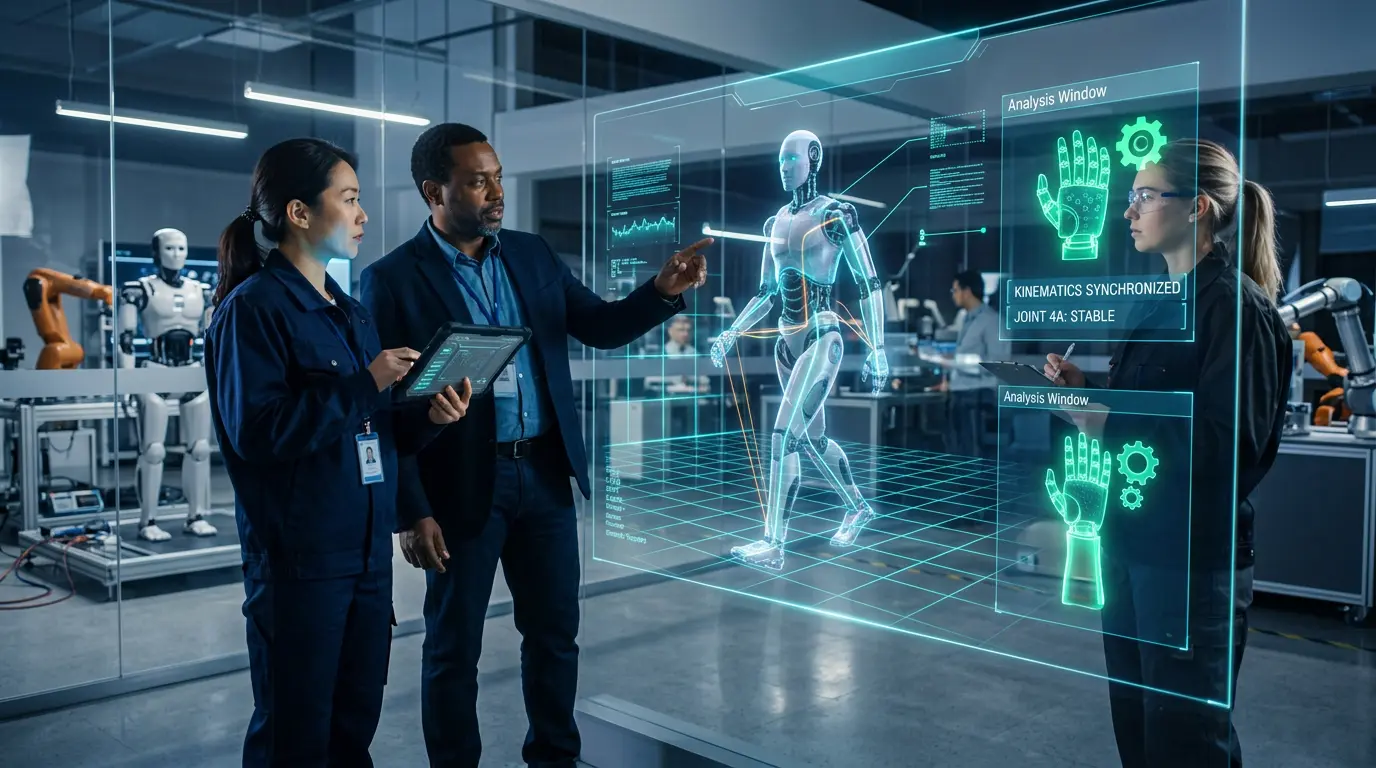
🤖 AI is leaving the screen and entering the physical world — and the consequences are extraordinary. From surgical robots and autonomous vehicles to AI-guided drones and warehouse automation systems, Physical AI is the discipline of building machines that perceive, decide, and act in the real world. This 2026 guide explains exactly how it works, where it is being deployed, and the safety guardrails that must govern every system that can cause physical harm.
Last Updated: August 23, 2026
For most of its history, Artificial Intelligence existed in a purely digital realm — processing text, generating images, analyzing data, and returning outputs that existed only as information. The consequences of AI errors were informational: a wrong answer, a poor recommendation, a flawed analysis. These errors could cause real harm in context — a bad medical recommendation, a flawed financial analysis — but the physical world remained insulated from direct AI action. Physical AI ends that insulation.
Physical AI refers to AI systems that perceive the physical world through sensors, make decisions based on that perception, and execute actions through physical actuators — motors, arms, wheels, rotors, surgical tools — that change the state of the physical world in real time. When a surgical robot guided by AI makes an incision, when an autonomous vehicle brakes to avoid a pedestrian, when a warehouse robot picks and packs an order, when an agricultural drone applies fertilizer to a specific square meter of a field — these are all Physical AI in action. The outcomes are not digital artifacts. They are physical realities that cannot be undone with a keystroke.
According to McKinsey’s research on Physical AI, the global market for AI-enabled physical systems — robotics, autonomous vehicles, drones, and smart manufacturing — is projected to exceed $400 billion by 2030, growing at more than 25% annually. This guide covers the technical foundations, major application domains, real-world results, and safety frameworks for Physical AI in 2026. For related topics, see our guides on Edge AI (the on-device processing architecture powering many physical AI systems), Confidential Computing (secure AI data processing), and Small Language Models (efficient models commonly deployed in physical AI devices).
📖 New to AI terminology? Visit the AI Buzz AI Glossary — 65+ essential AI terms explained in plain English, each linking to a full in-depth guide.
1. 📊 What is Physical AI? The Core Framework
Physical AI systems share a common architectural pattern — a continuous cycle of perception, reasoning, and action that operates in real time with consequences that unfold in the physical world.
The Perception-Reasoning-Action Loop
Every Physical AI system, regardless of its specific application, operates through this fundamental cycle:
- Perception: Sensors collect data about the physical environment — cameras capture visual information, LiDAR measures distances and creates 3D maps, radar detects objects and their velocities, microphones capture audio, force sensors measure contact and pressure, GPS provides location, and accelerometers and gyroscopes provide motion state. The richness and reliability of this sensor data is the foundation of everything that follows.
- Reasoning: AI processes the sensor data to build a model of the current state of the environment — identifying objects, understanding their positions and movements, predicting their future states, and determining what actions should be taken to achieve the system’s objectives while avoiding harm.
- Action: The AI’s decisions are translated into physical actions through actuators — motors that drive wheels or rotate joints, pneumatic systems that power grippers, thrust systems that control flight, or tool systems that perform surgical procedures. The quality of the action is determined both by the AI’s decision and by the precision of the mechanical systems executing it.
The Critical Difference from Digital AI: In digital AI, errors can be corrected. A wrong answer can be revised. A poor recommendation can be disregarded. In Physical AI, many errors cannot be undone. An autonomous vehicle that fails to brake cannot un-collide with a pedestrian. A surgical robot that cuts in the wrong location cannot un-make the incision. A drone that drops a payload cannot un-deliver it. This irreversibility is the defining characteristic that makes Physical AI safety requirements categorically more stringent than those for digital AI.
The Levels of Physical AI Autonomy
| Level | Name | Description | Physical AI Example |
|---|---|---|---|
| L1 | AI Assistance | Human performs all actions; AI provides information and alerts | Lane departure warning system; surgical navigation overlay |
| L2 | Partial Automation | AI controls specific functions; human monitors and can override | Adaptive cruise control; robotic-assisted surgery |
| L3 | Conditional Automation | AI handles all functions in defined conditions; human available to take over | Highway autopilot; warehouse autonomous mobile robots in defined zones |
| L4 | High Automation | AI handles all functions in specific operational domains; no human oversight required in domain | Waymo robotaxi in geofenced area; autonomous mining trucks in defined pit |
| L5 | Full Automation | AI handles all functions in all conditions without human involvement | Not yet achieved for most Physical AI applications in 2026 |
Understanding autonomy levels is essential for governance — because the appropriate safety requirements, human oversight mechanisms, and regulatory frameworks differ significantly across levels. A Level 2 system with an engaged human operator has fundamentally different safety requirements from a Level 4 system operating without real-time human supervision. For a deeper exploration of AI autonomy levels, see our guide on The 5 Levels of AI Autonomy.
2. 🚗 Autonomous Vehicles: The Flagship Physical AI Application
Autonomous vehicles are the Physical AI application that has received the most public attention and investment — and the one that most clearly illustrates both the transformative potential and the safety challenges of Physical AI at scale.
The Technology Stack of Autonomous Vehicles
A modern autonomous vehicle is one of the most complex Physical AI systems ever deployed — integrating multiple sensor modalities, real-time AI inference, precise mapping, and mechanical control systems into a unified system that must operate reliably in the unpredictable complexity of the real world.
- Sensor Fusion: Autonomous vehicles combine data from cameras (typically 8–12 cameras providing 360-degree visual coverage), LiDAR (producing detailed 3D point clouds of the surrounding environment), radar (providing object detection and velocity measurement in all weather conditions), and ultrasonic sensors (for close-range detection) — with AI fusion algorithms combining these data streams into a unified, reliable environmental model.
- HD Mapping: Autonomous vehicles operate against centimeter-accurate HD maps of their operational areas — using these maps as a prior against which real-time sensor data is registered and validated. The combination of HD maps with real-time sensor data is what enables the precise localization that safe autonomous driving requires.
- Prediction Models: AI models predict the future behavior of all detected road users — other vehicles, cyclists, pedestrians, and animals — over a planning horizon of several seconds. The quality of these prediction models is one of the most significant determinants of autonomous vehicle safety, because safe driving requires anticipating what others will do, not just reacting to what they have done.
- Motion Planning: AI motion planning generates a trajectory for the vehicle that achieves its navigation objective while avoiding collisions, respecting traffic laws, and maintaining passenger comfort — continuously replanning at high frequency as the environment changes.
The Commercial Reality in 2026
Commercial autonomous vehicle deployment in 2026 is concentrated in specific operational domains where the technology has been validated to sufficient safety standards:
- Robotaxi Services: Waymo operates fully autonomous robotaxi services (without safety drivers) in Phoenix, San Francisco, and Los Angeles — with a safety record that now includes tens of millions of fully autonomous miles. This represents the most significant commercial validation of Level 4 autonomous driving in passenger transport.
- Autonomous Trucking: Aurora and Kodiak Robotics operate autonomous long-haul trucking on defined freight corridors in Texas and other Sunbelt states — with a commercial model that addresses the severe truck driver shortage while improving highway freight efficiency.
- Autonomous Mining: Caterpillar and Komatsu autonomous haul trucks operate in mining operations across Australia, Canada, and Chile — with the controlled environment and defined routes of mining operations providing an ideal operational design domain for early autonomous vehicle deployment.
3. 🦾 Robotics and Industrial Physical AI
Industrial robotics has existed for decades — but traditional industrial robots operated within rigid, pre-programmed routines that required carefully controlled environments and human programming for every new task. AI-enabled robots in 2026 are fundamentally different: they can perceive complex, unstructured environments, learn new tasks from demonstration, adapt to variation in parts and processes, and collaborate safely with human workers in shared spaces.
AI-Enabled Industrial Robots
The defining capability that AI adds to industrial robotics is generalization — the ability to perform tasks in conditions that differ from those the robot was trained on. Traditional robots required every part to be presented in a specific orientation, every process to follow a precise sequence, and every deviation to trigger a fault. AI-enabled robots handle variation gracefully — recognizing parts presented in different orientations, adapting grip force to different material properties, and recovering from minor process deviations without human intervention.
Key AI capabilities in industrial robotics include:
- AI-Guided Assembly: Computer vision and AI guide robot arms through complex assembly sequences — verifying the presence and correct positioning of each component before proceeding and detecting assembly errors in real time
- Bin Picking: AI vision systems enable robots to pick individual parts from unstructured bins — identifying each part’s position and orientation in real time and computing the appropriate grasp for each specific instance
- Quality Inspection: AI-guided robot systems perform 100% dimensional and visual inspection of manufactured components — at speeds and accuracy levels that human inspection cannot match
- Flexible Manufacturing: AI-enabled robots that can be retasked through demonstration rather than programming are enabling flexible manufacturing cells that can switch between product variants without extended retooling periods
This connects to the comprehensive manufacturing AI applications covered in our guide on AI in Manufacturing.
Collaborative Robots (Cobots)
Collaborative robots — designed specifically to work safely alongside human workers rather than in isolated caged cells — are one of the fastest-growing segments of industrial Physical AI. AI enables cobots to perceive human presence and intent in real time, adapting their behavior to maintain safe proximity and to provide assistance that complements rather than competes with human capabilities.
AI cobot applications include ergonomic support (eliminating the lifting, reaching, and repetitive motions that cause musculoskeletal injury), precision assistance (holding components in precise position while a human performs a skilled assembly operation), and process guidance (using augmented reality overlays to guide a human worker through a complex assembly sequence with AI verification of each step).
4. 🏥 Physical AI in Healthcare: Surgical Robotics and Medical Devices
Healthcare Physical AI — where AI-guided physical systems assist in or perform medical procedures — represents one of the highest-stakes and most consequential Physical AI application domains. The potential benefits are extraordinary: surgical precision that exceeds human capability, consistent technique that eliminates operator-dependent variation, and the ability to perform minimally invasive procedures through anatomical access points too small for unassisted human hands. The risks are equally extraordinary: a Physical AI error in a surgical setting can cause immediate, irreversible patient harm.
Surgical Robotics in 2026
Surgical robotics has evolved from the teleoperated systems of the early 2000s — where a surgeon controlled a robot remotely with no AI involvement — to genuinely AI-enabled surgical assistance where AI perception, guidance, and in some cases semi-autonomous execution are integrated into the surgical workflow.
- Intuitive Surgical da Vinci System: The most widely deployed surgical robot globally, with AI enhancements in 2026 including AI-guided tissue identification (distinguishing cancerous from healthy tissue in real time during resection), automated suturing assistance, and procedural guidance based on analysis of thousands of previous surgical videos
- Mako Surgical Robotic System (Stryker): Orthopedic surgical robotics with AI that creates a patient-specific surgical plan from CT scan data and uses haptic force feedback to prevent the surgeon from making cuts outside the AI-defined safe operating zone — combining AI planning with surgeon execution in a genuinely collaborative model
- Autonomous Radiotherapy: AI-guided radiation therapy systems continuously adjust the radiation beam in real time as the patient moves during treatment — tracking the tumor target while protecting surrounding healthy tissue with a precision that fixed plans cannot achieve
For the complete healthcare AI application context, see our guide on AI in Healthcare and MedTech.
AI-Enabled Medical Devices
Beyond surgical robotics, AI is embedded in a growing range of implantable and wearable medical devices that constitute Physical AI in their own right — sensing physiological parameters in real time and delivering therapeutic interventions based on AI analysis.
- AI-enabled cardiac devices that detect arrhythmia patterns and deliver precisely timed electrical therapy
- Closed-loop insulin delivery systems that continuously monitor blood glucose and calculate insulin doses — the “artificial pancreas” that is transforming Type 1 diabetes management
- AI-guided deep brain stimulation systems that continuously adjust stimulation parameters based on real-time neural signal analysis
🚀 New to AI? Start with the AI Buzz Beginner’s Guide to AI — 30+ plain-English guides organized into four clear learning paths: fundamentals, tools, prompting, and business adoption.
5. 🛸 Drones and Autonomous Aerial Systems
Unmanned aerial systems — drones — represent one of the most rapidly expanding Physical AI application categories in 2026, with commercial deployment now well-established across delivery, inspection, agriculture, emergency response, and infrastructure monitoring.
Commercial Drone Delivery
AI-guided drone delivery has moved from regulatory experimentation to commercial operation in multiple markets. Wing (Google’s drone delivery service) operates commercial delivery services in Australia and the United States — with AI managing all aspects of flight planning, obstacle avoidance, payload delivery, and return journey. Amazon Prime Air has received FAA approval for expanded operations, and multiple specialized medical drone delivery networks are operating across Rwanda, Ghana, and other markets where drone delivery provides access to medical supplies that ground transport cannot reliably deliver.
Inspection and Infrastructure Monitoring
AI-guided drones are transforming infrastructure inspection — providing visual, thermal, and acoustic inspection data for bridges, pipelines, power transmission lines, wind turbines, and building structures at a fraction of the cost and risk of human inspection. AI systems process the imagery captured by inspection drones to identify defects, measure their severity, and prioritize maintenance interventions — providing infrastructure managers with condition intelligence at scales and frequencies that manual inspection cannot achieve.
Agricultural Drones
AI-guided agricultural drones apply fertilizer, pesticide, and water with centimeter-level precision — treating individual zones of a field based on AI analysis of crop health maps. As covered in our guide on AI in Agriculture, this precision application delivers 40–60% reductions in chemical application compared to conventional broadcast methods.
6. 📦 Warehouse Automation and Logistics Robotics
Warehouse and logistics operations have become one of the most extensive deployment environments for Physical AI — driven by the explosive growth of e-commerce, the structural challenge of warehouse labor availability, and the precision requirements of just-in-time supply chain operations.
Autonomous Mobile Robots (AMRs)
Autonomous Mobile Robots navigate warehouse floors using AI-based perception and mapping — picking orders, transporting inventory, and moving goods between receiving, storage, and shipping areas without fixed guide paths or infrastructure. Unlike earlier Automated Guided Vehicles (AGVs) that required embedded floor guides or reflective markers, AMRs build and update their own maps of the warehouse environment and navigate dynamically around obstacles, human workers, and other robots.
Amazon’s Proteus AMR — the first fully autonomous robot Amazon has deployed to work directly with human associates without physical barriers — uses AI to navigate complex warehouse environments shared with human workers. Its AI safety system continuously monitors human proximity and adapts its behavior to maintain safe distances and predictable movements in the shared environment.
AI-Guided Picking and Sorting Systems
Goods-to-person robotic systems — where robots bring storage pods to human pickers rather than having pickers walk to goods — reduce picker walking distances by 60–75% and increase picking throughput significantly. AI orchestration systems coordinate thousands of robots in these environments, managing traffic, charging schedules, storage location optimization, and picking sequence planning simultaneously.
This connects to the supply chain applications covered in our guide on AI in Supply Chains and Logistics.
7. 🏗️ The Technical Challenges of Physical AI
Physical AI faces technical challenges that digital AI does not — challenges that explain why development timelines are longer, validation requirements are more stringent, and failure consequences are more severe.
The Sim-to-Real Gap
Physical AI systems are typically trained primarily in simulation — where data is abundant, scenarios can be varied systematically, and failures have no physical consequences. But simulated environments are imperfect representations of the physical world — with subtle differences in physics, visual appearance, and environmental dynamics that cause AI systems to behave differently when transferred from simulation to reality. Closing this “sim-to-real gap” is one of the central technical challenges of Physical AI — requiring sophisticated simulation environments, domain randomization techniques, and careful real-world validation.
Long-Tail Safety Events
The most dangerous scenarios for Physical AI systems are the rarest ones — the edge cases and unexpected combinations of conditions that fall at the tail of the distribution of real-world experience. An autonomous vehicle may encounter millions of routine driving scenarios without difficulty, and then encounter a specific combination of weather, road marking, and pedestrian behavior that its training has not adequately prepared it for. Ensuring adequate safety for these long-tail events is an unsolved challenge in Physical AI — and a primary motivation for the extensive validation requirements that Physical AI regulatory frameworks impose.
Real-Time Reliability Requirements
Physical AI systems typically operate under hard real-time constraints — the AI must complete its perception, reasoning, and action cycle within a defined time budget that is determined by the physics of the system. An autonomous vehicle traveling at 60 mph must update its motion plan faster than the environment changes at that speed. A surgical robot must respond to tissue resistance faster than the surgeon’s reaction time. Meeting these real-time requirements while maintaining the safety and accuracy needed for Physical AI applications places demands on AI systems that digital AI applications do not face.
8. 🛡️ The Essential Safety Guardrails for Physical AI
The irreversibility of physical actions and the potential for catastrophic harm from Physical AI failures require safety frameworks that are fundamentally more rigorous than those applied to digital AI. The following guardrails represent the minimum safety requirements for responsible Physical AI deployment.
Guardrail 1: Operational Design Domain (ODD) Definition
Every Physical AI system must have a precisely defined Operational Design Domain — the specific set of conditions within which it is designed and validated to operate safely. The ODD defines the environmental conditions (weather, lighting, road types for autonomous vehicles), the operational parameters (speed ranges, load limits for robots), and the presence of other agents (human co-workers, other vehicles) within which the system’s safety performance has been validated.
Physical AI systems must not be deployed outside their validated ODD — and must be designed to recognize when they are approaching ODD boundaries and to safely disengage autonomous operation or alert human operators before those boundaries are crossed.
Guardrail 2: Fail-Safe Design and Redundancy
Physical AI systems must be designed to fail safely — meaning that any single component failure should result in a state that is safe for humans, even if it prevents the system from completing its intended task. This requires redundant sensor systems (so that the failure of any single sensor does not deprive the AI of critical perception capability), redundant computational systems (so that the failure of any single processor does not prevent safety-critical computation), and safe fallback behaviors (the system slows down, stops, or hands control to a human rather than continuing to operate with degraded capability).
Guardrail 3: Mandatory Human Override Capability
Every Physical AI system — at every level of autonomy — must provide clear, accessible, and reliable means for human operators to override, pause, or disable the AI’s physical actions at any time. This is the Human-in-the-Loop principle applied to Physical AI — and it must be implemented as a hardware-level capability, not just a software function that could be disabled by the AI system itself. The emergency stop must work even if the AI system’s software is malfunctioning.
Guardrail 4: Extensive Pre-Deployment Validation
Physical AI systems must undergo significantly more extensive validation than digital AI systems — because the consequences of deployment failures are physical and potentially irreversible. Validation must include testing across the full operational design domain, adversarial scenario testing for edge cases and failure modes identified during design review, and statistical validation of safety performance against defined minimum standards.
The OWASP AI Testing Guide and the Adversarial Machine Learning defensive framework provide the foundational testing methodologies — supplemented by domain-specific safety standards (ISO 26262 for automotive, IEC 62304 for medical devices, DO-178C for aviation) that specify the exact validation rigor required for each physical domain.
Guardrail 5: Continuous Safety Monitoring in Production
Physical AI systems must be continuously monitored in production for safety performance — tracking safety- critical events, near-misses, unexpected behavioral patterns, and environmental conditions that approach or exceed ODD boundaries. This monitoring must be independent of the AI system being monitored — with safety monitoring systems that cannot be influenced by the AI they are watching.
Connect this monitoring requirement to the broader AI Monitoring and Observability framework — with the specific addition that Physical AI monitoring must trigger automatic system shutdown when safety-critical degradation is detected, not just alert generation for human review.
Guardrail 6: Cybersecurity for Physical Systems
Physical AI systems connected to networks — autonomous vehicles receiving traffic data, robots receiving work orders, drones receiving flight plans — create cybersecurity attack surfaces where a successful compromise can cause physical harm. An adversary who can send false sensor data to an autonomous vehicle or manipulate the navigation system of a drone can cause physical harm through a purely digital attack. The NIST Cyber AI Profile controls that govern AI cybersecurity must be applied with particular rigor to Physical AI systems — because the physical consequences of successful attacks are categorically more severe than the data compromise consequences of attacks on purely digital AI systems.
Guardrail 7: Clear Liability and Accountability Frameworks
When a Physical AI system causes harm — a collision, a surgical error, a drone accident — the legal and ethical question of who bears responsibility must be answered clearly and in advance. The accountability gap that exists for AI systems generally is more urgent and more consequential for Physical AI — where harm is immediate, physical, and sometimes catastrophic. See our guide on AI Liability and Autonomous Agents for the current legal landscape and the governance frameworks that responsible Physical AI deployment requires.
🏁 Conclusion: Building Physical AI That Earns Trust
Physical AI is the frontier where the promises and the risks of Artificial Intelligence converge most dramatically. The potential — safer roads, more precise surgery, more efficient logistics, more sustainable agriculture — is genuine and compelling. The risk — autonomous systems causing physical harm through error, malfunction, or adversarial exploitation — is equally real and deserves equivalent attention.
The organizations and institutions building Physical AI responsibly in 2026 are those that treat safety not as a regulatory obstacle but as the foundational design requirement from which every other design decision flows. They define operational boundaries before they deploy systems. They build redundancy for failure modes they can predict and safe fallbacks for the ones they cannot. They maintain human override capability as a non-negotiable design constraint. And they monitor their systems in production with the same rigor they applied in validation — because the physical world is more complex and more variable than any validation environment can fully capture.
📌 Key Takeaways
| ✅ | Takeaway |
|---|---|
| ✅ | Physical AI systems perceive, reason, and act in the physical world — with consequences that are real, immediate, and often irreversible, unlike digital AI errors that can be corrected. |
| ✅ | The global market for AI-enabled physical systems is projected to exceed $400 billion by 2030, growing at more than 25% annually. |
| ✅ | The Perception-Reasoning-Action loop is the universal architecture of Physical AI — the quality of perception, the accuracy of reasoning, and the precision of action determine safety and capability in equal measure. |
| ✅ | Waymo’s Level 4 autonomous robotaxi operations in multiple US cities represent the most significant commercial validation of fully autonomous Physical AI in public spaces. |
| ✅ | The sim-to-real gap and long-tail safety events are the two most significant technical challenges in Physical AI — explaining why validation requirements are more stringent than for digital AI. |
| ✅ | Operational Design Domain definition is the foundational safety requirement — Physical AI systems must not be deployed outside the specific conditions for which their safety has been validated. |
| ✅ | Human override capability must be implemented at the hardware level — not as a software function that a malfunctioning AI could disable. |
| ✅ | Cybersecurity for Physical AI is categorically more critical than for digital AI — a successful cyber attack on a Physical AI system can cause immediate physical harm rather than data compromise. |
🔗 Related Articles
- 📖 The 5 Levels of AI Autonomy: From Simple Chatbots to Autonomous Agents
- 📖 AI in Manufacturing: Predictive Maintenance, Quality Control, and Smart Factories
- 📖 AI Liability and Autonomous Agents: Who is Responsible When the Machine Makes a Mistake?
- 📖 Edge AI Explained: How AI Works Without the Internet
- 📖 Human-in-the-Loop AI Explained: Draft-Only Workflows and Approval Gates
❓ Frequently Asked Questions: Physical AI
1. How is Physical AI different from a traditional factory robot?
Traditional robots follow fixed scripts in controlled environments. Physical AI uses “World Models” to perceive and react to the unpredictable real world in real-time. This allows a machine to navigate a busy warehouse or construction site using multimodal sensors rather than pre-programmed paths.
2. Does Physical AI require a constant internet connection to stay safe?
No. For safety-critical tasks, machines use Edge AI to process data locally. If a drone or autonomous vehicle loses its cloud connection, the local “brain” ensures it can still perform emergency stops or obstacle avoidance without needing the internet.
3. Can Physical AI “hallucinate” in a way that causes physical damage?
Yes. In the physical world, a hallucination is a “perception error”—like a self-driving car misidentifying a plastic bag as a concrete barrier. To prevent this, developers use LLM Red Teaming to test how the machine reacts to “corner cases” before deployment.
4. Who is legally responsible if a Physical AI machine causes an injury?
This is a complex area of AI Liability. Usually, responsibility is split between the software provider, the hardware manufacturer, and the operator. Companies must maintain an AI System Bill of Materials (sBOM) to track which component failed during an incident.
5. Can Physical AI robots be “hacked” to perform dangerous actions?
Yes. Unlike chatbots, hacking Physical AI has real-world consequences. Organizations must use Adversarial Machine Learning defenses to prevent “signal spoofing” or “sensor poisoning,” where an attacker tricks the robot’s cameras or sensors into seeing things that aren’t there.
📧 Get the AI Buzz Weekly Digest
Weekly AI insights, tools, and strategies — delivered every Monday. Free.




Leave a Reply