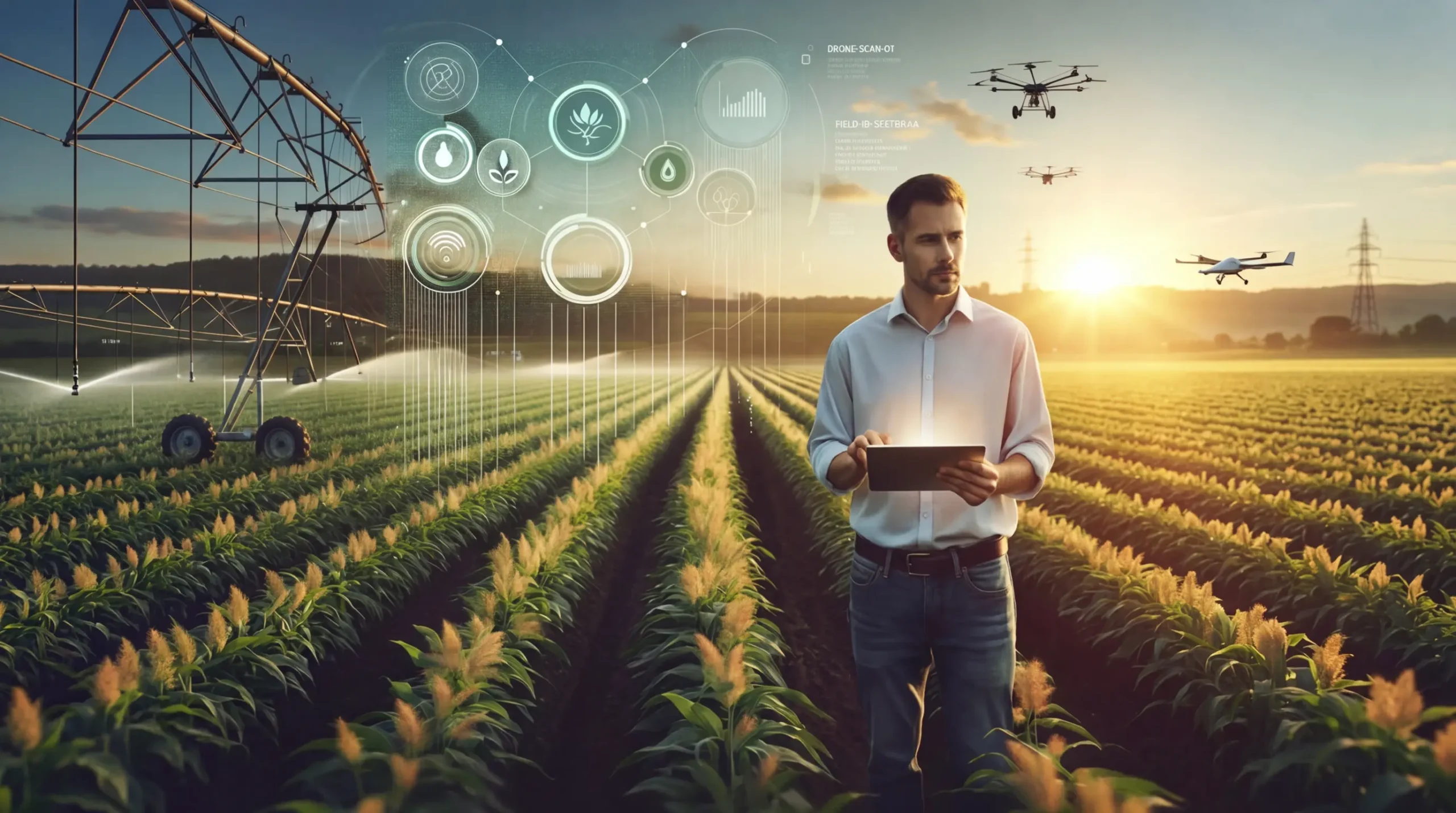
🌾 The world needs to feed 10 billion people by 2050 — and AI is the technology that makes that possible without destroying the planet in the process. This guide covers every major AI application transforming agriculture in 2026: precision crop monitoring, smart irrigation, yield prediction, livestock management, agricultural robotics, and the leading platforms — with real ROI data, real-world examples, and an honest assessment of where AI works and where it does not.
Last Updated: September 10, 2026
Agriculture is one of the oldest industries on Earth — and in 2026, it is undergoing its most radical transformation since mechanization. AI in agriculture is no longer a startup experiment or a niche technology for early adopters. It is the centerpiece of strategy at John Deere, CNH Industrial, Bayer, and AGCO — the companies that supply the equipment and inputs that feed the world. The global AI in agriculture market reached $2.43 billion in 2025 and is projected to hit $3.11 billion in 2026, with a compound annual growth rate of nearly 22% through 2031 according to Mordor Intelligence. That growth is being driven by a convergence of three pressures that are not going away: global food demand projected to increase 70% by 2050, accelerating climate variability that makes traditional farming intuition less reliable, and a structural agricultural labor shortage that is hitting operations of every scale. The UN Food and Agriculture Organization AI in agriculture overview frames this clearly — AI is not optional for feeding the next generation. It is the path.
This guide covers every major application of AI transforming agriculture in 2026: precision crop monitoring using satellite and drone data, AI-powered irrigation systems delivering 30% water reductions, yield prediction models that now achieve 90%+ accuracy three months before harvest, AI livestock health monitoring systems tracking millions of individual animals, agricultural robotics solving the labor shortage from weeding to harvesting, and the leading platforms and tools available to farm operators today. It also covers the honest limitations — where AI works and where it does not — and provides a practical decision framework for assessing which investments make sense for your specific operation. This guide is written for farm owners and operators, AgTech professionals, food industry executives, agricultural policy makers, sustainability and ESG teams, and rural technology leaders evaluating AI for the first time. For context on how AI is transforming other resource-intensive sectors, see AI in Energy and Utilities: how AI powers smart grids and predictive maintenance.
By the end of this guide, you will understand exactly how AI is being applied across the agricultural value chain, which technologies deliver the strongest and most documented ROI, what the real barriers to adoption are in 2026, and how to match AI investment to your specific farm type and operational constraints. The entry points are more accessible than most operators assume — from zero-cost smartphone disease detection apps to full autonomous precision agriculture platforms. The key is matching the technology to the problem, not chasing every innovation simultaneously.
📖 New to AI terminology? Visit the AI Buzz AI Glossary — 95+ essential AI terms explained in plain English, including computer vision, machine learning, edge AI, predictive analytics, and digital twin.
1. 🌾 The State of AI in Agriculture in 2026
AI adoption in agriculture has accelerated dramatically since 2023 — moving from experimental pilot programs to mainstream equipment features and standard farm management practice. The 2026 agricultural AI landscape is defined by three convergent trends that are reshaping how farms operate at every scale. Understanding these trends is the foundation for evaluating any specific AI investment — because the technology choices that make sense depend entirely on where your operation sits within this shifting landscape.
The first trend is AI embedded directly in equipment. Major manufacturers have integrated AI into tractors, harvesters, sprayers, and implements as core functionality — not as optional add-on technology. John Deere’s See & Spray Gen 2, launched in early 2026, uses 36 cameras and machine learning running on onboard processors to identify weeds versus crops in real time while moving at 15 mph, applying herbicide only to weeds. In 2025, the prior generation covered more than five million acres and reduced non-residual herbicide use by nearly 50%, saving farmers 31 million gallons of herbicide mix — confirmed by John Deere’s published deployment data. CNH Industrial’s Raven Industries unveiled a commercially available autonomous AI harvester in Q1 2026 that optimizes grain loss prevention via edge computing. AGCO’s Fuse technology platform now integrates AI-powered precision planting, harvesting optimization, and machine telematics across its equipment fleet. AI is no longer a feature layered onto machinery — it is becoming the primary decision-making engine inside the machine. The second trend is satellite, drone, and sensor data fusion. Agricultural AI now combines multiple data streams — commercial satellite imagery now updated daily at 50cm resolution, drone surveillance providing plant-level detail between satellite passes, and IoT soil sensors providing subsurface data — into unified farm intelligence platforms that generate field-level insights no human observer could produce at equivalent scale and speed. The third trend is the shift from reactive to predictive agriculture. In 2026, the leading AI platforms detect disease outbreaks 7–14 days before visible symptoms appear, forecast yield three months before harvest, and predict equipment failures weeks before they occur — transforming agricultural decision-making from responding to problems to preventing them.
| Statistic | Source / Context |
|---|---|
| $3.11 billion | Global AI in agriculture market size (2026) — Mordor Intelligence. Growing at 21.96% CAGR through 2031. |
| 70% | Projected increase in global food demand by 2050 — UN FAO. Primary macro driver of AI agriculture investment. |
| Nearly 50% | Herbicide reduction achieved by John Deere See & Spray across 5+ million acres in 2025 — John Deere published deployment data. Independent Iowa State trials recorded 76% reduction across five soybean fields. |
| Up to 40% | Yield uplifts demonstrated in AI precision farming deployments — WEF Deep-Tech Revolution in Agriculture report, corroborated by Intellias 2026 industry analysis. |
| 30% | Average reduction in water usage achieved through AI-powered irrigation optimization — WEF data. Documented Indian sugarcane case paired 30% water reduction with a 40% yield gain simultaneously. |
| $7 billion | AgTech investment raised in 2025 — Bank of America Institute research. Precision agriculture deals outpaced crop inputs in deal count for the first time. |
| 43.29% | Revenue share held by precision farming in the AI agriculture market in 2025 — Mordor Intelligence. The single largest application category, ahead of livestock monitoring and drone analytics. |
2. 🛰️ Precision Agriculture and AI Crop Monitoring: Every Plant, Every Day
Precision agriculture uses AI to treat every section of a field — or every individual plant — as a unique unit requiring tailored inputs, rather than applying uniform treatments across entire fields. This shift from field-level to plant-level management is delivering 20–40% reductions in input costs while improving yields simultaneously — a combination that is redefining agricultural economics for operations large enough to deploy the technology at scale. The underlying technology has improved dramatically since 2023: commercial satellites now provide 50cm resolution imagery updated daily, drone-mounted multispectral cameras provide plant-level detail between satellite passes, and AI models trained on hundreds of millions of labeled plant images now identify disease and stress with accuracy that exceeds expert agronomists in controlled comparisons.
The core application is AI analysis of multispectral satellite imagery to generate NDVI (Normalized Difference Vegetation Index) maps — identifying plant health, stress, and growth variation across entire fields. AI models detect nutrient deficiency, water stress, disease pressure, and pest damage 7–14 days before visible symptoms appear to the human eye. Farms using Planet Labs satellite imagery with AI analysis are detecting nitrogen deficiency zones and applying targeted fertilizer — reducing fertilizer use 20–30% without yield loss. Disease and pest detection models trained on the PlantVillage dataset and similar large-scale labeled image collections can now identify 50+ crop diseases from smartphone photos with 92–97% lab accuracy for major diseases including wheat rust, rice blast, potato blight, and maize tar spot. For more on how the underlying technology works, see Computer Vision Explained: how AI sees and interprets images.
Variable rate application is where precision monitoring translates directly into input cost savings. AI prescription maps generated from soil sensor and satellite data tell precision planting equipment exactly how much seed, fertilizer, and crop protection product to apply at each GPS coordinate across a field. High-yield zones receive optimal inputs. Low-yield zones receive reduced inputs. The result is maximum ROI per acre rather than maximum input per acre — a fundamental shift in how agricultural inputs are managed. John Deere Operations Center generates AI prescription maps that reduce seed costs 8–15% and fertilizer costs 15–25% per season for operations that integrate the full platform. Digital twin technology is the next frontier in 2026 — platforms are beginning to create virtual models of entire farms that simulate different management scenarios before real-world application, allowing operators to test interventions in the digital environment before committing capital in the field.
3. 💧 AI-Powered Irrigation and Water Management: 30% Less Water, Same Yields
Agriculture consumes approximately 70% of global freshwater withdrawals — and in an era of accelerating climate variability, water scarcity is the defining constraint on agricultural expansion in most of the world’s most productive regions. The US Southwest, Australia’s Murray-Darling Basin, Southern Europe, and large parts of India and China are all facing structural water deficits that are tightening season by season. AI irrigation systems are delivering 25–40% reductions in water use without yield loss — and in documented cases, the sensor-fusion approach has actually improved yields simultaneously. This makes irrigation optimization the strongest ROI case in agricultural AI for operations in water-stressed regions, both from a cost perspective and a regulatory compliance perspective as water allocation restrictions tighten across the American West.
How AI irrigation systems work: they integrate soil moisture sensor data from IoT devices deployed at multiple depths across the field, weather forecast data 7–14 days ahead, evapotranspiration models that calculate how much water crops lose to the atmosphere by crop type and growth stage, crop growth stage models that adjust water demand targets as crops move through their development phases, and historical yield and water use data to calibrate recommendations for each specific field zone. The AI system predicts water demand for the next 24–72 hours, accounts for forecast rainfall to avoid irrigation before rain events, optimizes irrigation timing to minimize evaporation losses, and identifies soil moisture variation across field zones for variable rate irrigation rather than uniform delivery. A documented Indian sugarcane deployment paired a 30% water reduction with a 40% yield gain — demonstrating that these outcomes are not necessarily in tension.
| Platform / Example | Water Saved | Additional Benefit |
|---|---|---|
| John Deere Smart Irrigation (Operations Center) | 25–35% per season | Integrates with John Deere Operations Center for whole-farm management — irrigation decisions connected to yield and input data |
| Netafim Precision Irrigation AI | 30–50% vs conventional drip | Largest precision irrigation network globally — deployed in 110 countries, most extensive real-world validation dataset in the industry |
| Lindsay Zimmatic AI | 20–30% per season | Pivot irrigation optimization purpose-built for large row-crop operations — integrates ET models with real-time soil data |
| CropX Soil Sensor Platform | 25% average across deployments | Soil health monitoring beyond moisture — nutrient content and temperature data generate agronomic insights alongside irrigation optimization |
| California Almond Growers (documented case study) | 33% reduction over 3 seasons | Maintained full yield while complying with California state water restriction mandates — regulatory compliance achieved alongside cost reduction |
4. 📈 AI Yield Prediction and Harvest Optimization: Knowing Before You Grow
Accurate yield prediction transforms agricultural economics at every level of the value chain. Farms can forward-contract at better prices. Processors and food companies can optimize storage and logistics capacity. Lenders can assess seasonal risk with greater precision. In 2026, leading AI yield prediction models achieve accuracy within 5–8% of actual harvest at field level for major row crops — three months before the crop is ready to pick. That accuracy window, combined with the economic value of the decisions it enables, makes yield prediction one of the clearest ROI cases in agricultural AI for large commercial operations.
Pre-season yield forecasting integrates historical yield records, soil health data, planting density, weather forecast models, and satellite imagery from previous seasons to generate field-level yield forecasts with confidence intervals. The Climate Corporation, now owned by Bayer and operating as the Climate FieldView platform, provides season-long yield forecasts for US corn and soybean growers integrated with crop insurance products — one of the clearest examples of AI yield intelligence being embedded into agricultural financial instruments. In-season yield updates use weekly satellite imagery revisions to continuously refine the forecast as the season progresses, identifying yield-limiting factors early enough for corrective agronomic action, and providing harvest timing recommendations by field zone based on crop maturity prediction models.
The yield prediction economic case: A 5% improvement in yield prediction accuracy is worth millions of dollars annually to a large agricultural operation — in better forward contract pricing, optimized input purchasing, and reduced storage cost from knowing exactly what is coming off the field before harvest begins. For a 10,000-acre corn operation averaging 180 bushels per acre at $4.50 per bushel, a 5% yield forecast error translates to a $4 million revenue planning uncertainty. AI narrows that uncertainty to under 1%.
Harvest optimization AI completes the yield intelligence loop by optimizing the harvest operation itself. AI-powered combine harvesters automatically adjust harvesting parameters — speed, header height, threshing intensity, sieve settings — based on real-time crop flow sensor data rather than fixed operator settings. John Deere Harvest Command adjusts combine settings more than 100 times per hour based on crop flow sensors, reducing harvest losses 5–15% compared to fixed-parameter operation. Solinftec’s Solix Sprayer robot demonstrated up to 97% herbicide reduction on some properties in its first commercial season, alongside up to 10% yield improvement across corn, popcorn, and soybean operations in its first US commercial deployment — one of the most comprehensive multi-benefit ROI demonstrations in agricultural AI to date.
5. 🐄 AI in Livestock Management: Health Monitoring, Welfare, and Productivity
Livestock AI has advanced from simple GPS tracking to continuous individual animal health monitoring systems that detect illness before clinical symptoms appear. The commercial deployments are operating at genuine scale: Allflex (MSD Animal Health) SenseHub platform now monitors more than 7 million cattle globally with individual animal health alerts, tracking body temperature, activity levels, rumination time, and reproductive status through wearable IoT ear tags and boluses. That scale of real-world deployment provides a validation dataset that laboratory testing cannot match. The economic case is equally clear: detecting a dairy cow’s early mastitis infection 48 hours earlier reduces treatment cost and production loss by an estimated $200–$400 per incident, and at an average dairy herd size of 900 cows with a 25–35% annual mastitis incidence rate, the math is compelling even before factoring in antibiotic reduction benefits.
Precision feeding AI calculates individual animal nutritional requirements based on live weight, growth stage, production level, and health status — reducing feed waste 10–20% while improving feed conversion ratio. Automatic milking systems use AI to optimize milking frequency per cow based on individual production patterns rather than fixed schedules. Reproductive management AI predicts optimal breeding windows for individual animals based on sensor data, improving conception rates 15–25% versus traditional observation-based methods and reducing days-open — the time between calving and conception — which has significant economic impact in dairy operations where every day-open costs approximately $3–$5 in lost production value.
Poultry and aquaculture AI applications demonstrate how computer vision scales to environments where individual monitoring is impractical at human-observer scale. Broiler house AI systems deploy overhead cameras with computer vision to monitor bird behavior, distribution, and activity levels in flocks of 50,000+ birds per house — detecting respiratory disease, heat stress, and welfare issues that would be invisible to a human walking the floor. Aquaculture AI deploys underwater cameras to monitor fish feeding behavior, health, and biomass estimation in fish farm pens — optimizing feeding delivery and reducing uneaten feed waste that both degrades water quality and represents a direct input cost. These applications collectively demonstrate that AI’s value in livestock is not limited to the largest operations or the highest-value individual animals.
6. 🤖 Agricultural Robotics and Automation: AI in the Field
Agricultural labor shortages are the fastest-growing adoption driver for AI robotics in farming. The US faces a structural shortage of more than 1.5 million agricultural workers annually, and the global average age of a farmer is approaching 60 — a demographic reality that makes labor-intensive agricultural operations structurally unsustainable without automation. AI-powered agricultural robots are solving the tasks that are simultaneously the most labor-intensive, the most physically demanding, and the most difficult to recruit human labor for: weeding, harvesting, planting transplants, and precision spraying in difficult terrain.
| Robot Type | AI Capability | Labor Replaced | Real 2026 Example |
|---|---|---|---|
| Autonomous Tractors | GPS navigation, obstacle detection, implement control, field mapping via LiDAR and cameras | Tractor operators for plowing, planting, spraying, harvesting prep | CNH Industrial Raven autonomous harvester commercially available Q1 2026. John Deere GUSS Automation acquisition extends autonomous spraying to orchard and vineyard operations. |
| AI Laser Weeding Robots | Computer vision weed identification, real-time classification, precision laser targeting at plant level | Manual weeding crews — the most labor-intensive and difficult-to-staff task in specialty crop production | Carbon Robotics LaserWeeder: 24 lasers, 36 cameras, 24 NVIDIA GPUs, trained on 150 million labeled plant images. Eliminates approximately 5,000 weeds per minute. Deployed commercially across 100+ growers in North America, Europe, and Australia. Customer-reported 70% chemical use reduction. |
| AI Harvesting Robots | Fruit ripeness detection via computer vision, pick-point identification, adaptive robotic grasping for delicate produce | Seasonal harvest crews for strawberries, apples, tomatoes, peppers — peak labor demand period | Tortuga AgTech strawberry harvesting robot operates 24/7, detects ripeness via computer vision. Harvest CROO Robotics operating commercially in Florida strawberry fields. Soft-grip technology for fresh produce handling improving at 18.9% CAGR per Mordor Intelligence. |
| AI Precision Spraying Drones | Field mapping, obstacle avoidance, variable rate application, GPS-guided precision targeting | Ground sprayer operators in difficult terrain — hillsides, vineyards, orchards, flooded fields | DJI Agras T40 covers 40 acres per hour with AI-guided precision application. PrecisionHawk AI drone analytics suite adopted by 1,200+ US Midwest farms in 2025 for real-time nutrient stress mapping. |
| AI Planting Robots | Precision seed or transplant placement, soil condition assessment, variable rate application at centimeter accuracy | Transplant planting crews for vegetable seedlings — high labor demand, high precision requirement | Transplant Systems automated AI-guided transplanter operating at commercial scale for vegetable production in US and European markets. |
| Greenhouse AI Systems | Climate control optimization, plant growth monitoring, automated harvest scheduling, energy management | Greenhouse monitoring and climate management workers — 24/7 requirement that human teams find difficult to sustain | Priva greenhouse AI manages climate, irrigation, and labor scheduling for commercial greenhouse operations globally. Infosys 5G.NATURAL program in Germany demonstrated 5G-connected autonomous harvesting swarms for greenhouse operations. |
The agricultural robotics market reached $18 billion in 2026 according to Mordor Intelligence, with harvesting and picking robots growing at the fastest rate — 18.9% CAGR — as soft-grip technology and machine vision overcome the dexterity challenges of fresh produce handling. For operations in labor-scarce regions, agricultural robots are moving from competitive advantage to operational necessity. The payback periods are shortening as scale drives down unit costs: John Deere See & Spray Select achieved payback in one season at $20–$30 per acre savings in early field deployments, a timeline that makes the capital justification straightforward for large operations. For broader context on how AI is enabling autonomous physical systems across industries, Edge AI Explained: how AI works without internet dependency covers the edge computing architecture that makes real-time agricultural robotics possible.
7. 🛠️ Leading AI Agriculture Platforms and Tools in 2026
The 2026 agricultural AI platform landscape spans large equipment manufacturers with embedded AI, specialized AgTech software companies, and satellite data providers — and the right choice depends heavily on equipment ecosystem, farm size, crop type, and specific operational challenge. The platforms below represent the most commercially established options across the primary use cases, with 2025–2026 deployments and commercial availability confirmed.
| Platform | Provider | Primary Capability | Best For |
|---|---|---|---|
| John Deere Operations Center AI | John Deere | Whole-farm AI management — prescription maps, machine telematics, yield mapping, See & Spray integration, autonomous equipment coordination. January 2026: NVIDIA Jetson Orin edge-AI modules embedded in next-gen autonomous tractors. | Large commercial row-crop operations running John Deere equipment fleets — maximum value within the John Deere ecosystem |
| Climate FieldView | Bayer (The Climate Corporation) | Crop monitoring, yield prediction, agronomic AI insights, weather intelligence, crop insurance integration. Multi-brand equipment compatibility — works across tractor brands. | Corn and soybean operations across the US Midwest — the largest independent precision agriculture platform in North America by acreage |
| Trimble Ag Software | Trimble | Precision agriculture data management, variable rate prescriptions, field mapping, agronomic analytics. Brand-agnostic platform integrating data from multiple equipment manufacturers. | Mixed equipment fleets where brand-agnostic data integration is the primary requirement — strong choice for operations running multiple equipment brands |
| Granular (Corteva) | Corteva Agriscience | Farm management software integrating financial planning, field records, agronomic intelligence, and labor management in a single platform | Large commercial farms needing integrated agronomy and business management — particularly strong for multi-entity farming operations |
| Taranis AI Aerial Scouting | Taranis (Corteva) | Sub-millimeter resolution drone imagery with AI disease, pest, and weed detection at plant level. Most granular aerial scouting resolution currently commercially available. | Intensive crop monitoring on high-value specialty crops where plant-level detail justifies premium scouting investment |
| CropX Platform | CropX Technologies | IoT soil sensor network with AI irrigation optimization — soil moisture, nutrient content, and temperature monitoring driving precision irrigation recommendations | Irrigated operations seeking measurable water use reduction and soil health improvement — entry-level hardware cost relative to ROI from water savings |
| Farmers Edge | Farmers Edge | Full-farm digital management platform combining satellite imagery, field weather stations, soil data, and AI agronomic insights in one integrated dashboard | Large grain operations seeking consolidated farm intelligence without committing to a single equipment manufacturer’s ecosystem |
| PlantVillage Nuru App | Penn State University | Smartphone AI disease diagnosis for smallholder farmers — takes a photo of a diseased plant and returns a diagnosis and treatment recommendation. No hardware required beyond a smartphone. | Smallholder and small farm operations seeking zero-hardware-cost AI entry point — deployed to millions of smallholder farmers across sub-Saharan Africa |
8. ⚠️ Challenges and Limitations: Where Agricultural AI Falls Short in 2026
Agricultural AI delivers genuine, documented value — and it has real limitations that every farm operator and AgTech investor needs to understand before committing capital. The technology advocates do not always lead with these realities. A CropLife/Purdue Precision Agriculture Dealership Survey of 93 Midwest agricultural retailers in 2025 found that the precision services AI-driven tools depend on are actually in decline in some markets — precision soil sampling dropped from 92% of dealers offering it in 2019 to just 62% in 2025. That data problem is at the heart of why AI agricultural tools do not deliver equal value to every operation. Strong AI recommendations require strong data foundations. Where those foundations are weak, AI tools underperform their potential.
| Challenge | Why It Matters | Current State in 2026 |
|---|---|---|
| Rural connectivity gaps | Most AI platforms require reliable internet connectivity for data upload, model updates, and real-time recommendations — but 35% of US rural farms lack adequate broadband | Starlink and low-earth orbit satellites improving rural coverage significantly in 2025–2026 — still a barrier for the most remote operations. Edge AI is an emerging solution for offline capability. |
| Data foundation decline | AI model quality scales with data quality — precision soil sampling (the data foundation for prescription maps) dropped from 92% to 62% of US ag retailers offering it between 2019–2025 | Actively problematic. AI tools only perform as well as the data they operate on. Operations without strong historical records will see reduced AI value until data accumulates. |
| High upfront hardware cost | Precision agriculture hardware — sensors, drones, AI-equipped equipment — requires significant capital. Carbon Robotics LaserWeeder is priced at $500,000. See & Spray Ultimate is a premium add-on. | Subscription and lease models reducing barriers. John Deere’s Unlimited Annual License and Carbon Robotics’ $13,889/month lease option making entry more accessible. Payback in 1–2 seasons documented for large operations. |
| Data privacy and ownership | Farm data generated by platform-connected equipment is commercially valuable — field boundaries, yield maps, agronomic data. Who owns it and how it can be used remains contested. | American Farm Bureau Federation data privacy principles adopted by major platforms — but data portability and enforcement remain ongoing concerns that operators should explicitly address in vendor contracts. |
| Agronomic expertise requirement | AI tools identify problems and generate recommendations — but acting on them correctly requires agronomic judgment. A system that identifies disease needs a human who knows what to do about it. | AI advisory tools improving at generating actionable guidance — but human agronomist expertise remains essential for interpreting and acting on AI recommendations in high-stakes situations. |
| Climate distribution shift | AI models trained on historical data may underperform in novel climate conditions — as climate change creates growing conditions increasingly outside historical training data distributions | Active research area. Climate-adaptive models incorporating real-time recalibration are in development but not yet mainstream in commercial platforms. Operators in highly climate-affected regions should apply additional human oversight to AI recommendations. |
The limitations above are not reasons to avoid agricultural AI — they are the parameters that determine which AI investments make sense for a given operation. An irrigated almond operation in California’s San Joaquin Valley with reliable Starlink connectivity and multi-year CropX soil sensor data has a fundamentally different AI ROI profile than a remote dryland wheat farm with no broadband and no digital records. The decision framework in the next section maps these parameters to investment priorities.
9. 🎯 Which Farms Benefit Most from AI? Decision Framework for 2026
Not every farm operation has the same AI opportunity. The ROI case for agricultural AI scales with farm size, crop type, data infrastructure, water dependency, labor context, and connectivity — and the best first investment varies dramatically across different farm types. This framework maps those variables to AI investment decisions so operators can identify where to start rather than where the marketing is loudest.
| Factor | 🟢 Strong AI ROI Case | 🟡 Weaker AI ROI Case |
|---|---|---|
| Farm size | 1,000+ acres (row crops) or 50+ acres (high-value specialty crops) — scale spreads fixed technology cost across sufficient revenue base | Small subsistence or hobby farms with limited capital — technology cost exceeds achievable savings at small scale |
| Crop type | High-value crops (berries, vegetables, nuts, wine grapes) or large-scale commodity crops where 1% yield improvement equals significant revenue at volume | Low-margin, low-value crops on small acreage — AI cost exceeds potential yield improvement value at small scale |
| Water dependency | Irrigated operations in water-stressed regions where water cost and allocation are significant constraints — irrigation AI ROI is immediate and measurable | Rain-fed operations in high-rainfall regions with minimal irrigation dependency — irrigation AI provides minimal benefit |
| Labor context | Operations in labor-scarce regions or with high labor costs — robotics ROI case is strongest when the labor alternative is expensive or unavailable | Operations with abundant, low-cost seasonal labor where robotics capital cost exceeds labor cost savings over the payback period |
| Data maturity | Operations with multi-year yield records, soil maps, and equipment telematics — AI models deliver better recommendations with richer historical data | Operations with no digital records — AI value builds over time as data accumulates, so starting simple is better than starting with the most sophisticated platform |
| Connectivity | Operations with reliable broadband or Starlink access — full cloud-connected platform functionality available | Remote operations with no connectivity — limited to offline edge AI tools; cloud-connected platforms will underperform without reliable data upload |
| Farm Type | Best First AI Investment in 2026 |
|---|---|
| Large row crop (1,000+ acres) | Satellite crop monitoring + AI prescription maps for variable rate application — fastest ROI through input cost reduction. Climate FieldView or John Deere Operations Center depending on equipment fleet. |
| Irrigated specialty crop | AI irrigation optimization — water cost reduction is immediate, measurable, and in water-restricted regions also ensures regulatory compliance. CropX soil sensor platform is a well-documented starting point. |
| Dairy operation (500+ cows) | Individual cow health monitoring — reduces veterinary costs, improves reproduction efficiency, and enables antibiotic stewardship documentation. Allflex SenseHub is the most widely deployed commercial platform. |
| Poultry operation | Computer vision flock monitoring — early disease detection reduces mortality and antibiotic use at the scale (50,000+ birds per house) where human observation cannot provide equivalent coverage. |
| Vegetable / berry specialty production | AI weeding or harvesting robot evaluation — labor shortage is most acute in specialty crop production. Carbon Robotics LaserWeeder for weeding; evaluate harvesting robot options for specific crop. Lease or hire model to validate ROI before capital commitment. |
| Small or mid-size mixed farm | Smartphone disease detection app (PlantVillage Nuru or similar) — zero hardware cost, immediate agronomic value, no connectivity requirement beyond basic mobile data. The right starting point before committing to any platform subscription. |
🏭 Exploring AI across industries? Browse the AI Buzz Industry Hub — 50+ in-depth guides covering how AI is transforming healthcare, finance, manufacturing, logistics, retail, energy, and more.
🏁 Conclusion: AI Agriculture Is Not the Future — It Is the 2026 Competitive Standard
The farms that adopt AI precision agriculture in 2026 are not getting a marginal efficiency advantage — they are building a structural cost and yield advantage over competitors who are not. A 40% yield improvement paired with a 30% reduction in water and input costs is not incremental progress. It is the difference between expanding profitability and margin compression in an industry where commodity prices are set by global markets outside any individual farmer’s control. The John Deere See & Spray data makes the case in concrete terms: nearly 50% reduction in herbicide use across five million acres in one season, with independent trials showing an additional 3–4 bushel per acre yield increase because crops were less chemically stressed. That is not a technology demonstration. It is a commercial reality operating at scale today. For context on the broader environmental case AI agriculture is building, AI and the Environment: how AI is being used to fight climate change covers how agricultural AI connects to sustainability outcomes beyond the farm gate.
The 2026 barriers to agricultural AI adoption are real but diminishing faster than most operators realize. Starlink is solving connectivity for operations where terrestrial broadband has failed to reach. Subscription and lease models are solving the upfront capital barrier — John Deere’s Unlimited Annual License and Carbon Robotics’ monthly lease option both reduce entry costs to a point where ROI is achievable within a single season for large operations. Data interoperability standards through ADAPT and AgGateway are reducing the switching costs that have locked operations into single-vendor ecosystems. And AI advisory tools are improving their agronomic guidance quality fast enough that the expertise gap between what the AI recommends and what a skilled agronomist would recommend is narrowing measurably season by season. The structural labor shortage is not going away — which means the economic case for agricultural robotics strengthens every year that recruiting farm labor remains difficult.
Start with the decision framework in Section 9. Identify your farm type and the first AI investment that delivers the clearest economic return for your specific constraints. The entry points span from zero — smartphone disease detection for any farm with mobile data coverage — to full autonomous precision agriculture platforms for large commercial operations. The right starting point is the one that solves your most expensive operational problem with the shortest payback period. That is the AI investment that builds the data foundation and organizational confidence for everything that follows.
📌 Key Takeaways
| ✅ | Takeaway |
|---|---|
| ✅ | The global AI in agriculture market reached $2.43 billion in 2025 and is projected to hit $3.11 billion in 2026, growing at 21.96% CAGR through 2031 — driven by precision farming (43% revenue share), livestock monitoring, and drone analytics (Mordor Intelligence). |
| ✅ | John Deere See & Spray covered 5+ million acres in 2025 and reduced non-residual herbicide use by nearly 50%, saving farmers 31 million gallons of herbicide mix — while independent Iowa State trials showed an additional 3–4 bushel per acre yield increase from reduced crop chemical stress. |
| ✅ | AI irrigation optimization is delivering 25–40% water use reductions without yield loss — the strongest per-dollar ROI in agricultural AI for irrigated operations in water-stressed regions. A documented Indian sugarcane case simultaneously achieved 30% water reduction and a 40% yield gain. |
| ✅ | AI yield prediction models now achieve 90%+ accuracy at field level for major row crops three months before harvest — enabling better forward contracting, labor planning, and storage optimization. A 5% yield forecast error on a 10,000-acre corn operation represents a $4 million planning uncertainty that AI narrows to under 1%. |
| ✅ | Carbon Robotics LaserWeeder uses 24 lasers, 36 cameras, and 24 NVIDIA GPUs trained on 150 million labeled plant images to eliminate approximately 5,000 weeds per minute — deployed commercially across 100+ growers in North America, Europe, and Australia. Customer-reported results include 70% chemical use reduction and 20–30% yield improvement. |
| ✅ | Livestock AI is operating at scale: Allflex SenseHub monitors 7+ million cattle globally with individual health alerts. AI livestock monitoring reduces antibiotic use 20–40% through earlier, more targeted treatment — delivering both economic ROI and regulatory compliance benefits as antibiotic stewardship requirements tighten. |
| ✅ | The primary barriers to agricultural AI adoption in 2026: rural connectivity gaps (35% of US rural farms lack adequate broadband), the decline of precision soil sampling foundations that AI tools depend on, high upfront hardware costs, data ownership concerns, and model accuracy limitations in novel climate conditions outside historical training data. |
| ✅ | Best first AI investments by farm type: large row crop → satellite monitoring + prescription maps; irrigated specialty → CropX soil sensor + irrigation AI; dairy → Allflex SenseHub individual cow monitoring; vegetable/berry → Carbon Robotics LaserWeeder lease evaluation; small/mid farm → PlantVillage Nuru smartphone disease detection (zero hardware cost). |
🔗 Related Articles
- 📖 AI in Manufacturing: Smart Factories, Predictive Maintenance, and Quality Control
- 📖 AI in Energy and Utilities: Smart Grids, Renewable Energy, and Predictive Maintenance
- 📖 Computer Vision Explained: How AI Sees and Interprets Images
- 📖 Edge AI Explained: How AI Works Without Internet Dependency
- 📖 AI and the Environment: How AI Is Being Used to Fight Climate Change
❓ Frequently Asked Questions: AI in Agriculture
1. What is AI in agriculture and how is it being used in 2026?
AI in agriculture refers to the use of machine learning, computer vision, predictive analytics, and autonomous robotics to improve farming decisions and automate field operations. In 2026, the main applications include precision crop monitoring via satellite and drones, AI-powered irrigation optimization, yield prediction, individual livestock health monitoring, and autonomous field robotics. Our AI in Industries hub covers how AI is transforming every major sector beyond agriculture.
2. How much does AI agriculture technology cost — is it accessible to small farms?
Costs range dramatically: Carbon Robotics LaserWeeder is priced at $500,000 (with a $13,889/month lease option), while John Deere See & Spray is a premium equipment feature. However, entry-level AI tools are available at zero hardware cost — the PlantVillage Nuru smartphone disease detection app is free to use. Subscription-based precision agriculture platforms like CropX start with per-sensor hardware and monthly software fees that can be cost-effective for mid-size irrigated operations. The right entry point depends on your farm type and primary operational challenge.
3. What is precision agriculture and how does AI improve it?
Precision agriculture treats each field zone or individual plant as a unique unit requiring tailored inputs — rather than applying uniform treatments across entire fields. AI improves precision agriculture by analyzing satellite imagery and sensor data to generate variable rate prescription maps, detecting crop disease and stress 7–14 days before visible symptoms appear, and automating application equipment to follow GPS-based prescriptions at centimeter accuracy. Operations using AI prescription maps report 8–25% reductions in seed and fertilizer costs per season. Our Computer Vision Explained guide covers the underlying technology that makes plant-level AI detection possible.
4. How does AI help with water conservation in farming?
AI irrigation systems combine IoT soil moisture sensors, weather forecast data, evapotranspiration models, and crop growth stage models to predict water demand and optimize irrigation timing. The result is 25–40% water use reduction without yield loss — documented across commercial deployments from Netafim’s global network to California almond farms operating under state water restriction mandates. A documented Indian sugarcane case simultaneously achieved 30% water reduction and a 40% yield improvement. For context on how AI is addressing broader resource sustainability challenges, see AI and the Environment.
5. What are the biggest limitations of AI in agriculture right now?
Three honest limitations stand out in 2026. First, rural connectivity: 35% of US rural farms lack adequate broadband, limiting access to cloud-connected AI platforms. Second, data foundation quality: AI models only perform as well as the data they operate on, and precision soil sampling — the data foundation for prescription maps — is declining in availability across US agricultural retailers (dropping from 92% to 62% of dealers offering it between 2019–2025 per CropLife/Purdue survey data). Third, climate distribution shift: AI models trained on historical data may underperform in novel climate conditions increasingly created by climate change — a risk that requires ongoing human agronomic oversight alongside AI recommendations.
📧 Get the AI Buzz Weekly Digest
Weekly AI insights, tools, and strategies — delivered every Monday. Free.




Leave a Reply