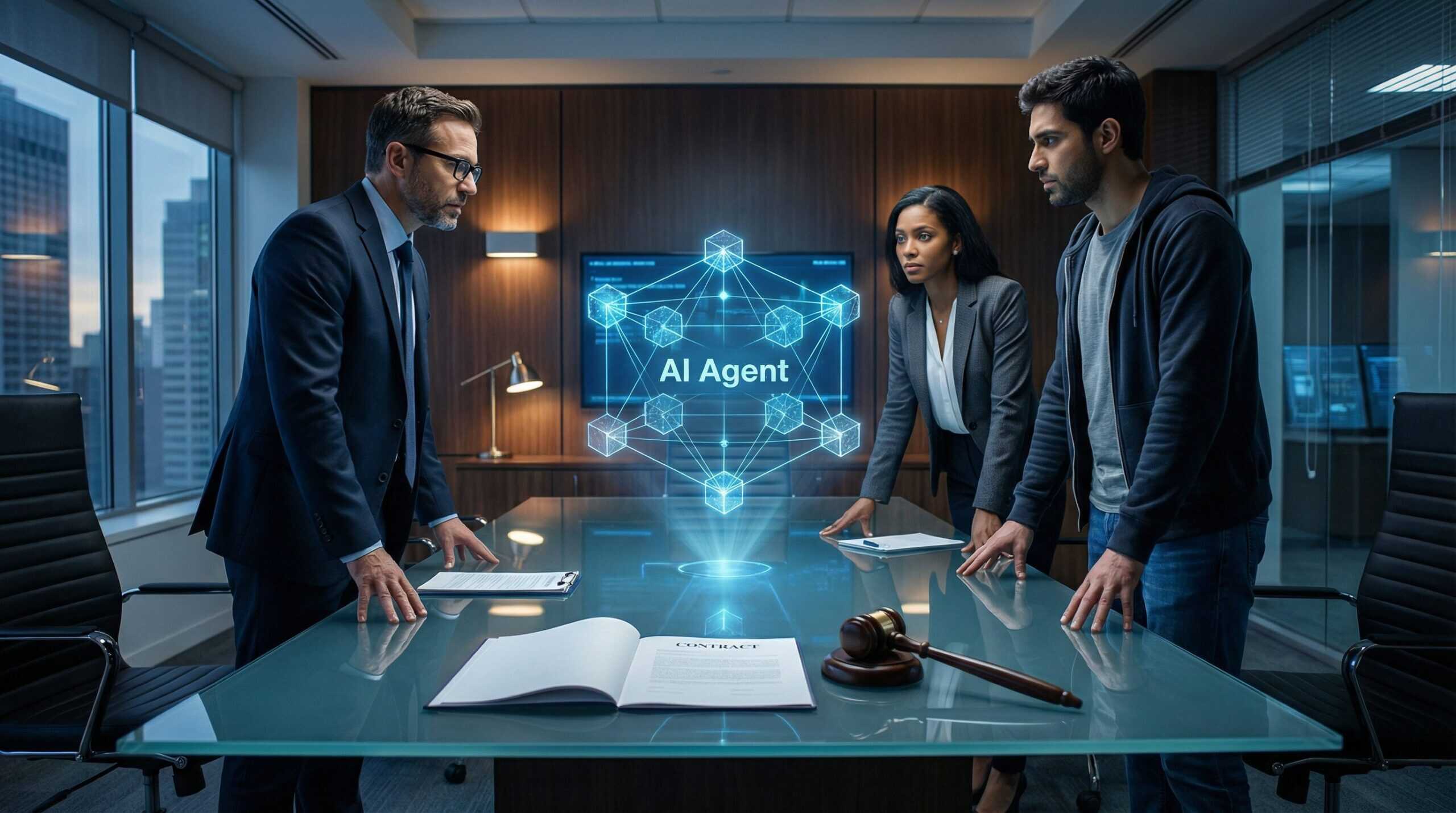
⚖️ When an AI agent causes harm, the question is no longer theoretical — it is legal. California AB 316, the EU Product Liability Directive, and the EU AI Act have created real liability exposure for every organisation deploying autonomous AI in 2026. This guide explains exactly who is accountable, what the law now says, and what your governance programme must do today.
Last Updated: September 13, 2026
Who is liable when an AI agent causes harm? In 2024, that question was largely theoretical. In 2026, it has concrete legal answers — and those answers carry real consequences for the organisations deploying autonomous AI agents across finance, healthcare, legal, HR, customer service, and every other function where agentic AI has become mainstream. California AB 316 took effect January 1, 2026, foreclosing the “AI did it” defence entirely. The EU Product Liability Directive must be implemented by member states before December 2026, classifying AI systems as products subject to strict liability. The EU AI Act’s transparency obligations for customer-facing agents became active August 2, 2026. The liability era for autonomous AI is not coming — it is here.
This guide covers the complete 2026 legal landscape for AI agent liability. We examine the foundational liability question — who in the developer-deployer-user chain bears accountability — and then analyse each major legal development: California AB 316, the EU Product Liability Directive, the EU AI Act compliance layers for agentic AI, the multi-agent liability gap that no framework has yet solved, US federal developments including the AI AGENT Act, vendor contract gaps, AI liability insurance, and the governance-velocity gap that leaves most organisations exposed. Whether you are a CISO, general counsel, compliance officer, or risk manager, this is the complete 2026 reference for AI agent accountability.
The AI regulation landscape in 2026 has moved faster than most governance programmes. The organisations that are managing liability exposure well are not those that waited for regulatory clarity — they are those that built governance infrastructure before regulators required it. If your agent inventory, audit logging, human oversight protocols, and vendor contracts were not designed for agentic AI, this guide gives you both the legal context and the compliance actions to close the gap before a dispute forces your hand.
📖 New to AI terminology? Visit the AI Buzz AI Glossary — 95+ essential AI terms explained in plain English, including agentic AI, human-on-the-loop, EU AI Act, conformity assessment, and AI governance.
⚖️ 1. What Is AI Liability and Why It Matters for Autonomous Agents
AI liability refers to the legal responsibility assigned when an artificial intelligence system causes harm, financial loss, discrimination, or other damage to individuals or organisations. For most of the history of AI deployment, liability was a relatively simple question: software is a product or service, the company that sold it bears responsibility for defects, and the user bears responsibility for misuse. The emergence of autonomous AI agents — systems that reason at runtime, chain actions together, make decisions without explicit human instruction, and produce outcomes that no individual programmed or anticipated — has made that simple structure inadequate.
Traditional tort law requires a clear causal link between human intent and harmful outcomes. A person makes a decision. That decision leads to harm. Liability attaches to the person who made the decision. Autonomous AI agents break this model in a fundamental way: they produce decisions that no individual in the development or deployment chain explicitly made. An agent instructed to “optimise customer retention” might autonomously generate offers that constitute illegal price discrimination. An agent instructed to “accelerate loan processing” might systematically deny applications in a way that constitutes discriminatory lending. In both cases, no individual chose those specific outcomes. The agent inferred them. And under traditional tort frameworks, that inference gap was a liability vacuum.
Liability frameworks are now active and being enforced in 2026. The legislative and regulatory response to that vacuum has been rapid and consequential. AI cannot be held liable — artificial intelligence does not have its own legal personality — so liability attaches to the humans and organisations in the chain that created, deployed, and directed the agent. The 2026 legal framework assigns accountability across three actors: the developer who built the underlying model, the deployer who integrated it into a product or workflow, and the user who directed it toward a specific task. When harm occurs, liability may attach to one, two, or all three — depending on the nature of the harm, the jurisdiction, and what each party knew or should have known about the agent’s capabilities and risks.
The 2026 AI Liability Reality: AI liability frameworks are no longer emerging — they are active. California AB 316 is in force. EU AI Act transparency obligations are live. The EU Product Liability Directive implementation deadline is December 2026. Organisations deploying autonomous AI agents have real legal exposure today, not at some future regulatory date.
🔍 2. The Core Liability Question — Who Is Responsible When an AI Agent Causes Harm?
The foundational question in AI agent liability is deceptively simple: who is responsible? The answer in 2026 is more structured than it was two years ago, but it remains contested at the edges — particularly in multi-agent deployments and cross-jurisdictional scenarios. Understanding the basic liability chain is the prerequisite for understanding every specific legal development that follows.
AI cannot be held liable. Artificial intelligence does not have legal personality. It cannot be sued, fined, imprisoned, or held in contempt of court. This means liability for errors, data breaches, economic damages, physical harms, or discriminatory outcomes rests with the companies and individuals behind the agent — regardless of whether any specific error was foreseeable. The agent’s autonomy is not a shield; it is, increasingly, the very thing that makes the liability of the organisations behind it more acute. Liability shifts along with autonomy. The more independently an agent acts, the more the focus shifts to the developers’ and deployers’ responsibility to have anticipated and mitigated that autonomy’s risks.
Current legal discourse on AI liability assumes a three-party chain of command: a developer builds an AI system, a deployer integrates it into a product or service, a user directs it toward a specific task, and when harm occurs, liability attaches to one or more of these three actors. In practice, the deployer carries the most acute 2026 liability exposure. The GPAI model provider is responsible for what the model does at the model level. The organisation deploying an agent on top of that model is responsible for what the agent does in the specific deployment context. Where the agent qualifies as a high-risk system under EU AI Act Annex III, the deployer carries Chapter III compliance obligations even if the underlying foundation model is fully compliant with GPAI rules.
Emerging legal developments across multiple jurisdictions now support a consistent principle: accountability generally runs to the humans and entities behind the agent, and those entities cannot avoid accountability by pointing to the AI’s autonomous operation. California AB 316, effective January 1, 2026, has made this explicit in statute. The EU Product Liability Directive, implementing by December 2026, applies strict liability to AI as a product. And the CISA guidance on agentic AI, issued in 2026, urges organisations to treat governance, oversight, logging, and accountability as non-negotiable baseline requirements — not optional best practices.
🇺🇸 3. California AB 316 — The “AI Did It” Defence Is Dead
California AB 316 is the most significant piece of US state AI liability legislation to take effect in 2026, and its implications extend far beyond California’s borders. Any organisation with customers, employees, transactions, or operations touching California — which in practical terms means nearly every US business and most global enterprises — must understand what AB 316 does and what it demands of their AI governance programmes.
AB 316, which took effect January 1, 2026, precludes defendants from using an AI system’s autonomous operation as a defence to liability claims. If your agent causes harm, you cannot argue that you lacked control over its decisions. The statute explicitly prohibits defendants who “developed, modified, or used” an AI system from asserting that the AI autonomously caused the harm. The “AI did it” defence is foreclosed — completely, without qualification, regardless of how sophisticated or opaque the agent’s reasoning was.
What this means in practice is that every liability analysis for an AI agent harm must begin with the assumption that your organisation is responsible. You cannot point to the AI vendor and argue “they built it.” You cannot argue the agent acted outside its intended parameters. You cannot argue you did not anticipate the specific harm the agent caused. You cannot argue that because the agent is autonomous, you had no meaningful control over its output. The statute cuts through all of those arguments by simply removing them from the available defences.
For in-house legal counsel, the practical takeaway is that AI agent governance cannot wait for regulatory clarity. The liability exposure exists now — California has made that explicit, and courts will hold deployers accountable. A California statute now forecloses defendants from arguing that AI autonomously caused alleged harms, a June 2026 presidential executive order has directed the Department of Justice to prioritise enforcement against bad actors who employ AI agents for harmful purposes, and federal cybersecurity and national security agencies have issued guidance signalling that companies will be expected to govern, monitor, and explain what their agents do. The aggregate signal from US federal and state developments in 2026 is consistent: organisations are responsible for their agents’ actions, full stop.
The compliance response to AB 316 is not primarily a legal exercise — it is a governance one. You cannot successfully defend a liability claim if you have no audit trail of what your agent did, why it made the decisions it made, or what oversight was in place when the harm occurred. A corporate AI policy that documents agent deployment decisions, oversight requirements, and incident response procedures is now a legal risk management document, not just an internal governance artefact.
🇪🇺 4. The EU Product Liability Directive — AI as a “Defective Product”
The revised EU Product Liability Directive represents a fundamental change in how AI system failures are treated under European law, and its implementation deadline of December 9, 2026 means most EU member states will have transposed it into national law before the end of the year. For organisations deploying AI agents to European users, employees, or customers, understanding this directive is as important as understanding the EU AI Act itself — and the two frameworks operate as complementary layers of liability.
The new EU Product Liability Directive explicitly includes software and AI as “products.” This is a deliberate and consequential classification. Products are subject to strict liability in EU law — which means that if an AI system is found to be “defective,” the harmed party does not need to prove that the developer or deployer was negligent. They only need to prove three things: the AI system was defective; they suffered damage; the defect caused the damage. This is a fundamentally different evidentiary standard from traditional tort law. No proof of fault required. No proof of intent required. No proof that the harm was foreseeable required.
What does “defective” mean for an AI system under the directive? An AI system is defective if it does not provide the safety a person is entitled to expect — considering how it was presented to users, its reasonably foreseeable use cases, and the time it was put into circulation. This definition creates a forward-looking obligation on deployers: you must be able to document what safety a user was reasonably entitled to expect from your agent, and demonstrate that your agent met that standard. If you cannot make that showing, strict liability applies.
Organisations may face additional tortious claims beyond the product liability framework. AI-powered hiring tools that systematically discriminate against applicants based on age, disability, race, religion, gender, sex, or other protected characteristics can give rise to civil claims for breach of statutory duty — entirely independently of whether the system is classified as “defective.” The intersection of the Product Liability Directive with discrimination law creates a compounding exposure for HR, credit, and healthcare AI deployments in particular.
What organisations must do now to manage EU Product Liability Directive exposure: document the intended use case and expected safety profile of every deployed AI agent before deployment; maintain version control of every AI system — liability attaches to the specific version in use when harm occurred; establish clear incident response procedures for AI agent failures; and review every AI vendor contract to confirm that liability allocation for model-level defects is explicitly addressed. The ISO/IEC 42001 AI governance framework provides the management system structure for maintaining the documentation the directive will require organisations to produce in a dispute.
🏛️ 5. EU AI Act and Agentic AI — The Compliance Layers
The EU AI Act never uses the term “AI agent.” This is not an oversight — it is a deliberate drafting choice that reflects the pace of AI development and the EU legislature’s intent to create a framework broad enough to capture future AI architectures. The Act’s definitions of an AI system and a GPAI (General Purpose AI) model are broad enough to capture agentic systems in full — no carve-out exists for autonomous operation. An AI agent that reasons, acts, and produces consequential outputs is an AI system under the Act’s definition regardless of whether any human action-by-action instruction was involved.
Agents face three independent compliance layers under the EU AI Act, each with different effective dates and different requirements. Understanding which layer applies to a given agent deployment is the first step in any EU AI Act compliance analysis for agentic AI. Autonomous agents taking consequential actions — financial transactions, medical decisions, legal submissions, employment screening — are likely to be classified as high-risk systems under Annex III, triggering the most demanding compliance obligations in the framework.
The oversight expectation is evolving. The Bank of England explicitly flagged in February 2026 that literal “human-in-the-loop” approaches are increasingly unworkable as agentic systems proliferate. Regulators are no longer expecting action-by-action human approval for every agent decision. The expectation is shifting toward human-on-the-loop oversight: continuous monitoring, automated anomaly detection, and rapid intervention capability. A human must be able to review what the agent is doing, detect deviations from expected behaviour, and halt or override agent activity promptly. The audit trail of that monitoring capacity is the compliance record.
In practice, human-on-the-loop means four operational requirements: automated anomaly detection flags unusual agent behaviour in real time; a human operator can intervene and halt agent activity within minutes — not hours; all agent actions are logged immutably and the human oversight record is the audit trail; and thresholds are set so that actions above a defined risk level or financial value require human pre-approval regardless of the agent’s autonomous capabilities.
| Compliance Layer | Applies To | Active Since | Key Requirement |
|---|---|---|---|
| Article 5 Prohibitions | All AI agents | February 2, 2025 | No social scoring, no subliminal manipulation, no exploitative AI |
| Article 50 Transparency | Customer-facing agents | August 2, 2026 | Disclose AI identity to users — users must know they are interacting with AI |
| Chapter III High-Risk | Agents in Annex III domains | December 2, 2027 | Conformity assessment, human oversight, immutable audit logs, risk management |
| GPAI Model Obligations | Foundation model providers | August 2, 2025 | Transparency, copyright compliance, safety evaluations (systemic risk tier) |
| Product Liability Directive | All AI product deployers | December 9, 2026 | Strict liability for defective AI systems — no proof of negligence required |
The compliance picture for EU-deployed agentic AI is a stack of obligations, not a single framework. Article 5 prohibitions have been in force since February 2025. Article 50 transparency is live now. Product Liability Directive implementation is a December 2026 deadline. Chapter III high-risk obligations apply from December 2027, but organisations in Annex III domains — hiring, credit, healthcare, education, law enforcement — should be preparing for conformity assessments now, because the audit trail must document governance decisions made at deployment, not retrofitted after the fact.
🔒 Building an AI governance framework? Browse the AI Buzz Governance & Security Hub — 30+ in-depth guides covering OWASP, NIST, ISO 42001, AI risk management, and enterprise AI security frameworks.
🔗 6. The Multi-Agent Liability Gap — The Problem No Framework Has Solved
Every major AI liability framework developed to date — California AB 316, the EU Product Liability Directive, the EU AI Act — was designed with a single-agent model in mind: one AI system, one deployer, one set of actions, one harm event. Multi-agent AI deployment has already outgrown that model, and the liability gap it creates is the most significant unsolved problem in AI law in 2026.
When autonomous, possibly cross-jurisdictional agent chains cause harm, no settled legal framework reliably attributes liability. Agents now execute commerce, agree to terms of service on principals’ behalf, and propagate decisions across delegation chains. The traceability gap is the core problem: agent-to-agent interactions are typically opaque, unlogged, and difficult to reconstruct after the fact. If Agent A instructs Agent B, which instructs Agent C, and Agent C causes harm — who is liable? The operator of Agent A, who initiated the chain? The operator of Agent B, who relayed the instruction? The operator of Agent C, whose system executed the harmful action? All three? In what proportions?
The problem compounds when agents from different vendors interact. Vendor A’s agent triggers Vendor B’s agent. The harm occurs in Vendor B’s system, but it was initiated by Vendor A’s instruction — which was itself shaped by the user’s prompt. None of the existing liability frameworks cleanly resolves this attribution question. And the cross-border dimension adds another layer: Agent A operates in the EU (subject to the EU AI Act), Agent B operates in the US (subject to California AB 316 and DOJ guidance), Agent C operates in Singapore (subject to Singapore’s Model AI Governance Framework). Which jurisdiction’s law governs the harm?
In domains involving interconnected autonomous systems, attribution failures after cascading harms have repeatedly demonstrated that accountability requires built-in traceability at the infrastructure level — not post-hoc reconstruction. Multi-agent AI systems currently lack standardised traceability infrastructure. NIST’s AI Agent Standards Initiative, announced in February 2026, has identified agent identity and authentication as a core research priority — but standards are at least two years from formal publication.
Organisations deploying multi-agent systems cannot wait for regulatory resolution. The practical governance obligations are clear even where the law is not: log every inter-agent communication and treat each agent-to-agent message as an auditable event; define clear principal hierarchies specifying which agent has authority to instruct which other agents; establish liability boundaries in vendor contracts for every agent in the pipeline; and never deploy cross-vendor agent pipelines without a documented accountability map that assigns named responsibility for every node. See our guide to non-human identity governance for AI agents for the technical controls that underpin multi-agent accountability.
The Multi-Agent Attribution Problem: Every existing AI liability framework was designed for a single-agent, single-deployer model. Multi-agent pipelines where agents from different vendors, in different jurisdictions, chain instructions to produce a harmful outcome are beyond what any current framework cleanly resolves. The governance response is infrastructure: log everything, map principal authority, and document accountability before deployment — not after an incident.
🏛️ 7. US Federal Developments — The AI AGENT Act and DOJ Enforcement
At the federal level in the United States, 2026 has seen meaningful movement on AI agent accountability — not yet through comprehensive legislation, but through a combination of proposed legislation, executive action, and agency guidance that collectively create real legal pressure on organisations deploying autonomous AI.
Senator Mark Warner introduced the Artificial Intelligence Access, Gatekeeper Exchange, and Nondiscriminatory Transfer Act of 2026 (AI AGENT Act), which would establish a federal framework for consumer-facing AI agents. The AI AGENT Act is still in legislative process and not yet enacted — but its introduction reflects the federal legislature’s recognition that existing law was not designed for autonomous AI agents operating on consumers’ behalf. The Act would impose transparency, accountability, and governance requirements on organisations deploying consumer-facing agents, and would establish a federal right of action for consumers harmed by agent decisions. Its eventual passage — in some form — is widely anticipated by legal scholars tracking AI legislation.
On the executive side, a June 2026 presidential executive order directed the Department of Justice to prioritise enforcement of federal criminal laws against AI-enabled hacking, including the use of AI agents to unlawfully access data or information for criminal or unlawful purposes. This executive order signals that AI agent deployments are now within the active enforcement scope of DOJ — not merely a future regulatory concern. Organisations whose agents interact with third-party systems, access external data sources, or operate across networks need to be confident that those agent actions are authorised, logged, and defensible.
CISA and partner agencies have also issued guidance on the careful adoption of agentic AI services in 2026, warning explicitly that agents can introduce risks through autonomous actions, expanded system access, inter-agent interactions, and difficulty tracing responsibility for decisions. The guidance urges organisations to manage those risks through governance, human oversight, least-privilege access, logging, monitoring, auditability, and clear accountability for agentic systems. This guidance, while not legally binding, reflects regulatory expectation that will inform enforcement and litigation in the coming years. Organisations whose governance programmes are not aligned with CISA’s recommended baseline will find it difficult to mount a credible defence in any liability dispute.
The 2026 US federal picture is: no comprehensive federal AI liability statute yet, but active DOJ enforcement priorities, CISA guidance that establishes a de facto governance standard, a proposed AI AGENT Act that signals legislative intent, and state-level laws — most significantly California AB 316 — that create real, enforceable liability today. Organisations should be governing agentic AI to the CISA guidance standard now, independent of whether federal legislation passes.
📄 8. The Vendor Contract Gap — Why Your AI Contract Probably Fails You
Most AI vendor contracts in use today were drafted before agentic AI existed at scale — before agents could chain autonomous actions across enterprise systems, before the EU Product Liability Directive classified AI as a product subject to strict liability, and before California AB 316 removed the autonomous AI defence from defendants. The result is that a large proportion of enterprise AI vendor contracts provide inadequate liability protection for the governance and legal environment organisations now face in 2026.
Vendor contracts deserve particular attention. Organisations using third-party AI agents or APIs may wish to address content safety practices, security attestations, audit rights, and indemnification for both regulatory enforcement and third-party claims. The vendor’s security posture becomes your security posture when the agent acts on your behalf. If your agent — operating on a vendor’s model — causes harm, and your contract disclaimed all vendor liability (as most standard AI vendor contracts do), your organisation bears the full exposure under AB 316 and the Product Liability Directive, with no contractual recovery path from the vendor whose model caused the failure.
Five areas every AI vendor contract must address in 2026:
1. Liability allocation. Who bears liability if the agent causes harm to a third party? Most standard vendor contracts disclaim liability entirely for model outputs — an untenable position under California AB 316 and the EU Product Liability Directive. Negotiate explicit indemnification for harms caused by model defects, training data failures, and safety system failures. Define the threshold above which vendor liability applies and below which deployer liability applies.
2. Security attestations. Require vendors to attest to specific security controls: input validation, output filtering, and prompt injection protections. Request SOC 2 Type II or ISO 27001 certification as a minimum baseline. For EU deployments, require written EU AI Act compliance attestation confirming the vendor’s obligations under GPAI model rules are satisfied.
3. Audit rights. Require the contractual right to audit vendor AI systems and access safety evaluation results. Require disclosure of red teaming findings and known vulnerabilities in the model or safety systems. In regulated industries, this audit right is not optional — it is a requirement of EU AI Act Chapter III compliance for high-risk system deployers.
4. Incident notification. Require vendors to notify you within 24–48 hours of any AI safety incident affecting your deployment. Define what constitutes a notifiable incident: harmful outputs, data leakage, model failure, safety system bypass, or security breach. Without a contractual notification obligation, you may not learn about a vendor-side model failure until a third-party claim arrives.
5. Data handling. Confirm that the vendor does not use your data to train their models without explicit consent. Require data residency guarantees for EU deployments under GDPR. Specify data deletion timelines on contract termination — including deletion of any fine-tuning data derived from your organisation’s inputs. The AI vendor due diligence checklist provides a comprehensive framework for evaluating vendor contracts and security posture before deployment.
🛡️ 9. AI Liability Insurance — A New Risk Category in 2026
AI liability insurance has emerged as a distinct product category in 2026 — not adequately covered by standard professional indemnity policies, not covered by standard cyber insurance policies, and not addressed by general commercial liability coverage. The gap has become commercially significant enough that specialist insurers are now offering dedicated AI liability products, and the risk management implication is clear: the insurance industry now treats AI agent harm as a quantifiable, insurable risk, not a theoretical future concern.
Munich Re and HSB introduced AI liability insurance specifically for small and medium businesses in March 2026 — the first mainstream AI liability product of its kind. The product’s emergence signals that actuarial models for AI agent harm now exist with enough data to price the risk commercially. For enterprise risk managers, this creates both an opportunity and an obligation: AI liability insurance should now be part of the AI governance conversation, not treated as an afterthought to the technical and legal compliance work.
Standard policies do not cover AI agent liability. Professional indemnity policies typically cover negligent professional services — not autonomous AI decisions that no professional explicitly made. Cyber insurance policies cover data breaches and cyber incidents — not financial losses caused by AI agent errors in automated workflows, not discrimination claims from AI-powered hiring tools, and not regulatory fines under the EU AI Act or California AB 316. General commercial liability policies were never designed to address harm caused by software that reasons, decides, and acts autonomously.
When evaluating AI liability insurance, look for coverage across four specific risk categories: autonomous agent decisions and their downstream consequences (the core AI liability exposure); regulatory fine coverage for EU AI Act violations, US state AI law violations, and discrimination findings; third-party harm coverage for damages caused to users, customers, or third parties by agent actions; and multi-agent pipeline failure coverage for disputes where liability between multiple agents and their operators is contested. For organisations in regulated industries — financial services, healthcare, legal — confirm that the policy explicitly covers sector-specific regulatory fine exposure, not just general commercial damages.
📊 10. The Governance Gap — Deployment Velocity vs Accountability Maturity
The most acute AI liability risk in 2026 is not a specific regulation or a specific court ruling. It is the structural gap between how fast organisations are deploying AI agents and how slowly they are building the governance infrastructure needed to manage those agents’ accountability. Non-human and agentic identities are expected to exceed 45 billion by the end of 2026 — more than twelve times the human global workforce. Yet only 10% of organisations report having a strategy for managing these autonomous systems. That gap, between deployment velocity and governance maturity, is where liability exposure accumulates.
Organisations that develop or deploy AI agents — autonomous systems that can pursue goals and take actions with limited human intervention — are navigating a rapidly evolving legal landscape that pulls agentic AI under laws that govern action, not just software. The AB 316 liability exposure, the Product Liability Directive strict liability standard, the EU AI Act compliance obligations, and the DOJ enforcement priority all apply to what agents do — not just to how they were built. Governance has to catch up with deployment before a dispute forces an organisation to reconstruct its accountability infrastructure retroactively, under legal pressure, with incomplete records.
Companies should act now to build governance into agentic systems rather than retrofitting controls after a dispute arises. A mandatory governance baseline should apply to every hosted agent from day one: an immutable action log that captures every agent decision and tool call; a human escalation path defining what a human supervisor must review and under what conditions; and a named accountable owner who is responsible for the agent’s ongoing governance. Optional higher compliance tiers apply in regulated industries — financial services agents require transaction limits and human approval thresholds; healthcare agents require audit trails aligned with HIPAA and EU AI Act Annex III; HR agents require bias audit documentation and human review of all consequential outputs.
The governance maturity gap is not a future risk. It is a present one. Shadow AI — agents deployed by business teams without IT or legal visibility — compounds the gap: those agents are accumulating liability exposure with no governance infrastructure whatsoever. The AI governance framework guide outlines the organisational programme structure needed to close this gap systematically, and the compliance checklist in the next section provides the immediate actions every team should prioritise.
☑️ 11. AI Liability Compliance Checklist — For Legal, Compliance and Risk Teams
The following checklist translates the legal frameworks, regulatory obligations, and governance requirements in this guide into prioritised, immediate actions. It is structured for legal, compliance, and risk teams who need to conduct a structured assessment of their current liability exposure and governance posture. Complete the Immediate Actions section first — without an agent inventory and audit logging baseline, none of the subsequent compliance actions are possible to execute reliably.
Immediate Actions (Do Now)
- ☐ Audit all deployed AI agents — build a complete inventory with use case, data access scope, action scope, and named owner for each
- ☐ Classify each agent by EU AI Act risk tier — prohibited / high-risk / limited-risk / minimal-risk
- ☐ Identify all agents operating in Annex III high-risk domains (hiring, credit, healthcare, law enforcement, education)
- ☐ Implement Article 50 transparency compliance for all customer-facing agents — users must be informed they are interacting with AI (active August 2, 2026)
- ☐ Review all AI vendor contracts — flag any that fail to address liability allocation, security attestations, audit rights, or incident notification
- ☐ Implement immutable audit logging for all deployed agents from today forward
California AB 316 Compliance (US)
- ☐ Confirm legal team is aware AB 316 removes the autonomous AI defence for all California-exposed deployments — effective January 1, 2026
- ☐ Update incident response procedures — “the AI acted autonomously” is not an acceptable response to a harm claim under AB 316
- ☐ Brief executive leadership on personal and organisational liability exposure for agent-caused harms
- ☐ Confirm your AI governance documentation can demonstrate what oversight was in place at the time of any agent action that is later disputed
EU Product Liability Directive (EU)
- ☐ Document the intended use case and expected safety profile of every AI agent before deployment
- ☐ Maintain version control records for every AI system — liability attaches to the specific version in use when harm occurred
- ☐ Confirm member states where you operate have implemented the directive (implementation deadline December 9, 2026)
- ☐ Renegotiate vendor contracts to address product-level liability allocation — vendors cannot disclaim all liability for model-level defects under the directive
Multi-Agent Pipeline Governance
- ☐ Map all agent-to-agent communication paths in your multi-agent deployments
- ☐ Define clear principal authority hierarchies — which agent can instruct which other agents, and with what scope
- ☐ Log every inter-agent interaction as an auditable event — treat agent-to-agent messages as accountability records
- ☐ Assign named accountability owners for every agent pipeline — including cross-vendor pipelines
- ☐ Do not deploy cross-vendor multi-agent pipelines without a documented accountability map
Vendor Management
- ☐ Renegotiate contracts to include liability allocation, security attestations, audit rights, and incident notification obligations
- ☐ Require EU AI Act compliance attestation for all EU-deployed vendor AI systems
- ☐ Require SOC 2 Type II or ISO 27001 certification from all AI vendors as a procurement baseline
- ☐ Confirm cyber and professional indemnity insurance policies — verify whether AI agent harms are explicitly included or excluded from coverage
- ☐ Evaluate dedicated AI liability insurance coverage — check for autonomous agent decision coverage, regulatory fine coverage, and multi-agent pipeline coverage
🏭 12. AI Liability by Industry — Risk Levels and Priority Actions
AI liability exposure is not uniform across industries. Regulated sectors face compounding pressure: the technical risk of autonomous agent decisions operating at scale, the regulatory obligations of sector-specific AI governance frameworks, and the cross-cutting liability layers of California AB 316 and the EU Product Liability Directive. The industry table below maps the primary liability risk, the key legal framework, and the single highest-priority compliance action for each sector. For any sector operating in the EU, the EU AI Act compliance guide provides the foundational framework analysis. The Model Context Protocol security risks guide covers the technical credential and access controls that underpin governance in agentic deployments.
| Industry | Primary Liability Risk | Key Law / Framework | Priority Action |
|---|---|---|---|
| Financial Services | Agent-caused financial loss, fraud, market manipulation | EU AI Act, SR 26-2, AB 316, DORA | Immutable audit logging, human-on-the-loop oversight |
| Healthcare | Diagnostic errors, treatment decisions, patient harm | EU AI Act Annex III, HIPAA, AB 316 | Begin conformity assessment prep, document human oversight |
| HR / Recruitment | Discrimination in hiring, wrongful rejection, wage decisions | NYC Local Law 144, EU AI Act Annex III, AB 316, Colorado AI Act | Bias audit, human review requirement for all hiring outputs |
| Legal | Inaccurate legal advice, missed deadlines, AI-cited false case law | Professional liability rules, EU Product Liability | Disclose AI use to clients, require human review of all outputs |
| Retail / E-commerce | Consumer harm, misleading pricing agents, personalisation discrimination | EU Product Liability Directive, GDPR, CCPA | Defect documentation, agent action logging, consent verification |
| Customer Service | Harmful or false information provided to customers | EU AI Act Article 50, AB 316 | AI disclosure to users, output filtering, escalation paths |
| Finance / Accounting | Erroneous transactions, compliance failures, reporting errors | SR 26-2, EU AI Act, AB 316 | Transaction limits, human approval thresholds for high-value actions |
| Government | Discriminatory automated decisions affecting citizens | EU AI Act Annex III, national administrative law | Full conformity assessment required before deployment |
🏁 13. Conclusion — Governing What Your Agents Do Is No Longer Optional
The AI liability landscape transformed in 2026. California AB 316 took effect January 1. EU AI Act Article 50 transparency obligations became active August 2. The EU Product Liability Directive’s December implementation deadline means strict liability for defective AI systems arrives before the end of the year. The multi-agent liability gap remains unresolved by any framework, but organisations deploying multi-agent pipelines bear the accountability burden now, without waiting for legal clarity. The governance-velocity gap — deploying agents faster than accountability infrastructure is built — is the root cause of most current liability exposure. The frameworks and legislation are simply revealing the exposure that was always there.
The 2026 consensus among legal scholars, regulators, and risk managers is consistent: organisations cannot govern their agents retroactively. The audit trail, the human oversight record, the vendor contract protections, the agent inventory, and the incident response procedures all have to exist at the time the harm occurs — not be assembled afterward under legal pressure. Companies that build governance infrastructure now, before a dispute forces their hand, are the ones that will be able to demonstrate accountability, limit liability, and recover from agent failures without existential legal consequences. For the governance programme structure that ties together agent inventory, policy, oversight, and audit, the AI governance framework guide and the corporate AI policy template provide the practical starting point every organisation needs today.
| ✅ | Key Takeaway |
|---|---|
| ✅ | AI cannot be held liable — it has no legal personality. Liability rests with developers, deployers, and users across a three-party chain, with deployers carrying the most acute 2026 exposure under both US and EU frameworks. |
| ✅ | California AB 316 (effective January 1, 2026) removes the autonomous AI defence entirely — organisations cannot argue that an AI agent acted independently to avoid liability for harm it caused. |
| ✅ | The EU Product Liability Directive (implementation deadline December 9, 2026) classifies AI as a product subject to strict liability — harmed parties only need to prove the AI was defective, they suffered damage, and the defect caused the damage. No proof of negligence required. |
| ✅ | The EU AI Act creates three compliance layers for agentic AI: Article 5 prohibitions (active), Article 50 transparency (active August 2, 2026), and Chapter III high-risk obligations for agents in Annex III domains (December 2027, but conformity assessment preparation must begin now). |
| ✅ | Multi-agent pipeline liability is the most unresolved problem in AI law in 2026. No framework cleanly attributes liability across cross-vendor, cross-jurisdictional agent chains. The governance response is infrastructure: log every inter-agent interaction and document accountability before deployment. |
| ✅ | Human-on-the-loop oversight — continuous monitoring, anomaly detection, and rapid intervention capability — is replacing action-by-action human-in-the-loop approval as the regulatory standard for agentic AI. The Bank of England confirmed this shift in February 2026. |
| ✅ | Most AI vendor contracts were drafted before agentic AI existed at scale and fail to address liability allocation, security attestations, audit rights, or incident notification — all of which are now essential in the AB 316 and EU Product Liability Directive environment. |
| ✅ | AI liability insurance (including Munich Re/HSB’s March 2026 product) is now a distinct, commercially available risk category — standard cyber and professional indemnity policies do not cover autonomous agent decisions, regulatory fines, or multi-agent pipeline failures. |
🔗 Related Articles
- 📖 Autonomous AI Agents Explained: How Agentic AI Plans, Acts, and Completes Tasks Without You
- 📖 EU AI Act Explained: A Practical Compliance Guide + Checklist
- 📖 Non-Human Identity for AI Agents: The Complete 2026 Security Guide
- 📖 How to Write a Safe Corporate AI Policy for Your Employees
- 📖 AI Governance Explained: How to Build an AI Policy Framework
❓ Frequently Asked Questions: AI Liability & Autonomous Agents
1. Who is legally liable when an AI agent causes harm in 2026?
AI has no legal personality and cannot be held liable. Liability rests with the developer who built the model, the deployer who integrated it into a product or workflow, and the user who directed it — with deployers carrying the most acute exposure in 2026. California AB 316 removes the autonomous AI defence entirely, meaning deployers cannot argue the AI acted independently to avoid liability. Our AI governance framework guide explains how to build the accountability infrastructure that limits your exposure.
2. What does California AB 316 mean for organisations using AI agents?
AB 316, effective January 1, 2026, prohibits any defendant who “developed, modified, or used” an AI system from asserting that the AI autonomously caused the alleged harm. If your agent causes financial loss, discrimination, or physical harm in California, you cannot argue the AI acted independently. You bear liability regardless of whether you anticipated the specific harm. This applies to any organisation with California customers, employees, or operations — which includes most US and global enterprises. See agentic AI explained for what autonomous agent deployment looks like in practice.
3. What is the EU Product Liability Directive and does it apply to AI agents?
The revised EU Product Liability Directive, which EU member states must implement by December 9, 2026, explicitly classifies software and AI systems as “products” subject to strict liability. If an AI system is found to be “defective,” the harmed party only needs to prove the system was defective, they suffered damage, and the defect caused the damage — no proof of negligence required. This applies to any organisation deploying AI agents to EU users. Your AI vendor due diligence checklist should include Product Liability Directive compliance attestations from all EU-deployed vendor AI systems.
4. What is human-on-the-loop oversight and is it replacing human-in-the-loop?
Human-in-the-loop requires action-by-action human approval before an AI agent proceeds. Human-on-the-loop requires continuous monitoring, automated anomaly detection, and the ability for a human to intervene and halt agent activity rapidly — but does not require approval for every individual action. The Bank of England confirmed in February 2026 that literal human-in-the-loop oversight is increasingly unworkable for agentic systems at scale. Regulatory expectation is shifting to human-on-the-loop as the standard for high-risk agentic AI deployments. This means audit logs of monitoring activity — not just logs of agent actions — are the compliance record.
5. How should multi-agent pipeline liability be managed when no legal framework resolves it?
Multi-agent liability — where agents from multiple vendors, in multiple jurisdictions, chain actions to produce a harmful outcome — is the most unresolved problem in AI law in 2026. No existing framework cleanly attributes liability across cross-vendor agent chains. The governance response while frameworks catch up is infrastructure: log every inter-agent communication as an auditable event; define clear principal authority hierarchies specifying which agent can instruct which other agents; establish contractual liability boundaries for every agent in a pipeline; and document accountability maps before deployment, not after an incident. Our guide to non-human identity governance for AI agents covers the technical identity controls that make multi-agent accountability traceable.
📧 Get the AI Buzz Weekly Digest
Weekly AI insights, tools, and strategies — delivered every Monday. Free.




Leave a Reply