🔒 Every AI tool your organisation uses introduces a vendor. Every vendor introduces risk. And as of August 2026, the EU AI Act makes that risk your legal problem — not your vendor’s. This guide covers how to assess, contract, and monitor third-party AI suppliers in 2026, with a practical due diligence checklist, mandatory contract clauses, and a vendor risk classification framework built for legal, procurement, and security teams.
Last Updated: October 5, 2026
Third-party AI vendor risk is the governance gap that most organisations are aware of but have not yet operationalised. The pattern is consistent: a business team adopts a new AI writing tool, a sales team connects a CRM AI add-on, a developer integrates an LLM API — and none of these decisions travel through a formal vendor risk assessment process. By the time the procurement or legal team is aware the tool exists, it has already processed customer data, generated customer-facing outputs, and in some cases been used in consequential decisions about pricing, lending, hiring, or benefits. The shadow AI problem and the third-party AI vendor risk problem are the same problem viewed from different angles — and in 2026, both carry regulatory consequences that organisations can no longer defer.
The regulatory context has sharpened significantly. The EU AI Act’s core provider and deployer obligations became fully enforceable on August 2, 2026, and Article 25 of the Act contains a supplier reclassification mechanism that converts any organisation deploying a third-party AI system under its own name or trademark into a full provider — with all the conformity assessment, technical documentation, and registration obligations that entails. The NIST AI Risk Management Framework GOVERN 6 function explicitly scopes third-party AI risk as an organisational responsibility, not a vendor responsibility. The February 2026 US Treasury Financial Services AI Risk Management Framework introduced 230 control objectives specifically for financial institutions, including a dedicated third-party risk section. And GDPR Article 28 has always required data processing agreements (DPAs) with any third party that processes personal data on your behalf — a requirement that almost every AI SaaS vendor relationship triggers, but that fewer than half of organisations have formally satisfied for their AI tool portfolio.
This guide provides the operational framework for third-party AI vendor risk management in 2026 across four domains: pre-contract assessment (what to evaluate before signing), contractual protections (what clauses to require), ongoing monitoring (what to track after go-live), and vendor classification (how to prioritise your risk management effort across a large AI tool portfolio). Each section includes a copy/paste checklist. For the broader AI governance programme in which vendor risk management sits, see our AI governance framework guide. For the internal AI use case risk assessment that precedes vendor selection, see our AI risk assessment guide.
📖 New to AI terminology? Visit the AI Buzz AI Glossary — 100+ essential AI terms explained in plain English, each linking to a full in-depth guide.
🔒 1. Why Third-Party AI Vendor Risk Is Now a Board-Level Issue
Third-party AI vendor risk has escalated from a procurement checkbox to a board-level governance obligation for three concurrent reasons: the scale of AI tool adoption has outpaced vendor oversight processes, the regulatory framework has crystallised with enforceable deadlines, and the failure modes are now documented and consequential enough that ignorance is no longer a credible defence.
On scale: the average enterprise now uses between 40 and 65 AI-enabled SaaS tools, according to enterprise software tracking data from 2026. Of these, the majority were adopted by individual teams or departments without a centralised procurement or risk assessment process. Each of these tools is a vendor relationship — and each vendor relationship carries a distinct risk profile depending on what data the tool accesses, what decisions it influences, and what jurisdiction it operates in. The scale problem is not that AI tools are inherently dangerous. It is that organisations are managing 40–65 vendor relationships with the vendor oversight infrastructure built for 10.
On regulation: the EU AI Act’s Article 25 reclassification mechanism means that an organisation deploying a third-party AI system under its own brand, or making a substantial modification to a third-party high-risk AI system, assumes full provider obligations — including conformity assessments, technical documentation, and EU database registration. This is not a theoretical risk for large technology companies. It is a practical risk for any organisation that has embedded a third-party AI model into a customer-facing product, rebranded an AI-powered tool for client use, or fine-tuned a foundation model for a specific business application. The deployer-to-provider reclassification was enforceable from August 2, 2026, and organisations that have not conducted an Article 25 reclassification audit of their AI vendor portfolio are exposed.
On failure modes: the documented third-party AI failures of 2025–2026 share a consistent structure. In each case, an AI vendor’s model update, training data change, or infrastructure failure produced an output error that the deploying organisation discovered through customer complaints, regulatory inquiry, or media coverage — not through its own monitoring. The deploying organisation bore the reputational and regulatory consequences because its name was on the product. The vendor’s liability was limited by its terms of service. The governance lesson from these cases is structural: the organisation deploying the AI system is responsible for the outcomes that system produces, regardless of which vendor’s model is running underneath it.
The Third-Party AI Vendor Risk Principle: NIST AI RMF applies whether organisations build AI internally or consume third-party AI services. Organisations remain responsible for understanding how vendors process data, how models are updated, what security controls exist, and how risks are monitored over time. The vendor relationship does not transfer the risk. It distributes it — and the distribution is rarely in the deploying organisation’s favour when a failure occurs.
⚠️ 2. The Four Categories of Third-Party AI Vendor Risk
Third-party AI vendor risk is not a single risk — it is four distinct risk categories that require different assessment questions, different contractual protections, and different ongoing monitoring approaches. Organisations that treat all AI vendor risk as “cybersecurity risk” or “compliance risk” miss the categories that are most likely to produce actual harm. The correct framing is four-category: Model Risk, Data Risk, Operational Risk, and Regulatory Risk.
Model Risk is the risk that the AI model itself — the underlying algorithm, its training data, its known failure modes, and its performance characteristics — produces outputs that are inaccurate, biased, unreliable, or unsafe for the intended use case. Model risk is the category that organisations are worst at assessing in vendor due diligence, because it requires understanding the model’s documented limitations, benchmark performance in conditions similar to the intended deployment context, and the vendor’s model update and versioning policy. A vendor that updates its underlying model monthly without notifying deployers, or that trained its model on data that does not represent the deploying organisation’s user population, is a model risk. The NIST AI RMF GOVERN 6 function explicitly requires policies addressing model provenance, third-party model validation, and the monitoring of vendor-supplied AI components — and model cards or system cards (if the vendor provides them) are the starting point for model risk assessment. Our guides on AI model cards and AI system cards explain what these documents contain and how to interpret them.
Data Risk is the risk that data you share with an AI vendor — including customer data, employee data, proprietary business data, and personally identifiable information — is processed, retained, or used in ways that create privacy, confidentiality, or IP exposure. Data risk is the most commonly understood category, but it is frequently underassessed because the scope of data sharing is larger than procurement teams realise. Most AI SaaS tools that receive any user input are technically receiving and processing data — prompts, documents, queries, and interaction logs all constitute data inputs that may be retained for model training, shared with sub-processors, or accessible to vendor personnel. The correct question is not “does this vendor have a privacy policy?” but “exactly what data does this vendor receive, retain, and how does it use that data?” — a question that requires reading DPA terms and data retention schedules, not just ticking a vendor questionnaire checkbox.
Operational Risk is the risk that the AI vendor’s infrastructure, availability, or performance characteristics create dependencies that could disrupt your operations. This includes vendor concentration risk (relying on a single AI API provider for a critical workflow), model versioning risk (a vendor silently updating its model in a way that changes output behaviour for your use case), and vendor viability risk (the AI startup your team has built a workflow around ceasing operations or being acquired). The sovereign AI resilience framework covers operational dependency risk in depth — for vendor risk purposes, the key mitigation is exit clause negotiation and multi-vendor redundancy planning for any AI tool that is embedded in a critical workflow.
Regulatory Risk is the risk that the AI vendor’s tool, as deployed in your context, creates legal exposure under applicable AI, privacy, or sector-specific regulations. This includes EU AI Act classification risk (is this tool a high-risk AI system under Annex III in the context of how you are using it?), GDPR Article 28 compliance risk (has a valid DPA been executed?), sector-specific risk (does this AI tool in a healthcare or financial services context trigger additional regulatory obligations?), and the Article 25 reclassification risk discussed above. Regulatory risk is the category where the interaction between the vendor’s product and your specific use case determines the risk level — the same AI tool may be low-risk for one organisation’s use case and high-risk for another’s.
| Risk Category | Core Failure Mode | Key Assessment Question | Primary Mitigation |
|---|---|---|---|
| Model Risk | Inaccurate, biased, or unsafe AI outputs | What are the documented failure modes and how is the model updated? | Model card review, performance testing, model change notification SLA |
| Data Risk | Customer or proprietary data processed or retained improperly | What data does the vendor receive, retain, and use for model training? | GDPR Article 28 DPA, data retention limits, training opt-out contractual clause |
| Operational Risk | Vendor outage, model change, or shutdown disrupts critical workflow | What is the vendor’s SLA and what is our exit / fallback plan? | SLA with uptime guarantees, data export rights, exit clause, multi-vendor redundancy |
| Regulatory Risk | Tool deployment triggers EU AI Act, GDPR, or sector-specific obligations | Does this use case trigger high-risk AI classification or Article 25 reclassification? | Use case risk classification, vendor compliance documentation, DPA execution |
🔍 3. Pre-Contract Assessment: The AI Vendor Due Diligence Checklist
Pre-contract AI vendor due diligence is the assessment you conduct before signing — and before any data is shared with the vendor’s system. For most organisations, this is the weakest point in their vendor risk programme: due diligence either does not happen at all (shadow AI adoption), happens superficially (checkbox questionnaires that vendors fill in themselves without verification), or happens too late (after a proof of concept has already been run with production data). The correct sequence is: risk classification first, due diligence second, contract negotiation third, and technical integration fourth.
The due diligence checklist below is organised into five domains — Model Transparency, Data Governance, Security Controls, Operational Resilience, and Regulatory Compliance. Not every question applies to every vendor; use the risk classification framework in H2 7 to prioritise which domains require the most rigorous assessment for each vendor tier.
Domain 1 — Model Transparency
- ☐ Does the vendor provide a model card or system card documenting the model’s training data sources, known limitations, benchmark performance, and intended use cases?
- ☐ Is the model trained on licensed data only, or does it include scraped internet content that may create IP exposure for commercial outputs?
- ☐ What is the vendor’s model versioning and change notification policy? Will you be notified before the underlying model is updated, and how much notice will you receive?
- ☐ Has the model been independently benchmarked or evaluated for bias in the specific context relevant to your use case (e.g., demographic fairness in hiring, accuracy across language groups)?
- ☐ Does the vendor disclose the model provider (e.g., OpenAI, Anthropic, Google) if the product is built on a third-party foundation model, rather than a proprietary model?
- ☐ Does the vendor publish a known limitations section and document specific failure modes relevant to your deployment context?
Domain 2 — Data Governance
- ☐ Does the vendor explicitly opt you out of model training on your data by default — or is training opt-out only available on higher pricing tiers?
- ☐ What is the vendor’s data retention policy? How long are prompts, completions, and interaction logs retained, and are retention periods contractually enforceable?
- ☐ Does the vendor disclose all sub-processors — including the foundation model provider — that receive or process data from your account?
- ☐ Where is data stored and processed geographically? Does this create data residency issues for your EU, UK, or other jurisdictionally sensitive data?
- ☐ Does the vendor provide a GDPR Article 28-compliant DPA? If so, is it a standard DPA or does it require negotiation for your specific data processing context?
- ☐ What are the vendor’s breach notification timelines? GDPR requires notification within 72 hours of awareness — does the vendor’s contract commit to notifying you within sufficient time to meet your own regulatory obligations?
Domain 3 — Security Controls
- ☐ Does the vendor hold current SOC 2 Type II certification? Is the report available for review under NDA?
- ☐ Does the vendor hold ISO 27001 certification? If so, what is the certification scope?
- ☐ Does the vendor conduct regular penetration testing by a named third-party firm, and are results available to enterprise customers?
- ☐ Does the vendor have a published vulnerability disclosure policy and a documented patch management process?
- ☐ For AI-specific security: does the vendor conduct adversarial testing (red-teaming) against prompt injection, jailbreaking, and data extraction attacks? See our guide on LLM red teaming for the specific attack vectors to ask about.
- ☐ Does the vendor implement access controls and audit logging at the account level, allowing you to see who in your organisation accessed the tool and what data was submitted?
Domain 4 — Operational Resilience
- ☐ What is the vendor’s published SLA uptime commitment? Is it 99.9% (8.7 hours downtime/year) or 99.99% (52 minutes/year)? Does the SLA include AI inference endpoint availability specifically?
- ☐ Does the vendor publish a historical uptime record (e.g., a status page with incident history)?
- ☐ What is the vendor’s disaster recovery RTO and RPO? For AI tools embedded in critical workflows, the recovery time matters as much as the security posture.
- ☐ Does the contract include data portability and export rights — meaning you can extract your data in a usable format if you decide to switch vendors?
- ☐ Does the contract include an exit clause that specifies how your data is deleted and how quickly after contract termination?
- ☐ Is there a vendor financial viability risk — is this an early-stage startup without Series B funding or a profitable, established vendor? For critical workflow dependencies, financial viability matters.
Domain 5 — Regulatory Compliance
- ☐ Has the vendor conducted an EU AI Act classification assessment of its product, and does it make the results available to deploying organisations?
- ☐ Does the vendor provide the technical documentation and conformity information required for you to satisfy your own EU AI Act deployer obligations (Article 26) if the tool is used in a high-risk context?
- ☐ Does the vendor comply with the EU AI Act GPAI transparency requirements (Article 50 and the GPAI Code of Practice) if its product is built on a general-purpose AI model?
- ☐ For US federal contractors and regulated industries: does the vendor provide evidence of alignment with NIST AI RMF GOVERN function requirements, including third-party risk documentation?
- ☐ Has the vendor formally addressed compliance with the Colorado AI Act (effective February 2026) if it is used in consequential decision-making contexts in Colorado-regulated operations?
- ☐ For financial services: does the vendor provide documentation supporting compliance with the February 2026 US Treasury Financial Services AI Risk Management Framework, including its third-party risk section?
📝 4. Contractual Clauses Every AI Vendor Agreement Must Include
Standard SaaS vendor agreements were not written for AI. They were written for software that does what it was configured to do and changes only when deliberately updated. AI systems — particularly those built on foundation models — change behaviour when the underlying model is updated, when training data is refreshed, or when the vendor adjusts its RLHF fine-tuning. Standard SaaS terms typically contain no provisions for these dynamics, which means that without specific AI-relevant clauses, the deploying organisation has no contractual protection against the most common AI vendor failure modes.
The following clauses are the minimum contractual requirements for any AI vendor agreement involving production data or consequential outputs. For high-risk AI use cases (as classified in H2 7), additional clauses from the sector-specific section (H2 8) apply.
Clause 1 — Model Change Notification
The vendor must provide written notice of any material change to the underlying AI model — including changes to the foundation model provider, updates to training data, and changes to fine-tuning or alignment approaches — no fewer than 30 days before the change takes effect for enterprise customers, with an option to remain on the prior model version for a defined period. “Material change” should be defined in the contract as any change that could reasonably affect output accuracy, tone, language, or behaviour in ways relevant to the deploying organisation’s use case. Vendors that refuse to commit to advance model change notification are operational risk exposures, not just inconveniences.
Clause 2 — Training Opt-Out
The vendor must contractually confirm that no data submitted by the deploying organisation — including prompts, documents, completions, and interaction logs — will be used to train or fine-tune any AI model, whether the vendor’s own models or third-party foundation models accessed through the vendor’s API. This clause should survive contract termination (i.e., even after the contract ends, previously submitted data cannot be used for training). Vendors whose standard DPA or terms of service include model training rights on customer data — including as a default that requires active opt-out — are data risk exposures that require escalation before contract signature.
Clause 3 — Sub-Processor Disclosure and Approval
The vendor must disclose all sub-processors — including any third-party foundation model providers (OpenAI, Anthropic, Google, Mistral, etc.) — that receive or process data from the deploying organisation’s account. The contract must require advance written notice of any sub-processor changes, with a minimum 30-day notice period and the deploying organisation’s right to object to new sub-processors. This clause is required under GDPR Article 28(2) for any vendor processing personal data on your behalf — it is not optional for EU-regulated organisations.
Clause 4 — EU AI Act Article 25 Compliance Cooperation
If the vendor’s product is or may be classified as a high-risk AI system under EU AI Act Annex III in the context of the deploying organisation’s use case, the contract must include a clause requiring the vendor to provide, on request, all technical documentation, compliance records, and access required for the deploying organisation to satisfy its own EU AI Act deployer obligations under Article 26. Article 25 of the EU AI Act requires this cooperation by written agreement between providers and third-party suppliers — a contract that lacks this clause creates a compliance exposure for the deploying organisation that the vendor’s terms of service cannot remedy.
Clause 5 — Breach Notification SLA
The vendor must commit to notifying the deploying organisation of any confirmed or suspected data breach involving the deploying organisation’s data within 24 hours of the vendor’s own awareness — not within 72 hours, which is the GDPR regulatory deadline for the deploying organisation to notify its own supervisory authority. The deploying organisation needs time to investigate, assess scope, and prepare its own notification. A 24-hour vendor-to-customer notification SLA is the minimum that allows the deploying organisation to meet its own 72-hour regulatory obligation with any reasonable investigation buffer.
Clause 6 — Audit Rights
The contract must include an audit rights clause allowing the deploying organisation — or its nominated third-party auditor — to conduct, or require the vendor to conduct and share the results of, periodic security and compliance audits. For vendors with SOC 2 Type II certification, the audit right may be satisfied by annual provision of the SOC 2 report. For high-risk AI vendors, the audit right should extend to AI-specific controls: model documentation, bias testing records, and red-team assessment results.
Clause 7 — Liability and Indemnification for AI Outputs
Standard SaaS limitation-of-liability clauses — which cap vendor liability at the fees paid in the preceding 12 months — are not adequate for AI tools that influence consequential decisions. The contract should include a carve-out from the liability cap for losses arising from the vendor’s wilful misconduct, gross negligence, or material breach of the data processing agreement. For high-risk AI use cases, negotiate for expanded indemnification covering losses caused by the vendor’s model producing discriminatory, inaccurate, or harmful outputs that the deploying organisation reasonably relied upon.
Clause 8 — Data Deletion and Exit Rights
The contract must specify that all data submitted by the deploying organisation — including prompts, outputs, interaction logs, fine-tuning data, and any derived data — will be permanently deleted within 30 days of contract termination, with the vendor providing written certification of deletion. Additionally, the contract must include data portability rights — the deploying organisation can export all its data in a machine-readable format before termination — and a clear exit process that does not require lengthy notice periods for data retrieval.
| Clause | What It Protects Against | Risk If Absent | Priority (All Vendors) |
|---|---|---|---|
| Model Change Notification | Silent model updates changing output behaviour | Operational / Model | 🔴 Mandatory for any production deployment |
| Training Opt-Out | Customer / proprietary data used to train vendor models | Data / IP | 🔴 Mandatory for all data-processing vendors |
| Sub-Processor Disclosure | Hidden data flows to undisclosed third parties | Data / Regulatory | 🔴 Required by GDPR Art. 28 for personal data |
| EU AI Act Art. 25 Cooperation | Inability to satisfy deployer obligations without vendor documentation | Regulatory | 🔴 Mandatory for high-risk AI use cases |
| Breach Notification SLA | Missing GDPR 72-hour notification deadline due to late vendor alert | Regulatory / Reputational | 🔴 Mandatory for all personal data processors |
| Audit Rights | No ability to verify vendor compliance claims post-signature | Operational / Regulatory | 🟡 Required for Tier 1–2 vendors (see H2 7) |
| Liability / Indemnification | Standard SaaS liability cap leaving AI output losses unrecovered | Financial / Reputational | 🟡 Required for high-risk AI use cases |
| Data Deletion / Exit Rights | Data stranded with vendor after contract termination | Data / Operational | 🔴 Mandatory for all data-processing vendors |
📋 5. Data Processing Agreements for AI Vendors — GDPR Article 28 Requirements
GDPR Article 28 requires a written Data Processing Agreement (DPA) with every third party that processes personal data on your behalf. This is not a new requirement — but the AI tool adoption wave of 2024–2026 has created a significant compliance backlog in most organisations, where AI tools that process personal data through user prompts, document uploads, and interaction logs have been deployed without a valid Article 28 DPA in place. The practical test for whether a DPA is required is simple: if any data submitted to the AI tool could identify a natural person — including names in documents, email addresses in prompts, employee records uploaded for analysis, or customer data described in a query — a DPA is required. In practice, this means almost every AI SaaS tool that accepts user inputs requires a DPA for EU-regulated organisations or those with EU user data.
A GDPR Article 28-compliant DPA must contain the following mandatory elements. These are not negotiable — an agreement that omits any of these elements does not satisfy the Article 28 requirement regardless of how it is titled:
- Subject matter and duration of the processing — what data is processed and for how long
- Nature and purpose of the processing — what the AI tool does with the data
- Type of personal data and categories of data subjects — whose data and what type
- Controller obligations and rights — your rights as the data controller
- Processor instructions — the vendor must only process data on your documented instructions
- Confidentiality obligations — vendor personnel with data access must be bound by confidentiality
- Technical and organisational security measures — Article 32 security controls referenced
- Sub-processor authorisation and notification — including all AI model providers as sub-processors
- Data subject rights assistance — vendor must assist with access, deletion, and portability requests
- Breach notification — vendor must notify you of breaches without undue delay
- Deletion or return of data at contract end — with written certification of deletion
- Audit cooperation — vendor must cooperate with your compliance audits or inspections
The specific AI-related DPA provisions that standard Article 28 templates do not cover — and that must be added for AI vendor agreements — are: (1) an explicit prohibition on using controller data to train, fine-tune, or improve any AI model without separate written consent; (2) a requirement to disclose the specific AI foundation model provider(s) that receive controller data as sub-processors; (3) a commitment to notify the controller of model changes that affect the nature of processing; and (4) a commitment to provide AI-specific technical and organisational measures documentation, including any data used in the model’s training that might contain the controller’s data categories. For a comprehensive guide to the privacy obligations that apply to AI systems in the EU context, see our guide on AI and data privacy and our dedicated guide on GDPR and AI in 2026.
🔐 Building your AI governance programme? Visit the AI Governance Framework Guide — a complete programme structure covering policy, risk assessment, vendor management, and audit evidence for organisations at every maturity level.
📡 6. Ongoing Monitoring: How to Track AI Vendor Risk After Go-Live
Pre-contract due diligence and strong contractual clauses are necessary conditions for third-party AI vendor risk management — but they are not sufficient. The most significant AI vendor failures of 2025–2026 did not occur at onboarding. They occurred months after go-live, when a vendor updated its underlying model, changed its data retention policy, experienced a security incident, or was acquired by a company with different privacy practices. The deploying organisation discovered each of these changes through external signals — a user complaint, a news article, a regulatory notice — rather than through its own monitoring programme. Ongoing monitoring is the control that converts a point-in-time due diligence exercise into a continuous risk management posture.
Ongoing AI vendor monitoring operates across four cadences: continuous automated monitoring (real-time or near-real-time signals that require no human intervention to detect), monthly review cycles (structured checks against defined indicators), quarterly formal reviews (deeper assessment of vendor risk posture changes), and annual reassessments (full due diligence refresh, equivalent to the pre-contract assessment). The appropriate cadence for each vendor is determined by its tier classification — covered in H2 7 — but the monitoring domains apply across all vendor tiers, scaled by intensity.
Continuous Monitoring — Automated Signals
The following signals should be monitored continuously through automated tooling — security posture management platforms, vendor risk intelligence feeds, and AI-specific monitoring tools. Our guide on AI Security Posture Management (AI-SPM) covers the platform category that automates many of these signals:
- ☐ Vendor security incident feeds — subscribe to the vendor’s status page and security advisory feed; route alerts to your security team’s incident queue
- ☐ CVE and vulnerability disclosures involving the vendor’s named software components or foundation model dependencies
- ☐ Data breach notification monitoring — vendor breach notifications arriving against your contractual 24-hour SLA
- ☐ AI output quality monitoring — automated sampling of AI tool outputs against a defined quality baseline, flagging statistical deviations that may indicate a model update has occurred
- ☐ Usage anomaly detection — unusual spikes in data volume submitted to the vendor’s API that may indicate shadow AI usage or misconfigured integrations
Monthly Review Cycle — Structured Checks
- ☐ Review the vendor’s changelog and release notes published in the past 30 days — flag any model updates, infrastructure changes, or policy changes for assessment
- ☐ Check the vendor’s sub-processor list for any new entries not previously disclosed or approved
- ☐ Review user-reported output quality issues from internal teams using the AI tool — pattern recognition for systematic failure modes
- ☐ Confirm that access control lists for the AI vendor account remain current — departing employees’ access removed, new users provisioned through the approved process
- ☐ Validate that AI audit logs are being captured and retained per your internal data retention policy
Quarterly Formal Review — Risk Posture Assessment
- ☐ Review the vendor’s SOC 2 Type II or ISO 27001 certification status — confirm no lapses or scope changes since last quarter
- ☐ Assess any changes in the vendor’s business situation — new funding, acquisition activity, leadership changes, or public reporting of financial difficulty
- ☐ Review any regulatory actions, fines, or enforcement notices involving the vendor from the preceding quarter
- ☐ Evaluate whether the vendor’s EU AI Act compliance posture has changed — particularly for vendors whose products are in regulatory scope that is being phased in through 2026–2027
- ☐ Confirm that the DPA and contractual clauses remain current relative to any changes in how the tool is being used — use case expansion often creates new regulatory obligations without triggering a contract review
- ☐ Document the quarterly review outcome and any risk rating changes in your AI vendor register
Annual Reassessment — Full Due Diligence Refresh
- ☐ Re-run the full pre-contract due diligence checklist (H2 3) against the vendor’s current documentation — what the vendor disclosed at onboarding may no longer be accurate 12 months later
- ☐ Conduct a use case review — confirm that the vendor’s tool is still being used for the purpose it was assessed for, or initiate a supplementary risk assessment if the use case has expanded
- ☐ Review the contractual clauses against the current regulatory landscape — new regulations enacted since the contract was signed may require updated DPA terms or additional clauses
- ☐ Conduct or commission an AI-specific penetration test or red-team exercise for Tier 1 vendors — particularly testing for prompt injection vectors and data extraction risks in production integrations
- ☐ Reassess the vendor’s tier classification — a tool that was Tier 3 at onboarding may have become Tier 1 as its use has expanded into consequential decision-making workflows
- ☐ Generate an updated vendor risk report for the AI vendor register and share with the relevant risk committee or governance body
The AI Vendor Register
All third-party AI vendor monitoring output should feed into a centralised AI Vendor Register — a living document that records every AI tool in use, its vendor, its tier classification, its data processing scope, the status of its DPA and contractual clauses, its last assessment date, and its current risk rating. The AI Vendor Register is the operational backbone of your third-party AI vendor risk programme. Without it, monitoring activities produce findings that are not tracked, risk ratings that are not updated, and a vendor portfolio that grows through shadow AI adoption faster than the register can capture it. For organisations subject to the EU AI Act’s deployer obligations, the AI Vendor Register is also a practical prerequisite for the technical documentation requirements — you cannot document what you have not inventoried. When a vendor incident occurs, the AI Vendor Register is the first document your AI incident response team will need.
| Monitoring Activity | Cadence | Owner | Applies To | Output |
|---|---|---|---|---|
| Security incident feed monitoring | Continuous | Security / SOC team | All vendors (Tier 1–3) | Incident ticket if triggered |
| AI output quality sampling | Continuous / automated | AI Ops / Product team | Tier 1–2 production integrations | Quality deviation alert |
| Vendor changelog review | Monthly | Vendor risk / Procurement | Tier 1–2 vendors | Register update / escalation flag |
| Access control review | Monthly | IT / Identity team | All vendors (Tier 1–3) | Updated access list |
| Formal risk posture review | Quarterly | Vendor risk / Legal | Tier 1–2 vendors | Risk rating update in register |
| Full due diligence reassessment | Annual | Vendor risk / Legal / Security | Tier 1 vendors; Tier 2 every 2 years | Full vendor risk report |
🏷️ 7. High-Risk vs Low-Risk AI Vendor Classification Framework
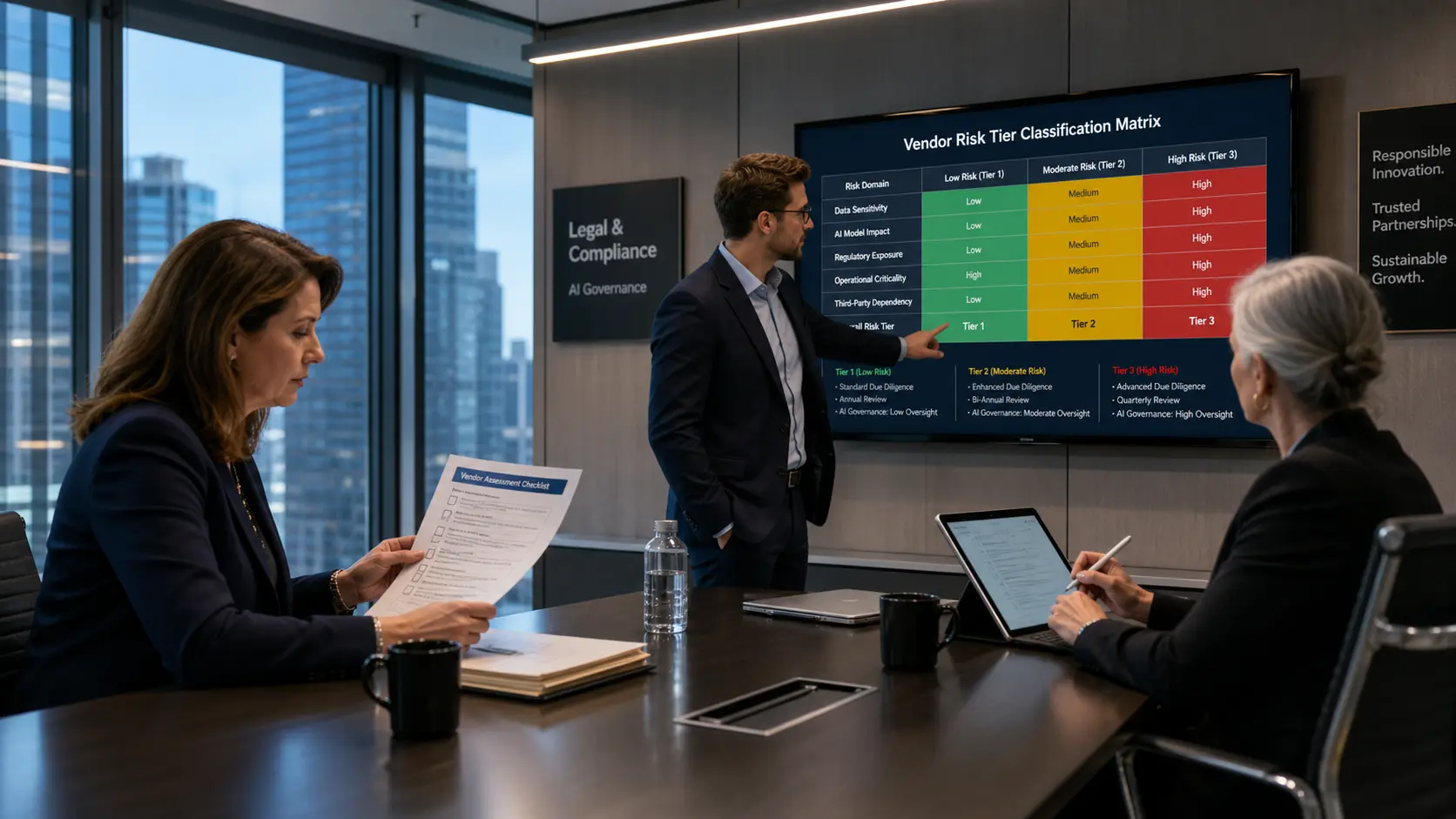
Not every AI vendor in your portfolio requires the same intensity of due diligence, contractual protection, and ongoing monitoring. Applying Tier 1-level scrutiny to a low-stakes AI spell-checker wastes compliance resources and creates vendor friction that slows legitimate adoption. Applying Tier 3-level oversight to an AI system making credit decisions or clinical recommendations creates regulatory exposure and organisational liability. The classification framework below maps each vendor in your AI tool portfolio to one of three tiers based on five factors: data sensitivity, decision consequence, regulatory classification, operational criticality, and replaceability. Each factor is scored independently and the tier is determined by the highest individual factor score — not the average.
Classification Factor 1 — Data Sensitivity
- Tier 1 (High): The vendor processes special category personal data (health, financial, biometric, political opinion, racial/ethnic origin); EU-regulated personal data of more than 1,000 data subjects; or confidential business data whose exposure would cause material competitive harm
- Tier 2 (Medium): The vendor processes general personal data (names, email addresses, work information) of fewer than 1,000 data subjects; or non-personal proprietary data whose exposure would cause limited competitive harm
- Tier 3 (Low): The vendor processes no personal data and no proprietary data — only generic, non-identifiable inputs such as publicly available text or anonymised queries
Classification Factor 2 — Decision Consequence
- Tier 1 (High): The AI tool’s output directly or materially influences a consequential decision affecting individuals — including employment decisions, credit or insurance decisions, healthcare treatment decisions, law enforcement decisions, or access to essential services
- Tier 2 (Medium): The AI tool’s output informs decisions that affect business operations or internal resource allocation, but does not directly affect individual rights, benefits, or access to services
- Tier 3 (Low): The AI tool’s output is used for drafting, brainstorming, summarisation, or content generation where a human reviews and independently decides before any action is taken
Classification Factor 3 — Regulatory Classification
- Tier 1 (High): The use case triggers EU AI Act Annex III high-risk classification; the tool is used in a context regulated by sector-specific AI guidance (SR 11-7 for financial services, FDA AI/ML guidance for medical devices, FedRAMP for US federal government); or the deploying organisation may be reclassified as a provider under EU AI Act Article 25
- Tier 2 (Medium): The tool processes personal data requiring a GDPR Article 28 DPA; or the use case falls into a sector with AI governance guidance (not hard regulatory requirements) such as insurance, HR, or education
- Tier 3 (Low): No specific regulatory classification triggered; general data protection principles apply but no sector-specific AI obligations
Classification Factor 4 — Operational Criticality
- Tier 1 (High): The AI tool is embedded in a critical business workflow where its unavailability for more than 4 hours would cause material business disruption, revenue loss, or regulatory reporting failure
- Tier 2 (Medium): The AI tool supports an important but not critical workflow — its unavailability for up to 24 hours would cause inconvenience and productivity loss but not business disruption
- Tier 3 (Low): The AI tool is used opportunistically and is easily replaceable with manual processes or an alternative tool with no material disruption
Classification Factor 5 — Replaceability
- Tier 1 (High): The vendor is the only viable supplier for this capability in your context; migrating to an alternative would require significant re-engineering, data migration, or retraining; or the vendor provides a proprietary data asset (fine-tuned model, unique training data) that cannot be replicated
- Tier 2 (Medium): There are 2–3 credible alternative vendors; migration would take 1–3 months and require moderate re-integration effort
- Tier 3 (Low): Multiple alternative vendors exist at comparable capability and price; migration could be completed in days to weeks with minimal re-integration
| Vendor Tier | Classification Trigger | Due Diligence Depth | Contract Requirements | Monitoring Cadence |
|---|---|---|---|---|
| 🔴 Tier 1 — High Risk | Any single factor scores High: special category data, consequential decisions, Annex III classification, critical workflow, or sole-source dependency | Full 5-domain checklist + independent verification + DPIA required | All 8 clauses mandatory + sector-specific additions + negotiated DPA | Continuous + Monthly + Quarterly + Annual reassessment |
| 🟡 Tier 2 — Medium Risk | General personal data processing, operational but not critical workflow, sector governance guidance applies, 2–3 available alternatives | Domains 2–5 of checklist + standard vendor questionnaire | Clauses 1, 2, 3, 5, 8 mandatory + standard DPA | Monthly + Quarterly + Biennial reassessment |
| 🟢 Tier 3 — Low Risk | No personal data, no consequential decisions, no regulatory classification, easily replaceable, non-critical workflow | Domain 3 (security basics) + vendor self-attestation | Clauses 1, 2, 8 + standard ToS review | Access review monthly + Annual register update |
⚠️ Reclassification trigger: Any expansion of a vendor’s use case — moving from drafting assistance (Tier 3) to influencing hiring decisions (Tier 1), or from internal analytics (Tier 2) to customer-facing product outputs (Tier 1) — requires an immediate reclassification assessment, not a scheduled annual review. Use case creep is the most common reason a Tier 3 vendor is managing Tier 1-level risk without Tier 1-level oversight. A quarterly use case review question — “Is this tool still being used only for the purpose it was assessed for?” — catches most reclassification needs before they become exposures.
🏛️ 8. Sector-Specific AI Vendor Obligations
In addition to the cross-sector framework above, organisations in regulated industries face additional third-party AI vendor obligations that sit on top of — not instead of — the general framework. These sector-specific requirements are the most commonly missed elements of AI vendor due diligence, because they require knowledge of sector regulation that general procurement and vendor risk teams may not hold. The three sectors with the most developed and immediately enforceable AI vendor requirements in 2026 are financial services, healthcare, and public sector.
Financial Services
Financial services organisations face the most developed AI vendor regulatory framework of any sector. The February 2026 US Treasury Financial Services AI Risk Management Framework, built on the NIST AI RMF structure, introduced 230 control objectives specifically for financial institutions, with a dedicated third-party risk section requiring documented vendor due diligence, ongoing monitoring programmes, and AI-specific contractual protections. The OCC’s existing model risk management guidance (SR 11-7/OCC 2011-12) has been formally extended to AI models and requires financial institutions to validate third-party AI models used in credit decisioning, fraud detection, and risk management to the same standard as internally developed models — meaning independent validation of the vendor’s model, documentation of its limitations, and ongoing performance monitoring cannot be delegated to the vendor itself.
Additional financial services-specific requirements for AI vendor agreements: the contract must include provisions allowing the institution to conduct or commission independent model validation of the vendor’s AI system; the vendor must provide all model documentation required for the institution’s own model risk management programme; the vendor must notify the institution of any model changes within the advance notice period required for the institution’s own model risk governance processes (typically 30–60 days for material model changes); and for AI systems used in consumer lending or insurance, the vendor must support the institution’s adverse action notice obligations under ECOA and FCRA — meaning the vendor’s model must be interpretable enough to generate the specific reasons for adverse decisions required by law.
Healthcare
Healthcare organisations and their AI vendors face obligations under HIPAA, the FDA’s AI/ML-Based Software as a Medical Device (SaMD) framework, and — for EU-operating healthcare organisations — the EU AI Act’s Annex III classification of AI systems used in clinical settings as high-risk. HIPAA requires that any vendor receiving protected health information (PHI) through AI tool interactions execute a Business Associate Agreement (BAA) — not merely a GDPR Article 28 DPA. A GDPR DPA without a HIPAA BAA does not satisfy US healthcare regulatory requirements, and vice versa. Both are required for healthcare organisations with EU and US patient data.
The FDA’s 2025 AI/ML-Based SaMD Action Plan requires that AI tools making or supporting clinical decisions be validated for clinical performance, undergo predetermined change control planning, and maintain real-world performance monitoring. Healthcare organisations deploying AI vendor tools that provide clinical decision support — including AI-powered diagnostic assistance, treatment recommendation systems, and clinical documentation AI — must obtain from the vendor the clinical validation documentation and change control plan required for the organisation’s own regulatory submissions. Additionally, for a complete framework for conducting the privacy impact assessments that healthcare AI vendor relationships require, see our guide on DPIAs for AI systems.
Public Sector
Public sector organisations in the US face AI vendor requirements under FedRAMP (Federal Risk and Authorization Management Program) for cloud services, NIST SP 800-53 Rev 5 security controls for federal information systems, and the Executive Order on Safe, Secure, and Trustworthy AI’s acquisition requirements for AI tools used in federal government contexts. FedRAMP authorisation is required for cloud AI tools used by federal agencies — and organisations in the federal supply chain should verify that AI vendors they recommend to government clients hold current FedRAMP authorisations at the appropriate impact level. For UK public sector organisations, the Government Functional Standard GovS 006 (Cyber Security) applies to AI vendor procurement, and the Central Digital and Data Office’s AI assurance guidance requires documented vendor due diligence for AI tools used in public-facing services.
For all public sector organisations, AI vendor contracts must address Freedom of Information implications — specifically, whether AI-generated outputs, vendor model documentation, and audit logs are subject to disclosure under FOIA (US) or the Freedom of Information Act (UK/EU member states). Vendors that claim model documentation is a trade secret may be creating FOIA compliance complications for public sector deployers that the contract should address proactively. The EU AI Act’s public sector-specific obligations — including mandatory human oversight for consequential public sector AI decisions and post-market monitoring requirements — add a further layer of vendor documentation requirements for EU public authorities deploying third-party AI systems.
⚖️ 9. Decision Framework: When to Approve, Escalate, or Reject an AI Vendor
The vendor classification framework determines how much due diligence to conduct. The decision framework below determines what to do with the results. Not every vendor that fails a due diligence question should be rejected — some deficiencies are remediable through contract negotiation, technical controls, or use case constraints. Not every vendor that passes a due diligence questionnaire should be approved — a questionnaire filled in by the vendor is self-attestation, not verification, and for Tier 1 vendors, self-attestation is not sufficient. The decision framework maps due diligence findings to one of four outcomes: Approve, Conditional Approve, Escalate, or Reject.
Apply the human-in-the-loop governance principle to this decision framework — the approval or rejection of a Tier 1 AI vendor should never be an automated or delegated decision. It requires human review at an appropriate seniority level, documented reasoning, and a record in the AI Vendor Register.
| Due Diligence Finding | Tier 1 Decision | Tier 2 Decision | Tier 3 Decision | Remediation Path |
|---|---|---|---|---|
| All due diligence domains satisfied; all contractual clauses agreed | ✅ Approve | ✅ Approve | ✅ Approve | Register vendor; set monitoring cadence |
| Model card absent but vendor confirms model is proprietary and well-documented internally | ⚠️ Conditional — require model documentation under NDA within 30 days | ⚠️ Conditional — accept with enhanced output monitoring | ✅ Approve with note | Contractual commitment to provide documentation; quarterly review |
| Vendor defaults to model training on customer data; opt-out requires tier upgrade | 🔴 Reject unless opt-out contractually guaranteed | ⚠️ Conditional — upgrade tier or negotiate out | ⚠️ Conditional — restrict to non-proprietary inputs only | Negotiate contractual training opt-out or elevate to enterprise tier |
| No SOC 2 Type II or ISO 27001 — vendor is early-stage startup | 🔴 Escalate to CISO + Risk Committee | ⚠️ Conditional — require penetration test results and security questionnaire | ✅ Approve with annual review | Contractual commitment to achieve SOC 2 by defined date |
| EU AI Act Annex III high-risk classification confirmed for this use case | ⚠️ Conditional — Article 25 cooperation clause + DPIA mandatory before go-live | ⚠️ Escalate — reassess as Tier 1 | ⚠️ Escalate — reassess as Tier 1 | Reclassify to Tier 1; apply full framework |
| Vendor refuses model change notification clause or audit rights | 🔴 Reject | 🔴 Reject | ⚠️ Conditional — accept only for non-critical, easily replaceable use | Seek alternative vendor; document rejection rationale in register |
| Vendor confirms data stored outside EEA with no SCCs or adequacy decision | 🔴 Reject for EU personal data | 🔴 Reject for EU personal data | ✅ Approve if no EU personal data confirmed | Require SCCs or EEA data residency before approval |
| Vendor discloses prior data breach in the past 24 months | 🔴 Escalate — require full incident report and remediation evidence | ⚠️ Conditional — review remediation; enhanced ongoing monitoring | ⚠️ Conditional — review remediation | Obtain incident report; assess remediation adequacy before approval |
| Vendor is pre-revenue startup with under 12 months runway and no enterprise clients | 🔴 Reject — unacceptable vendor viability risk | ⚠️ Conditional — require escrow of model weights and data export | ⚠️ Conditional — monitor viability quarterly | Require data export rights and source code escrow for critical tools |
| Vendor is already in use via shadow adoption — retroactive assessment | 🔴 Escalate — suspend use pending emergency due diligence | ⚠️ Conditional — run expedited due diligence; confirm no data breach | ⚠️ Conditional — run standard due diligence within 30 days | Conduct retroactive DPIA; document in register; address DPA gap immediately |
| Vendor known bias issues in use case context; no independent bias audit available | 🔴 Reject or commission independent bias audit before approval | ⚠️ Conditional — require bias testing results and mitigation plan | ✅ Approve with bias monitoring clause | See our AI bias guide for testing methodology |
🏁 Conclusion: From Checkbox to Continuous Control
Third-party AI vendor risk management in 2026 is not a procurement exercise. It is a continuous risk control that spans pre-contract assessment, contractual protection, ongoing monitoring, and incident response — and it now carries enforceable regulatory consequences under the EU AI Act, GDPR, and a growing set of sector-specific frameworks in financial services, healthcare, and government. The organisations that are managing this risk well in 2026 share three characteristics: they have an AI Vendor Register that captures every tool in their portfolio; they have applied a tiered classification to every vendor in that register; and they have a monitoring programme that is proportionate to each vendor’s tier.
The path from where most organisations are today — informal, decentralised AI tool adoption with inconsistent due diligence — to a mature third-party AI vendor risk programme is not a single project. It is a sequence of four steps, each of which builds on the last: inventory first (build the register, capture every AI tool in use including shadow AI), classify second (apply the five-factor tier classification to every vendor in the register), remediate third (execute the contractual and DPA gaps for Tier 1 and Tier 2 vendors as a priority programme), and monitor fourth (implement the continuous and periodic monitoring controls proportionate to each tier). For organisations that have not yet started, the highest-priority first action is the inventory — you cannot manage vendor risk you have not yet seen. For the complete internal AI audit framework that supports the vendor risk programme, see our AI Audit Checklist.
📌 Key Takeaways
| Key Takeaway | |
|---|---|
| ✅ | EU AI Act Article 25 (enforceable from August 2, 2026) converts any organisation deploying a third-party AI system under its own name or brand into a full AI provider — with conformity assessment, technical documentation, and registration obligations. Any organisation with AI-embedded products must conduct an Article 25 reclassification audit immediately. |
| ✅ | Third-party AI vendor risk falls into four distinct categories — Model Risk, Data Risk, Operational Risk, and Regulatory Risk — each requiring different assessment questions, contractual protections, and monitoring controls. Treating all AI vendor risk as “cybersecurity risk” misses the categories most likely to produce actual harm. |
| ✅ | GDPR Article 28 requires a written DPA with every AI vendor that processes personal data on your behalf — including those receiving names, email addresses, or any identifiable information through user prompts. Most AI SaaS tools that accept user inputs trigger this requirement, and fewer than half of organisations have satisfied it for their full AI tool portfolio. |
| ✅ | Eight contractual clauses are non-negotiable for AI vendor agreements: model change notification (30 days advance), training opt-out, sub-processor disclosure, EU AI Act Article 25 cooperation, 24-hour breach notification SLA, audit rights, liability/indemnification carve-out, and data deletion/exit rights. Standard SaaS agreements satisfy none of these. |
| ✅ | The five-factor vendor classification framework — Data Sensitivity, Decision Consequence, Regulatory Classification, Operational Criticality, and Replaceability — determines each vendor’s tier. Tier is set by the highest individual factor score, not the average. Use case creep is the most common reason a Tier 3 vendor silently accumulates Tier 1-level risk. |
| ✅ | The February 2026 US Treasury Financial Services AI Risk Management Framework introduced 230 control objectives for financial institutions, including mandatory third-party AI vendor due diligence, independent model validation of vendor AI models, and advance change notification requirements for AI models used in credit, fraud, and risk decisions. |
| ✅ | Healthcare organisations require both a HIPAA Business Associate Agreement (BAA) and a GDPR Article 28 DPA for AI vendors receiving patient data — a GDPR DPA alone does not satisfy US healthcare regulatory requirements, and vice versa. Both are required for organisations with EU and US patient data. |
| ✅ | The highest-priority first action for organisations without a mature vendor risk programme is inventory — build the AI Vendor Register, capture every tool including shadow AI adoptions, and classify every vendor before applying due diligence resources. You cannot manage vendor risk you have not yet seen. |
| ✅ | NIST AI RMF GOVERN 6.1 explicitly requires policies and procedures addressing AI risks associated with third-party entities — organisations remain responsible for understanding how vendors process data, how models are updated, what security controls exist, and how risks are monitored, regardless of whether the AI is built internally or consumed as a vendor service. |
🔗 Related Articles
- 📖 AI Governance Explained: How to Build an AI Policy Framework Your Organisation Will Actually Follow
- 📖 AI Risk Assessment and Risk Register: How to Evaluate AI Use Cases Before You Deploy Them
- 📖 The AI Audit Checklist: How to Prove Your Company Is Compliant in 2026
- 📖 GDPR and AI in 2026: A Practical Compliance Playbook for Small Teams
- 📖 EU AI Act Explained: A Beginner-Friendly Compliance Guide + Practical Checklist
- 📖 Shadow AI Explained: What It Is, Why It Happens, and How to Manage It
- 📖 AI Incident Response: What to Do When an AI System Is Wrong, Unsafe, or Leaks Data
FAQs
1. What is the difference between third-party AI vendor risk and general vendor risk management?
General vendor risk management was designed for software that behaves deterministically and changes only when deliberately updated. AI vendors introduce three additional risk dimensions that standard vendor management frameworks do not cover: model risk (the AI’s outputs can change without any action by you or your vendor, simply because the underlying model was updated or retrained); data risk at a new level of granularity (every prompt, document, and interaction may be retained and used for model training); and regulatory risk specific to AI (EU AI Act Article 25 reclassification, GDPR Article 28 DPA requirements for AI sub-processors, and sector-specific AI frameworks). Your existing vendor risk programme needs AI-specific extensions, not a replacement.
2. Does every AI tool we use require a GDPR Article 28 DPA?
Yes, if the tool receives any personal data — and in practice, almost every AI SaaS tool that accepts user inputs does. The test is whether any data submitted to the tool could identify a natural person: names in documents, email addresses in prompts, employee information uploaded for analysis, or customer data described in a query all qualify. The vendor’s privacy policy is not sufficient — a GDPR Article 28-compliant DPA requires specific mandatory elements including sub-processor disclosure, training opt-out, breach notification timelines, and data deletion terms that privacy policies do not contain.
3. How do I handle AI tools that were already adopted by teams without going through vendor risk assessment?
Retroactive assessment — sometimes called shadow AI remediation — follows a four-step sequence. First, inventory: identify every AI tool in use across the organisation, using IT usage logs, expense reports, and team surveys. Second, classify: apply the five-factor tier classification to determine each tool’s risk level. Third, triage: for Tier 1 vendors discovered through retroactive inventory, assess immediately whether use should be suspended pending due diligence, or whether the data sensitivity of the use case is low enough to allow continued use under expedited assessment. Fourth, remediate: execute the DPA and contractual gaps for all vendors that process personal data, and document the remediation in the AI Vendor Register.
4. Can we rely on our AI vendor’s EU AI Act compliance to satisfy our own obligations as a deployer?
No. EU AI Act deployer obligations (Article 26) are distinct from provider obligations, and you cannot delegate them to your vendor. You are responsible for: conducting a use case risk classification for your specific deployment context; implementing appropriate human oversight measures; maintaining records of your AI system usage; conducting a DPIA if required; ensuring your staff have adequate AI literacy; and — critically — conducting an Article 25 reclassification assessment to determine whether your deployment converts you from a deployer into a provider. Your vendor’s conformity documentation supports your compliance programme, but does not satisfy it.
5. What should we do if a Tier 1 AI vendor refuses to negotiate the contractual clauses we require?
Document the refusal and escalate to your legal and risk committee before proceeding. Vendor refusal to negotiate model change notification clauses or audit rights is a material risk signal — it means the vendor is unwilling to provide the transparency commitments that responsible AI deployment requires. The practical options are: accept a compensating control (e.g., enhanced output monitoring as a substitute for model change notification, if the vendor will commit to at least announcing major updates on its changelog); restrict the use case to a Tier 2 or Tier 3 context where the contractual gap is tolerable; or reject the vendor and seek an alternative. For Tier 1 use cases involving consequential decisions or special category personal data, accepting a Tier 1 vendor without the mandatory contractual protections is not a risk management decision — it is a risk acceptance decision that should be made explicitly at board or executive level, documented, and reviewed quarterly.
📧 Get the AI Buzz Weekly Digest
Weekly AI insights, tools, and strategies — delivered every Monday. Free.




Leave a Reply