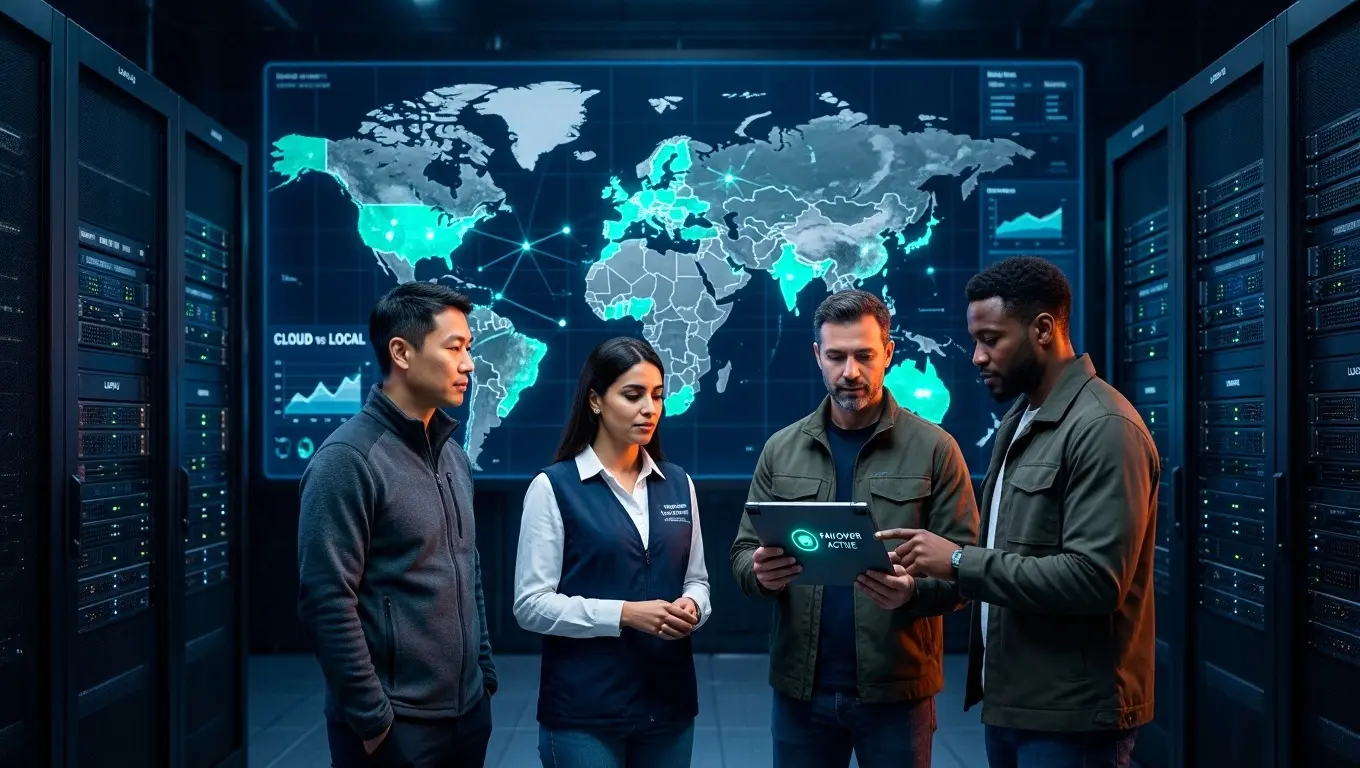
🛡️ Every organization running AI on foreign cloud infrastructure has a hidden vulnerability — a vendor kill-switch, a geopolitical block, or a cloud outage that can stop critical AI workflows without warning. This guide covers what sovereign AI means in 2026, the 5 dependency risks every organization must assess, how nations and enterprises are building AI resilience, and a practical roadmap for reducing dangerous AI concentration risk.
Last Updated: September 10, 2026
Artificial intelligence has become critical infrastructure — and most organizations have built that infrastructure on a small number of foreign-controlled cloud platforms. When AWS experienced a major outage in December 2021, thousands of AI-dependent businesses lost critical capability instantly. In 2026, that dependency is deeper, the workflows are more critical, and the geopolitical risks are significantly higher. Sovereign AI — the ability of a nation or organization to develop, control, and operate AI systems without dangerous dependency on external actors — has moved from a theoretical concern to a board-level risk management priority. According to industry research, 63% of enterprise AI workloads run on just three cloud providers: AWS, Azure, and Google Cloud. That concentration creates systemic risk that most organizations have not formally assessed.
The forces driving sovereign AI urgency are structural and accelerating. US AI export controls have created a tiered global access framework for frontier AI models and semiconductor chips. EU data sovereignty requirements under GDPR and the EU AI Act create legal tension with US cloud AI providers. China’s AI self-sufficiency drive has split the global AI ecosystem into two increasingly incompatible stacks. The Global South is rejecting AI dependency on both US and Chinese platforms. These are not temporary conditions — they are the new operating environment for any organization with international AI deployments. World Economic Forum analysis of sovereign AI identifies it as one of the defining geopolitical technology questions of the decade. This guide is for CIOs, CTOs, Chief AI Officers, government technology leaders, and enterprise risk teams who need to understand that risk — and act on it.
This guide covers everything you need: a plain-English definition of sovereign AI at both national and enterprise levels, the five specific dependency risks your organization faces, how major nations are building AI independence in 2026, the four pillars of enterprise sovereign AI strategy, a five-level AI resilience maturity model with self-assessment checklist, a workload classification framework for deciding which tasks need sovereignty, the four geopolitical developments reshaping AI access, and a practical 90-day roadmap for building resilience. You can also explore Edge AI: how AI works without internet dependency as a core technical building block for sovereign deployment. By the end of this guide, you will understand exactly what sovereign AI risk means for your organization — and what to do about it.
📖 New to AI governance terminology? Visit the AI Buzz AI Glossary — 95+ essential AI terms explained in plain English, including sovereign AI, federated learning, edge computing, and AI supply chain.
🛡️ 1. What Is Sovereign AI? Plain-English Definition
Sovereign AI is one of the most important — and most misunderstood — concepts in the 2026 technology landscape. It is frequently conflated with building domestic AI models, avoiding US cloud providers, or pursuing technological isolationism. None of these definitions is accurate. Sovereign AI is about control, resilience, and independence — not isolation.
Sovereign AI defined: Sovereign AI refers to a nation’s or organization’s ability to develop, control, and operate AI systems independently — using its own infrastructure, data, talent, and governance — without critical dependency on foreign governments, foreign cloud providers, or external vendors who can restrict, modify, or terminate access.
Sovereign AI operates at two distinct levels: national and enterprise. Both are strategic priorities in 2026, but they involve different actors, different risks, and different strategies. Understanding both levels — and how they interact — is essential before building a sovereign AI response.
Level 1 — National Sovereign AI
National sovereign AI is a country’s capacity to develop and control its own AI ecosystem — including domestic AI research, indigenous foundation models, national compute infrastructure, and AI regulation that is not dictated by foreign powers. A nation with strong AI sovereignty can develop its own frontier models, train them on domestic data, run them on domestically controlled compute, and regulate their use under its own legal framework. Examples include France’s Mistral AI (a European alternative to US frontier models), the UAE’s Falcon model series (built by the Technology Innovation Institute for the Arabic-speaking world), China’s Doubao and Qwen (domestic alternatives to OpenAI and Anthropic), and India’s national AI mission which is building domestic compute infrastructure and indigenous language models.
Level 2 — Enterprise Sovereign AI
Enterprise sovereign AI is an organization’s ability to operate its critical AI workflows without dangerous dependency on any single vendor, cloud provider, or foreign-controlled platform that could restrict access due to commercial decisions, geopolitical sanctions or export controls, regulatory data residency requirements, infrastructure failures, or contractual disputes. Enterprise sovereign AI does not require building a foundation model. It requires deliberate architecture decisions that preserve operational continuity regardless of what any single vendor does.
| Dimension | National Sovereign AI | Enterprise Sovereign AI |
|---|---|---|
| Who it applies to | Governments and nation-states | Organizations of all sizes |
| Primary concern | Geopolitical independence, national security, economic competitiveness | Operational resilience, vendor lock-in, data sovereignty, regulatory compliance |
| Key assets | Domestic compute, indigenous models, national data, AI talent pipeline | Multi-vendor architecture, portable models, owned data, fallback workflows |
| 2026 drivers | US export controls, EU AI Act, China tech rivalry, Global South AI independence movement | Cloud concentration risk, EU data residency, GDPR, supply chain disruption, vendor price increases |
| Primary strategy | Build domestic AI champions, fund national compute, develop indigenous foundation models | Multi-cloud deployment, open-source model portfolio, edge AI, workflow portability, vendor diversification |
⚠️ 2. The 5 Sovereign AI Risks Every Organization Must Assess
Most organizations have not formally assessed their AI dependency exposure. These five risks represent the most common — and most dangerous — forms of AI sovereignty vulnerability in 2026. Every organization with critical AI workflows is exposed to at least one.
| Risk | Description | Real Example | Most Exposed |
|---|---|---|---|
| ⚠️ Vendor Kill-Switch | A single AI vendor can restrict, throttle, or terminate your access — due to commercial decisions, policy changes, or geopolitical pressure | OpenAI restricted API access in certain regions citing policy compliance requirements in 2024 | Organizations with single-vendor AI dependencies for critical workflows |
| ⚠️ Geopolitical Export Control | US AI export controls restrict access to frontier AI models and chips for organizations in sanctioned countries or affected supply chains | BIS AI Diffusion Rule (2025) established tiered country access — Tier 1/2/3 jurisdictions face different frontier model and compute access levels | Multinationals, government contractors, organizations with operations in restricted regions |
| ⚠️ Cloud Outage Concentration | Running all critical AI workloads on a single cloud provider creates single-point-of-failure risk during provider outages | AWS us-east-1 outages have repeatedly disabled AI-dependent services across thousands of organizations simultaneously | Organizations with 100% cloud AI dependency and no offline fallback capability |
| ⚠️ Data Residency and Foreign Access | Data processed by foreign cloud AI providers may be subject to foreign government access requests regardless of contractual protections | EU organizations using US cloud AI providers face ongoing GDPR vs US CLOUD Act jurisdiction tension — a conflict with no clean contractual resolution | Healthcare, legal, financial services, government, and defense organizations |
| ⚠️ Model Dependency Capture | Building critical workflows on proprietary model APIs creates dependency on model behavior, pricing, and availability — when the model changes, your workflow breaks | GPT-3.5 deprecation forced thousands of organizations to rebuild complex prompt chains, RAG systems, and fine-tuned workflows optimized for that specific model | Organizations with complex prompt chains, fine-tuned workflows, or RAG systems built on proprietary APIs |
⚠️ Quick sovereignty check: If your single most critical AI vendor terminated your contract tomorrow — how long could your organization operate before critical workflows failed? If the answer is less than 30 days, your sovereign AI risk is HIGH.
🌍 3. Sovereign AI at the National Level: How Countries Are Building AI Independence
The race for national AI sovereignty is reshaping the global technology landscape in 2026. Every major economy has a sovereign AI strategy — and the gap between leaders and laggards is widening rapidly. NVIDIA’s sovereign AI infrastructure overview documents how nations are investing in national AI compute stacks as strategic infrastructure equivalent to roads, power grids, and financial systems. The total global investment in sovereign AI infrastructure exceeded $200 billion in committed funding across national programs in 2025–2026.
| Country/Region | Sovereign AI Strategy | Key Assets |
|---|---|---|
| 🇺🇸 United States | Maintain frontier model leadership. Control semiconductor supply chain. Restrict adversary access via export controls. $500B Stargate infrastructure investment (2025). | OpenAI GPT-5.x, Anthropic Claude Opus 4.7, Google Gemini 3.1 Pro, Meta Llama 4. NVIDIA chip dominance. Stargate national compute program. |
| 🇪🇺 European Union | Regulatory leadership via EU AI Act. Build European AI champions. Enforce data sovereignty via GDPR. Fund pan-European compute infrastructure via GAIA-X. | Mistral AI (France), Aleph Alpha (Germany). EU AI Act as global regulatory template. €109B French AI investment commitment (2024). |
| 🇨🇳 China | Full AI self-sufficiency. Domestic semiconductor development via Huawei Ascend. State-backed AI champions. AI integration into national defense and economic strategy. | Alibaba Qwen, Baidu ERNIE, ByteDance Doubao, DeepSeek V4 Pro. Huawei Ascend 910B chips. Massive domestic training data from 1.4B population. |
| 🇦🇪 United Arab Emirates | Become the sovereign AI hub for the Global South and Arabic-speaking world. AIM7 sovereign AI initiative. $100B AI infrastructure investment commitment. | Falcon 180B (TII) — competitive open-source Arabic foundation model. Abu Dhabi AI campus. Strategic position bridging East and West AI ecosystems. |
| 🇮🇳 India | IndiaAI Mission — build domestic compute (10,000+ GPU cluster), indigenous models, and AI talent pipeline. ₹10,372 crore government commitment. | Sarvam AI (Indian language models), IIT AI research network. Strong technical talent base — 5.4M STEM graduates annually. |
| 🇫🇷 France | European AI champion strategy. Position Mistral AI as sovereign alternative to US foundation models for the EU and francophone world. | Mistral Large 2 — competitive with GPT-4 class models. Open-weight model releases. €109B investment commitment from President Macron (February 2024). |
The 2026 Sovereign AI Race: The race for national AI sovereignty is not just about who builds the best model — it is about who controls the compute, the data, and the governance frameworks that determine how AI is developed and deployed globally. Nations without a sovereign AI strategy are not neutral — they are dependent.
The strategic pattern across all leading nations is consistent: invest in domestic compute infrastructure, develop or support indigenous foundation models, build domestic AI talent pipelines, and establish regulatory frameworks that assert national governance over AI systems operating within their borders. The nations that establish these foundations in 2026–2027 will have structural advantages that are difficult to close later. For enterprise leaders, these national strategies matter directly — because they determine which vendors, which data residency rules, and which export control regimes will govern your AI deployments in each country where you operate.
🏢 4. Sovereign AI at the Enterprise Level: What Organizations Must Do in 2026
Enterprise sovereign AI is not about building your own foundation model — it is about ensuring your organization can operate critical AI workflows without dangerous dependency on any single vendor or platform. The 2026 enterprise sovereign AI strategy has four pillars. None of them requires proprietary model development. All of them require deliberate planning decisions that most organizations have not yet made.
Pillar 1: Multi-Vendor Architecture
Never route all critical AI workloads through a single model provider. This sounds obvious — but the economics of enterprise AI contracts, the convenience of single-vendor integration, and the complexity of managing multiple providers lead most organizations to consolidate around one primary vendor. That consolidation is exactly the sovereignty vulnerability. A resilient enterprise AI architecture maintains active capability across at least two frontier model providers — for example, both Anthropic Claude and OpenAI GPT-5.x for core reasoning tasks — and tests critical workflows on alternative providers quarterly, before the need to switch becomes an emergency. The 2026 recommendation for most organizations: one primary frontier model provider, one secondary frontier provider, and one open-source fallback (Llama 4, Mistral, or Falcon) for highest-criticality workflows that require offline capability.
Pillar 2: Open-Source Model Portfolio
Open-source models — Llama 4, Mistral Large, Falcon 180B, Gemma 3 — can be self-hosted on your own infrastructure, eliminating vendor dependency entirely for appropriate use cases. The trade-off is real: self-hosted models require compute infrastructure, MLOps capability, and ongoing maintenance. They are not zero-cost alternatives. But for high-volume, latency-sensitive, or highly sensitive use cases where data must not leave your environment, self-hosted open-source models are often the correct architecture choice. The practical 2026 approach is a portfolio strategy: use frontier model APIs for complex, low-volume reasoning tasks where frontier capability matters most, and self-hosted open-source for high-volume, sensitive, or latency-critical tasks where sovereignty requirements override convenience. Our Open Source vs Closed Source AI guide: privacy, cost, and control covers this trade-off in detail.
Pillar 3: Data Sovereignty
Your training data, fine-tuning datasets, RAG knowledge bases, and prompt engineering libraries are sovereign AI assets — they represent the organizational intelligence embedded in your AI systems. Treat them accordingly. Never store proprietary training data exclusively on vendor platforms. Maintain local, independently owned copies of all data used in AI workflows in standard, portable formats. Implement data portability requirements from day one of any new AI deployment: every dataset must be exportable, every fine-tuned model checkpoint must be owned and retained by your organization. Organizations that discover they cannot export their data after a vendor dispute or termination have lost both their AI investment and their data sovereignty simultaneously.
Pillar 4: Workflow Portability
The most overlooked pillar — and often the most expensive to fix retroactively. AI workflows built with deep optimization for a single model’s specific behavior, token limits, output format quirks, and response patterns become brittle dependencies. When that model is deprecated, repriced, or restricted, those workflows require extensive rework to migrate. Workflow portability means designing AI workflows to be model-agnostic where possible: using abstraction layers that allow the underlying model to be swapped, documenting prompt chains and RAG configurations in sufficient detail that a team member could migrate them to an alternative model within 48 hours, and testing that migration at least annually. Test migration to an alternative model before a forced migration becomes a crisis — not during one.
🔄 5. AI Resilience Framework: How to Protect Critical Workflows
AI resilience is the operational counterpart to AI sovereignty — it is the ability to maintain critical AI workflow capability when a primary provider becomes unavailable. The following framework applies to any organization with mission-critical AI dependencies, regardless of current maturity level. Before using this framework, review your AI Vendor Due Diligence Checklist: 50 questions before you share data to ensure vendor contractual protections align with your resilience requirements.
| Level | Maturity | What It Means |
|---|---|---|
| Level 1 | ❌ Vulnerable | All critical AI workloads on one provider. No fallback tested. Full vendor kill-switch exposure. Most enterprise organizations in 2026. |
| Level 2 | ⚠️ Aware | Alternative providers identified but not tested. Knows where to go but has not verified it works. Theoretical resilience without operational proof. |
| Level 3 | 🟡 Developing | Alternative providers tested quarterly. Workflows documented for migration. Can switch within days under pressure — not hours. |
| Level 4 | ✅ Resilient | Critical workflows distributed across 2+ providers in active use. Can absorb loss of any single provider without operational crisis. Data owned and portable. |
| Level 5 | ✅✅ Sovereign Ready | Critical workflows can run on self-hosted open-source models. Full offline capability for highest-priority use cases. No external dependency for mission-critical operations. |
Use the checklist below to assess your current resilience level honestly. Most organizations that complete this assessment discover they are at Level 1 or Level 2 — not because they made bad decisions, but because sovereign AI risk was not part of their original AI deployment framework.
| ☐ | Assessment Question | Risk If “No” |
|---|---|---|
| ☐ | Have you inventoried all AI tools and workflows in use across the organization and classified each by criticality? | Cannot prioritize resilience investment without knowing your exposure — Level 1 by definition |
| ☐ | Do you have a second model provider tested and ready for your most critical AI workflow? | Level 1 vulnerability — single point of failure for critical operations |
| ☐ | Is your AI workflow documentation sufficient for a team member to migrate to an alternative provider within 48 hours? | Migration under pressure takes weeks instead of days — Level 2 without operational proof |
| ☐ | Do you own and control local copies of all data used in AI workflows — training data, fine-tuning datasets, RAG knowledge bases? | Data loss or inaccessibility if vendor terminates contract or is acquired |
| ☐ | Have you reviewed your top 3 AI vendor contracts for termination notice periods, data portability rights, and export restrictions? | Legal and operational surprise at worst possible moment — contractual lock-in discovered during crisis |
| ☐ | Do you have offline fallback procedures for your highest-criticality AI workflows? | Full operational failure during cloud outage or vendor restriction event |
⚖️ 6. Cloud AI vs Sovereign AI: Decision Framework for 2026
Sovereign AI does not mean abandoning cloud AI — it means making deliberate decisions about which workloads require sovereignty and which can safely run on cloud infrastructure. The most common mistake in sovereign AI planning is treating it as all-or-nothing. The correct framework classifies workloads by their sovereignty requirements and assigns the appropriate deployment model to each category.
| Workload Type | Cloud AI | Sovereign/Edge AI | Recommended Approach |
|---|---|---|---|
| Customer service chatbot | ✅ Appropriate | ⚠️ Overkill for most | Cloud AI — low sovereignty risk, benefits from frontier capability |
| Internal document analysis (non-sensitive) | ✅ Appropriate | Optional | Cloud AI with enterprise tier (no training on your data) |
| Patient health record analysis | ⚠️ Requires HIPAA BAA + careful vendor selection | ✅ Preferred | Edge AI or self-hosted model — patient data must not leave clinical environment |
| Legal documents (M&A, litigation) | ⚠️ High confidentiality risk | ✅ Strongly preferred | Self-hosted or air-gapped deployment — M&A data must not reach public cloud APIs |
| Defense and intelligence applications | ❌ Not appropriate | ✅ Mandatory | Air-gapped, classified infrastructure only — no exceptions |
| Financial fraud detection (real-time) | ⚠️ Latency and data residency concerns | ✅ Preferred for real-time | Edge AI for real-time transaction scoring, cloud for complex batch analysis |
| HR and people analytics | ⚠️ Employee data privacy concerns | ✅ Preferred | Private cloud or self-hosted — employee data should not reach public AI APIs |
| R&D and IP-sensitive work | ❌ IP leakage risk | ✅ Required | Air-gapped or strict enterprise tier with contractual no-training guarantee + audit rights |
This workload classification exercise — applied systematically across your AI inventory — transforms sovereign AI from an abstract concern into a concrete set of deployment decisions. For each workload your organization runs, the framework produces a clear recommendation: cloud AI, cloud AI with enterprise data protections, edge AI, self-hosted model, or air-gapped deployment. The output becomes the architectural blueprint for your sovereign AI roadmap.
🌐 7. Sovereign AI in 2026: The Geopolitical Forces Reshaping AI Access
Sovereign AI has moved from a theoretical concern to a practical business risk because of four concrete geopolitical developments in 2025–2026. Every organization with international operations needs to understand these forces — not as background context, but as direct operational variables affecting which AI vendors you can use, in which jurisdictions, under which legal frameworks. According to McKinsey State of AI research, geopolitical risk has become the most frequently cited external concern among enterprise AI leaders in 2026 — ahead of regulatory risk and ahead of vendor lock-in risk.
Development 1: US AI Export Controls and the Diffusion Rule
The US Bureau of Industry and Security (BIS) expanded AI chip and model export controls through the AI Diffusion Rule, establishing a tiered country access framework. Tier 1 countries (close US allies) receive nearly unrestricted access to frontier AI models and compute. Tier 2 countries (most of the world) face cap-based controls on compute acquisition. Tier 3 countries (adversarial nations under existing sanctions) face near-total restrictions. For multinationals, this creates a fragmented AI access landscape: your Singapore operations may freely access frontier US cloud AI, while your operations in Tier 2 jurisdictions face compute acquisition limits, and your supply chain partners in restricted jurisdictions cannot access those tools at all. AI vendor selection is now a trade compliance decision as much as a technology decision.
Development 2: EU AI Act Data Sovereignty Requirements
The EU AI Act high-risk provisions became active on August 2, 2026 — the same period that GDPR data residency requirements continue to create legal tension with US cloud AI providers. EU organizations processing EU personal data through US cloud AI APIs face an unresolved jurisdictional conflict: GDPR requires data protection equivalent to EU standards, while the US CLOUD Act gives US law enforcement potential access to data held by US cloud providers regardless of where that data physically resides. The practical result is that risk-conscious EU organizations are increasingly favoring European AI providers — particularly Mistral AI — or self-hosted deployment for sensitive workloads. Our EU AI Act Explained: compliance guide and practical checklist covers the specific data handling requirements in detail.
Development 3: US-China AI Decoupling
The US-China technology decoupling has split the global AI ecosystem into two increasingly incompatible stacks. US frontier models (GPT-5.x, Claude, Gemini) are restricted or unavailable in China. Chinese frontier models (Qwen, ERNIE, Doubao, DeepSeek V4 Pro) operate under Chinese cybersecurity law, which includes data access requirements that create sovereignty concerns for non-Chinese organizations. Multinationals operating in both markets face AI vendor decisions with direct geopolitical implications: they must maintain separate AI vendor relationships for China operations versus rest-of-world operations, and those stacks must be managed independently to avoid cross-jurisdiction compliance violations.
Development 4: Global South AI Sovereignty Movement
A significant and underreported development: emerging economies are systematically rejecting AI dependency on both US and Chinese platforms. The UAE’s AIM7 sovereign AI initiative, India’s IndiaAI Mission, the African Union’s AI strategy, and Brazil’s national AI program all prioritize indigenous AI capability development. This is creating a new tier of sovereign AI vendors — non-aligned providers that serve organizations seeking to avoid both US and Chinese AI ecosystems. For enterprise organizations operating across the Global South, these emerging sovereign AI providers will increasingly appear as viable alternatives to US cloud AI for certain workloads and jurisdictions.
The 2026 Geopolitical AI Reality: Your AI vendor selection is now a geopolitical decision — not just a technology decision. The providers you choose determine which legal jurisdictions, which export control regimes, and which government access requests apply to your most sensitive AI workflows. Most organizations made those vendor selections without understanding these implications.
🗺️ 8. Building Your Sovereign AI Roadmap: A Practical 90-Day Plan
Sovereign AI resilience is built incrementally — not in a single project. This 90-day roadmap gives organizations a structured starting point regardless of current maturity level. Its design principle is the same as any effective risk management program: inventory and assess before acting, execute quick wins that reduce highest-risk exposure, then build structural resilience that sustains over time. Integrate this roadmap with your broader AI governance framework and AI risk assessment process — sovereign AI risk belongs in your AI risk register alongside model risk, data privacy risk, and compliance risk.
| Phase | Timeframe | Actions and Outputs |
|---|---|---|
| Phase 1 — Inventory and Assess | Days 1–30 |
→ Inventory all AI tools and workflows across the organization → Classify each by criticality: mission-critical, important, nice-to-have → Map each workflow to its vendor dependencies → Apply the workload classification framework (Section 6) to each → Assess current resilience maturity (Levels 1–5 from Section 5) → Identify the 5 highest-risk AI dependencies → Output: AI dependency map + risk assessment report ready for leadership |
| Phase 2 — Quick Wins | Days 31–60 |
→ Register enterprise accounts with a second model provider for all mission-critical workflows → Test mission-critical workflows on alternative providers — document results → Ensure all AI workflow data is backed up locally in portable formats → Review top 3 AI vendor contracts for termination notice periods, data portability rights, and export restrictions → Identify 1–2 open-source model candidates (Llama 4, Mistral, Falcon) for highest-risk workflows → Output: Tested fallbacks for top 5 mission-critical AI workflows + contract gap report |
| Phase 3 — Structural Resilience | Days 61–90 |
→ Implement multi-vendor routing for mission-critical workflows in active production → Deploy and test a self-hosted open-source model for the highest-risk use case identified in Phase 1 → Document all workflow migration procedures to the standard required for 48-hour migration → Establish a quarterly resilience testing cadence — calendar it now → Present sovereign AI risk assessment to CISO, CIO, and board risk committee with remediation plan → Output: Level 3+ resilience maturity for mission-critical workflows + leadership-ready risk briefing |
🔒 Building your AI governance and resilience framework? Explore the AI Buzz AI Governance and Security Hub — 44+ guides covering EU AI Act compliance, AI risk assessment, vendor due diligence, ISO 42001, and responsible AI deployment.
🏁 Conclusion: Sovereign AI Is a Risk Management Priority — Not a Technology Project
Sovereign AI is not about building your own foundation model or abandoning cloud AI entirely. It is about making deliberate, informed decisions about which AI workloads can safely run on external infrastructure — and which require the control, portability, and independence that only sovereign deployment provides. In 2026, that distinction is a risk management imperative. The 63% of enterprise AI workloads concentrated on three cloud providers represents a systemic risk posture that most boards have not formally reviewed, most risk registers have not captured, and most incident response plans have not addressed. The organizations doing that work now are building resilience that will matter when the next outage, vendor restriction, or geopolitical disruption arrives.
The geopolitical forces driving sovereign AI — US export controls, EU data sovereignty requirements, US-China decoupling, and the Global South independence movement — are structural and accelerating. They will not reverse. Organizations that treat AI vendor selection as a pure technology decision are accumulating geopolitical risk that will not become visible until a crisis forces a rapid and expensive migration. The organizations building sovereign AI resilience systematically in 2026 are the ones that will operate without disruption when that crisis arrives for their less-prepared competitors.
Start with the 90-day roadmap in Section 8. The first 30 days — inventory and assessment — costs nothing and reveals everything. You cannot manage sovereign AI risk you have not mapped. Map it first. Then build the resilience that your actual dependency exposure requires — not more, not less. The goal is not zero cloud dependency. The goal is deliberate, risk-informed cloud dependency — and the organizational capability to operate without it when you need to.
📌 Key Takeaways
| Takeaway | |
|---|---|
| ✅ | Sovereign AI operates at two levels: national (a country’s AI independence) and enterprise (an organization’s ability to operate critical AI workflows without dangerous vendor dependency). Both are strategic priorities in 2026. |
| ✅ | The 5 sovereign AI risks: vendor kill-switch, geopolitical export controls, cloud outage concentration, data residency and foreign government access, and model dependency capture. Every organization with critical AI workflows is exposed to at least one. |
| ✅ | 63% of enterprise AI workloads run on just 3 cloud providers — creating systemic concentration risk that most organizations have not formally assessed, risk-registered, or mitigated. |
| ✅ | Enterprise sovereign AI has 4 pillars: multi-vendor architecture, open-source model portfolio, data sovereignty, and workflow portability. None requires building a foundation model — all require deliberate planning decisions most organizations have not yet made. |
| ✅ | The 5-level AI resilience maturity model runs from Level 1 (single vendor, fully vulnerable) to Level 5 (sovereign ready — critical workflows can run on self-hosted models with no external dependency). Most enterprise organizations are at Level 1 or 2 in 2026. |
| ✅ | US AI export controls (BIS Diffusion Rule), EU AI Act data sovereignty (August 2026), US-China tech decoupling, and the Global South independence movement have made AI vendor selection a geopolitical decision — not just a technology decision. |
| ✅ | Not all workloads require sovereignty. Customer service chatbots and non-sensitive internal documents can safely run on cloud AI. Patient health records, M&A documents, defense applications, and R&D data require sovereign or edge deployment. |
| ✅ | The 90-day sovereign AI roadmap: Days 1–30 (inventory and assess — identify your 5 highest-risk AI dependencies), Days 31–60 (test fallbacks and review contracts), Days 61–90 (implement multi-vendor routing and self-hosted model for highest-risk workflow). Start with the inventory — you cannot manage risk you have not mapped. |
🔗 Related Articles
- 📖 Edge AI Explained: How AI Works Without Internet Dependency
- 📖 AI Geopolitics and Global Sanctions: How Export Controls Affect Your Business
- 📖 AI Vendor Due Diligence Checklist: 50 Questions Before You Share Data
- 📖 Open Source vs Closed Source AI: Privacy, Cost, and Control Guide
- 📖 EU AI Act Explained: Compliance Guide and Practical Checklist
❓ Frequently Asked Questions: Sovereign AI Explained
1. What is sovereign AI in simple terms?
Sovereign AI is the ability of a nation or organization to develop, control, and operate AI systems without dangerous dependency on foreign governments, cloud providers, or vendors who can restrict or terminate access. It operates at two levels: national (a country’s AI independence) and enterprise (an organization’s operational resilience). Our AI governance framework guide covers how sovereign AI fits into your broader governance program.
2. Is sovereign AI only relevant for governments and large enterprises?
No. Any organization with mission-critical AI workflows — regardless of size — faces sovereign AI risk. If a single vendor terminating your contract would disable critical operations within 30 days, your sovereign AI risk is high. SMBs using cloud AI for financial reporting, legal document review, or customer-facing automation face real dependency risk. The AI vendor due diligence checklist helps any size organization assess its exposure.
3. What is the difference between sovereign AI and edge AI?
Sovereign AI is the strategic goal — maintaining control and independence over AI systems. Edge AI is one of the key technical tools for achieving it. Edge AI runs AI models locally on devices or private infrastructure without cloud dependency, eliminating both cloud outage risk and data residency concerns for specific workloads. See our Edge AI Explained guide for implementation detail on how edge deployment supports sovereign AI strategy.
4. How do US AI export controls affect my organization’s AI strategy?
The US AI Diffusion Rule (2025) created a tiered country framework: Tier 1 allies receive near-unrestricted access to US frontier AI and compute, Tier 2 countries face acquisition caps, and Tier 3 countries face near-total restrictions. If your organization has operations, supply chain partners, or customers in Tier 2 or Tier 3 jurisdictions, your current US cloud AI vendor relationships may not serve those locations legally. Our AI Geopolitics and Global Sanctions guide covers the specific implications for multinationals.
5. What open-source AI models can replace proprietary APIs for sovereign deployment in 2026?
The leading options for self-hosted sovereign deployment in 2026 are Llama 4 (Meta — open weights, competitive with GPT-4 class performance for most business tasks), Mistral Large 2 (strong for European and multilingual deployments), Falcon 180B (UAE TII — strong for Arabic and Global South use cases), and Gemma 3 (Google — smaller, efficient, good for edge deployment). All are available as open-weight models that can be self-hosted. Trade-off: self-hosting requires compute infrastructure and MLOps capability. Our Open Source vs Closed Source AI guide covers the full cost and capability comparison.
📧 Get the AI Buzz Weekly Digest
Weekly AI insights, tools, and strategies — delivered every Monday. Free.




Leave a Reply