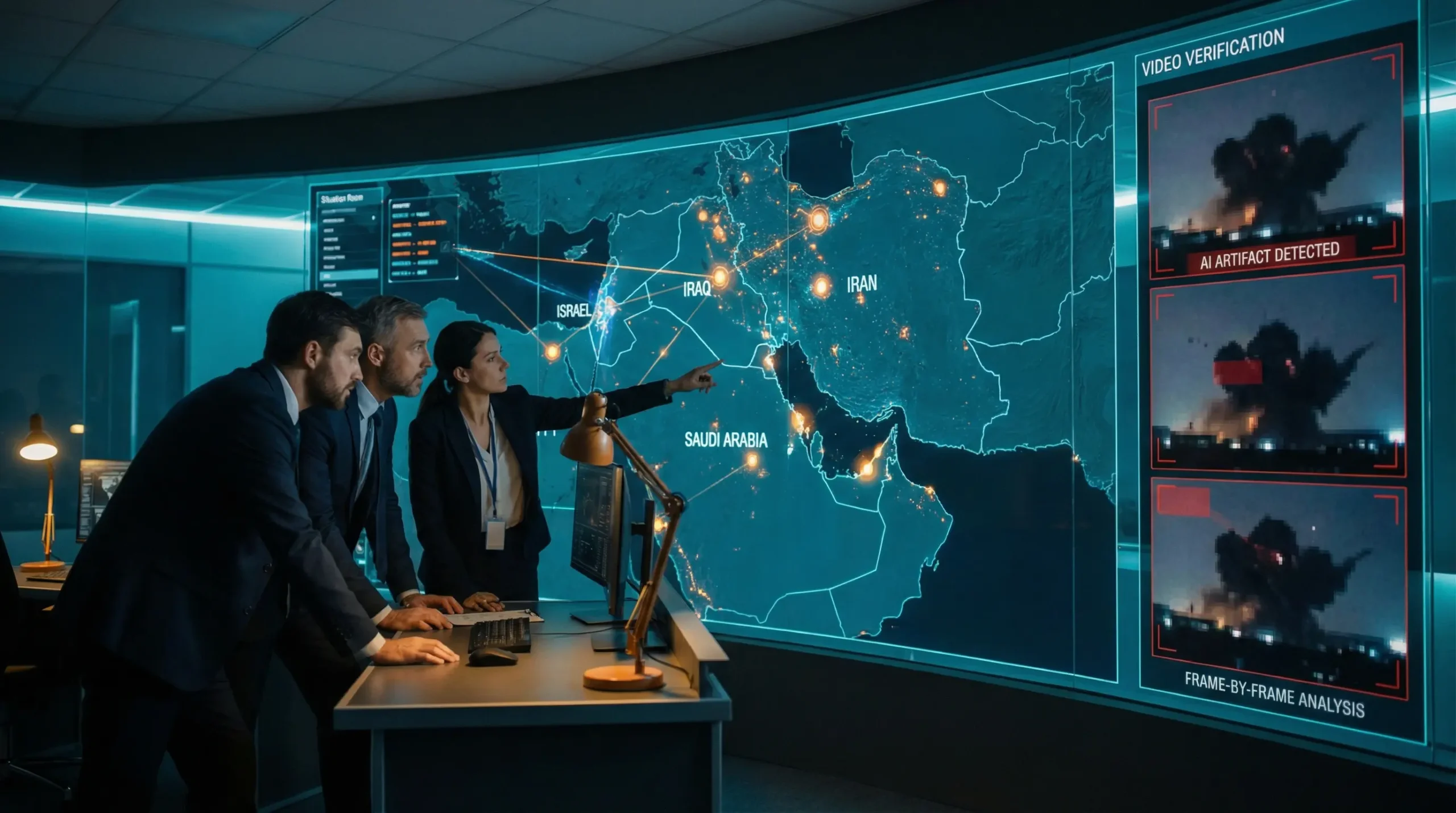
🌐 AI has become the defining weapon of 21st-century geopolitics — and the battlefield is everywhere. From deepfake disinformation targeting elections to autonomous drone swarms, semiconductor chip wars, and cognitive operations running around the clock, this is the most complete guide to how AI is reshaping global power, information warfare, and national security in 2026.
Last Updated: May 15, 2026
The geopolitical map is being redrawn — not through shifting borders, but through control of code and compute. AI in geopolitics and information warfare has moved from a theoretical concern debated in academic papers to an operational reality shaping election outcomes, military doctrines, national security strategies, and the daily experience of citizens across every democracy on earth. The World Economic Forum’s Global Risks Report 2026 placed mis- and disinformation among the top short-term global risks alongside geoeconomic confrontation and societal polarization — one of the few risks rated severe across both the two-year and ten-year horizons, and the one most likely to catalyze and worsen every other risk on the list. The year 2026 is proving that assessment correct in real time.
The convergence driving this moment is unprecedented. Generative AI has demolished the old constraints on producing and distributing disinformation: human effort, limited distribution capacity, and high coordination costs have all collapsed. At the same time, the race to control AI infrastructure — semiconductors, foundation models, data centers, and talent — has become the central strategic competition of the decade, eclipsing traditional resource rivalries. Nations without sovereign AI capability are discovering that technological dependence translates directly into strategic vulnerability: depending on foreign models for intelligence, military planning, or critical infrastructure is, as one leading European AI researcher put it, equivalent to outsourcing the decisions those systems inform. The geopolitical implications are systemic, not episodic.
This guide is built for every reader who needs to understand this landscape clearly: business leaders assessing geopolitical risk exposure, security professionals building defenses against AI-powered threats, policy professionals tracking the regulatory and governance dimensions, and citizens trying to understand what is actually happening beneath the surface of the information environment they navigate every day. We cover the AI-powered information warfare playbook that state actors are running right now, the deepfake crisis and its 2026 escalation, the semiconductor chip war reshaping the global technology order, the autonomous weapons arms race and its governance vacuum, the sovereign AI movement transforming national strategy, and the fragile global governance framework attempting to manage all of it simultaneously.
📖 New to AI terminology? Visit the AI Buzz AI Glossary — 65+ essential AI terms explained in plain English, each linking to a full in-depth guide.
🧠 1. The New Information Warfare — How AI Has Industrialized Influence Operations
Information warfare is not new. States have used propaganda, deception, and psychological operations as instruments of power for as long as organized conflict has existed. What generative AI has done is change the economics and scale of those operations so dramatically that the underlying logic of the information environment itself has shifted. The barriers that previously limited influence operations — the need for skilled human writers, translators, video editors, and distribution networks — have been largely eliminated. A small team or even a single sophisticated actor can now operate at the scale and sophistication that previously required state-level resources.
The numbers are concrete. NewsGuard reports that AI-generated news and content sites have grown to over 2,089 sites operating across 16 languages, most with almost no human oversight. Deepfake attacks reached a frequency of one every five minutes in 2024. Digital document forgery rose 244% in a single year. Research from the Observer Research Foundation documents that leading AI chatbots repeated false narratives 35% of the time in August 2025 — up from 18% just one year earlier — as a result of strategic information laundering through fake local news sites that had been indexed and absorbed into training pipelines. The information environment is not just being polluted by AI-generated content. It is being systematically exploited by actors who understand exactly how AI systems consume and reproduce information.
The September 2025 GoLaxy revelations provided the clearest window yet into how professional state-linked influence operations are structured in 2026. Documents leaked from the Beijing-based firm showed a “Smart Propaganda System” — an army of AI-generated personas engineered to appear and behave like real people, using millions of data points to build detailed psychological profiles of their targets and deliver tailored messaging designed to shift their opinions, amplify their anxieties, and deepen their distrust of institutions. This is cognitive warfare at industrial scale: personalized, persistent, and nearly invisible to the individuals being targeted.
Key Definition: Cognitive warfare is the deliberate use of information, narrative, and psychological manipulation to shape the beliefs, decisions, and behaviors of target populations — without their awareness that they are being influenced. AI amplifies cognitive warfare by enabling personalized, persistent, and scalable operations that were previously impossible to execute at speed and across multiple languages and cultures simultaneously.
Russia’s Information Operations — From Volume to Precision
Russia’s information warfare program — historically built around volume, speed, and deniability — has evolved under AI into a more precision-targeted architecture. The Storm-1516 operation, a spinoff of Russia’s Internet Research Agency, demonstrated this evolution clearly. In April 2025, NewsGuard found that leading AI chatbots repeated Storm-1516 disinformation narratives about France 32% of the time — a result of strategic laundering through fake local news sites and fabricated whistleblower videos that were indexed by AI systems and absorbed into their knowledge bases. France’s Viginum intelligence service assessed that Storm-1516 directly targeted European leaders and their staff with deepfakes specifically designed to discredit Ukraine and create political pressure for the suspension of military aid.
The operational innovation in these campaigns is not the deepfake technology itself — it is the pipeline. Content is created at volume using generative AI, seeded across hundreds of fake local news sites and social media accounts, indexed by search engines and AI knowledge systems, and then surfaces as apparent corroboration when targets search for information on the relevant topics. By the time the content reaches the target, it has been laundered through enough intermediate sources to appear authentic. The original fabrication is buried; only the narrative remains.
China’s Cognitive Warfare and the Taiwan Focus
In 2026, the PRC’s AI-enabled disinformation efforts are intensifying in scale, persistence, and technical sophistication, particularly those targeting Taiwan. PRC actors are using AI-generated audio, video, and text distributed through networks of fake accounts and contracted private firms to conduct “cognitive warfare” campaigns aimed at shaping political perceptions and voter behavior. These campaigns prioritize volume, localization, and algorithmic exploitation, and they are increasingly designed to be continuous rather than episodic.
As AI-generated content is blended with human-curated messaging and commercial infrastructure, PRC-linked operations are becoming harder to detect and attribute, reflecting a shift toward more deniable, adaptive, and professionalized influence operations. The combination of AI-generated content and human editorial curation is particularly difficult to counter: purely automated content can be detected by pattern analysis, but hybrid operations that blend synthetic and human elements at high volume defeat most current detection approaches. The goal in the Taiwan context is not necessarily to convince target audiences of specific propositions — it is to create sufficient confusion and distrust that democratic deliberation itself becomes harder to sustain.
Iran’s Deepfake Disinformation Playbook
Iran’s information operations have adopted AI-generated deepfakes as a standard operational tool for active conflict contexts. In March 2026, the Foundation for Defense of Democracies identified more than 110 unique deepfakes conveying pro-Iran battlefield narratives — including fake footage of missile strikes, fabricated images of prominent Israeli landmarks ablaze, and repurposed battle footage from other conflicts presented as evidence of Iranian military success. The advancement of AI tools, particularly the advent of AI agents that can act without human oversight, has made the creation of synthetic disinformation easier than ever. The strategic objective is not to win an argument but to create a parallel information environment — a synthetic reality in which Iranian military performance appears credible and Western responses appear to be failing — and sustain it long enough to affect international political and media narratives.
🎭 2. The Deepfake Crisis — How Synthetic Media Is Weaponizing Democracy
Deepfake technology has crossed a critical threshold in 2026. The question is no longer whether synthetic media will affect democratic politics. The question is whether democratic institutions can adapt their verification, disclosure, and response capabilities fast enough to prevent irreversible damage to the foundations of public trust on which elections and accountable governance depend.
The evidence from the 2024–2025 electoral cycle is already alarming. In Ireland’s 2025 presidential election, a deepfake video falsely depicted the eventual winner withdrawing his candidature and included fake footage of national broadcasters apparently confirming the news — released just days before polling day. In Romania’s May 2025 presidential election, scammers used Facebook to distribute deepfake videos showing presidential candidates promoting a non-existent government investment opportunity. In the Netherlands, roughly 400 AI-generated synthetic images were used to attack political counterparts during a national campaign. Deepfake-driven fraud led to more than $200 million in financial losses in the first quarter of 2025 alone — a figure that captures the commercial exploitation of synthetic media but understates its political and institutional costs.
The Liar’s Dividend — When Deepfakes Make Truth Unverifiable
The most dangerous long-term consequence of the deepfake proliferation is not the specific false narratives that individual deepfakes produce. It is the systematic erosion of the evidential foundation on which truth claims rest. We are seeing the erosion of the “seeing is believing” standard, which is now morphing into the “liar’s dividend” — a politician caught in a scandal on video can now simply claim it as a deepfake. This dynamic — where the existence of deepfake technology provides a plausible denial mechanism for any video evidence — degrades accountability even when no deepfakes are actually involved. The mere possibility of synthetic media is enough to cast doubt on authentic footage.
The legal system is already feeling this impact. In Mendones v. Cushman & Wakefield in September 2025, a California judge issued a terminating sanction after two deepfake videos were submitted as evidence. While those particular videos were poorly executed and easily identified, the case established a precedent that will be tested with increasing frequency as generation quality improves. The integrity of digital evidence in civil and criminal proceedings — which underpins the rule of law in modern democratic societies — is now a direct casualty of the deepfake proliferation.
The Technical and Regulatory Response
The technical response to the deepfake crisis is advancing on three parallel tracks: content provenance standards, AI-generated content watermarking, and detection tooling. The C2PA (Coalition for Content Provenance and Authenticity) standard — which embeds tamper-evident metadata into content at the point of creation — is gaining adoption across media supply chains, with Meta, Google, and OpenAI all committing to implementation. The EU AI Act’s Article 50, active from August 2026, requires disclosure of synthetic interactions and machine-readable labeling of AI-generated content, with fines up to 6% of global revenue for non-compliance. The EU Omnibus agreement extends the AI-generated content watermarking deadline to December 2026, while the US TAKE IT DOWN Act established 48-hour takedown windows for non-consensual intimate deepfakes in 2025.
Detection tooling has improved significantly but remains in a structural arms race with generation capability. Every improvement in detection is met by improvements in generation that circumvent the detection method. With 2026 densely packed with elections across continents, and particular nations at risk of irreparable democratic backsliding, the speed and scale of synthetic media is a compounding risk. The technical measures are necessary but not sufficient. The deeper solutions require changes in media literacy, platform accountability, and the institutional capacity of news organizations and election authorities to verify and respond to synthetic content in real time — capacities that most democratic systems have not yet built at the scale the threat demands. Our guide on AI and Misinformation covers the detection technologies and institutional responses in greater depth.
💾 3. The Semiconductor Chip War — How Hardware Controls Have Become Strategic Weapons
The AI race is, at its foundation, a compute race. Every frontier AI model, every autonomous weapons system, every large-scale surveillance apparatus requires vast quantities of advanced semiconductor processing power to train, deploy, and operate. Control over the semiconductor supply chain — who can design advanced chips, who can manufacture them, and who can access them — has therefore become one of the most consequential dimensions of the US-China strategic competition. The chip war is not a metaphor. It is a live, escalating conflict being fought through export controls, tariffs, corporate sanctions, and legislative maneuvers that are restructuring a $600 billion global industry.
The Evolution of US Export Controls Through 2026
The US export control regime targeting China’s access to advanced AI chips has undergone multiple escalations since the initial October 2022 restrictions, and the policy direction in 2026 has taken a significant and contested turn. In December 2025, the Trump administration reversed the Biden-era presumption of denial for Nvidia’s H200 chip to China. The Commerce Department’s Bureau of Industry and Security formally shifted its licensing posture to case-by-case review in January 2026, subject to conditions: third-party testing in the US before export, a volume cap limiting China-bound shipments to 50% of domestic US sales, and a 25% tariff attached to each shipment. This policy reversal created an immediate and intense legislative counter-reaction.
The AI Overwatch Act, advanced by the House Foreign Affairs Committee in January 2026, would treat advanced semiconductor exports similarly to arms sales — requiring congressional review of export licenses and imposing mandatory denial for chips more powerful than the H200, including Nvidia’s Blackwell architecture. Despite pushback from industry voices and some White House officials, congressional resistance to AI chip exports has hardened, positioning the issue as a top legislative priority in 2026. In April 2026, the bipartisan MATCH Act was introduced in both chambers, targeting chipmaking equipment exports and seeking to close the loopholes that Chinese firms have been exploiting to acquire sensitive manufacturing tools through allied and third-country intermediaries.
China’s Semiconductor Self-Reliance Drive
The US export control regime has produced an outcome that its architects did not fully anticipate: it has dramatically accelerated China’s drive for domestic semiconductor self-sufficiency. While the controls have disrupted Chinese access to leading-edge chips and equipment, their principal effect has been to accelerate the adoption of indigenous equipment and products, giving new impetus to coordinated state and industry efforts to localize semiconductor design and manufacturing. TrendForce projects that in 2026, the domestic share of China’s AI chip market will increase to 50%.
The domestic alternatives are advancing faster than most Western analysts predicted. Huawei has emerged as the most credible challenger to Nvidia within the Chinese market. Its Ascend 910C AI accelerator has gained significant traction among Chinese enterprises, and Huawei is targeting 1.6 million Ascend dies across its product line by 2026. The company has also built its own AI computing framework — MindSpore — as an open-source alternative to Nvidia’s CUDA software ecosystem. The strategic implication is significant: what started as a targeted export control regime has evolved into a bifurcated global chip ecosystem where both sides are building independent supply chains, independent chip architectures, and increasingly incompatible AI infrastructure. The US-China chip war 2026 is a structural realignment of the global semiconductor market, and the decisions being made today will define competitive positions through 2035.
The Global Spillover — Allies, Gray Markets, and Supply Chain Risk
The chip war’s effects extend far beyond the US-China bilateral. Washington’s policy changes on chip exports have a ripple effect on allies’ industrial and AI development planning — especially those deeply involved in the interdependent supply chain such as the Netherlands, Taiwan, and Japan. Gray market diversion is a serious and growing problem: chip smuggling is reportedly widespread, with third countries such as Malaysia and Singapore allegedly utilized as intermediaries for China. The April 2026 MATCH Act’s provision requiring US allies to adopt equivalent restrictions within 150 days or face unilateral action under the Foreign Direct Product Rule reflects Washington’s recognition that unilateral controls alone cannot close the gaps that sophisticated actors exploit through intermediary channels.
For enterprises with global supply chains, the semiconductor competition creates concrete strategic risk that goes beyond the geopolitical level. Targeted attacks based on AI and professionalized state-sponsored actors have eroded traditional digital boundaries. The integration of hybrid threats, which combine physical and digital aggression, represents a fundamental change in how organizations must assess risk. Supply chain exposure to Chinese foundries, dependence on single-source semiconductor components, and the potential for export control escalation to disrupt technology procurement all require active supply chain risk management that most organizations have not yet fully built. Our guide on AI Geopolitics and Global Sanctions covers the supply chain and sanctions dimensions in detail.
🤖 4. The Autonomous Weapons Arms Race — The New “Mutually Automated Destruction”
The militarization of AI is no longer speculative. It is underway at a pace and scale that is outrunning the international governance frameworks attempting to constrain it. AI enhances intelligence gathering, cyber capabilities, and autonomous weapons systems. The militarization of machine learning is no longer speculative — it is underway. The Ukraine conflict has served as the most consequential real-world proving ground for AI-enabled autonomous systems — particularly drone warfare — that the world has seen, and its lessons are reshaping military doctrine globally.
Ukraine — The World’s First AI-Drone War
The Ukraine conflict has documented the military effectiveness of AI-enabled drone systems at scale in a way that transforms every major power’s defense planning. In March 2026, drones accounted for 96% of Russia’s 35,551 battlefield casualties. In 2025 alone, Ukrainian drones killed or seriously injured more than 240,000 Russian soldiers, according to Defense Minister Mykhailo Federov. These are not precision-guided munitions fired from manned aircraft. They are cheap, AI-augmented autonomous systems, some of which cost less than $500 to produce, deployed in volumes that traditional air defense systems cannot cost-effectively counter.
The proliferation implications are severe. According to ACLED, while only 10 non-state armed groups had access to drone weaponry in 2010, 469 groups deployed drones in attacks in 2025 across 17 countries, with 58 groups doing so for the first time. The pattern documented with conventional military drones — from advanced military capability to terrorist weapon within a decade — is repeating with AI-augmented autonomous systems, but at a faster pace and at lower cost. Non-state actors including terrorist organizations have already adopted drone warfare inspired by Ukraine’s innovation, and the barrier to entry continues to fall.
The US-China Military AI Competition
The strategic competition between the United States and China in military AI is the defining security dynamic of the decade. For the 2026 fiscal year, the Pentagon has requested a record $14.2 billion for AI and autonomous research. The US Pentagon FY2026 budget request includes $13.4 billion specifically dedicated to AI-facilitated autonomous systems, $9.4 billion of which is earmarked for unmanned aerial vehicles. On the Chinese side, on January 23, 2026, a broadcast of a drone swarm operation by the PLA’s National University of Defence Technology showed one soldier operating a formation of 200 autonomous drones.
Stanford HAI’s 2026 AI Index Report shows China has erased America’s lead in artificial intelligence, with both nations now neck-and-neck in performance benchmarks. The 2026 Iran war has become the first large-scale field test of an AI-integrated military machine — with over 13,000 targets struck under Operation Epic Fury, including 1,000 on the opening day alone according to US Central Command, with targeting systems designed to compress decisions that once took days into seconds. The practical and ethical implications of that compression — who bears accountability when AI-accelerated targeting produces civilian casualties — represent one of the deepest unresolved questions in the intersection of AI and international humanitarian law.
The Governance Vacuum — Why LAWS Regulation Is Failing
The international community’s attempts to regulate Lethal Autonomous Weapons Systems (LAWS) have not kept pace with their deployment. When the UN General Assembly’s First Committee took action in November 2025, passing a historic resolution calling to negotiate a legally enforceable LAWS agreement by the Seventh Review Conference in 2026, 156 nations supported it overwhelmingly. Only five nations strictly rejected the resolution, notably the United States and Russia. Their resistance sends a clear message: leading military powers remain unwilling to allow international law to constrain the rapid integration of artificial intelligence into their armed forces. For these states, strategic and technological advantage appears to outweigh concerns about legal or ethical limits.
The window for preventive governance is closing. Lethal Autonomous Weapons Systems are AI systems that can recognize and engage targets without a human making the ultimate decision. These systems are being advanced by China. The US is stepping up its defense AI initiatives. The issue with autonomous weapons operating at AI speed, which an increasing number of observers have begun referring to as “mutually automated destruction,” is structural. Unlike nuclear weapons, which require rare materials and massive infrastructure, AI-enabled autonomous weapons can be produced cheaply and at scale, making proliferation control far more difficult. Our guide on AI in Defense and Military covers the full landscape of military AI applications and their ethical dimensions.
📰 Want to stay current on AI? Browse the AI Buzz News & Trends Hub — curated analysis of the latest AI market shifts, geopolitics, workforce impact, and industry trends shaping 2026.
🌏 5. The Sovereign AI Race — Why Every Nation Wants Its Own AI Stack
The geopolitical vulnerabilities created by AI dependence have triggered a global movement toward sovereign AI — national or regional AI capability built on domestic infrastructure, trained on domestic data, and controlled by domestic institutions. Nations are seeking sovereign AI to strengthen their domestic economies, protect national security, mitigate geopolitical shocks, and reflect national values. The movement spans every continent and political system, from France’s Mistral AI to India’s sovereign language model launched at the AI Impact Summit in February 2026, from Japan’s ongoing strategic assessment to Saudi Arabia’s multi-billion-dollar AI investment program.
The Strategic Logic of Sovereign AI
Control over AI ecosystems — cloud infrastructure, semiconductor supply chains, regulatory standards — has become synonymous with digital sovereignty. The geopolitical map is being redrawn not through shifting borders but through control of code and compute. In this emerging order, resilience is defined less by geography and more by technological depth. The concern driving sovereign AI investment is not hypothetical. Any nation whose critical systems — energy grids, financial infrastructure, defense communications, government operations — run on foreign AI faces the theoretical risk that the AI provider can withhold updates, introduce vulnerabilities, or simply refuse service during a crisis. That risk calculus has changed the strategic calculation for governments that previously outsourced AI capability to American commercial platforms.
One leading European AI researcher has stated unequivocally that a country’s military loses sovereignty in the absence of domestic AI capabilities — depending on foreign models for battlefield intelligence is equivalent to outsourcing the decisions such models inform. Sovereignty is no longer just about producing chips or funding startups. It is about controlling the digital infrastructure that supports national defense, determining who can update AI systems operating on classified networks, and deciding who sets the operational rules of software during crises.
The Limits and Tensions of Sovereign AI
The sovereign AI movement faces structural constraints that make the goal of full domestic AI stacks impractical for most nations. Not every country can, or should, try to build every part of the AI stack on its own. Trying to recreate from scratch everything from data centers to models is expensive, redundant, and impractical. Nations will need to choose what to build, what to buy, and where partnerships make more sense than going solo. The US and China together generate around 80% of innovative AI research output and over 70% of worldwide AI investment — a concentration that leaves most nations structurally dependent on one or both of those ecosystems regardless of their sovereign AI ambitions.
The practical sovereign AI path for most nations involves selective investment: building sovereign capability at the layers with the highest strategic sensitivity — data infrastructure, model fine-tuning on domestic data, government-specific deployment environments — while accepting dependence on foreign foundation models for lower-sensitivity applications. This hybrid approach is pragmatic but leaves nations exposed to the very supply chain vulnerabilities they are trying to mitigate. The deeper tension is governance: the United States, Israel, and China are already integrating AI into military doctrine at high speed. Europe risks remaining trapped between regulation and technological dependence unless it develops its own industrial capabilities, operational autonomy, and independent evaluation frameworks. Our article on Sovereign AI and Resilience examines the national strategy dimension in full.
🏛️ 6. The Global AI Governance Landscape — Fragmented, Contested, and Consequential
The attempt to build international governance for AI is proceeding simultaneously with the deployment of AI as a weapon, a strategic asset, and an instrument of national power — which creates an inherent tension between the cooperative logic of governance and the competitive logic of geopolitics. In 2026, the governance landscape is more developed than it has ever been, and still far less developed than the threats it is attempting to manage.
The UN Global Dialogue and Its Limits
In 2026, AI governance enters its first truly global phase with the United Nations–backed Global Dialogue on AI Governance and Independent International Scientific Panel on AI. For the first time, nearly all states have a forum to debate AI’s risks, norms, and coordination mechanisms, signaling that AI has crossed into the realm of shared global concern. Yet this ambition unfolds amid acute geopolitical tension: the European Union pushes a rights- and risk-based regulatory model, while the United States favors voluntary standards to preserve innovation and security flexibility. China promotes inclusive cooperation while defending state control over data and AI deployment. Smaller and developing states gain a voice but remain structurally dependent on the major powers that control the bulk of AI talent, capital, and computing power.
The result is a fragile, uneven global framework. States converge on scientific assessments, transparency norms, and voluntary principles, but they avoid binding limits on high-risk AI uses such as autonomous weapons, mass surveillance, or information manipulation. Coordination emerges, but the core strategic competition remains unresolved, producing a governance architecture that manages risks at the margins while leaving rival models largely intact. This is not a governance failure in the conventional sense — it reflects the genuine difficulty of building binding international rules when the primary rule-makers are simultaneously the primary competitors in the domain being regulated.
The EU AI Act as a Global Standard-Setter
The EU AI Act — with its full application date of 2 August 2026 and active prohibitions already enforced since February 2025 — is the most consequential piece of AI-specific legislation in force anywhere in the world. Its risk-based framework, transparency requirements, and extra-territorial scope have established a regulatory template that other jurisdictions are studying, adapting, and in many cases adopting elements of. The EU AI Act’s Article 50 specifically addresses the information warfare dimension, requiring disclosure of AI-generated content and synthetic interactions from August 2026 — with fines up to 6% of global revenue for violations — and mandating machine-readable watermarking of AI-generated content from December 2026 under the Omnibus agreement.
The Act’s requirement that AI systems used in electoral processes, law enforcement, and public services carry full transparency, human oversight, and conformity assessment obligations creates the most direct regulatory constraint on the use of AI in democratic processes currently in force anywhere. It is critical to treat disinformation as a governance and risk-management issue, not just a content moderation task. The EU AI Act reflects this shift through its risk-tiered mandates. Whether the Act’s enforcement creates effective deterrence for state actors conducting information operations, rather than simply creating compliance obligations for commercial platforms, remains an open and important question. Our detailed guide to the NIST Cyber AI Profile covers how US federal agencies are approaching AI security governance from a complementary angle.
Governance Reality Check: The international governance frameworks currently in development — the UN Global Dialogue, the EU AI Act, the GPAI Code of Practice, the OECD AI Principles — are all designed for the commercial and institutional AI deployment context. None of them directly bind the state actors conducting information operations, developing autonomous weapons, or running offensive cyber capabilities through AI-enhanced systems. The governance gap between civilian AI regulation and military and intelligence AI deployment is one of the defining unresolved challenges of the current moment.
🔐 7. What Organizations and Individuals Can Do — Practical Responses to the AI Geopolitical Threat
The AI geopolitical threat landscape is not only a concern for governments and military strategists. The information warfare dimension affects every citizen who consumes media. The cybersecurity dimension affects every organization connected to global networks. The supply chain dimension affects every business with technology dependencies. And the regulatory dimension — particularly the EU AI Act — affects every organization that deploys AI systems affecting EU residents. Understanding the threat is the first step. Building practical resilience is the work that follows.
Media Literacy and Personal Verification
The deepfake proliferation makes media literacy a foundational civic skill rather than an optional enhancement. The practical habits that provide meaningful protection are consistent: check primary sources before sharing content that triggers strong emotional reactions, verify claims from unfamiliar websites through established news organizations, use reverse image search to check the provenance of images, and treat content that arrives through encrypted messaging applications or social media without clear attribution with significantly elevated skepticism. The emotional signature of disinformation — content designed to provoke outrage, fear, or tribal solidarity — is itself a reliable signal that closer verification is warranted.
At the organizational level, media literacy training for employees has moved from an HR best practice to a security requirement. Phishing attacks increasingly use deepfake audio and video to impersonate executives and request urgent financial or data transfers. Business email compromise is evolving into business video compromise — video calls that appear to show genuine company leaders are already being used in sophisticated fraud operations. Organizations that have not updated their verification protocols for an environment where synthetic audio and video are operational attack tools are operating with security processes designed for a threat landscape that no longer exists. Our guide on AI and Cybersecurity covers the organizational security dimensions in detail.
Geopolitical Risk Integration in Enterprise Strategy
91% of organizations with more than 100,000 employees have altered their cybersecurity strategies in response to geopolitical volatility. For organizations below that scale, the strategic integration of geopolitical AI risk into enterprise planning is significantly less advanced — despite the fact that the information warfare, supply chain, and regulatory threats are not limited to large enterprises. The practical requirements include mapping AI technology dependencies for geopolitical exposure (which foundation models, cloud providers, and semiconductor suppliers your AI systems depend on, and what your options are if access to any of them is disrupted), assessing regulatory exposure under the EU AI Act and emerging US state-level AI legislation, and building scenario plans for supply chain disruptions driven by escalating export control regimes.
| Threat Dimension | Key 2026 Development | Who Is Most Exposed | Primary Defense |
|---|---|---|---|
| AI Information Operations | Continuous, personalized cognitive warfare campaigns from Russia, China, Iran | Democratic electorates, policy communities, news consumers | Media literacy, content provenance standards, platform accountability |
| Deepfake Proliferation | Deepfakes crossed threshold of electoral influence; fraud losses exceed $200M/quarter | Elections, executives, public figures, financial institutions | C2PA watermarking, verification protocols, EU AI Act Article 50 |
| Semiconductor Chip War | Bifurcating global chip ecosystem; China reaches 50% domestic AI chip market share | Tech companies, AI platform providers, supply chain-dependent enterprises | Supply chain diversification, dependency mapping, compliance monitoring |
| Autonomous Weapons Arms Race | Pentagon requests $14.2B for AI/autonomous research; drone warfare at industrial scale in Ukraine | All nations; non-state actor proliferation accelerating | International LAWS treaty (blocked by US/Russia); national governance frameworks |
| Sovereign AI Competition | India sovereign LLM launches; France, Japan, Saudi Arabia advancing domestic AI stacks | Governments, defense agencies, critical infrastructure operators | Strategic AI investment, data sovereignty policy, alliance-based compute access |
| AI Governance Gap | UN Global Dialogue launched; EU AI Act enforcing; no binding LAWS agreement | All organizations deploying AI; democratic institutions | EU AI Act compliance, NIST AI RMF adoption, proactive governance investment |
🏁 8. Conclusion — The Geopolitical AI Moment Demands Clarity, Not Paralysis
The picture that emerges from 2026’s AI geopolitical landscape is simultaneously alarming and clarifying. It is alarming because the most powerful AI capabilities are being deployed faster than the governance frameworks designed to constrain their most dangerous applications — and because the state actors most responsible for information warfare, autonomous weapons proliferation, and strategic competition are also the ones most resistant to binding international constraints. The governance gap between what AI can do as a tool of state power and what international law currently constrains is large and growing.
It is clarifying because the strategic logic is now visible. AI is the new currency of geopolitical power — alongside, and in many contexts displacing, traditional currencies of military hardware, energy resources, and financial capital. Much like nuclear technology during the Cold War, AI has moved to the heart of strategic competition. States are not merely investing in algorithms — they are investing in power. Economic primacy, military superiority, and societal control increasingly hinge on who shapes, trains, and governs intelligent systems. Understanding that logic — clearly, without either dismissing the stakes or surrendering to fatalism — is the foundation of every intelligent response to the AI geopolitical moment. For organizations, that means integrating geopolitical AI risk into strategy and security frameworks. For citizens, it means building the media literacy that the synthetic information environment demands. For policymakers, it means closing the governance gaps before the window for preventive action closes permanently.
| ✅ | Takeaway |
|---|---|
| ✅ | Generative AI has eliminated the historical constraints on information warfare — human effort, limited distribution, and high coordination costs — enabling small actors to operate at the scale previously requiring state-level resources. |
| ✅ | The WEF Global Risks Report 2026 ranked AI-enabled mis- and disinformation among the top short-term global risks — one of the few risks rated severe over both the two-year and ten-year horizons, and the one most likely to worsen every other risk on the list. |
| ✅ | The “liar’s dividend” — where the existence of deepfake technology provides plausible deniability for any video evidence — degrades accountability even when no deepfakes are involved, representing a systemic threat to the rule of law and democratic accountability. |
| ✅ | The US-China semiconductor chip war has bifurcated the global AI chip ecosystem: China’s domestic AI chip market share is projected to reach 50% in 2026 as US export controls accelerate, rather than constrain, China’s drive for semiconductor self-reliance. |
| ✅ | The Ukraine conflict has produced the world’s first AI-drone war at scale — with AI-augmented autonomous systems accounting for 96% of Russian battlefield casualties in March 2026 — and its lessons are reshaping military doctrine in every major power simultaneously. |
| ✅ | The Pentagon’s FY2026 budget requests $14.2 billion for AI and autonomous research — while 156 nations voted at the UN for a binding LAWS treaty that only 5 nations, including the US and Russia, rejected, exposing the governance gap at the heart of military AI. |
| ✅ | 91% of large enterprises have already altered their cybersecurity strategies in response to geopolitical volatility — organizations that have not integrated AI geopolitical risk into their security and supply chain strategy are operating with an incomplete threat model. |
| ✅ | The EU AI Act’s Article 50 — requiring disclosure of AI-generated content and machine-readable watermarking from August–December 2026 — is the most direct regulatory constraint on the information warfare dimension currently in force, with fines up to 6% of global revenue. |
🔗 Related Articles
- 📖 AI and Misinformation: How Artificial Intelligence Spreads and Fights False Information
- 📖 Sovereign AI and Resilience: Why Nations Are Building Their Own AI Stacks
- 📖 AI in Defense and Military: Autonomous Weapons, Intelligence, and the Ethics of AI Warfare
- 📖 AI Geopolitics and Global Sanctions: How Export Controls Are Reshaping the AI Industry
- 📖 EU AI Act Explained: The Complete Compliance Guide for 2026
❓ Frequently Asked Questions: AI in Geopolitics & Information Warfare
1. Can AI-generated disinformation campaigns be detected and attributed to a specific state actor?
Increasingly yes — but it is technically difficult and politically complex. Digital Provenance tools, linguistic fingerprinting, and infrastructure analysis can identify patterns consistent with known state-sponsored operations. However, sophisticated actors deliberately “launder” AI content through multiple intermediaries to obscure origin. Attribution requires convergent evidence across technical, behavioral, and geopolitical intelligence — no single tool provides definitive proof.
2. Is it legal for democratic governments to use AI for offensive information operations against adversary states?
This sits in a deeply contested legal grey zone. International humanitarian law — including the Geneva Conventions and the Tallinn Manual on cyber operations — does not yet explicitly address AI-powered information warfare. Most democratic governments maintain classified offensive information operation capabilities while publicly condemning adversary use of the same techniques. The absence of a binding international treaty specifically governing AI information warfare is one of the most significant gaps in the current AI governance landscape.
3. How do social media platforms detect and remove AI-generated disinformation at scale — given the volume of content?
Through a combination of multimodal AI classifiers, behavioral network analysis, and C2PA Content Credentials verification. Platforms like Meta and X use AI to detect coordinated inauthentic behavior — identifying networks of accounts posting similar AI-generated content in synchronized patterns — rather than attempting to verify every individual post. The C2PA standard allows platforms to verify whether an image or video has a valid provenance chain before amplifying it.
4. Can AI deepfake detection tools keep pace with AI deepfake generation tools — or is detection always one step behind?
Detection is structurally disadvantaged. Generation models only need to fool the detector once to succeed — detection models must succeed every time to be effective. This asymmetry means that as generation quality improves, detection accuracy degrades. The most reliable long-term solution is not better detection but better content provenance — cryptographically signing authentic content at the point of creation so that unsigned content is automatically treated with suspicion.
5. How should ordinary citizens protect themselves from AI-powered targeted influence operations during election periods?
Through three practical habits: verify images and videos using Digital Provenance tools like the Content Authenticity Initiative (CAI) before sharing, apply a mandatory 24-hour delay before sharing emotionally triggering political content, and cross-reference breaking political stories across at least three editorially independent sources. AI Literacy training that includes media verification skills is the most scalable long-term defense against AI-powered influence operations at the individual level.
📧 Get the AI Buzz Weekly Digest
Weekly AI insights, tools, and strategies — delivered every Monday. Free.




Leave a Reply