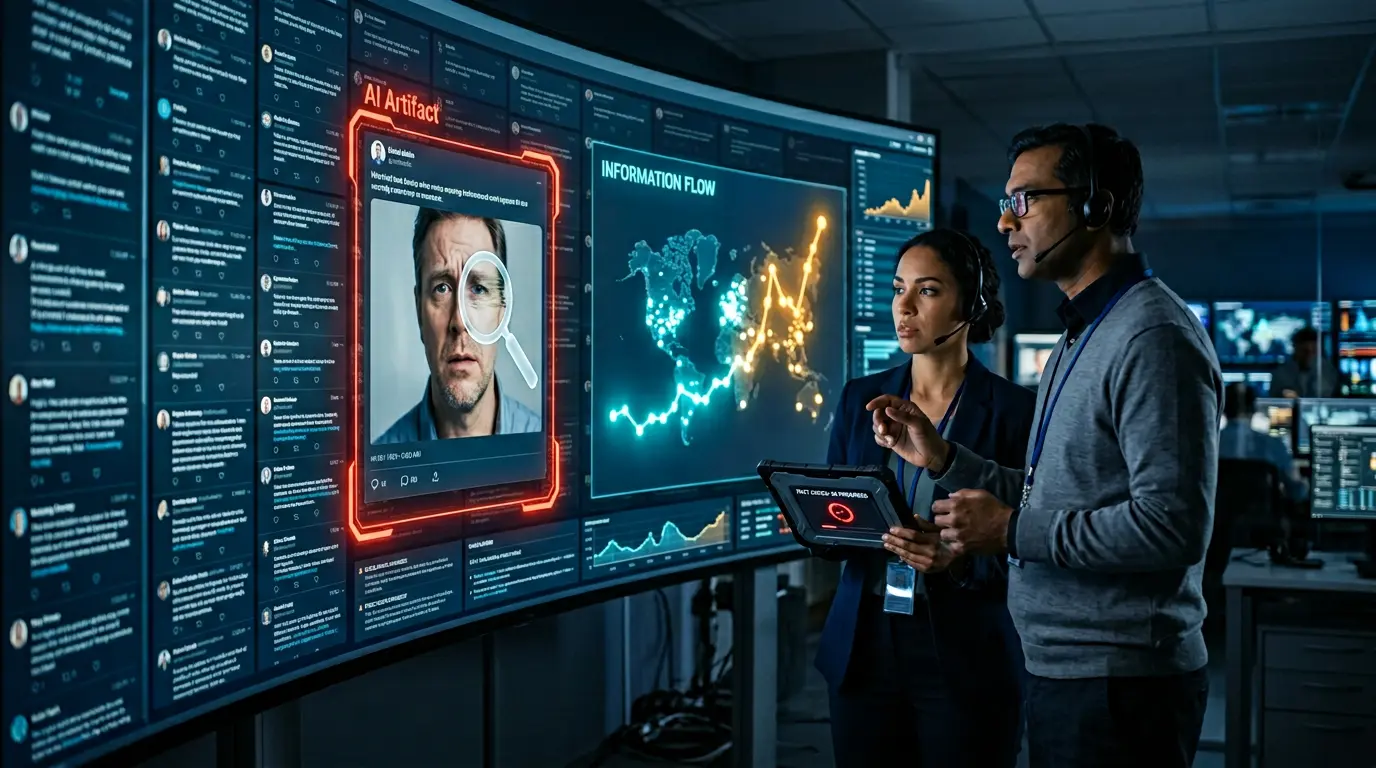
🎭 Only 0.1% of people in a 2025 iProov study correctly identified all fake and real media shown to them — and a convincing 60-second deepfake video can now be created in 25 minutes at zero cost. This guide covers how to spot AI-generated deepfakes, fake images, and AI-generated fake news in 2026 — with the detection tools that actually work, the real-world cases that define the threat, the TAKE IT DOWN Act and NO FAKES Act explained, and a practical verification protocol for individuals and organizations.
Last Updated: May 27, 2026
AI-generated misinformation has crossed a threshold in 2026 that fundamentally changes the relationship between citizens and information. Deepfake files surged from 500,000 in 2023 to a projected 8 million in 2025 — a 16-fold increase in two years that reflects both the democratization of synthesis tools and the explosion of use cases ranging from corporate fraud to political manipulation. Human detection rates for high-quality video deepfakes are just 24.5%, and a 2025 iProov study found that only 0.1% of participants correctly identified all fake and real media shown to them. The asymmetry this creates is not a minor inconvenience — it is an epistemic crisis. Deepfakes don’t just introduce falsehoods into our information ecosystem — they erode the very mechanisms by which societies construct shared understanding. The World Economic Forum’s March 2026 analysis of AI disinformation describes the threat as one of compound risk: the volume of synthetic media is accelerating exactly when trust in authentic media is declining, creating an environment where neither false nor true content is believed reliably.
This article covers the full picture of AI misinformation and deepfake detection in 2026. You will learn the mechanics of how deepfakes are made and why human detection is so unreliable, how AI-generated fake news differs from traditional misinformation and why it is harder to detect, what the real-world incidents from corporate fraud to election interference look like in practice, which detection tools work and under what conditions, and what the regulatory landscape looks like after the TAKE IT DOWN Act took effect and the NO FAKES Act advanced in Congress. Most importantly, you will get a practical verification protocol — a step-by-step approach to evaluating media authenticity — that works for both individuals and organizations without requiring forensic expertise.
Whether you are a professional responsible for your organization’s media security, a journalist evaluating source authenticity, an educator building digital literacy programs, or a citizen trying to navigate an information environment where synthetic media is now ubiquitous, this guide delivers current data, named tools, and practical frameworks. Our companion guide to Digital Provenance and Content Credentials covers the C2PA authentication standard that is emerging as the technical infrastructure for verifying media authenticity at scale.
For journalists and newsroom teams using AI as a professional workflow tool — for transcription, research, and content repurposing — our guide to AI in Media and Journalism covers the specific applications and guardrails that matter for working reporters and editors in 2026.
📖 New to AI terminology? Visit the AI Buzz AI Glossary — 65+ essential AI terms explained in plain English, each linking to a full in-depth guide.
1. 📊 The Scale of the Problem: AI Misinformation in 2026 by the Numbers
In Q2 2025, Resemble tracked 487 discrete deepfake incidents — an increase of 312% year-over-year and 41% from the previous quarter. A deepfake attempt occurred every five minutes in 2024 — a rate that subsequent tracking suggests has accelerated in 2025 and 2026 as synthesis tools became freely accessible. Fraud losses in the U.S. facilitated by generative AI are projected to climb from $12.3 billion in 2023 to $40 billion by 2027, with a compound annual growth rate of 32%, according to the Deloitte Center for Financial Services. Losses in North America exceeded $200 million in the first quarter of 2025 due to deepfake fraud. These numbers describe not a future threat but a present operational reality that is already affecting businesses, democratic institutions, and individuals at scale.
Analysts expect the deepfake detection market to grow 42% annually, rising from $5.5 billion in 2023 to $15.7 billion in 2026 — a market size that reflects the commercial recognition of detection as essential infrastructure rather than optional protection. Just 13% of companies have anti-deepfake protocols, and only 11% of individuals conduct critical source analysis to verify potentially fake information. The gap between the scale of the threat and the level of organizational preparedness is one of the defining risk management failures of the AI era. 71% of people worldwide do not know what deepfakes are — a figure that includes a significant proportion of the business professionals, voters, and consumers who are the primary targets of deepfake fraud and misinformation campaigns. Awareness is the prerequisite for defense, and awareness remains critically low.
Voice cloning now requires only 20–30 seconds of audio to produce a convincing replica of a target’s voice, and a convincing 60-second deepfake video can be created in under 25 minutes at zero cost using freely available tools. The collapse in production cost and time is the structural driver of the volume surge. When creating a sophisticated deepfake required specialized technical expertise and significant computational resources, the threat was limited to well-resourced actors. When creating a convincing deepfake requires 25 minutes and a smartphone, the threat is effectively unlimited in scope. Deepfakes have crossed a critical threshold in 2026 — they have improved and eliminated earlier tell-tale glitches and are now accessible to anyone with a smartphone. The “uncanny valley” artifacts that made earlier deepfakes detectable to attentive viewers — irregular blinking, unnatural skin texture, misaligned lighting — have been largely eliminated by the current generation of synthesis models.
The Three Categories of AI Misinformation
Understanding the AI misinformation threat requires distinguishing three distinct categories that have different mechanics, different detection approaches, and different governance implications. The first is deepfake media — AI-synthesized or AI-manipulated video, audio, and images that depict real people doing or saying things they never did. This is the category that generates the most media coverage and the most legislative attention. The second is AI-generated fake text — fabricated news articles, social media posts, synthetic reviews, and disinformation content written by large language models at a volume and linguistic quality that overwhelms manual fact-checking capacity. The third is synthetic identity and contextual manipulation — AI-generated documents, fabricated research citations, composite personas assembled from real data, and the manipulation of authentic content through selective editing, false context, and misleading framing. Each category requires different detection strategies and creates different organizational risks. Organizations that address only deepfake video while remaining blind to AI-generated text and synthetic identity fraud have addressed the most visible category while leaving the most commercially significant vectors unprotected.
2. 🎬 How Deepfakes Work: The Technology Behind Synthetic Media
Understanding how deepfakes are created is the foundation for understanding why they are difficult to detect and which detection approaches can work. The technical literacy to recognize a deepfake does not require a computer science degree — but it does require a basic understanding of the mechanisms that produce them, because those mechanisms leave specific traces that both human observation and automated detection tools can learn to identify.
Modern deepfake video is primarily produced using diffusion models and Generative Adversarial Networks (GANs) — architectures that learn to generate synthetic content by training on large datasets of authentic video and images. In a face-swap deepfake, the model learns the facial geometry, texture, and motion patterns of a target individual and then transfers those patterns onto a source video. In a full-body generation deepfake, the model generates an entirely synthetic person or scene from a text or image prompt. In a face-reenactment deepfake, the model maps the expressions and movements of a source person onto the face of a target, enabling a small amount of source video to drive the synthetic performance of the target. Each approach leaves different types of artifacts — inconsistencies in lighting, texture, motion continuity, physiological signals like pulse-driven micro-movements, and compression patterns — that detection systems are trained to identify.
Voice cloning works differently from video deepfakes, relying on neural vocoder models that learn to replicate a speaker’s acoustic characteristics — pitch, rhythm, timber, and speech patterns — from a short audio sample. Voice cloning is the top attack vector: cheap, fast, and convincing. The commercial deployment of voice cloning in fraud attacks has outpaced both public awareness and organizational defense. 70% of people said they aren’t confident they can tell the difference between a real and cloned voice. The practical implication for organizations is that any workflow involving voice-based authorization — wire transfer approval, access control, identity verification — requires additional verification layers that do not rely on voice recognition alone as the authentication mechanism.
The Liveness Problem: The fundamental detection challenge in 2026 is that deepfake models are trained on detection failures — when a deepfake is detected and the detection signal is fed back to the generation model, the model learns to produce content that avoids that specific artifact. This creates a co-evolutionary arms race where detection tools and generation tools continuously improve against each other. Advanced multi-modal detection systems achieve 94–96% accuracy under controlled conditions, but widely available detection technology catches only about 65% of deepfakes in real-world deployment. The gap between controlled accuracy and real-world accuracy reflects how quickly generation models adapt to detection signals that are publicly available.
AI-Generated Fake Text: The Higher-Volume Threat
While deepfake video generates the most public alarm, AI-generated fake text is the higher-volume, more commercially impactful threat in 2026. Large language models can generate syntactically convincing, topically coherent fake news articles, social media posts, product reviews, and research citations at a rate that no human fact-checking operation can match. The specific challenge of AI-generated text is that it does not have the equivalent of a face-swap artifact — there is no pixel-level inconsistency that a detector can identify. The “tells” in AI-generated text are statistical and stylistic, which means detection relies on pattern analysis rather than artifact identification, and those patterns shift as models are updated. Less than 1% of all fact-checked misinformation during the 2024 election cycles was AI content — a finding that should be read not as evidence that AI text misinformation is rare, but as evidence that human fact-checking infrastructure was not specifically adapted to detect AI-generated content during those cycles.
3. 🗳️ Real-World Incidents: Deepfakes in Elections, Finance, and Personal Harm
The academic and theoretical dimensions of deepfake risk are reinforced by a growing catalogue of documented real-world incidents that illustrate what the threat looks like in operational contexts. These incidents are not isolated events — they are data points in a trend that shows deepfake deployment moving from isolated high-profile cases toward industrialized, routine exploitation across multiple sectors simultaneously.
The most commercially significant documented deepfake fraud case involves Arup, the global engineering firm. In February 2024, a finance worker at Arup was tricked into wiring $25 million due to a deepfake video conference call. The worker attended what appeared to be a legitimate video meeting with colleagues, including a convincing synthetic version of the company’s CFO, and authorized the transfer based on instructions given during the call. The case is significant not just for its financial scale but for its operational sophistication: it was not a simple voice-cloned phone call but a multi-person, real-time deepfake video conference — a capability that most organizations had not contemplated as an attack vector when designing their authorization procedures. CEO fraud now targets at least 400 companies per day using deepfakes — a rate that confirms the Arup case was not an isolated experiment but a proof-of-concept that has since been industrialized.
In the political domain, the 2025–2026 electoral cycle has produced documented deepfake interventions across multiple democracies. In Ireland’s 2025 presidential election, a deepfake video falsely depicted the eventual winner withdrawing his candidature, and included fake footage of national broadcasters “confirming” the news. This was released just days before polling day. The Netherlands likewise saw roughly 400 AI-generated synthetic images used to attack political counterparts. Celebrities were targeted 47 times in Q1 2025, an 81% jump over the total in 2024. Politicians were impersonated 56 times in Q1 2025. With the 2026 U.S. midterm elections approaching, research shows 58% of U.S. adults expect synthetic lies to escalate before ballots are cast.
The Liar’s Dividend: Just knowing deepfakes exist can make us doubt things we read and see — even the truth. This is what researchers call the “liar’s dividend” — the secondary harm of deepfake proliferation is not just that false content is believed, but that authentic content is disbelieved. A politician can dismiss a genuine video of misconduct as “probably a deepfake.” A criminal can argue that authentic evidence of their crime is synthetic. The erosion of evidential trust is a harm that compounds across every use of authentic media in institutional contexts — courts, journalism, regulatory enforcement, and democratic accountability all depend on the assumption that authentic media can be authenticated. Deepfake proliferation attacks that assumption directly.
Personal Harm: The Non-Consensual Intimate Imagery Crisis
The most widespread personal harm from deepfake technology involves non-consensual intimate imagery (NCII) — AI-generated sexually explicit content depicting real people without their consent. In 2025, 38% of reported deepfake incidents occurred in North America, led by the U.S. AI-generated sexual images of Taylor Swift reached 47 million views before removal — a single incident that illustrated both the scale of reach and the inadequacy of platform moderation response times. In 2025 alone, state lawmakers introduced almost 150 bills related to deepfakes, addressing a range of issues from political misinformation to impersonation of real people. The legislative response has been rapid by historical standards, driven by the severity and visibility of the harm — but legislative pace still lags the deployment of the technology causing the harm.
🔒 Building an AI governance framework? Browse the AI Buzz Governance & Security Hub — 30+ in-depth guides covering OWASP, NIST, ISO 42001, AI risk management, and enterprise AI security frameworks.
4. 🔍 Detection Tools and Methods: What Actually Works in 2026
The deepfake detection landscape in 2026 is maturing rapidly — but the gap between controlled-environment accuracy and real-world deployment effectiveness remains the central challenge for organizations building detection capabilities. The best AI image detection solutions in 2026 combine multiple detection methods, including forensic analysis, biological signal detection, and deep learning classification to provide comprehensive protection against visual misinformation. The key insight for practitioners is that no single detection method provides reliable protection against the full range of synthetic media attacks — a layered, multi-modal approach is the minimum viable standard for any organization handling media where authenticity matters.
The most effective detection methodology in 2026 is multi-modal cross-verification. The most advanced deepfake detection methods in 2026 don’t analyze audio or video in isolation — they cross-reference both simultaneously. A synthetic call may have authentic video but cloned audio, or vice versa. Multi-modal detection catches inconsistencies between lip-sync timing, environmental audio, background visuals, and lighting direction — dramatically reducing the false negative rate. For video deepfakes specifically, temporal consistency analysis — examining how facial features, lighting, and background elements behave across the full sequence of frames rather than in individual snapshots — is the most reliable detection approach, because synthesis models that produce convincing single frames often produce detectable inconsistencies when their output is analyzed as a sequence.
Content credentials and provenance verification represent the architectural approach to the detection problem that has the most long-term promise. Rather than attempting to detect manipulation after the fact, provenance systems embed cryptographic authentication into media at the point of creation — creating a verifiable chain of custody that can be checked at any downstream point. NIST’s AI standards work includes provenance and traceability as core requirements for trustworthy AI systems. Google’s SynthID watermarking tool tags AI-generated content at generation time, though adversaries simply migrate to unmarked open-source models — confirming that watermarking alone cannot solve the detection problem as long as unwatermarked synthesis tools remain freely accessible. Our guide to Digital Provenance, Content Credentials, and C2PA covers the full technical architecture of content authentication in detail.
Detection Tools by Category and Use Case
Detection tools in 2026 fall into four practical categories that serve different use cases and organizational contexts. Enterprise identity verification platforms — including Sensity AI, Reality Defender, and deepidv — provide API-accessible, high-accuracy detection specifically optimized for identity fraud prevention in onboarding, financial authorization, and access control workflows. These platforms achieve the highest accuracy figures in real-world deployment and are the appropriate choice for any organization where deepfake fraud carries direct financial liability. Organizations rely on these systems to prevent impersonation attacks, safeguard communications, and reduce exposure to synthetic media risks.
Consumer and professional media verification tools — including Deepware Scanner, Microsoft Video Authenticator (where available), and browser-based detection extensions — provide accessible first-line detection for journalists, researchers, and individuals evaluating specific pieces of content. These tools are valuable for spot-checking but should not be treated as authoritative verification for high-stakes decisions. When selecting an AI image detection tool, consider accuracy requirements, volume needs, integration capabilities, cost considerations, and technical expertise requirements. Platform-level detection systems — deployed by Meta, Google, TikTok, and YouTube at the scale of billions of posts per day — use a combination of automated detection, watermark verification, and reporter-flagged review to identify and label or remove synthetic media. These systems reduce the volume of harmful deepfakes that reach large audiences but cannot prevent the viral spread that often occurs in the first hours before detection.
The Practical Verification Protocol: Six Steps for Evaluating Media Authenticity
For individuals and organizations that need to evaluate media authenticity without access to enterprise detection platforms, a systematic verification protocol delivers substantially better outcomes than intuition-based assessment. Step 1: Reverse image or video search — check whether the content appears in its claimed original context on authoritative sources, or whether it appears elsewhere in a different context that suggests manipulation. Step 2: Check the source — evaluate the credibility and track record of the account, publication, or channel sharing the content, and assess whether the claimed source matches the apparent production quality and context. Step 3: Look for artifact indicators — check for unnatural blinking patterns, skin texture inconsistencies, hair and ear rendering (historically difficult for synthesis models), lighting direction mismatches between foreground and background, and audio-visual synchronization. Step 4: Cross-reference with established outlets — if the event depicted in the content is real and significant, it should appear in multiple authoritative sources with corroborating evidence. Step 5: Use a detection tool — run the content through a reputable detection tool, interpreting the result as one input among several rather than a definitive verdict. Step 6: Apply the “viral urgency” test — manipulative synthetic media is systematically designed to create emotional urgency that bypasses critical evaluation. Content that makes you feel you must share it immediately before confirming its authenticity deserves the most rigorous scrutiny.
5. ⚖️ The Legal Landscape: TAKE IT DOWN Act, NO FAKES Act, and the 2026 Regulatory Framework
The legal framework governing AI-generated misinformation and deepfakes has advanced more rapidly in 2025–2026 than in any previous year — driven by the visibility of documented harms, bipartisan political consensus around specific categories of harm, and the 2026 midterm election cycle creating urgency around political deepfake regulation. Understanding what the law currently requires, what it does not cover, and where the gaps remain is essential for both compliance planning and for understanding the limits of legal protection.
The federal TAKE IT DOWN Act, signed into law in May 2025, provides the first nationwide framework for addressing intimate deepfakes, with platform compliance requirements now in effect as of May 19, 2026. The Act criminalizes the intentional online publication of non-consensual intimate visual depictions of an identifiable person, including depictions that are authentic or AI-generated. It also imposes civil obligations on websites and online platforms to remove such content within 48 hours of notice from a victim. The TAKE IT DOWN Act is the first federal law that limits the use of AI in ways that can be harmful to individuals. The FTC oversees platform compliance, with violations treated as unfair or deceptive trade practices with civil penalties of up to $53,088 per violation. FTC Chairman Andrew Ferguson sent formal warning letters to more than a dozen major platforms, including Meta, Apple, Microsoft, TikTok, Reddit, Snapchat, and X, signaling the agency’s intent to actively investigate and enforce the law.
The NO FAKES Act — reintroduced in 2026 with bipartisan support — would go further than the TAKE IT DOWN Act by establishing a federal intellectual property right to one’s own voice and likeness, creating causes of action against the creators, distributors, and platforms that enable unauthorized digital replicas. Polling confirms that 92% of Americans are concerned about the impact of AI deepfakes on their neighbors and culture, with near-total support for a federal law that protects voice and likeness. As artificial intelligence rapidly evolves, unauthorized digital replicas, manipulated videos, voice cloning, and deceptive deepfakes are becoming more sophisticated and more difficult to detect. The NO FAKES Act would create clear federal guardrails to protect Americans from exploitation, fraud, and digital impersonation while preserving innovation, responsible AI development, and First Amendment protections.
State Laws and the Electoral Deepfake Battleground
Deepfake legislation has expanded rapidly across the United States, with 46 states having enacted laws targeting AI-generated synthetic media as of spring 2026. 30 states have enacted laws specifically addressing deepfakes in political communications, up from 28 at the start of the year, ahead of the 2026 midterms. Most laws focus on disclosure requirements rather than outright bans, requiring political advertisements containing AI-generated content to include clear disclaimers such as: “This ad was generated or substantially altered using artificial intelligence.” The California AI Transparency Act (effective January 2026) reinforces these requirements in the highest-profile state market, adding consumer-facing disclosure obligations for AI-generated content that intersect with the political advertising requirements. For organizations creating political content or operating platforms that carry political advertising, the patchwork of state disclosure requirements has become a compliance management challenge requiring jurisdiction-by-jurisdiction tracking.
The EU’s response to AI misinformation is channeled through the Digital Services Act (DSA), which imposes systematic risk assessment obligations on very large online platforms for “systemic risks” including the dissemination of illegal content and disinformation. The EU AI Act’s provisions on manipulative AI practices — systems that use subliminal techniques or exploit vulnerabilities — are directly applicable to AI systems used to generate or distribute disinformation at scale. The EU Democracy Shield, announced in 2025, links AI liability to existing Digital Services Act mandates and creates additional requirements for platforms operating during election periods. Our EU AI Act guide covers the full compliance framework including the provisions most relevant to synthetic media and misinformation.
6. 🏢 Enterprise Defenses: Protecting Your Organization From Deepfake Fraud
Enterprise protection against deepfake fraud requires a combination of technical controls, procedural safeguards, and employee training — because no single layer provides adequate protection against an attack surface that includes video, audio, text, and identity fraud simultaneously. The Arup $25 million wire fraud case is the reference architecture for enterprise deepfake defense planning: the attack succeeded not because no detection technology existed, but because the organization’s authorization procedures did not require verification beyond what the synthetic video conference provided.
The highest-return enterprise defense investment is procedural rather than technological: establishing out-of-band verification requirements for all high-value authorizations. Any request for wire transfer, credential access, sensitive data disclosure, or contractual commitment that arrives through any digital channel — email, video call, voice call, messaging platform — should require verification through a separate, pre-established communication channel before execution. This “callback protocol” does not require technology investment and defeats the vast majority of deepfake-enabled business email compromise and CEO fraud attacks, because the attacker cannot simultaneously control the synthesis channel and the pre-established verification channel. If you suspect a deepfake attack: do not act on the instruction. Verify independently through a pre-established channel. Report to your security team, and if synthetic media of your organization exists publicly, contact a specialized deepfake detection service immediately.
Only 13% of companies have anti-deepfake protocols — which means 87% of organizations have not yet codified the procedural safeguards and technical controls needed to protect against an attack vector that is targeting 400 companies per day. For enterprises building a deepfake defense program, the minimum viable framework includes four elements: a documented callback protocol for high-value authorizations; employee training covering how to recognize the social engineering signals that accompany deepfake attacks (urgency, confidentiality requirements, unusual communication patterns); an approved set of detection tools integrated into media verification workflows; and an incident response procedure specific to deepfake and synthetic identity fraud. Our AI Incident Response guide covers the broader incident response framework that deepfake fraud response sits within.
Training Employees to Recognize What They Cannot See
Employee training for deepfake defense requires a conceptual shift from traditional cybersecurity training: the goal is not to train employees to spot deepfakes visually — because visual detection is unreliable even for trained professionals with high-quality tools. The goal is to train employees to recognize the procedural and contextual signals that accompany deepfake-enabled attacks: requests for urgency that bypass normal authorization procedures, instructions to maintain confidentiality about a request before it is verified, communication patterns that deviate from a person’s established norms, and any request arriving through digital channels that involves authorization without independent verification. These behavioral and contextual signals are detectable by trained employees even when the synthetic media itself is visually indistinguishable from authentic content — making them a more reliable and more durable defense than visual detection training alone. The EU AI Act’s Article 4 AI literacy requirement mandates that organizations ensure staff have sufficient AI literacy for their roles — and deepfake awareness is a core component of the AI literacy that any employee interacting with digital communications needs in 2026.
7. 🔮 Where This Is Heading: The 2026 to 2028 Trajectory
The trajectory of AI-generated misinformation through 2028 is shaped by the same technological acceleration and governance lag dynamic that defines most AI risk categories. Generation quality will continue to improve, production costs will continue to fall, and access will continue to democratize. The detection arms race will continue, with each improvement in generation models requiring corresponding improvements in detection systems. The regulatory response will continue to expand, but will remain jurisdiction-fragmented and will continue to lag the deployment of the technology it is trying to govern.
With 2026 densely packed with elections across continents, and particular nations at risk of irreparable democratic backsliding, the speed and scale of synthetic media is a compounding risk. Evidence from the 2024–2025 electoral cycle shows how AI systems optimized content for maximum emotional impact across multiple countries. The 2026 U.S. midterm elections will be the most significant test yet of whether platform detection systems, regulatory disclosure requirements, and media literacy infrastructure can collectively manage the deepfake threat in a high-stakes democratic context. The outcome of that test will shape both the regulatory response and the platform investment decisions that determine the detection landscape through 2028.
The most important structural shift in the medium-term trajectory is the potential mainstreaming of content credentials as a default feature of media creation tools. If major camera hardware manufacturers, video editing platforms, and social media apps implement C2PA-compliant content credentials by default, the provenance-based verification approach becomes increasingly effective — because the absence of credentials becomes a meaningful signal of potential manipulation, rather than just the absence of authentication. Several major technology companies including Adobe, Microsoft, and Google have committed to C2PA implementation across their creative tools, and the coalition is expanding. Whether this commitment translates into the near-universal adoption needed to make credentials-absence a reliable signal depends on whether major platforms enforce credentials requirements for content distribution — a policy decision that no single company has yet made unilaterally.
8. 🏁 Conclusion: Verification Is the New Media Literacy
The ability to distinguish authentic from synthetic media has become a foundational digital literacy skill — as essential in 2026 as the ability to evaluate source credibility was in the era of web-based misinformation, and the ability to recognize propaganda was in the era of broadcast media. The difference is that the current challenge is harder, because the synthesis tools are better, the production costs are lower, the distribution channels are faster, and the human detection capability is, as the research documents, barely above chance for high-quality deepfakes. The response cannot be “trust your instincts” — the instincts were calibrated in an era when authentic media looked different from fabricated media, and that distinction has been substantially eroded.
The practical response is the combination of verification infrastructure and behavioral safeguards described in this article. Use detection tools — imperfect as they are — as one input among several. Apply the six-step verification protocol before acting on media that carries consequential implications. Build out-of-band verification into your organization’s authorization procedures before a deepfake fraud attempt tests them. Support the policy frameworks — TAKE IT DOWN, NO FAKES, C2PA adoption — that are building the legal and technical infrastructure for media accountability. And invest in the AI literacy that allows everyone in your organization to understand that seeing is no longer believing — and that the most important question to ask about any piece of media in 2026 is not “does this look real?” but “can I verify this through a source I established before I needed it?”
| Threat Type | How It Works | Key 2025–2026 Evidence | Best Detection Approach | Primary Defense |
|---|---|---|---|---|
| Deepfake Video | GAN/diffusion face-swap or full generation | 8M files projected 2025; 312% YoY incident surge; 24.5% human detection rate | Multi-modal AI detection + temporal analysis | Out-of-band verification before acting |
| Voice Cloning | Neural vocoder trained on 20–30 second audio sample | CEO fraud targeting 400+ companies daily; Arup $25M fraud via deepfake video call | Audio analysis tools + biological signal detection | Callback protocol; never authorize via voice alone |
| Political Deepfakes | Synthetic video/audio of candidates and officials | Ireland 2025 election interference; 82 cases in 38 countries 2023–2024; 56 politician impersonations Q1 2025 | Reverse search + multi-source corroboration | Verify through official channels; check disclosure labels |
| AI-Generated Fake Text | LLM-generated articles, posts, fake citations | Less than 1% fact-checked in 2024 elections; scale exceeds manual review capacity | Statistical pattern analysis; source corroboration | Six-step verification protocol; lateral reading |
| Non-Consensual Intimate Imagery | AI face-swap onto explicit content without consent | Taylor Swift 47M views before removal; 150 state bills in 2025; TAKE IT DOWN Act signed May 2025 | Detection tools + platform reporting systems | TAKE IT DOWN Act 48-hour takedown request |
| Synthetic Identity Fraud | AI-generated documents and identity composites | 311% increase in synthetic identity document fraud Q1 2024–Q1 2025 (Sumsub); deepfakes = 40% of biometric fraud | Multi-modal enterprise identity verification platforms | Liveness detection + document + face verification |
| Real-Time Meeting Deepfakes | Live-rendered synthetic participants in video calls | Arup case; Gartner: 30% of enterprises will not rely on identity verification alone by 2026 | Real-time meeting analysis tools; behavioral cues | Pre-shared codeword verification; out-of-band confirm |
| Disinformation at Scale | AI-optimized content targeting emotional manipulation | WEF March 2026: AI optimized for emotional impact across multiple countries in 2024–2025 cycle | Platform detection + fact-checking partnerships | Media literacy; lateral reading; pause before sharing |
📌 Key Takeaways
| Takeaway | |
|---|---|
| ✅ | Deepfake files surged from 500,000 in 2023 to a projected 8 million in 2025 — a 16-fold increase in two years — driven by collapsing production costs: a convincing 60-second deepfake video can now be created in 25 minutes at zero cost using freely available tools. |
| ✅ | Human detection rates for high-quality video deepfakes are just 24.5%, and a 2025 iProov study found that only 0.1% of participants correctly identified all fake and real media shown to them — confirming that visual intuition is not a reliable defense against current-generation synthetic media. |
| ✅ | AI fraud losses in the U.S. are projected to reach $40 billion by 2027 (Deloitte), with CEO fraud now targeting over 400 companies per day using deepfakes — making enterprise procedural defenses (out-of-band verification, callback protocols) more urgent than technology investment alone. |
| ✅ | Advanced multi-modal detection systems achieve 94–96% accuracy in controlled conditions but only 65% accuracy in real-world deployment — requiring layered defenses that combine automated detection, provenance verification, and procedural safeguards rather than relying on any single tool. |
| ✅ | The TAKE IT DOWN Act (signed May 2025, platform compliance effective May 19 2026) is the first U.S. federal law targeting AI-powered harm — requiring platforms to remove non-consensual intimate deepfakes within 48 hours of notice, with FTC enforcement and civil penalties up to $53,088 per violation. |
| ✅ | 46 states have enacted deepfake laws and 30 states have election deepfake protections as of spring 2026, while the NO FAKES Act advancing in Congress would establish federal voice and likeness rights — with 92% of Americans supporting a federal law protecting personal identity from AI exploitation. |
| ✅ | The “liar’s dividend” — where deepfake awareness causes people to doubt even authentic media — compounds the harm beyond false content being believed: politicians, criminals, and bad actors can dismiss genuine evidence as “probably a deepfake,” eroding the evidentiary trust that democratic and legal accountability depends on. |
| ✅ | Only 13% of companies have anti-deepfake protocols despite CEO fraud targeting 400+ companies daily — the minimum viable enterprise defense is a documented callback protocol for high-value authorizations, employee training on contextual warning signs, and detection tools integrated into media verification workflows. |
🔗 Related Articles
- 📖 Digital Provenance Explained: How to Verify What’s Real Online (Content Credentials, C2PA, and AI Watermarking)
- 📖 AI in Geopolitics and Information Warfare: Spotting Deepfakes and Propaganda in Global Conflicts
- 📖 AI Watermarking vs. Metadata vs. Fingerprinting: How We Will Track Fake Content in the Future
- 📖 Agentic Phishing: Why AI Scams Beat Your Defenses (2026)
- 📖 AI Governance Explained: How to Build an AI Policy Framework Your Organization Will Actually Follow
❓ Frequently Asked Questions: AI Deepfakes and Misinformation
1. Can I reliably spot a deepfake video just by watching it carefully?
No — human detection rates for high-quality video deepfakes are just 24.5%, and a 2025 iProov study found only 0.1% of participants correctly identified all fake and real media. Visual inspection alone is unreliable for current-generation deepfakes. Use the six-step verification protocol and detection tools as complements to visual assessment. Our Digital Provenance guide covers the content credentials standard that enables machine-verified authenticity.
2. What should I do if I receive a deepfake of someone in my organization or of myself?
Document everything — screenshots, URLs, timestamps. If it is intimate or harmful content, submit a takedown request under the TAKE IT DOWN Act to the hosting platform (48-hour removal requirement). Report to your security team and consider contacting law enforcement. Consult an attorney if the content is defamatory or constitutes fraud. Our AI Incident Response guide covers the broader incident response process.
3. How does the TAKE IT DOWN Act differ from the NO FAKES Act?
The TAKE IT DOWN Act (signed May 2025, enforcement effective May 2026) specifically addresses non-consensual intimate deepfakes — criminal penalties for publishing them and platform takedown obligations. The NO FAKES Act (advancing in Congress in 2026) would be broader — establishing a federal IP right to your voice and likeness covering any unauthorized digital replica, including in commercial and political contexts. Our AI Regulation in 2026 guide covers both laws in the full regulatory context.
4. What is the most effective enterprise defense against deepfake-enabled financial fraud?
Procedural defense outperforms technology: establish a callback protocol requiring out-of-band verification for all high-value authorizations regardless of how legitimate the initiating communication appears. The Arup $25M fraud succeeded because no callback procedure was required. Technology complements this — detection tools, liveness verification, and AI-powered fraud monitoring — but the procedural layer defeats the majority of deepfake BEC attacks without requiring any technology investment. Our AI and Cybersecurity guide covers the broader enterprise threat landscape.
5. Are content credentials (C2PA) a complete solution to the deepfake problem?
No — they are an important part of a layered solution but not a complete one. C2PA credentials verify that content was created by a specific tool or device and has not been modified since — but only if the creation tool embeds credentials. Deepfakes created with unwatermarked open-source tools will not carry credentials. The practical value of credentials increases as adoption by creation tools and distribution platforms grows. Our Digital Provenance guide covers the C2PA standard and its limitations in full detail.
📧 Get the AI Buzz Weekly Digest
Weekly AI insights, tools, and strategies — delivered every Monday. Free.




Leave a Reply