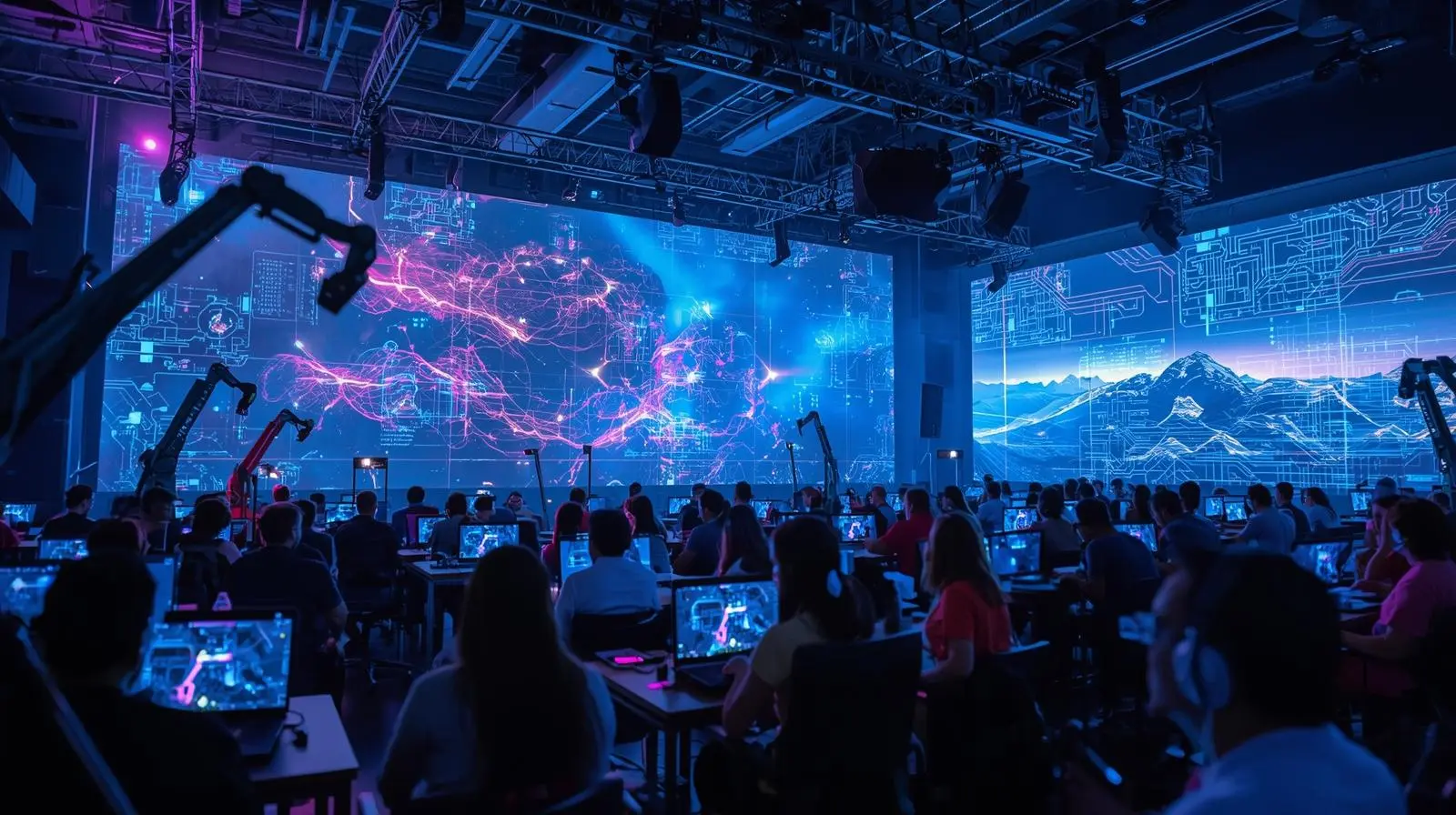
🎬 AI is rewriting how entertainment is made, distributed, and experienced — and the dollars flowing into it prove this is not hype. This guide covers how AI is transforming filmmaking, music production, gaming, streaming personalization, content moderation, and the creative workforce — with 2026 market data, real studio deployments, and an honest look at the copyright and labor tensions shaping the industry.
Last Updated: May 24, 2026
Entertainment is one of the industries where AI in entertainment is moving fastest and generating the most public debate — because the outputs are visible to everyone. When Netflix acquires an AI filmmaking startup, when Disney licenses 200 characters to an AI video platform, when a deepfake of a living actor goes viral, when a music track generated by AI accumulates millions of streams, the public sees it immediately and reacts. The AI in media and entertainment market grew from $28.32 billion in 2025 to $35.77 billion in 2026 at a compound annual growth rate of 26.3%. That growth rate — significantly faster than the entertainment industry overall — reflects a technology that has moved from research labs and conference demos into the operational core of how studios, platforms, and creators work. McKinsey’s technology, media, and telecommunications research consistently identifies AI as the primary force reshaping content economics across every segment of the entertainment value chain.
This article covers the full picture of AI in entertainment in 2026. You will learn how AI is transforming film and television production — from pre-production planning through virtual effects and localization. You will see how music production, streaming recommendation engines, gaming experiences, and content moderation are all being reshaped by machine learning, computer vision, and generative AI. You will also get an honest assessment of the tensions driving the industry’s most important debates: the copyright status of AI-generated content, the labor displacement risks that prompted Hollywood’s historic strikes, the deepfake threat to performers’ likenesses, and the consumer trust challenges that determine whether audiences accept or reject AI-created media.
Whether you work in media production, manage creative teams, invest in entertainment technology, or simply want to understand how the content you consume is changing, this guide delivers current data and practical context. Every concept is explained in plain English — no film school or engineering background required. By the end, you will have a clear framework for understanding where AI is delivering proven value in entertainment, where it is generating legitimate concern, and what the industry landscape looks like heading into the second half of 2026.
📖 New to AI terminology? Visit the AI Buzz AI Glossary — 65+ essential AI terms explained in plain English, each linking to a full in-depth guide.
1. 📈 The 2026 Landscape: AI in Entertainment by the Numbers
The scale of AI investment in entertainment has reached a level that makes it impossible to treat as a peripheral technology experiment. The global AI in media and entertainment market size was estimated at USD 25.98 billion in 2024 and is projected to reach USD 99.48 billion by 2030, growing at a CAGR of 24.2% from 2025 to 2030. Within this market, the personalization application held approximately 27% of market share in 2025, confirming that recommendation engines and audience analytics remain the largest single use case — but content creation, virtual production, and automated moderation are growing faster and attracting the most strategic attention from studios and platforms in 2026.
North America leads the global industry, accounting for a share of 33.6% in 2024, driven by the concentrated presence of major studios, streaming platforms, and technology companies that set the pace for AI adoption across the entertainment value chain. The U.S. market benefits from a uniquely dense cluster of AI capability and entertainment production infrastructure — the same region that houses Hollywood, Silicon Valley, and the headquarters of every major streaming platform also houses the AI research labs developing the tools those platforms are deploying. The generative AI in media and entertainment market size is expected to increase from USD 2.24 billion in 2025 to USD 21.2 billion by 2035 — a tenfold expansion that reflects the shift from AI being used primarily for analytics and recommendation to AI being used directly in content creation, production, and post-production workflows.
The investment signals from the industry’s largest companies reinforce this trajectory. Disney and OpenAI struck a $1 billion, three-year partnership, licensing more than 200 characters from Disney, Marvel, Pixar, and Star Wars properties for use in OpenAI’s Sora AI video generator. Netflix acquired InterPositive — a filmmaker-built AI startup — on March 5, 2026, bringing AI production technology in-house rather than licensing it from a third party. These are not pilot programs — they are strategic commitments that reshape how content gets made, distributed, and monetized at the highest levels of the industry.
Where the Investment Is Concentrated
Growth in the historic period can be attributed to growth of digital content platforms, expansion of streaming services, rising demand for personalized content, adoption of animation software, and investment in digital media. What is shifting in 2026 is the distribution of that investment across the production pipeline. Deloitte research found that major studios expected to direct less than 3% of production budgets toward generative AI tools for content creation in 2025, favoring AI for operational functions like marketing, localization, and contract management instead. Netflix’s InterPositive acquisition and Disney’s Sora partnership represent a deliberate move up the value chain — from using AI for operational efficiency to using AI as a creative production tool. That distinction matters commercially because the budget line items for creative production are an order of magnitude larger than the budget for marketing automation.
The Generative AI Segment: Speed and Scale
By content type, the video generation segment is expected to grow at the fastest CAGR during the forecast period, reflecting the enormous commercial potential of tools that reduce the cost and time required to produce visual content. In 2026, OpenAI launched Sora Studio, enabling broadcasters to generate 4K AI videos from text and image prompts within minutes. Discovery Networks adopted the platform for multilingual promotional content generation across 50 international markets simultaneously. The pace of capability improvement in video generation is compressing production timelines that previously spanned weeks into hours — a shift that is most immediately disruptive to promotional content, localization, and short-form media, and is progressively moving into longer-form creative production as model quality improves.
2. 🎥 AI in Film and Television: From Pre-Production to Post
Film and television production is where AI’s impact on entertainment is most structurally significant — because production is where the largest budgets, the longest timelines, and the most complex workflows are concentrated. AI is now embedded at every stage of the production pipeline: script analysis and development, casting analytics, pre-visualization, on-set virtual production, post-production visual effects, color grading, sound design, localization, and marketing. The film and television studios segment accounted for a considerable revenue share of 21.3% in the market in 2025. These industries use AI-powered tools for script writing and scene planning, which allows them to make data-driven creative decisions.
The most commercially impactful AI deployment in film and television today is in post-production — visual effects, color grading, and content finishing. InterPositive develops AI tools that are trained on a specific production’s own dailies, then used in post-production to handle tasks like color grading, relighting, background replacement, and visual effects work. Unlike platforms such as OpenAI’s Sora, InterPositive does not generate synthetic video from text prompts — it works within the existing footage and visual language of a real production. This distinction is critical for understanding where AI is most rapidly gaining acceptance in Hollywood: tools that augment and accelerate existing footage are adopted much more readily than tools that generate content from scratch, because they preserve the creative authorship of the human team while delivering documented efficiency gains.
Producers who built deliberate AI frameworks in 2024–2025 are running 25–35% leaner pre-production cycles. Those efficiency gains compound across large production slates — a studio releasing 20 projects per year that saves 30% on pre-production planning generates significant freed capital that can be reinvested in production quality or additional titles. The economics of AI adoption in film production are not abstract — they translate directly into the number and quality of projects a studio can produce within a fixed budget, which is the competitive equation that defines every major studio’s business strategy.
Virtual Production and AI-Powered VFX
Virtual production — the use of real-time rendered digital environments displayed on LED volumes during live-action filming — has become one of the most prominent applications of AI-adjacent technology in entertainment, pioneered by productions like The Mandalorian and now adopted broadly across the industry. AI enhances virtual production by enabling real-time adjustments to lighting, environment complexity, and camera tracking that make the LED volume responsive to the creative decisions being made on set. Netflix opened a new facility called Eyeline Studios on March 12 in Hyderabad, designed for what Netflix calls “generative virtual effects.” The investment in dedicated AI-VFX infrastructure signals that Netflix views generative effects not as an experiment but as a permanent component of its production capability.
Streamers are accepting AI-assisted dubbing for markets where traditional dubbing costs were previously prohibitive. The cost reduction is 50–70% with significant timeline compression — making localization into 20+ language markets financially viable for productions that previously targeted 5–8. AI dubbing and localization represent one of the clearest ROI cases in entertainment AI because they expand the addressable audience for every production without proportional cost increases, and they do so at a speed that aligns with the compressed release timelines of streaming-first distribution strategies.
The Netflix vs. Disney AI Strategy Divide
The two dominant entertainment companies pursuing AI most aggressively in 2026 are taking fundamentally different strategic approaches, and the contrast is instructive. Netflix acquired InterPositive outright — no licensing arrangement, no revenue-sharing structure — making the technology exclusively Netflix’s to develop and deploy across its production ecosystem. Disney recently signed a licensing pact with OpenAI’s Sora platform: controlled access without full ownership. Netflix chose ownership and vertical integration; Disney chose licensed access and platform partnership. Rather than chasing legacy IP and studio libraries, Netflix pivoted sharply toward production technology infrastructure — a deliberate signal that Netflix believes real competitive advantage in 2026 lives inside the tools that shape how content gets made, not just what content gets made.
The Strategic Insight: Netflix’s AI-driven recommendation engine already saves the company an estimated $1 billion annually in customer retention. Bringing the same data intelligence to content creation — not just content delivery — is the natural extension of a platform that has always treated storytelling as both an art form and a systems challenge.
3. 🎮 AI in Gaming: Smarter NPCs, Procedural Worlds, and Adaptive Experiences
Gaming is the entertainment sub-sector where AI has the longest history and the deepest technical integration. AI has been part of game development since the earliest video games — pathfinding algorithms, enemy behavior trees, and difficulty scaling are all forms of AI that gamers have interacted with for decades. What has changed in 2025–2026 is the sophistication and scope of AI capabilities available to game developers, driven by the same advances in large language models, generative AI, and reinforcement learning that are reshaping every other entertainment sector. Growth in the forecast period can be attributed to AI-powered gaming experiences, growth of immersive entertainment, and demand for real-time analytics.
The most commercially impactful AI application in modern gaming is procedural content generation — using AI algorithms to create game environments, missions, narrative branches, and visual assets dynamically rather than hand-crafting every element manually. Procedural generation powered by AI can produce vast, explorable game worlds at a fraction of the development cost and time required for fully hand-authored content, enabling open-world games to deliver scale and variety that would be prohibitively expensive through traditional development alone. AI-generated terrain, architecture, vegetation, and weather systems create environments that feel organic and varied because the algorithms introduce controlled randomness that prevents the visual repetition that players notice in manually tiled environments.
NPC (Non-Playable Character) behavior is the gaming AI application that has advanced most dramatically with the emergence of large language models. Traditionally, NPCs operated on scripted dialogue trees — players quickly learned the boundaries of what an NPC could say and found the interaction predictable and immersion-breaking. LLM-powered NPCs can engage in open-ended conversation, respond to novel player inputs, remember previous interactions within a session, and adjust their tone and behavior based on the game’s narrative context. The result is a qualitative leap in immersion that changes the player’s relationship with the game world — NPCs that feel genuinely responsive create emotional engagement that scripted characters cannot.
AI-Powered Game Testing and QA
Game testing and quality assurance is one of the most labor-intensive phases of game development — and one where AI is delivering measurable efficiency gains with relatively low creative risk. AI-powered automated testing systems can play through game environments for thousands of hours, systematically exploring interaction paths, identifying collision bugs, testing performance under stress conditions, and detecting gameplay balance issues that would take human testers months to surface. For large-scale open-world games where the combinatorial space of possible player interactions is effectively infinite, AI testing is not just a cost-saving tool — it is the only practical way to achieve adequate coverage within the development timeline.
The gaming segment also leads entertainment in AI-powered personalization of the experience itself — dynamic difficulty adjustment, personalized mission recommendations, and adaptive soundtracks that respond to player behavior in real time. These adaptive systems use reinforcement learning to observe player patterns and adjust the game’s parameters to maintain engagement without creating frustration. The commercial logic is straightforward: a player who stays engaged longer generates more lifetime revenue through subscriptions, in-game purchases, and franchise loyalty.
4. 🎵 AI in Music: Creation, Curation, and the Deepfake Challenge
Music is the entertainment sector where AI raises the most immediate and emotionally charged questions about creative authenticity — because music is deeply personal, and the line between AI-assisted creation and AI-replacement of human artistry is harder to draw than in any other medium. AI music tools in 2026 span the full spectrum: composition assistants that help songwriters develop melodies and arrangements, production tools that automate mixing and mastering, text-to-music generators that produce complete tracks from written prompts, and voice synthesis models that can replicate the vocal style of specific performers without their participation. Each point on that spectrum carries different creative, commercial, and ethical implications.
In 2025, Spotify expanded its AI DJ feature across 100 global markets using GPT-4-powered mood-adaptive playlist generation, improving user engagement and listening session duration through personalized music recommendations. Spotify’s AI DJ represents the curation end of the music AI spectrum — using AI to surface and sequence existing human-created music more effectively. The reception has been broadly positive because it enhances human music rather than replacing it. At the other end of the spectrum, fully AI-generated tracks uploaded to streaming platforms raise fundamental questions about artistic attribution, royalty distribution, and the economic viability of human musicianship when AI can produce passable imitations at near-zero marginal cost.
Streaming platforms have reported rapidly growing volumes of fully AI-generated submissions, motivating the need for scalable and reliable detection pipelines. The deepfake challenge in music is particularly acute because voice cloning technology can now produce synthetic vocals that are difficult for listeners — and even for platform moderation systems — to distinguish from authentic recordings. The ability to create credible minute-long music deepfakes in a few seconds on user-friendly platforms poses a real threat of fraud on streaming services and unfair competition to human artists. Detection systems are advancing — researchers have demonstrated classification accuracy above 99% in controlled settings — but real-world deployment at the scale required to police millions of daily uploads to streaming platforms remains an active engineering challenge.
AI Music and the Rights Framework
The commercial music industry’s response to AI music generation is being shaped simultaneously by legal action, platform policy, and collective bargaining. The Tennessee ELVIS Act, signed into law in 2024, became the first U.S. state law specifically designed to protect individual voice, image, and likeness against AI-generated deepfakes — a direct response to the music industry’s concerns about unauthorized AI cloning of artist voices. Additional states are advancing similar legislation, and the NO FAKES Act reintroduced in the U.S. Senate in April 2025 — with support from YouTube, SAG-AFTRA, and the Recording Academy — would create federal-level protections against unauthorized digital replicas of performers.
For music producers and labels, the practical framework emerging in 2026 is one of licensed AI use: human artists and rightsholders grant specific, compensated permissions for AI models to train on or generate content using their creative works, rather than having their material scraped without consent. This licensing model mirrors the broader trajectory of AI content licensing across entertainment — the shift from unauthorized training data scraping toward negotiated commercial agreements that protect creators while enabling AI innovation within defined boundaries.
🏭 Exploring AI in your industry? Browse the AI Buzz Industry Guide — 35+ in-depth sector guides covering how AI is transforming healthcare, finance, HR, legal, retail, manufacturing, and more.
5. 📺 AI-Powered Streaming and Personalization
Streaming platforms were among the earliest and most successful adopters of AI in entertainment, and the recommendation engine remains the highest-revenue AI application in the sector. The commercial logic is direct and measurable: a recommendation engine that surfaces the right content to the right viewer at the right time reduces churn, increases viewing hours, and extends subscriber lifetime value. The personalization segment is projected to contribute 27.4% of the AI in media and entertainment market revenue in 2025, supported by the increasing demand for customized user experiences in streaming platforms, gaming, publishing, and advertising.
AI algorithms have been utilized to analyze user behavior, preferences, and consumption patterns, allowing content providers to deliver highly relevant recommendations that drive engagement and retention. Industry reports highlight that personalized experiences directly influence subscriber growth and reduce churn, making personalization a key competitive differentiator. Netflix’s recommendation system is the most widely cited example — the company has disclosed that its algorithm influences approximately 80% of the content viewed on the platform, and as noted earlier, the AI-driven recommendation engine saves the company an estimated $1 billion annually in customer retention. That figure alone makes the recommendation engine one of the most commercially valuable AI applications in any industry, not just entertainment.
The 2026 evolution of streaming personalization extends beyond “what to watch next” into personalized thumbnails, personalized trailers, personalized content summaries, and — increasingly — personalized content itself. AI systems can now generate multiple versions of promotional artwork for the same title, each tailored to the visual preferences of different viewer segments, and A/B test their performance continuously to maximize click-through rates. This micro-personalization of the content discovery experience represents a qualitative expansion of what “personalization” means in streaming — from selecting which titles to recommend to customizing how each title is presented to each individual viewer.
Advertising and Monetization
Advertisers have also embraced AI-driven personalization to tailor campaigns, improving conversion rates and return on investment. For ad-supported streaming tiers — now offered by Netflix, Disney+, Amazon Prime Video, and virtually every major platform — AI-powered ad insertion and targeting are critical revenue functions. AI systems that match advertising content to viewer profiles, content context, and viewing moment (the specific emotional register of the scene surrounding an ad break) are delivering measurably higher engagement and completion rates than conventional demographic targeting alone.
The data infrastructure required to power streaming personalization and targeted advertising creates significant opportunities — and significant governance responsibilities. The volume of behavioral data collected by streaming platforms to train and operate their AI recommendation and advertising systems is enormous, and the privacy implications are substantial. NIST’s AI standards provide useful frameworks for evaluating privacy-by-design practices in AI-powered entertainment platforms. The California AI Transparency Act, effective January 2026, introduces disclosure requirements that are directly relevant to AI-generated content presented to consumers on streaming platforms, and the EU AI Act’s high-risk provisions effective August 2026 add additional compliance requirements for recommendation systems that influence consumer choices.
6. 🛡️ Copyright, Deepfakes, and Labor: The Three Pillars of AI Entertainment Law
The legal and ethical tensions surrounding AI in entertainment are not side issues — they are central to the industry’s structure, economics, and creative culture. Three interconnected legal domains are shaping how AI can and cannot be used in entertainment in 2026: copyright law, likeness protection (deepfake regulation), and labor agreements. Understanding all three is essential for any entertainment professional evaluating AI adoption decisions.
In the United States, copyright protection requires meaningful human authorship. Content generated entirely by artificial intelligence generally does not qualify for copyright protection because there is no human creator behind the work. That does not mean AI tools cannot be used in production. Many creative teams use AI to assist with editing, visual effects, or idea generation. What matters is that human creators exercise creative judgment over the final result. This distinction — between AI as a tool wielded by a human author and AI as the autonomous creator — is the practical line that determines copyright protection for AI-assisted entertainment content in 2026. Production teams that document how human creative judgment shaped the final output position themselves for copyright protection; teams that automate creative decisions entirely risk producing content that cannot be copyrighted or protected as intellectual property.
Key Legal Principle: More than 50 copyright cases against AI companies are currently pending in U.S. federal courts. No major fair use rulings are expected before summer 2026. The legal landscape is genuinely uncertain, and entertainment companies deploying AI in creative production should document human authorship contributions meticulously as a risk mitigation practice until the courts provide clearer guidance.
Deepfake Protection and the NO FAKES Act
The ability of AI to generate convincing synthetic video and audio replicas of real people — particularly performers whose likeness and voice are their primary professional assets — has created a new category of legal and ethical risk in entertainment. YouTube’s proprietary deepfake detection tool is now open to anyone at high risk of having their likeness abused: actors, athletes, creators, and musicians, whether they have a YouTube channel or not, can sign up to identify and request removal of deepfakes on the platform. This platform-level response supplements the legislative efforts underway at both state and federal levels, including the NO FAKES Act and the Tennessee ELVIS Act.
The Take It Down Act, signed into federal law in May 2025, introduces comprehensive legal protections against nonconsensual intimate visual depictions including deepfakes on online platforms. For the entertainment industry specifically, SAG-AFTRA’s Nickelodeon contract became the first animation voiceover contract with protections against the misuse of artificial intelligence — a milestone in collective bargaining that establishes contractual guardrails for AI use in performer-dependent content. These labor agreements are creating the practical governance framework that determines how AI is used in entertainment production: not through regulation alone, but through negotiated contracts that specify consent requirements, compensation structures, and creative control boundaries for AI-generated or AI-augmented performance content.
The Content Authentication Imperative
As AI-generated content becomes more prevalent across entertainment, the ability to verify the provenance and authenticity of media becomes commercially and legally essential. Content credentials — cryptographic metadata embedded in media files that document their creation history and any AI-assisted modifications — are emerging as the technical infrastructure for authentication in a world where synthetic media is increasingly indistinguishable from captured footage. The Content Credentials and C2PA standard provides the framework that studios, platforms, and distributors are adopting to maintain trust in the media supply chain. For entertainment companies, implementing content authentication is not just a governance best practice — it is increasingly a requirement for distribution partnerships and completion bond compliance in markets where AI-generated content is subject to disclosure requirements.
7. 🔮 The Workforce Impact: Jobs Created, Jobs Changed, Jobs at Risk
The workforce impact of AI in entertainment is the most politically and emotionally charged dimension of the transformation, and it deserves direct engagement rather than evasion. The 2023 SAG-AFTRA and WGA strikes were fundamentally about AI — about establishing contractual protections that would prevent studios from using AI to replace human creative labor without consent or compensation. Those strikes produced historic agreements that set precedents for AI governance in entertainment labor, but the economic forces driving AI adoption in production have not diminished since the strikes concluded. If anything, they have accelerated.
The studio is, in effect, hiring for hybrid creative-technical roles that did not exist 18 months ago. Pay differences are real and cut both ways: junior pipeline roles compress hardest — when one artist plus a model can do the work of four, hiring for four entry-level animators stops making sense — and the people who do get hired are paid more per seat. Senior roles, especially those who can both direct an AI shot and code against the production stack, are scarcer than ever and command premiums. The net employment effect is a compression of the middle tier: fewer entry-level positions but higher compensation for the skilled individuals who remain, and strong demand for a new category of hybrid creative-technical professional who can direct AI tools with artistic judgment while understanding their technical capabilities and limitations.
The VFX workforce is the segment most directly affected by AI displacement in 2026. Technicolor, one of the world’s largest visual effects companies and a key vendor for Disney, Paramount, and Netflix, collapsed under unsustainable debt and abruptly shut down its India operations in February 2025. About 3,000 workers in Bengaluru and Mumbai were left without pay, without notice, and without severance. While Technicolor’s collapse was driven by financial mismanagement rather than AI directly, it exposed the structural fragility of the VFX labor ecosystem at the exact moment when AI tools are reducing demand for traditional VFX labor hours. The convergence of industry consolidation and AI capability advancement creates a workforce transition challenge that the entertainment industry has not yet addressed with adequate retraining, transition support, or policy frameworks.
The Skills That Matter in AI-Era Entertainment
For entertainment professionals navigating the AI transition, the practical career question is which skills become more valuable and which become commoditized. The evidence from 2025–2026 hiring patterns suggests a clear hierarchy: creative direction, narrative judgment, audience understanding, and the ability to shape AI outputs into work that meets professional quality standards are becoming premium skills. Technical execution tasks that can be automated — rotoscoping, basic compositing, first-pass color correction, subtitle generation, promotional content assembly — are being absorbed into AI pipelines at accelerating rates. The professionals who will thrive in AI-era entertainment are those who combine creative taste with technical fluency: the ability to envision what the final product should look and feel like, combined with the ability to direct AI tools to produce it at the required quality level.
8. 🏁 Conclusion: Where AI in Entertainment Goes From Here
AI in entertainment is no longer approaching — it has arrived, and its presence is structural rather than experimental. The market is growing at over 24% annually. The industry’s largest companies are making billion-dollar AI commitments. Production workflows, creative tools, distribution pipelines, and audience engagement systems are all being reshaped by machine learning, generative AI, and automation. The question for entertainment professionals, executives, and creators in 2026 is not whether AI will affect their work — it already does. The question is how to engage with it deliberately, ethically, and strategically so that AI amplifies creative capability rather than replacing creative judgment.
The path forward requires holding two truths simultaneously. First, AI delivers documented efficiency gains, cost reductions, and capability expansions across entertainment production, distribution, and personalization — value that cannot be captured without adoption. Second, AI creates genuine risks to creative livelihoods, intellectual property rights, performer likeness protection, and audience trust — risks that cannot be managed without governance, labor protections, and regulatory frameworks. The entertainment organizations that will lead the industry over the next decade are those that treat both truths as real and build their AI strategies accordingly: investing in capability while investing equally in the governance, transparency, and creative protection frameworks that sustain audience trust and workforce health. The studios, platforms, and creators who achieve that balance will define what entertainment looks and sounds like in the AI era — and the audiences, artists, and investors watching that transition unfold will judge them not just by what AI enables them to create, but by how responsibly they choose to create it.
| Entertainment Sector | Primary AI Application | Key 2026 Development | Maturity Level |
|---|---|---|---|
| Film & TV Production | Virtual production, AI VFX, automated localization | Netflix acquires InterPositive; Disney licenses 200 characters to Sora | ✅ Deployed at scale by major studios |
| Streaming Personalization | Recommendation engines, personalized thumbnails | 27.4% of market revenue; $1B retention value at Netflix | ✅ Mature and universal across platforms |
| Gaming | Procedural generation, LLM-powered NPCs, dynamic difficulty | LLM NPCs enable open-ended player interaction | ✅ Strong commercial adoption |
| Music Production | AI composition assistants, mood-adaptive curation | Spotify AI DJ in 100 markets; deepfake detection advancing | ✅ Growing — curation mature; generation contested |
| Generative Video | Text-to-video, promotional content automation | Sora Studio launches for broadcasters; 4K from prompts | 🔶 Commercial rollout underway — creative use emerging |
| Content Moderation | Automated classification, deepfake detection | YouTube opens deepfake detection to all of Hollywood | ✅ Deployed at platform scale |
| AI Dubbing & Localization | Automated multilingual voice and subtitle generation | 50–70% cost reduction; 20+ language market viability | ✅ Accepted by major streaming platforms |
| Creative Workforce | Hybrid creative-technical roles; AI art direction | Junior roles compress; senior AI-fluent roles command premiums | 🔶 Rapid transition — new role categories emerging |
📌 Key Takeaways
| Takeaway | |
|---|---|
| ✅ | The AI in media and entertainment market grew to $35.77 billion in 2026 at a 26.3% CAGR — with generative AI content creation, virtual production, and streaming personalization driving the fastest-growing segments. |
| ✅ | Disney’s $1 billion OpenAI partnership and Netflix’s InterPositive acquisition represent two fundamentally different AI strategies — licensed access versus full ownership — that will define how major studios use AI in creative production for years to come. |
| ✅ | AI-assisted dubbing reduces localization costs by 50–70% and expands market viability from 5–8 languages to 20+, making it one of the clearest ROI cases in entertainment AI and a direct revenue multiplier for streaming-first distribution strategies. |
| ✅ | U.S. copyright law requires meaningful human authorship for protection — AI-generated content without documented human creative judgment cannot be copyrighted, making authorship documentation a critical risk mitigation practice for production teams. |
| ✅ | More than 50 copyright cases against AI companies are pending in U.S. federal courts as of 2026, with no major fair use rulings expected before summer — creating genuine legal uncertainty that entertainment companies must navigate through careful documentation and licensing practices. |
| ✅ | YouTube has opened its deepfake detection tool to all of Hollywood, the NO FAKES Act is advancing in the U.S. Senate, and SAG-AFTRA contracts now include AI performance protections — collectively building the governance framework for AI-generated likenesses in entertainment. |
| ✅ | The entertainment workforce is bifurcating: junior execution roles are compressing as AI absorbs routine tasks, while senior hybrid creative-technical roles — professionals who can direct AI tools with artistic judgment — are commanding premium compensation and are in short supply. |
| ✅ | Entertainment organizations that balance AI capability investment with governance, labor protection, and content authentication frameworks will define the industry’s creative and commercial direction — those that prioritize only speed or only caution will fall behind on both fronts. |
🔗 Related Articles
- 📖 AI in Gaming and Game Development: Smart NPCs, Procedural Worlds, and the Ethics of Creation
- 📖 AI and Copyright: What Creators Should Know About Using AI-Generated Text and Images
- 📖 Digital Provenance Explained: How to Verify What’s Real Online
- 📖 AI and Misinformation: How to Spot Deepfakes, Fake Images, and AI-Generated Fake News
- 📖 The Impact of AI on Jobs: Which Roles Are at Risk, Which Are Growing, and What Workers Should Do
❓ Frequently Asked Questions: AI in Entertainment
1. Can AI-generated music be copyrighted in the United States?
Not if the music was generated entirely by AI without meaningful human creative direction. U.S. copyright law requires human authorship. However, if a human composer uses AI as a tool and exercises substantial creative judgment over the final result, the work may qualify for protection. Our AI and Copyright guide explains the legal framework for creators in detail.
2. How is Netflix using AI differently from Disney in 2026?
Netflix acquired InterPositive outright, owning the AI production technology exclusively for its pipeline. Disney licensed access to OpenAI’s Sora platform without full ownership. Netflix chose vertical integration; Disney chose partnership. Both approaches reflect different risk tolerance and competitive positioning strategies. Our AI in Media and Journalism article covers how AI is reshaping content production across media sectors.
3. What protections exist for actors against AI deepfakes in 2026?
Federal protections include the Take It Down Act (signed May 2025) and the pending NO FAKES Act. The Tennessee ELVIS Act protects voice and likeness at the state level. SAG-AFTRA contracts now include AI performance protections, and YouTube has opened its deepfake detection tool to all performers. Our guide on AI and misinformation covers deepfake detection and verification methods.
4. Are AI-generated visual effects accepted by major streaming platforms for distribution?
Yes — with conditions. Platforms are accepting AI-assisted VFX, color grading, and localization when the AI tools are trained on licensed content with clear chain-of-title documentation. Content generated entirely from text prompts without human creative oversight may face distribution restrictions and IP liability. Our digital provenance guide explains how content authentication works.
5. What skills should entertainment professionals develop to stay relevant in the AI era?
Prioritize creative direction, narrative judgment, and the ability to direct AI tools toward professional-quality outputs. Learn prompt fluency for generative AI platforms, understand basic ML concepts, and build portfolios that demonstrate hybrid creative-technical capability. Technical execution skills that AI automates are depreciating; taste, judgment, and AI fluency are appreciating. Our impact of AI on jobs guide covers workforce transition strategies across industries.
📧 Get the AI Buzz Weekly Digest
Weekly AI insights, tools, and strategies — delivered every Monday. Free.




Leave a Reply