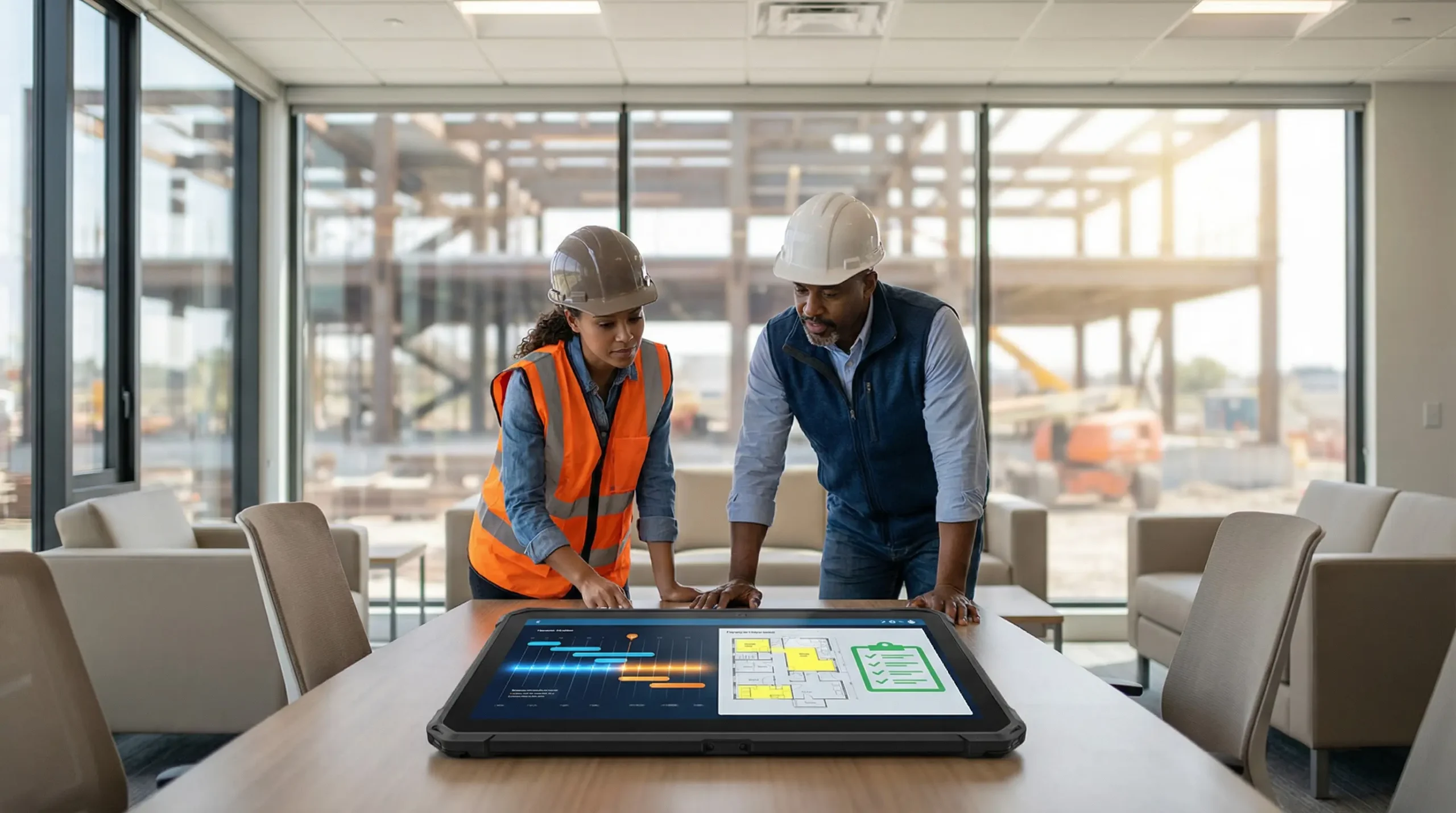
🏗️ Construction Is One of the World’s Largest Industries — and One of the Least Digitized. AI Is Changing That Fast: From predicting safety incidents before they happen to generating accurate project estimates in minutes, AI is transforming how construction projects are planned, managed, and delivered. This plain-English guide explains exactly what is working on job sites and in project offices in 2026, and the guardrails that responsible adoption demands.
Last Updated: May 8, 2026
Construction is, by almost every measure, one of the most consequential industries on earth. It builds the homes people live in, the hospitals that keep them healthy, the schools that educate their children, the infrastructure that connects communities, and the commercial spaces where economies operate. It employs tens of millions of people globally and represents trillions of dollars of annual economic activity. And it is, by the standards of almost every other major industry, remarkably resistant to the productivity and efficiency improvements that technology has delivered elsewhere. While manufacturing has been transformed by automation and logistics has been transformed by optimization algorithms, construction productivity — measured as output per labor hour — has barely grown over the past fifty years in most developed economies. The industry’s problems are well-documented: projects routinely run over budget and behind schedule, safety incidents remain alarmingly frequent, labor shortages are acute and growing, and the planning and coordination complexity of large projects consistently exceeds human management capacity.
AI is beginning to address these problems — not by replacing the skilled tradespeople, engineers, and project managers who are the industry’s backbone, but by giving them tools that extend their capabilities, sharpen their decision-making, and reduce the administrative and analytical burden that has always competed with their time for actual construction work. According to McKinsey’s construction productivity research, AI and advanced analytics have the potential to deliver 14–15% productivity improvement across the construction sector — gains that would represent hundreds of billions of dollars in additional economic value annually and would significantly reduce the cost overruns and schedule delays that currently characterize most large construction projects.
This guide provides a comprehensive, practical examination of AI in construction for non-technical professionals in 2026 — covering the specific applications delivering the most significant results in safety, scheduling, estimation, and project management, the tools and platforms leading each application category, the implementation approaches that construction organizations of different sizes can realistically pursue, and the critical guardrails that responsible AI adoption in construction demands. Construction is an industry where the consequences of errors — in safety, in structural design, in cost estimation — can be severe and irreversible. This guide helps construction professionals understand both what AI can genuinely deliver and the human expertise and oversight that must accompany every AI application in this high-stakes environment. The governance foundation for any AI construction deployment should begin with our guide to AI Acceptable-Use Policy — the document that defines how AI tools can and cannot be used across your organization.
📖 New to AI terminology? Visit the AI Buzz AI Glossary — 65+ essential AI terms explained in plain English, each linking to a full in-depth guide.
1. 🗺️ The AI Construction Landscape: Eight Transformation Zones
AI is being applied across the full lifecycle of construction projects — from pre-construction planning and estimation through active site management to post-construction operations and maintenance. Understanding the complete landscape of where AI is delivering value helps construction leaders prioritize their adoption journey and set realistic expectations for different application areas.
| Application Area | What AI Does | Primary Business Impact | Deployment Maturity (2026) |
|---|---|---|---|
| Safety Monitoring | Computer vision detects PPE violations, unsafe conditions, and high-risk behaviors in real time | Reduced incident rates, lower workers’ compensation costs, regulatory compliance | 🟢 Widely Deployed |
| Cost Estimation | AI analyzes historical project data to generate and validate cost estimates faster and more accurately | More accurate bids, reduced cost overruns, faster proposal development | 🟢 Widely Deployed |
| Schedule Optimization | AI analyzes dependencies, resource constraints, and risk factors to optimize project schedules | Reduced schedule delays, earlier risk identification, better resource utilization | 🟢 Widely Deployed |
| Quality Control | Computer vision compares as-built conditions against design specifications to identify defects | Earlier defect detection, reduced rework costs, better quality documentation | 🟡 Rapidly Growing |
| Risk Management | AI predicts project risks from early warning signals in schedule, budget, and site data | Proactive risk mitigation, fewer surprise cost and schedule impacts | 🟡 Rapidly Growing |
| Document Management | AI extracts, classifies, and cross-references information across thousands of project documents | Faster document retrieval, better compliance documentation, reduced claims exposure | 🟡 Rapidly Growing |
| Equipment Management | Predictive maintenance prevents equipment failures and optimizes utilization across fleet | Reduced equipment downtime, lower maintenance costs, better utilization | 🟡 Rapidly Growing |
| BIM and Design Optimization | AI analyzes BIM models to identify design conflicts, optimize constructability, and generate quantity takeoffs | Fewer RFIs, reduced change orders, faster design validation | 🟢 Widely Deployed |
2. 🦺 AI Safety Monitoring: Protecting Workers Before Incidents Happen
Construction is consistently among the most dangerous industries in the United States and globally. In the US alone, construction accounts for approximately 20% of all workplace fatalities despite employing only about 6% of the workforce — a sobering disparity that reflects the genuine physical dangers of working at height, in confined spaces, around heavy equipment, and with hazardous materials. The financial costs of construction safety incidents — in workers’ compensation, litigation, productivity loss, project delay, and insurance — are enormous. But the human cost — in lives lost and workers permanently injured — is the more fundamental motivation for the industry’s growing investment in AI-powered safety monitoring.
Computer Vision Safety Monitoring: What It Detects
The most widely deployed AI safety application in construction is computer vision monitoring — systems that continuously analyze camera feeds from job sites to detect safety hazards and violations in real time. These systems use deep learning models trained on vast datasets of construction site imagery to recognize safety-relevant patterns: workers not wearing required PPE (hard hats, high-visibility vests, safety harnesses), workers in proximity to moving equipment or material drop zones without adequate protection, workers in dangerous positions at height without fall protection, workers entering confined spaces without proper atmospheric monitoring, and vehicles operating in areas without appropriate spotter coverage.
When the computer vision system identifies a safety concern, it generates an alert — escalated to a safety officer’s mobile device, flagged on a site safety dashboard, and logged for documentation purposes. The alert can trigger an automated PA system announcement directing workers to the safety issue, or it can be routed to a nearby supervisor for immediate physical intervention depending on the severity of the detected condition. The system’s value is in its tirelessness and comprehensiveness: a human safety observer can watch one location at a time and inevitably experiences attention fatigue. A computer vision system monitors every camera simultaneously, every minute of the working day, without fatigue or distraction.
Predictive Safety Risk Assessment
Beyond real-time detection of existing hazards, AI safety platforms are increasingly applying predictive analytics to identify elevated safety risk conditions before incidents occur. These predictive models analyze combinations of factors that historical data shows are associated with elevated incident rates: workforce fatigue indicators (based on shift duration and schedule patterns), weather conditions that affect working surface safety and visibility, the specific activity mix being performed on site (certain activity types are historically higher risk than others), the experience composition of the crew assigned to high-risk activities, and the recent near-miss and incident history of the site. When predictive models identify elevated risk conditions, they alert site safety management to take proactive measures — modifying work sequences, providing targeted safety briefings for the at-risk activity, or increasing direct safety observation — rather than waiting for an incident to reveal that the risk was present.
Organizations implementing AI safety monitoring consistently report significant reductions in incident rates — with leading implementations achieving 20–40% incident rate reductions in the first year of deployment. According to OSHA’s industry safety data, reducing construction incident rates not only protects workers but directly improves project economics — the average direct and indirect cost of a construction incident significantly exceeds the annual cost of comprehensive AI safety monitoring for most job sites.
Near-Miss Reporting and Pattern Analysis
One of the most valuable but least captured data sources in construction safety is the near-miss event — a safety incident that almost happened but did not result in injury. Near-miss events are leading indicators of future incidents — sites with high near-miss rates are statistically more likely to experience actual injuries — but they are chronically underreported in construction because workers fear disciplinary consequences and because there is no systematic mechanism for capturing near-miss data beyond voluntary reporting.
AI safety platforms are beginning to address this gap through automated near-miss detection — identifying events from video footage that meet near-miss criteria (a load that swings close to a worker, a worker who loses footing and recovers without falling, a vehicle that comes within a defined proximity threshold of a worker without contact) and logging them automatically, without relying on voluntary human reporting. This automated near-miss data creates a safety intelligence dataset that site safety management can analyze to identify high-frequency hazard patterns and prioritize safety interventions before those patterns result in actual injuries.
The Safety Technology Principle: AI safety monitoring is most valuable when it is implemented as a worker protection tool rather than a worker surveillance tool. Sites that communicate to workers that the system exists to protect them — that alerts trigger safety interventions rather than disciplinary actions for first-time violations — see much higher worker acceptance and much more effective safety outcomes than sites where workers perceive monitoring as punitive oversight. The technology is the same; the implementation philosophy determines whether it saves lives or damages culture.
3. 💰 AI-Powered Cost Estimation: More Accurate Bids in Less Time
Cost estimation is one of the most consequential and most difficult tasks in construction project management. An accurate estimate is the foundation of a competitive, profitable bid — too high and you lose the work, too low and you win the work but lose money on it, sometimes catastrophically. Traditional cost estimation relies on experienced estimators who manually take off quantities from drawings, apply unit cost data from historical projects and current market pricing, assess risk contingencies based on professional judgment, and produce estimates that are only as accurate as the estimator’s experience and the quality of the historical data they work from.
AI-Assisted Quantity Takeoff
The most time-consuming component of traditional cost estimation is quantity takeoff — the process of measuring and counting every material, labor, and equipment item required to build the project from the design drawings. For a complex commercial project, a complete quantity takeoff can require hundreds of hours of estimator time, is prone to errors and omissions under deadline pressure, and must be repeated or substantially revised whenever the design changes. AI quantity takeoff tools — integrated into platforms like Procore, PlanSwift, and Autodesk Takeoff — can automate large portions of this process, particularly for projects using Building Information Modeling (BIM) where the design exists as a three-dimensional digital model with embedded dimensional data.
For BIM-based projects, AI takeoff tools can extract quantity data directly from the model — calculating floor areas, structural member lengths, wall areas, window and door counts, and material volumes with a speed and accuracy that manual takeoff cannot approach. For projects using traditional 2D drawings, AI pattern recognition tools can identify and measure common construction elements — walls, doors, windows, structural members — from scanned or digital drawing files, reducing but not eliminating the manual takeoff effort required. The time savings from AI-assisted takeoff — consistently reported at 50–75% compared to fully manual takeoff — translate directly into more competitive bidding capacity (the ability to evaluate more opportunities in the same time) and better estimating accuracy (more time per estimate for risk assessment and market pricing research rather than mechanical quantity counting).
Historical Data-Driven Cost Benchmarking
Beyond quantity takeoff, AI estimation tools apply historical project cost data to benchmark current estimates against the performance of similar completed projects — identifying line items where the current estimate is significantly above or below historical actuals for comparable work, alerting estimators to potential pricing anomalies that merit investigation, and providing confidence intervals around estimate ranges based on the variability observed in historical comparable projects. This historical benchmarking capability is particularly valuable for organizations that have been collecting project cost data systematically over time — the larger and more comprehensive the historical dataset, the more valuable the AI benchmarking becomes.
The discipline of collecting and organizing project cost actuals — capturing not just the final project cost but the costs of individual work packages, trade categories, and major material categories — creates an organizational asset of growing value as AI estimation tools become more capable of leveraging historical data. Organizations that have invested in historical cost data collection are realizing compound returns on that investment as AI tools become more capable of extracting value from it.
Risk-Adjusted Estimating
Construction projects face risks that can significantly affect costs — weather delays, labor availability constraints, material price volatility, underground conditions that differ from assumptions, regulatory changes, and the complexity risks inherent in coordinating multiple trades working in the same space simultaneously. Traditional risk contingency in estimates is often a rough percentage applied uniformly to the base estimate — a blunt instrument that consistently under-contingencies high-risk projects and over-contingencies low-risk ones. AI risk assessment tools analyze specific project risk factors and historical data on how similar risk factors have affected project costs to generate project-specific risk adjustments that are more accurate than uniform percentage contingencies.
4. 📅 Intelligent Schedule Management: Delivering Projects on Time
Schedule overruns are the construction industry’s most visible and most expensive problem. Studies consistently show that the majority of large construction projects are delivered late — and that the average schedule overrun for major infrastructure projects exceeds 20% of original planned duration. The causes of schedule overruns are well understood: design changes that cascade through dependent activities, weather events that disrupt planned work sequences, resource conflicts when multiple activities compete for the same crew or equipment, material delivery delays, and the inherent complexity of coordinating hundreds of interdependent activities across multiple contractors and subcontractors.
AI Schedule Analysis and Optimization
AI schedule management tools analyze construction schedules — typically represented as CPM (Critical Path Method) networks with hundreds or thousands of interdependent activities — to identify optimization opportunities, risk concentrations, and likely delay scenarios that are not visible to human schedulers working with the same data. These tools apply machine learning to historical schedule performance data from similar projects to calibrate the expected duration and variability of individual activities — replacing the single-point duration estimates that traditional CPM schedules use with probability distributions that reflect the realistic range of outcomes for each activity. This probabilistic scheduling approach, increasingly common in major construction projects through platforms like Oracle Primavera, Asta Powerproject, and newer AI-native scheduling tools, provides a much more realistic picture of schedule risk than deterministic CPM schedules where every activity is assumed to complete exactly as planned.
The practical output of AI schedule analysis is a set of schedule risk insights that human schedulers and project managers can act on: which activities have the highest schedule risk (where actual durations are most variable relative to planned durations in historical comparable work), which schedule paths are most likely to become critical (where parallel work streams might converge on the critical path), which resource conflicts are most likely to cause delay (where multiple activities compete for the same scarce crew or equipment at the same time), and what the probability distribution of the project completion date looks like given current schedule assumptions and historical performance data.
Real-Time Schedule Progress Monitoring
AI schedule monitoring tools continuously compare actual progress on site against the planned schedule — automatically updating the schedule model with progress data captured from drone flights, BIM model updates, foreman daily reports, and IoT sensors tracking crew and equipment location and activity. This continuous comparison identifies developing delays weeks or months before they would become visible in traditional monthly schedule updates — when there is still time to intervene effectively through schedule recovery strategies, resource reallocation, or scope adjustment.
For large projects with complex schedules, the ability to identify a developing delay on a critical path activity 6 weeks before it would appear in the next monthly schedule update represents the difference between a manageable schedule recovery action and an unmanageable project crisis. AI schedule monitoring provides this early warning capability — but its value depends entirely on the quality and timeliness of the progress data it receives. Projects that invest in the data capture infrastructure needed to provide AI schedule monitoring with accurate, frequent progress updates realize dramatically more value from AI schedule analysis than those where progress data is infrequent, inconsistent, or manually entered under end-of-period time pressure.
🏭 Exploring AI in your industry? Browse the AI Buzz Industry Guide — 35+ in-depth sector guides covering how AI is transforming healthcare, finance, HR, legal, retail, manufacturing, and more.
5. 🔍 AI Quality Control: Catching Defects Earlier and Cheaper
Construction defects are dramatically cheaper to fix early than late. A concrete pour that does not meet specification requirements identified during the pour can be addressed with a relatively simple remediation measure. The same defect identified during final inspections may require demolition and reconstruction of completed work at enormous cost and schedule impact. The economic logic of early defect detection is clear — but traditional quality control processes, relying on periodic human inspection of completed work, are too infrequent to catch many defects before they are buried under subsequent construction.
Computer Vision Quality Inspection
AI computer vision quality inspection tools provide continuous, comprehensive quality monitoring of construction work as it is being performed — rather than the periodic snapshot inspections that human quality control traditionally provides. Camera-based systems that monitor active construction can detect concrete finishing that does not meet specification, reinforcement placement that deviates from design, structural connections that appear inconsistent with the connection schedule, and surface preparations that do not meet the requirements for the subsequent coating or finishing work. Drone-based inspection systems capture high-resolution imagery of building envelope systems, roofing installations, and exterior cladding that allows AI analysis to identify installation defects, weathertightness risks, and specification non-conformances that would be invisible or impractical to detect through traditional inspection methods.
The value of computer vision quality inspection is most clearly demonstrated in the reduction of rework — work that must be demolished and reinstalled because it was installed incorrectly. Rework is estimated to represent 5–15% of project costs in typical construction projects — a staggering waste that represents both direct construction cost and schedule impact as crews who should be advancing new work are instead correcting previous work. AI quality inspection that identifies defects before they are buried in subsequent construction can eliminate a significant portion of this rework cost.
BIM Clash Detection and Design Coordination
Before physical construction begins, AI analysis of Building Information Models identifies design coordination conflicts — instances where different building systems (structural, mechanical, electrical, plumbing, fire protection) are designed to occupy the same physical space. These conflicts, known as clashes, are a major source of construction inefficiency: when they are not identified and resolved before construction, they result in requests for information, change orders, and field coordination problems that disrupt work sequences and generate significant cost and schedule impact.
Automated BIM clash detection has been available for years — software tools that mathematically check whether model elements from different systems physically intersect. AI advances the value of this capability in two ways: by prioritizing clashes based on their likely construction impact (not all clashes are equal — some involve minor routing adjustments while others require major redesign), and by suggesting resolution options based on how similar clashes in historical models have been resolved. This prioritization and resolution suggestion capability reduces the time design teams spend working through clash reports from days to hours — and improves the quality of clash resolution by bringing historical knowledge of effective resolution approaches to bear on each identified conflict.
6. 📊 AI Project Risk Management: Seeing Problems Before They Become Crises
Construction projects are inherently complex systems — with hundreds of interacting variables, multiple stakeholders with different interests, significant dependence on external factors like weather and supply chains, and long time horizons over which initial assumptions may prove incorrect. Managing this complexity requires identifying and addressing risks proactively — a task that benefits enormously from AI’s ability to process large volumes of project data and identify patterns that precede problems before those problems become crises.
Early Warning Signal Detection
AI risk management platforms — including products like Newmetrix, Alice Technologies, and the risk management modules in enterprise platforms like Procore and Oracle Construction Intelligence Cloud — continuously analyze project data across multiple dimensions to identify the early warning signals that historically precede cost overruns and schedule delays. These signals include: planned versus actual productivity rates for ongoing work packages (is the crew achieving the assumed production rate?), material delivery schedule adherence (are materials arriving when needed?), subcontractor activity levels relative to their planned commitments (are they mobilizing the resources their schedule requires?), RFI and change order volume trends (is the rate of design questions and scope changes accelerating?), and financial performance of completed work packages relative to budget (is the early work tracking over or under estimate?)
When these signals are analyzed individually, each may appear within normal project variation. When AI analyzes them in combination — recognizing patterns where multiple signals simultaneously trend in unfavorable directions — the combined pattern can be a reliable predictor of project problems weeks or months before those problems would become visible in traditional project controls reporting. This early warning capability enables proactive intervention: owner-contractor conversations about resource mobilization before subcontractor performance becomes a schedule problem, design team engagement to address the RFI pattern before it creates critical path delay, or contingency planning for supply chain disruptions before the schedule impact is unavoidable.
Claims Risk Management
Construction disputes and claims — disagreements between owners, general contractors, and subcontractors about who is responsible for cost and schedule impacts — are one of the industry’s most significant sources of financial loss and relationship damage. Claims frequently arise from inadequate contemporaneous documentation of project events, unclear contract allocation of specific risk types, and the difficulty of reconstructing the facts of project events months or years after they occurred. AI document management and risk monitoring tools help organizations build the contemporaneous documentation that supports claims defense or claim prosecution — systematically capturing daily project conditions, decision records, and communication histories in organized, searchable form that can be retrieved quickly when a dispute arises.
7. 🚜 Predictive Equipment Management: Preventing Downtime Before It Happens
Heavy construction equipment — excavators, cranes, loaders, concrete pumps, and other major equipment — represents a significant capital investment and a critical constraint on project productivity. Equipment downtime — whether from unexpected mechanical failure, scheduled maintenance that takes longer than planned, or wait time for parts — directly affects project schedule and has cascading effects on the work of crews and subcontractors whose activities depend on that equipment being available. Traditional equipment maintenance programs were either scheduled at fixed intervals (maintaining equipment whether or not it needed it) or reactive (repairing equipment after it failed). Both approaches are expensive and both accept significant unnecessary downtime risk.
IoT Sensors and Predictive Maintenance
AI predictive maintenance for construction equipment combines IoT sensor data from equipment telematics — engine hours, fuel consumption, operating temperatures, hydraulic pressures, vibration patterns, and error codes — with machine learning models trained on historical maintenance data to identify the specific equipment condition signatures that precede failures before those failures occur. When sensors indicate that an excavator’s hydraulic system is developing a pressure pattern that historically precedes hydraulic pump failure, the AI system generates a maintenance alert that allows the repair to be scheduled proactively — during a planned work stoppage when the equipment is not needed — rather than reactively when the pump fails during an active work period.
The financial value of predictive maintenance versus reactive maintenance is well-documented in fleet management contexts: predictive maintenance reduces unplanned equipment downtime by 30–50% compared to reactive maintenance, reduces maintenance costs by 10–25% compared to fixed-interval scheduled maintenance (by maintaining equipment when condition data indicates it is needed rather than on a predetermined calendar), and extends equipment service life by identifying and addressing developing problems before they cause catastrophic failures that damage secondary systems.
Equipment Utilization Optimization
Beyond maintenance, AI telematics and fleet management systems analyze equipment utilization patterns across project sites to identify underutilized equipment that could be redeployed, overloaded equipment that is a reliability and safety risk, and opportunities to improve the sequencing of equipment-intensive activities to reduce idle time and improve throughput. Equipment utilization data — capturing how many hours per day equipment is actively working versus idling, waiting, or being maintained — provides the evidence base for decisions about fleet size optimization, rental versus own decisions, and equipment deployment priority across multiple concurrent projects.
8. 📁 AI Document Management: Finding the Needle in the Construction Haystack
Major construction projects generate enormous volumes of documents — contracts, drawings, specifications, submittals, RFIs, change orders, daily reports, meeting minutes, correspondence, inspection records, and test reports — that collectively constitute the project record. Managing this document volume has always been a significant challenge: finding the right document when it is needed, ensuring that the current revision of each document is in use rather than a superseded version, tracking the status of submittals and RFIs through their review and approval cycles, and organizing documents in a way that supports both active project management and eventual closeout and handover. AI document management tools are transforming this function — not just organizing documents but understanding their content and enabling intelligence that was previously impossible.
Intelligent Document Classification and Search
AI document classification tools can automatically categorize incoming project documents by type, trade, location on site, and subject matter — without requiring manual filing by project staff. This automatic classification means that documents are organized and searchable from the moment they enter the project management system, rather than accumulating in inboxes waiting for staff time to file them. More importantly, AI-powered document search enables natural language queries — “show me all RFIs related to the mechanical penthouse that are currently unresolved and affecting the Level 12 steel erection” — that would be impossible with traditional keyword search against document metadata. This search capability transforms the project document archive from a storage repository into an active project intelligence resource.
Contract and Specification Compliance Monitoring
AI tools that can read and understand contract language and project specifications are increasingly being used to monitor project execution for compliance with contractual obligations — flagging situations where a required inspection has not occurred, where a submittal approval has not been received before installation is scheduled, where a contract-required notice has not been issued within the specified timeframe, or where a specification requirement appears inconsistent with an installed material submittal. This compliance monitoring capability — applied systematically across the thousands of contract and specification requirements that govern a major project — is beyond the capacity of any human project team to perform comprehensively. AI tools that can monitor this compliance landscape continuously provide project managers with early warning of compliance gaps before they become claims or defect liability issues.
9. ⚖️ The Guardrails That Responsible AI Construction Adoption Requires
Construction is a domain where the consequences of relying on AI outputs without appropriate human oversight can be severe — both in terms of worker safety and in terms of the structural and legal consequences of construction defects. The guardrails described below are not barriers to AI adoption; they are the implementation discipline that makes AI adoption sustainable and responsible in a high-stakes physical environment.
Safety Technology: Worker Protection First
AI safety monitoring must be implemented within a framework that prioritizes worker protection over productivity surveillance. Workers who believe that AI cameras are being used to monitor their work speed or to identify grounds for disciplinary action will find ways to defeat or avoid the monitoring systems — rendering them ineffective for their intended safety purpose. Successful AI safety implementations communicate clearly to the workforce that the system’s purpose is to protect workers, not to surveil them; that safety alerts trigger interventions rather than disciplinary processes for first-time violations; and that workers are encouraged to report system errors and limitations that affect its effectiveness. Union consultation and worker representative involvement in safety monitoring implementation — where applicable — is not just good practice; it is often contractually required and is consistently associated with higher system adoption and better safety outcomes.
AI Estimates and Schedules Require Professional Judgment
AI cost estimates and AI schedule analyses are starting points for professional judgment — not final answers that can be submitted to clients or used for procurement decisions without experienced review. Experienced estimators and schedulers understand aspects of a project’s context — the specific subcontractor market conditions, the site-specific logistical challenges, the owner’s typical change order behavior, the specific risks associated with the chosen construction method — that AI systems trained on historical comparable project data do not capture. Every AI-generated estimate and AI-analyzed schedule must be reviewed by a qualified construction professional who applies current market knowledge, project-specific understanding, and professional judgment before it is used as the basis for a bid, a contract, or a project commitment.
Structural and Safety-Critical AI Applications
Any AI application that directly informs decisions about structural safety — AI-generated design checks, AI-analyzed load calculations, AI-assessed structural inspection results — must be treated with particular caution. The consequences of structural failures are catastrophic and irreversible. AI tools can accelerate and improve the quality of structural analysis, but they cannot replace the licensed structural engineering judgment and professional responsibility that structural safety decisions require. No AI system should serve as the final authority on a structural safety decision — licensed engineers must review, verify, and take professional responsibility for all structural conclusions, regardless of how those conclusions were developed.
Data Privacy and Worker Monitoring Compliance
AI safety monitoring systems that capture continuous video footage of job sites and workers must comply with applicable privacy law and labor relations requirements. Video monitoring of workers is regulated in various jurisdictions — with requirements for worker notification, restrictions on data retention periods, limitations on the purposes for which monitoring data can be used, and in some jurisdictions, requirements for worker consent or union agreement. Before deploying any AI camera or monitoring system on a job site, obtain legal review of the applicable requirements in the relevant jurisdiction, ensure workers are notified of the monitoring in the manner required by law, and establish data retention and access policies that comply with applicable requirements. Our guide to AI and data privacy covers the practical compliance framework for AI monitoring systems in workplace contexts.
Human Oversight for Consequential Decisions
The principle of human oversight for consequential decisions applies across all AI construction applications. AI safety alerts should trigger human safety officer response — not automated site shutdowns or disciplinary actions without human review. AI schedule risk assessments should inform project manager decision-making — not automatically trigger contract notifications without human judgment about whether notification is appropriate given project context. AI fraud or compliance alerts in document management should trigger human investigation — not automated vendor termination or regulatory reporting without human review. The Human-in-the-Loop framework provides the architectural guidance for designing AI workflows in construction contexts that maintain appropriate human accountability for all consequential decisions.
| AI Application | Required Guardrail | Risk if Guardrail Ignored | Who Must Review |
|---|---|---|---|
| Safety Camera Monitoring | Worker notification, privacy law compliance, human response for all alerts | Legal violation, worker relations damage, system defeat | Safety officer — all alerts requiring intervention |
| AI Cost Estimates | Experienced estimator review before bid submission or commitment | Underpriced bids, project losses, contractual disputes | Qualified estimator — all estimates before use |
| Schedule Risk Analysis | Scheduler and project manager review before schedule commitments | Unrealistic schedules, missed milestones, delay claims | Project manager and scheduler — all risk reports |
| Structural Analysis AI | Licensed structural engineer review and professional responsibility sign-off | Structural failure, loss of life, catastrophic liability | Licensed structural engineer — mandatory |
| Quality Defect Detection | Qualified inspector verification before work rejection or rework directive | False rejections creating disputes, actual defects missed | Quality inspector — before any rejection decision |
| Predictive Maintenance Alerts | Equipment mechanic assessment before major maintenance decisions | Unnecessary maintenance costs, missed actual failures | Equipment mechanic — before maintenance commitment |
10. 🛠️ Getting Started: An AI Adoption Roadmap for Construction Organizations
Construction organizations approaching AI adoption for the first time face a market with hundreds of vendors making bold claims about capability and ROI — and limited internal guidance about where to start, what to prioritize, and how to implement tools effectively in an industry with complex labor relations, strong craft traditions, and genuine stakes around the physical safety of the people who work on site. The following roadmap provides a practical starting framework for construction organizations at different stages of organizational sophistication.
For Small and Medium Contractors (Under $50M Annual Revenue)
For smaller construction organizations, the most accessible and highest-ROI starting point is AI-assisted estimation using cloud-based takeoff and estimation platforms. The investment is modest, the implementation is straightforward, the productivity gain (faster takeoff, more bids evaluated, more accurate estimates) is immediately visible, and the capability advantage relative to competitors still using manual estimation methods is significant. Once estimation AI is established, the natural next step is AI project management integration — platforms like Procore, Buildertrend, or Contractor Foreman that incorporate AI features into their project management workflows, enabling schedule monitoring, RFI management, and document control without requiring separate platform investments.
For Large General Contractors and Specialty Contractors ($50M+ Annual Revenue)
For larger organizations, the priority order changes to reflect the scale of potential impact. AI safety monitoring — with its direct impact on the industry’s most serious cost and human risk — is typically the highest priority, followed by AI schedule risk management (given the financial consequences of schedule overruns at scale), and then AI document management (given the claims risk that large, complex projects face). Enterprise construction management platforms like Procore, Oracle Primavera, and Autodesk Construction Cloud have been integrating AI capabilities across their platforms — making AI adoption increasingly accessible through existing platform relationships rather than requiring new vendor introductions.
For Owners and Developers
Construction owners and developers benefit from AI primarily through improved project oversight capabilities — AI-powered project performance monitoring that provides independent validation of contractor-reported progress, AI risk assessment that identifies projects in their portfolio that are at elevated risk of cost or schedule overrun, and AI document management that supports more effective contract administration and claims management. According to Deloitte’s construction industry outlook, owners who invest in AI project oversight capabilities are consistently better positioned to identify and address project risks proactively — and achieve significantly better cost and schedule outcomes on their capital programs than those relying solely on contractor self-reporting.
11. 🏁 Conclusion: Building the Future with Human Expertise and AI Capability
The construction industry’s resistance to technology adoption is changing — not because the industry has suddenly become comfortable with digital transformation, but because the specific problems that AI addresses — project cost overruns, schedule delays, safety incidents, estimation uncertainty, and the administrative burden that consumes project manager time — are problems whose costs have become too large to continue accepting when viable solutions exist. The AI tools described in this guide are not hypothetical future capabilities; they are available today, they are being deployed at scale on construction projects around the world, and the organizations using them are demonstrating measurable performance advantages over those that are not.
The construction professionals who will be most successful in the AI era are those who engage with these tools as extensions of their expertise rather than as replacements for it. The experienced site supervisor whose safety instinct is sharpened by AI-detected near-miss patterns they had never seen before. The estimator whose professional judgment is validated and calibrated by AI benchmarking against hundreds of comparable historical projects. The project manager whose focus on relationship management and problem-solving is enabled by AI that handles the schedule monitoring and document management that previously consumed their time. In each case, the human expertise remains essential — and AI amplifies it.
The path forward is not to wait until AI tools are perfect before adopting them, nor to adopt every tool available without discipline or governance. It is to identify the specific problems in your organization’s project delivery that cause the most significant and most recurring losses — in safety, cost, schedule, or quality — and to evaluate AI tools against their demonstrated ability to address those specific problems within a framework of professional human oversight. Start with one tool, one project, and one clearly defined success metric. Demonstrate the value. Build the organizational capability and confidence. Then expand. The industry that builds the physical world has an extraordinary opportunity to use AI to build it better. Our guide to AI risk assessment provides the evaluation framework for assessing each AI construction tool against your organization’s specific risk profile before deployment.
📌 Key Takeaways
| Takeaway | |
|---|---|
| ✅ | McKinsey research estimates AI has the potential to deliver 14–15% productivity improvement across the construction sector — gains driven by smarter planning, better safety, fewer rework incidents, and more accurate estimation. |
| ✅ | Computer vision safety monitoring that operates continuously across all cameras simultaneously — without fatigue — is achieving 20–40% incident rate reductions in leading implementations and transforming how job site safety is managed. |
| ✅ | AI-assisted quantity takeoff consistently reduces takeoff time by 50–75% compared to fully manual takeoff — translating directly into more competitive bidding capacity and more estimator time available for risk assessment. |
| ✅ | Probabilistic AI schedule analysis — replacing single-point duration estimates with probability distributions based on historical comparable project performance — provides a dramatically more realistic picture of schedule risk than traditional CPM schedules. |
| ✅ | Rework represents 5–15% of construction project costs in typical projects — and AI quality monitoring that identifies defects before they are buried in subsequent construction eliminates a significant portion of this waste. |
| ✅ | Predictive equipment maintenance reduces unplanned equipment downtime by 30–50% compared to reactive maintenance — directly improving project schedule reliability for equipment-intensive activities. |
| ✅ | AI safety monitoring must be implemented as a worker protection tool — with transparent communication about its purpose and protection-focused response protocols — not as a productivity surveillance system, which consistently defeats adoption and safety outcomes. |
| ✅ | No AI application in construction removes the requirement for licensed professional judgment on structural safety decisions — AI accelerates and informs engineering analysis but cannot replace the professional responsibility that licensed engineers carry for structural conclusions. |
🔗 Related Articles
- 📖 AI in Construction: How AI Improves Planning, Safety, and Project Delivery
- 📖 Physical AI Explained: How Robots, Drones, and Smart Machines Use AI
- 📖 AI in Manufacturing: How AI Powers Smart Factories and Predictive Maintenance
- 📖 Human-in-the-Loop AI Explained: Draft-Only Workflows and Approval Gates
- 📖 AI Risk Assessment 101: How to Evaluate an AI Use Case Before You Deploy It
❓ Frequently Asked Questions: AI in Construction
1. Who is legally liable if an AI safety monitoring system fails to detect a hazard that causes a worker injury?
Liability is typically shared between the AI vendor, the site operator, and the principal contractor — but the distribution depends on the contract terms and whether the system was deployed correctly. A site operator who relied solely on AI monitoring without maintaining traditional safety protocols will face significantly greater liability exposure. Always maintain a Human-in-the-Loop safety verification process alongside any AI monitoring system.
2. Can AI scheduling tools account for unpredictable events like extreme weather or sudden material shortages?
Partially. Modern AI scheduling tools can incorporate weather forecast APIs and supply chain disruption signals to adjust timelines proactively. However, truly unpredictable “Black Swan” events still require human judgment. Treat AI schedule adjustments as a “first draft” recommendation that a qualified project manager must review — particularly when the adjustment affects critical path activities or contractual milestone dates.
3. Does using AI for cost estimation create any contractual risk if the actual costs differ significantly?
Yes — if the AI estimate is presented as a guaranteed figure rather than a probabilistic range. AI cost estimates are directional tools, not financial commitments. Any contract that references an AI-generated estimate should explicitly state the confidence range and the assumptions the model used. Failure to disclose the AI origin of an estimate that later proves materially wrong could constitute misrepresentation under standard construction contract law.
4. Can smaller subcontractors realistically adopt AI tools — or is this only viable for large construction firms?
Smaller subcontractors have more accessible entry points than most assume. Cloud-based AI safety monitoring, scheduling assistants, and document review tools are available on subscription models that require no infrastructure investment. The practical barrier is not cost — it is AI Literacy. Subcontractors who invest in basic AI training for their site managers gain a measurable competitive advantage in tender evaluations in 2026.
5. How should construction firms handle AI-generated safety reports if they contain errors or miss a known hazard?
Immediately document the failure through a formal AI Incident Response process. A safety report that missed a known hazard must be flagged, the vendor notified, and the gap covered by traditional inspection methods until the system is verified. Never suppress an AI error in a safety context — doing so transforms a technical failure into a potential criminal liability under workplace health and safety legislation in most jurisdictions.
📧 Get the AI Buzz Weekly Digest
Weekly AI insights, tools, and strategies — delivered every Monday. Free.




Leave a Reply