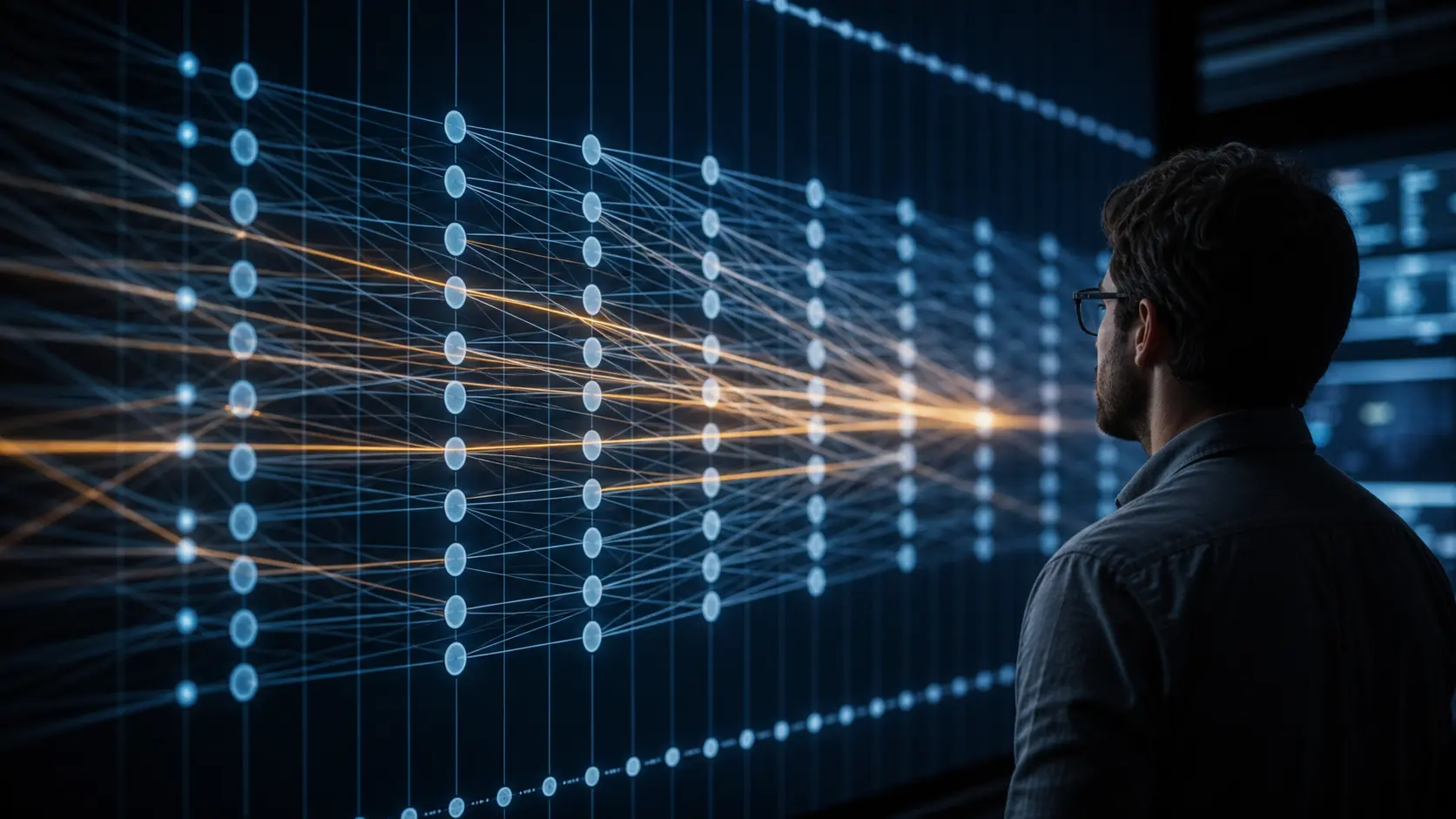
🔮 The transformer is the single architecture behind ChatGPT, Claude, Gemini, Google Search, GitHub Copilot, and virtually every AI system that understands or generates language, images, or audio in 2026. This plain-English guide explains what a transformer is, how the attention mechanism works, why it replaced everything that came before, and what the three main transformer types do differently.
Last Updated: September 7, 2026
In June 2017, eight researchers at Google Brain published a paper titled “Attention Is All You Need.” Thirty-one pages long. Twelve thousand citations within four years. The architecture it described — the transformer — became the engine behind almost every significant AI advancement of the following decade. GPT-5, Claude Sonnet 4.5, Gemini 2.5 Pro, DALL-E 3, Stable Diffusion, GitHub Copilot, Google Search’s core ranking model, and the AI features in Microsoft 365, Salesforce, and every other enterprise software platform you use in 2026 — they all run on transformer architecture, or direct descendants of it. Understanding what a transformer is, why it works, and how its three main variants differ is the single most useful piece of AI architectural knowledge available to a non-technical reader in 2026.
Before the transformer, AI language systems used recurrent neural networks (RNNs) and long short-term memory networks (LSTMs) — architectures that processed text sequentially, one word at a time, like reading a sentence left to right with a limited short-term memory. They worked, but they had a fundamental constraint: they struggled to understand relationships between words far apart in a sentence, and they could not be efficiently trained in parallel on modern hardware. The transformer eliminated both constraints simultaneously by introducing the self-attention mechanism — a way for every token in a sequence to look at every other token simultaneously and compute how much each one matters for understanding the current one. That shift from sequential to parallel processing, and from limited memory to full-context attention, is what made modern AI possible. Deep learning’s neural network foundations provide the mathematical substrate transformers run on — but the transformer architecture is the specific design that made those foundations scale to billions of parameters and genuinely useful AI systems.
This guide covers what a transformer is and what problem it solved, how self-attention works in plain English, the three main transformer variants and what each is best for, the most important transformer-based models in production in 2026, how transformers extended beyond language to images and audio, honest limitations, and a plain-English summary of why transformers matter for every technology decision-maker regardless of technical background. If you have been using natural language processing tools or large language models, transformers are the architecture underneath every one of them — this guide explains what is actually happening inside the systems you have been using.
📖 New to AI terminology? Visit the AI Buzz AI Glossary — 95+ essential AI terms explained in plain English, each linking to a full in-depth guide.
🔮 1. What Is a Transformer in AI? A Plain-English Definition
A transformer is a type of neural network architecture designed to process sequences of data — text, tokens, pixels, audio frames, or any other ordered series — by computing relationships between every element in the sequence simultaneously. “Architecture” in this context means the specific design of how the network is structured: what layers it has, how information flows between them, and what mathematical operations it performs. The transformer’s architectural innovation is not that it uses neural networks — those existed long before. The innovation is the specific mechanism it uses to understand context: self-attention.
Plain-English definition: A transformer is an AI architecture that understands any piece of data by asking “how does every part of this sequence relate to every other part?” simultaneously. When processing the sentence “The bank called about the deposit on the river bank,” a transformer does not read left to right and forget earlier words as it goes. It looks at the entire sentence at once, computes how much “bank” (word 2) relates to “river” (word 9) and “deposit” (word 6) simultaneously, and uses those relationships to understand that the first “bank” is financial and the second is geographical. That simultaneous full-context reasoning is what makes transformers powerful.
Before transformers, the dominant architectures for language tasks were recurrent neural networks (RNNs) and their improved variant, long short-term memory networks (LSTMs). These processed sequences one element at a time — reading word 1, updating internal state, reading word 2, updating state again, and so on. This sequential processing created two critical problems. First, information about early tokens degraded as the sequence grew longer — by the time the model processed word 100, it had largely “forgotten” the context from word 1. Second, the sequential nature meant these models could not be parallelized across modern GPU hardware efficiently — training was slow and expensive. The transformer solved both problems: its self-attention mechanism gives every token direct access to every other token in the sequence simultaneously, and the entire sequence can be processed in parallel across thousands of GPU cores. This is why transformer training and inference is so much faster than RNN-based approaches — and why transformers scaled to the billions of parameters that produce genuinely useful AI.
IBM’s transformer architecture documentation confirms the practical consequence: transformer models’ ability to discern how each part of a data sequence influences and correlates with every other part gives them multimodal uses that RNN architectures could not achieve — from language understanding to vision, audio, and the combined multimodal systems that define frontier AI in 2026. Every major AI system you interact with today — every chatbot, every image generator, every code assistant, every search engine — uses transformer architecture or a direct derivative of it.
⚙️ 2. How Self-Attention Works — The Core Mechanism Explained
Self-attention is the mechanism that makes transformers work. Everything else in the transformer architecture — the feed-forward layers, the layer normalization, the positional encoding — supports and surrounds self-attention. Understanding self-attention in plain English is sufficient to understand why transformers are so capable and where their limits come from.
The Query, Key, Value Framework
Self-attention works through three concepts: Query, Key, and Value — often abbreviated Q, K, V. These are the three mathematical representations of each token that the attention mechanism computes and compares. The analogy that makes this intuitive is a library search system. When you search a library catalogue:
- Your search term is the Query — what you are looking for
- The book titles and descriptions are the Keys — the labels the system uses to match your query against available content
- The actual book content is the Value — what gets returned when a strong match is found
In self-attention, every token in the sequence generates its own Query, Key, and Value vectors. The mechanism then compares each token’s Query against every other token’s Key to compute an “attention score” — a number that represents how relevant token B is to understanding token A. Tokens with high attention scores between them are strongly related; tokens with low scores are weakly related. These scores are then used to compute a weighted average of the Value vectors — the output for each token is a blend of all other tokens’ information, weighted by how relevant each is.
A Concrete Example: Resolving Pronoun Reference
Consider the sentence: “The computer executes the program because it is told to.” The word “it” is ambiguous — does it refer to the computer or the program? A human immediately resolves this to “the computer” based on semantic context. Self-attention resolves it the same way. When computing the attention scores for “it,” the model finds that “it” has a high attention score with “computer” (because computers execute instructions and are told to do things) and a lower score with “program” (programs are executed, not executors). The attention-weighted value vector for “it” therefore incorporates more information from “computer” than from “program” — giving the model a representation of “it” that correctly captures its referent. This disambiguation, which was extremely difficult for sequential RNN architectures that could not look back with full attention, happens naturally in a transformer through the Q-K-V computation.
Multi-Head Attention: Looking at Relationships in Multiple Ways
A single self-attention computation captures one type of relationship between tokens. Multi-head attention runs multiple self-attention operations in parallel — each “head” focusing on different aspects of the relationships between tokens. Consider the sentence “The fat cat sat on a mat.” One attention head might focus on subject-verb relationships (cat → sat). Another might focus on spatial relationships (sat → on → mat). A third might focus on descriptive relationships (fat → cat). Google’s AI research on transformer attention confirms that different attention heads in production models specialize in capturing different linguistic and semantic relationship types — some heads track syntactic structure, others track semantic similarity, others track positional relationships. The multi-head outputs are concatenated and projected into the next layer, giving each token a rich, multi-perspective representation of its context.
Positional Encoding: Telling the Model Where Each Token Sits
Self-attention treats the sequence as a bag of tokens that all interact with each other — but it has no inherent sense of order. “Cat bites dog” and “Dog bites cat” would produce the same attention scores if word order were ignored. Transformers solve this by adding positional encoding to each token’s embedding before the attention computation — a mathematical signal that tells the model the position of each token in the sequence. This gives the transformer the ability to understand both global relationships (via attention) and local sequence order (via positional encoding) simultaneously.
| Transformer Component | What It Does | Why It Matters |
|---|---|---|
| Tokenization | Splits raw input into tokens — subword units for text, patches for images, frames for audio | Converts any input type into a sequence the transformer can process. Tokenization decisions affect model vocabulary size and context window capacity. |
| Embeddings | Converts each token into a high-dimensional numerical vector that represents its meaning | Places semantically similar tokens close together in mathematical space — “cat” and “kitten” are closer than “cat” and “spreadsheet.” This learned similarity is what makes semantic search and understanding possible. |
| Positional Encoding | Adds position information to each token’s embedding so the model knows the order of the sequence | Without this, “dog bites man” and “man bites dog” would produce identical representations — the model would not know word order matters. |
| Self-Attention (Q-K-V) | Computes how much every token should attend to every other token simultaneously — produces context-aware representations for each token | This is the core innovation. Gives every token full-context awareness regardless of distance in the sequence. Resolves ambiguity, captures long-range dependencies, and enables cross-modal reasoning in multimodal systems. |
| Multi-Head Attention | Runs multiple self-attention computations in parallel — each head focuses on different relationship types | Allows the model to simultaneously capture syntactic structure, semantic similarity, coreference, and positional relationships — richer representation than any single attention perspective provides. |
| Feed-Forward Network | Applies a non-linear transformation to the attention output — token-by-token, independently | Adds the capacity to learn complex non-linear patterns that pure attention cannot capture. The majority of a transformer’s parameters live in the feed-forward layers — this is where most of the model’s knowledge is stored. |
| Layer Normalization | Normalizes the activations after each major component to stabilize training | Prevents training instabilities that would otherwise occur when stacking dozens of attention and feed-forward layers. Makes it possible to train models with hundreds of layers reliably. |
📊 3. The Three Main Transformer Types — What Each Is For
Not all transformers are built the same way. The original “Attention Is All You Need” paper described an encoder-decoder architecture designed for translation. Since 2017, three main transformer variants have emerged — each optimized for a different class of AI tasks. Understanding the distinction explains why BERT works differently from GPT, and why choosing the wrong transformer type for a task produces poor results.
| Transformer Type | How It Works | Best For | 2026 Examples | Attention Direction |
|---|---|---|---|---|
| Encoder-Only | Reads the entire input sequence simultaneously in both directions — every token attends to all other tokens. Produces rich contextual representations of the input. Does not generate new text. | Understanding tasks: classification, sentiment analysis, named entity recognition, semantic search, embeddings generation | BERT, RoBERTa, DeBERTa, sentence-transformers | Bidirectional — sees full context in both directions |
| Decoder-Only | Generates text token by token. Each new token attends only to the tokens that came before it — causal (masked) attention prevents the model from “looking ahead” to future tokens it has not generated yet. | Generation tasks: text generation, question answering, coding assistance, instruction following, chat | GPT-5, Claude Sonnet 4.5, Gemini 2.5 Pro, Llama 4, DeepSeek V4 Pro | Causal (left-to-right) — only sees previous tokens |
| Encoder-Decoder | Uses an encoder to process and understand the input (with bidirectional attention), then uses a decoder to generate the output — attending to both the encoder’s representations and the tokens generated so far. | Sequence-to-sequence transformation: translation, summarization, question answering from a document, text-to-SQL | T5, BART, mT5, original machine translation models | Encoder: bidirectional. Decoder: causal + cross-attention to encoder |
The decoder-only architecture — used by every major conversational AI in 2026 — is worth understanding in slightly more depth, because the “causal attention” (also called masked self-attention) it uses is what determines the behavior people find most remarkable about ChatGPT and Claude. When GPT-5 generates the response “The capital of France is Paris,” it generates “The” first, then computes attention across just [“The”] to generate “capital,” then computes attention across [“The”, “capital”] to generate “of,” and so on. At each step, it can only attend to tokens it has already generated — it cannot look ahead. This token-by-token generation with causal attention is what creates the streaming behavior you see when ChatGPT appears to type its response word by word — it is genuinely computing one token at a time, conditioned on everything that came before.
🤖 4. The Most Important Transformer Models in 2026
Understanding the transformer lineage from 2017 to 2026 in plain English helps explain why current AI models behave the way they do — and why specific architectural decisions in those models produce specific capabilities and limitations.
BERT (2018) — Google’s Encoder Revolution
BERT (Bidirectional Encoder Representations from Transformers) was Google’s 2018 breakthrough that demonstrated how a transformer encoder could be pre-trained on massive text corpora and then fine-tuned for specific tasks. IBM’s documentation confirms that BERT remains the basis of most modern word embedding applications — from modern vector databases to Google Search’s core ranking model. BERT’s key innovation was bidirectional pre-training: unlike GPT’s left-to-right training, BERT was trained to predict masked words using context from both left and right simultaneously. This bidirectional understanding makes BERT exceptionally powerful for understanding tasks — sentiment analysis, named entity recognition, semantic search — but it cannot generate new text because it was never trained to predict the next token.
GPT Series (2019–2026) — OpenAI’s Decoder Scaling
The GPT (Generative Pre-trained Transformer) series demonstrated that decoder-only transformers trained on internet-scale text could acquire broad language capabilities through scale alone — no task-specific training required. GPT-2 (2019, 1.5 billion parameters) could write coherent paragraphs. GPT-3 (2020, 175 billion parameters) could perform few-shot tasks — answering questions, writing code, translating languages — with no fine-tuning, just a few examples in the prompt. GPT-4 introduced multimodal capability. GPT-5 in 2026 represents the current state of the art in the GPT lineage. The critical insight from the GPT series: decoder transformers exhibit emergent capabilities at scale — behaviors that appear suddenly when the model reaches sufficient size, rather than improving gradually with training. This emergence is not fully understood theoretically, but is consistently observed in production.
Vision Transformers — ViT (2020–2026)
The Vision Transformer (ViT), introduced by Google in 2020, applied the transformer architecture to images by splitting images into fixed-size patches and treating each patch as a token — exactly like words in a sentence. Before ViT, computer vision was dominated by convolutional neural networks (CNNs). Fortune Business Insights confirms the Vision Transformers market is growing from $0.50 billion in 2026 to $5.66 billion by 2034 at 35.51% CAGR — driven by ViTs outperforming CNNs on object detection, OCR, and image classification across manufacturing, logistics, retail, insurance, and fintech. Vision transformers now extract text from complex document layouts with near-human accuracy, detect microscopic manufacturing defects that older models miss, and power the visual understanding layer in multimodal AI systems like GPT-4o and Gemini 2.5 Pro.
Mixture of Experts (MoE) Transformers — 2024–2026
The latest evolution of the transformer architecture in 2026 is the Mixture of Experts (MoE) design — used by Gemini 2.5 Pro, GPT-5, and DeepSeek V4 Pro. In a standard transformer, every token passes through every layer’s full feed-forward network. In an MoE transformer, each layer contains multiple “expert” feed-forward networks, and a learned routing mechanism sends each token to only 2–4 of the experts per layer rather than all of them. This allows MoE transformers to have enormous total parameter counts — providing the knowledge capacity of a much larger model — while only activating a fraction of those parameters per token, dramatically reducing inference cost. DeepSeek V4 Pro’s MoE architecture compressed training costs to approximately one-tenth of conventional approaches for equivalent capability — the architectural innovation that reshaped the global cost curve for frontier AI in 2025.
🌐 5. Transformers Beyond Language — Vision, Audio, and Multimodal AI
The transformer architecture’s power does not derive from anything specific to language. It derives from its ability to compute relationships between any sequence of tokens. This generality is why transformers have expanded beyond text to become the dominant architecture in computer vision, audio processing, drug discovery, protein structure prediction, and autonomous vehicle navigation — any domain where understanding relationships between elements of a sequence is the core challenge.
The 2026 architectural consensus: The transformer is not a language model. It is a general-purpose sequence relationship computing engine that happens to be extraordinarily effective at language. Every domain where understanding context and relationships within a sequence matters — vision, audio, genomics, materials science, climate modeling — is being transformed by the same architectural innovation that made ChatGPT possible.
In computer vision, Vision Transformers treat image patches as tokens — 16×16 pixel regions of an image become the equivalent of words. The self-attention mechanism then computes relationships between every patch and every other patch simultaneously, allowing the model to understand that a patch in the upper left corner of an image is related to a patch in the lower right corner without needing to process the distance between them sequentially. This global context awareness is precisely what allows ViTs to outperform CNNs on complex recognition tasks where distant regions of an image are semantically related.
In audio processing, transformers treat audio spectrograms (visual representations of sound frequency over time) as image-like inputs — or tokenize audio waveforms directly. Whisper (OpenAI’s speech recognition model) uses a transformer encoder-decoder architecture to convert speech audio into text with near-human accuracy across 99 languages. The same architecture that processes text for ChatGPT processes audio for Whisper and code for GitHub Copilot — the domain changes but the underlying self-attention mechanism remains the same.
In multimodal AI, transformers are the shared reasoning layer that allows vision, text, and audio encoders to be combined. Multimodal AI models like GPT-4o and Gemini 2.5 Pro convert images, audio, and text into embeddings in a shared vector space, then feed all of those embeddings into a single transformer reasoning layer. The self-attention mechanism operates across all modalities simultaneously — allowing the model to compute relationships between an image patch and a word token, between an audio frame and a text description, or between a diagram and a question about it. The transformer architecture is what makes true multimodal reasoning (as opposed to sequential pipeline processing) possible.
⚠️ 6. Honest Limitations: Where Transformers Still Fall Short
The transformer’s dominance in 2026 should not suggest it has no weaknesses. Several fundamental limitations shape what transformer-based AI can and cannot do reliably — and understanding these limitations is critical for setting appropriate expectations when deploying AI tools.
Quadratic attention scaling — the context window bottleneck. Standard self-attention requires every token to attend to every other token — meaning the computational cost scales quadratically with sequence length. A sequence of 1,000 tokens requires 1,000,000 attention computations. A sequence of 1,000,000 tokens would require 1,000,000,000,000 computations — computationally infeasible with standard attention. This is why context windows are a hard constraint in transformer-based LLMs. While architectural innovations (Flash Attention, sparse attention, linear attention approximations) and hardware improvements have extended context windows substantially — Gemini 2.5 Pro achieves 1 million tokens, Claude Sonnet 4.5 achieves 1 million tokens — the fundamental scaling challenge shapes what is computationally achievable.
No persistent memory — every context window starts fresh. Transformer-based language models have no memory between separate conversations. Each new conversation begins from scratch — the model has no access to previous sessions, no ability to learn from individual user interactions, and no accumulated knowledge about the specific user or organization. This is a fundamental architectural property, not a configuration option. Retrieval-Augmented Generation (RAG) architectures address this partially by retrieving relevant documents at inference time — but this is a workaround, not native memory.
Hallucination from probability, not truth. Transformer language models generate text by predicting the most probable next token given the context — they are trained to produce plausible text, not verified facts. When a model does not know the answer to a question but is prompted to answer, it will generate a plausible-sounding response that may be completely fabricated — a phenomenon called hallucination. This is not a bug that can be fixed with more data or larger models. It is a consequence of the token prediction training objective. Mitigation approaches — grounding through RAG, chain-of-thought reasoning, uncertainty quantification — reduce but do not eliminate hallucination in current transformer architectures.
Opaque reasoning — limited interpretability. Despite their extraordinary capabilities, transformer attention patterns are difficult to interpret in terms that explain why a specific output was produced. Attention visualization shows which tokens the model attended to, but attention patterns do not straightforwardly map to causal explanations. This interpretability limitation creates compliance challenges under the EU AI Act’s Article 13 transparency requirements and SR 26-2 model risk management obligations for organizations deploying transformer-based AI in consequential decisions.
Massive compute and energy requirements. Training frontier transformer models requires computational resources measured in tens of thousands of GPU-hours and energy consumption equivalent to hundreds of thousands of households. While inference costs have fallen dramatically (a 90%+ reduction in API costs from 2023 to 2025 per Stanford HAI), the training cost barrier limits who can develop frontier models. MoE architectures are reducing inference costs further — but the fundamental compute intensity of transformer-scale AI remains a significant infrastructure and environmental consideration.
🤔 7. What Transformers Mean for Business Leaders — The Plain-English Summary
You do not need to implement a transformer to benefit from understanding what it is. The architectural knowledge in this guide provides three practical advantages for business and technology decision-makers in 2026.
First: understanding why context window size matters. The context window is the amount of text a transformer model can hold in its attention mechanism at once. It is not just a number — it determines what information the model has access to when generating a response. A 128,000-token context window (GPT-4o) can hold approximately 90,000 words — about the length of a typical business novel. A 1,000,000-token context window (Gemini 2.5 Pro, Claude Sonnet 4.5) can hold entire codebases, contract libraries, or multi-year email archives. For use cases involving long documents, large codebases, or extensive context, context window size is a primary selection criterion — not a secondary specification.
Second: understanding why encoder vs. decoder matters for your use case. If you are building a classification system, sentiment analyzer, or semantic search tool — you need an encoder-only transformer (BERT-family) or embeddings from a model trained for representation. If you are building a content generation, coding assistance, or conversational AI system — you need a decoder-only transformer (GPT-family, Claude, Gemini). Using the wrong architecture for the task — a decoder model for classification when an encoder would work at a fraction of the cost — is a common and expensive deployment error.
Third: understanding why “transformer-based” is not a guarantee of quality. Transformer architecture is necessary but not sufficient for high-quality AI. The training data, RLHF alignment, system prompt configuration, retrieval augmentation, and deployment infrastructure all determine whether a transformer-based model produces reliable outputs in your specific use case. The architecture is the foundation — the construction on top of it is what determines whether the building is useful. For how reinforcement learning trains transformer models to be safe and aligned, and how RLHF specifically applies that training to language models, those guides cover the alignment layer that sits above the architecture layer explained here.
🏁 8. Conclusion: The Transformer Is the Architecture That Made Modern AI Possible
The 2026 consensus on transformer architecture is unambiguous: it is the foundational innovation that enabled the modern AI era. Before the transformer, AI language systems were limited by sequential processing, poor long-range memory, and slow training. After the transformer, AI scaled to billions of parameters, achieved near-human language understanding, extended to vision and audio, and produced the systems that are now transforming every industry. When someone tells you they are using an AI tool in 2026 — for writing, coding, customer service, medical imaging, drug discovery, or financial analysis — they are using a system built on transformer architecture. Understanding what that architecture does and what its fundamental limits are is the single most useful AI technical foundation available to a non-technical decision-maker.
The most important practical takeaway is the simplest: transformers work by paying attention to context — all of it, simultaneously, across every element in the input. That full-context simultaneous reasoning is what makes AI systems capable of resolving ambiguity, understanding nuance, maintaining coherent long-form generation, and reasoning across multiple modalities at once. It is also what makes them computationally expensive, context-window-bounded, and prone to hallucination when asked to generate content beyond the knowledge in their training data. For the full picture of the AI systems built on this architectural foundation — how large language models use transformers to generate language, how generative AI uses them to create new content, and how multimodal AI combines transformer encoders for different data types — those guides cover each application layer in the depth this architecture makes possible.
📌 9. Key Takeaways
| Takeaway | |
|---|---|
| ✅ | The transformer is the neural network architecture behind ChatGPT, Claude Sonnet 4.5, Gemini 2.5 Pro, Google Search, GitHub Copilot, and virtually every modern AI system that processes language, images, or audio — introduced in the 2017 paper “Attention Is All You Need” by Google Brain researchers. |
| ✅ | Self-attention — the transformer’s core innovation — allows every token in a sequence to attend to every other token simultaneously, giving the model full-context awareness regardless of distance. This replaced sequential RNN/LSTM architectures that lost context over long sequences and could not be trained in parallel. |
| ✅ | Three transformer types serve different tasks: encoder-only (BERT) for understanding tasks like classification and semantic search; decoder-only (GPT, Claude, Gemini) for generation tasks like chat and coding; encoder-decoder (T5) for sequence-to-sequence tasks like translation and summarization. |
| ✅ | BERT (2018) remains the foundation of most modern word embedding applications including Google Search. The GPT series demonstrated that decoder transformers trained at scale acquire emergent capabilities — behaviors that appear suddenly at sufficient model scale rather than improving gradually. |
| ✅ | Vision Transformers (ViTs) treat image patches as tokens and apply self-attention to images — outperforming convolutional neural networks on object detection, OCR, and image classification. The Vision Transformers market is growing from $0.50 billion in 2026 to $5.66 billion by 2034 at 35.51% CAGR (Fortune Business Insights). |
| ✅ | Mixture of Experts (MoE) transformers — used by Gemini 2.5 Pro, GPT-5, and DeepSeek V4 Pro — route each token through only 2–4 of many expert networks per layer rather than all of them. This allows enormous total parameter counts at a fraction of the inference cost of dense transformers. |
| ✅ | Transformers have four fundamental limitations: quadratic attention cost that constrains context window size; no persistent memory between conversations; hallucination from token-prediction training rather than verified facts; and poor interpretability that creates regulatory compliance challenges for high-stakes deployments. |
| ✅ | For business decision-makers: context window size determines how much information the model can reason about simultaneously; encoder vs. decoder architecture determines whether a model understands or generates; and “transformer-based” is a necessary but not sufficient condition for quality — training data, alignment, and deployment configuration determine whether the architecture produces reliable results. |
🔗 Related Articles
- 📖 Deep Learning Explained: How Neural Networks Power Modern AI (2026)
- 📖 What Is a Large Language Model (LLM)? A Plain-English Beginner’s Guide (2026)
- 📖 Multimodal AI Explained: Models, Use Cases and Safety (2026)
- 📖 What Is Natural Language Processing (NLP)? Plain-English Guide (2026)
- 📖 RLHF Explained: How Humans Teach AI to Behave, Reason, and Stay Safe
🔮 Frequently Asked Questions: What Is a Transformer in AI?
1. What is a transformer in AI, in simple terms?
A transformer is the neural network architecture that powers virtually every modern AI system — ChatGPT, Claude, Gemini, Google Search, GitHub Copilot, and image generators all use it. It works by computing relationships between every part of an input simultaneously — allowing it to understand context across long sequences in a way older architectures could not. Introduced in 2017 in the paper “Attention Is All You Need,” it replaced sequential recurrent networks as the dominant AI architecture. Our deep learning guide covers the neural network foundations transformers are built on.
2. What is the difference between a transformer and a large language model (LLM)?
A transformer is an architecture — the structural design of a neural network. A large language model (LLM) is a specific application of transformer architecture — a very large decoder-only transformer trained on massive text datasets to understand and generate language. All LLMs use transformer architecture, but not all transformers are LLMs. BERT uses a transformer encoder for understanding tasks without generating text. Vision Transformers use transformer architecture for images. The transformer is the engine; the LLM is one type of vehicle built on that engine. Our LLM guide covers how language models specifically work.
3. What is self-attention and why does it matter?
Self-attention is the mechanism that makes transformers work. It allows every token in a sequence to compute a relevance score against every other token simultaneously — giving the model full-context awareness regardless of how far apart tokens are in the sequence. Before self-attention, recurrent networks read sequences one token at a time and lost context over long distances. Self-attention solves this by making every token’s representation a weighted blend of all other tokens’ information. This full-context reasoning is what allows AI to resolve ambiguity, maintain coherence over long documents, and understand relationships between distant parts of an input.
4. What is the difference between encoder-only and decoder-only transformers?
Encoder-only transformers (like BERT) read the entire sequence bidirectionally and produce rich representations — they understand text but cannot generate new text. They are best for classification, sentiment analysis, and semantic search. Decoder-only transformers (like GPT-5, Claude Sonnet 4.5, Gemini 2.5 Pro) generate text token by token, each new token attending only to previous tokens. They are best for chat, coding, and content generation. Using the wrong type for your task — a decoder for classification when an encoder costs a fraction of the price — is a common and expensive deployment error.
5. What are the main limitations of transformer-based AI?
Four key limitations: context window constraints (quadratic attention scaling means processing all tokens simultaneously becomes computationally prohibitive beyond a certain length, though MoE architectures and hardware improvements are pushing these limits); no persistent memory (each conversation starts fresh — no learning from past interactions without external memory systems); hallucination (transformers generate probable text, not verified truth — they can produce confident, fluent, factually wrong outputs); and interpretability gaps (attention patterns do not straightforwardly explain why outputs were generated, creating regulatory challenges under EU AI Act Article 13 for high-stakes deployments).
📧 Get the AI Buzz Weekly Digest
Weekly AI insights, tools, and strategies — delivered every Monday. Free.




Leave a Reply