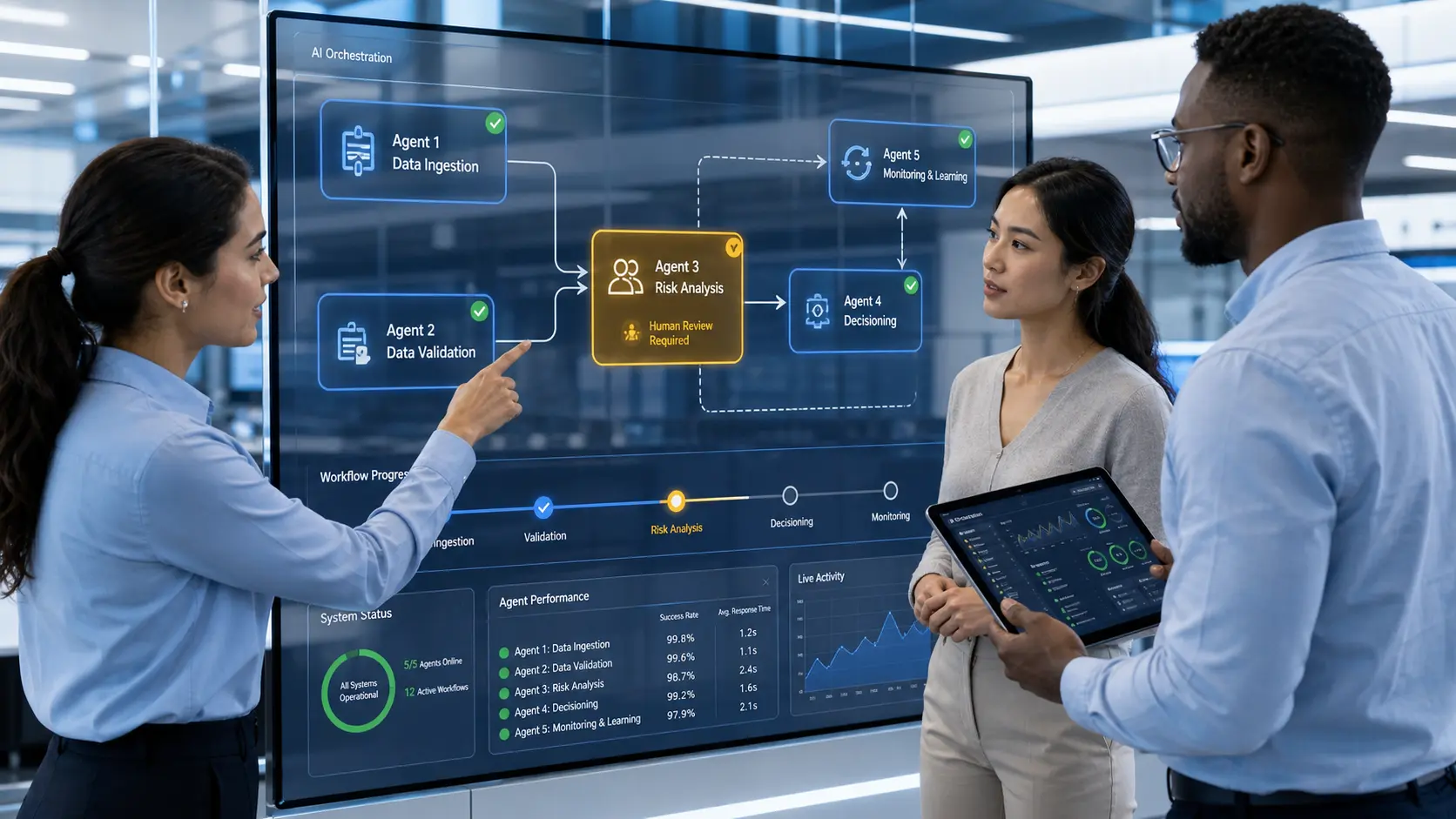
🤖 Running one AI agent is easy. Running ten that actually cooperate is a different problem entirely. This guide explains how AI agent orchestration works, the five patterns enterprises are using in 2026, and the governance controls you must have before you scale — with a framework comparison table to help you choose the right tool for your team.
Last Updated: November 10, 2026
AI agent orchestration is the dominant enterprise AI challenge of 2026. According to McKinsey’s State of AI 2026 survey of 1,719 participants, 40% of large organizations (those with revenues above $1 billion) are now scaling AI agents in at least one business function — up from just 27% a year earlier. Yet the same research reveals that only about 30% of organizations have reached maturity level three or higher in agentic AI governance. The gap between deploying agents and governing them reliably is where most enterprise AI projects stall, fail, or quietly become a liability. Managing multi-agent workflows — getting autonomous agents to coordinate, hand off tasks, share context, and recover from failures without human intervention for every step — is the core orchestration problem that every business deploying AI at scale must solve in 2026.
This article explains what AI agent orchestration is and why it matters, the five architectural patterns teams use to structure multi-agent workflows, the leading frameworks and platforms available today, the governance controls that separate prototype systems from production-grade deployments, and the five failure modes that cause most real-world orchestration projects to collapse. Whether you are evaluating LangGraph, CrewAI, Microsoft Agent Framework, or a managed enterprise platform like Azure AI Foundry Agent Service or AWS Bedrock AgentCore, the frameworks covered here apply regardless of which vendor you ultimately choose.
By the end of this article, you will understand not just what AI agent orchestration is, but how to evaluate an orchestration architecture, what questions to ask vendors, and what governance layer must exist before any multi-agent system goes into production. The 2026 consensus is clear: organizations that treat orchestration as a purely technical problem — without parallel investment in state management, observability, and human-in-the-loop controls — are building systems that will eventually behave in ways nobody planned for.
📘 New to AI terminology? Before diving in, bookmark the AI Buzz Glossary — 100+ essential AI terms explained in plain English. It covers agents, orchestration, context windows, and everything in between.
🧩 1. What Is AI Agent Orchestration? (And Why It’s Different From Running a Single Agent)
A single AI agent is relatively straightforward: you give it a goal, tools to use, and a model to reason with, and it works through the problem step by step. AI agent orchestration is what happens when more than one agent needs to work on the same task — with explicit coordination governing how they hand off work, share information, run in parallel, and combine their outputs into a coherent result. The word “orchestration” is deliberate: like a conductor managing an ensemble, the orchestration layer decides which agent plays, when, with what instructions, and what happens if one misses its cue.
At its most fundamental level, orchestration solves five problems that single-agent systems never face. First, task decomposition: breaking a complex goal into sub-tasks that individual specialist agents can handle. Second, agent routing: deciding which agent handles which sub-task, and in what order. Third, state management: keeping track of everything that has happened across all agents so each one has the context it needs without redundant work. Fourth, result aggregation: combining the outputs of parallel or sequential agents into a final result. Fifth, error handling and escalation: deciding what to do when an agent fails, times out, or returns a low-confidence result — including when to escalate to a human.
The practical difference between single-agent and multi-agent systems shows up quickly in real enterprise workflows. Consider an AI-assisted contract review process. A single general-purpose agent might read a contract and produce a summary. An orchestrated multi-agent system might deploy a legal language parser, a risk-flagging agent, a compliance checklist agent, and a summarization agent in parallel — then route the aggregated output to a final drafting agent that produces a structured briefing for the legal team. The orchestrated system is faster, more accurate on each sub-task, and more auditable. It is also substantially more complex to build, maintain, and govern.
The 2026 Orchestration Reality: Nearly two-thirds of organizations experimenting with AI agents have not yet scaled them to deliver tangible value, according to McKinsey. The bottleneck is rarely the agent itself — it is the orchestration layer that coordinates agents, manages state, and enforces governance.
Understanding this distinction matters for how you evaluate vendors and frameworks. Many tools marketed as “AI agents” are single-agent tools with tool-calling capabilities. True orchestration platforms manage the coordination layer — the routing logic, shared memory, state persistence, and observability infrastructure — that makes multi-agent systems reliable in production. If a vendor cannot explain how their platform handles state across a multi-step, multi-agent workflow when one agent fails mid-sequence, it is likely a single-agent tool with multi-agent marketing.
🏗️ 2. The Five Orchestration Patterns — Which Architecture Should Your Team Use?
Not all multi-agent systems are structured the same way. The pattern you choose determines how agents communicate, how failure propagates, how easy the system is to debug, and how well it scales. In 2026, five orchestration patterns have emerged as the dominant architectural approaches used by enterprise teams. Each has clear strengths, clear weaknesses, and use cases where it clearly outperforms the others.
Sequential (Pipeline) Orchestration
Sequential orchestration is the simplest pattern. Agents execute one after another in a fixed order, with each agent receiving the output of the previous one as its input. This is the assembly-line model of AI orchestration: Agent A produces output X, Agent B takes X and produces Y, Agent C takes Y and produces Z. The workflow is deterministic, easy to debug, and straightforward to monitor. When something goes wrong, you know exactly which stage failed and what the input was at that point.
Sequential orchestration is best suited to workflows where tasks have a clear natural order and where intermediate outputs must be validated before the next step begins. Document processing pipelines — where text is first extracted, then structured, then analyzed, then summarized — are a natural fit. The limitation is performance: sequential systems cannot parallelize work, so they are slower than other patterns when sub-tasks are independent. They are also brittle: a failure at step three in a seven-step pipeline means the entire workflow stops unless explicit retry and fallback logic is built in.
Hierarchical (Supervisor-Subagent) Orchestration
Hierarchical orchestration adds a manager layer. A supervisor agent receives the top-level goal, decomposes it into sub-tasks, delegates those tasks to specialist sub-agents, and aggregates the results. Sub-agents can themselves have sub-agents, creating nested layers of delegation for complex multi-domain problems. This pattern maps naturally to how human organizations divide and delegate work, which is part of why it has become one of the most widely adopted patterns in enterprise deployments.
The practical advantage of hierarchical orchestration is flexibility: the supervisor can dynamically allocate work based on agent availability, task complexity, or intermediate results, without the user needing to define the exact workflow path in advance. Google’s Agent Development Kit (ADK) is designed around this pattern, using a parent-child agent tree where each agent in the hierarchy has distinct tools, memory, and instructions. The risk is supervisor overload: if the supervisor agent is making too many routing decisions, those decisions consume tokens, introduce latency, and create a single point of failure. Well-designed hierarchical systems include explicit fallback rules so the system degrades gracefully when the supervisor model produces a poor routing decision.
Parallel (Fan-Out) Orchestration
Parallel orchestration runs multiple agents simultaneously on different aspects of the same task, then aggregates their outputs. This is the fastest pattern for tasks that can be decomposed into genuinely independent sub-tasks. A research workflow that needs to simultaneously search five different data sources, with the results merged and synthesized, is a natural parallel orchestration candidate. Gartner forecasts that by end-2026, 40% of enterprise applications will include task-specific AI agents built in — and many of those will be running agents in parallel to meet performance requirements that sequential systems cannot match.
The challenge with parallel orchestration is aggregation logic. When five agents return five different outputs at five different times, the aggregation layer must decide how to combine them, how to handle conflicts, and what to do when one agent is significantly slower than the others. Explicit timeouts, partial-result handling, and conflict resolution rules are not optional in parallel systems — they are the difference between a system that works under load and one that hangs waiting for a slow agent.
Swarm (Peer-to-Peer Handoff) Orchestration
Swarm orchestration has no central manager. Whichever agent is currently active decides which peer agent should take over next, calling a handoff tool and passing context directly. The workflow emerges from the agents’ own reasoning rather than being defined by a supervisor or a fixed pipeline. This pattern is the most flexible and the least predictable. It is well-suited to open-ended research tasks where the right next step depends on what has been discovered so far, but it is poorly suited to workflows with compliance requirements, fixed audit trails, or approval gates.
The A2A (Agent-to-Agent) protocol, now maintained under the Linux Foundation, is the open standard for cross-agent communication that enables swarm-style coordination across different frameworks and vendors. Its adoption means that agents built in LangGraph can, in principle, hand off work to agents built in CrewAI or OpenAI Agents SDK — though in practice, enterprise teams typically standardize on a single framework to maintain observability and governance consistency.
Graph-Based (Stateful Loop) Orchestration
Graph-based orchestration models the workflow as a directed graph: nodes represent agents or processing steps, edges represent the conditions under which the workflow moves from one node to the next. This pattern supports loops (where an agent can re-evaluate its own output before passing it on), conditional branching (where different results route to different next steps), and persistent state (where the system can pause, resume, and recover from failure without losing context). LangGraph was built specifically for this pattern, and Microsoft Agent Framework’s graph-based workflows — which reached stable 1.0 status in April 2026 — bring the same capabilities to the Microsoft ecosystem.
Graph-based orchestration is the most powerful and the most complex of the five patterns. It is best suited to workflows with conditional logic, iterative refinement steps, or human-in-the-loop approval gates. Its main limitation is the upfront design investment: building a well-structured agent graph requires explicit workflow mapping before a single line of code is written. Teams that skip the design phase and attempt to build a graph-based system incrementally typically end up with an unmaintainable tangle of conditions and edges that is impossible to debug in production.
| Pattern | How It Works | Best For | Main Risk | Framework Match |
|---|---|---|---|---|
| Sequential | Fixed order pipeline; each agent passes output to the next | Document processing, ordered multi-step tasks | Brittle; full stop on any stage failure | Any framework |
| Hierarchical | Supervisor delegates to specialist sub-agents; aggregates results | Complex multi-domain tasks, dynamic delegation | Supervisor becomes a bottleneck and token cost | Google ADK, LangGraph |
| Parallel | Multiple agents run simultaneously; outputs merged | Research, multi-source analysis, speed-critical tasks | Aggregation conflicts; slow-agent timeout handling | Microsoft Agent Framework, Google ADK |
| Swarm | No central manager; active agent hands off to peers directly | Open-ended research, exploratory workflows | Unpredictable paths; poor audit trail | OpenAI Agents SDK, LangGraph Swarm |
| Graph-Based | Directed graph; nodes are agents, edges are conditional routing rules | Complex logic, iterative refinement, HITL gates | High design overhead; hard to retrofit | LangGraph, Microsoft Agent Framework |
🛠️ 3. The Leading AI Agent Orchestration Frameworks and Platforms in 2026
The orchestration market in 2026 has matured significantly from two years ago, when most teams were stitching together custom solutions from first-generation LangChain components. Today, the market has divided into two distinct categories: developer frameworks that give engineering teams direct control over orchestration logic, and managed enterprise platforms that provide pre-built orchestration infrastructure with integrated governance, observability, and enterprise connectors. Choosing between them is not primarily a technical question — it is an organizational one.
Developer Frameworks: Code-First Control
LangGraph is the most widely adopted open-source framework for stateful, graph-based multi-agent orchestration. It models workflows as directed graphs with nodes representing agents or functions and edges encoding routing conditions. LangGraph supports loops, persistent memory, checkpointing, and human-in-the-loop approval gates natively — making it the strongest framework for workflows that require iterative reasoning or conditional branching. It is best suited to engineering teams comfortable building and maintaining Python code, and it is typically deployed alongside a managed runtime such as AWS Bedrock AgentCore or Temporal for durability in production.
CrewAI takes a role-based approach to multi-agent orchestration, framing the system as a crew of agents with assigned roles, goals, and backstories. This abstraction maps naturally to how non-engineering stakeholders think about team-based work, which has made CrewAI a popular choice for rapid prototyping. Independent 2026 comparisons note it carries the heaviest token footprint among major frameworks on simple, repetitive tasks — a cost consideration that matters significantly at scale. CrewAI is best for teams that need to prototype quickly and whose workflows map naturally to role-based collaboration.
Microsoft Agent Framework, which reached stable 1.0 general availability in April 2026, is the unified successor to both AutoGen and Semantic Kernel. It combines AutoGen’s conversational multi-agent abstractions with Semantic Kernel’s enterprise features — including session-based state management, middleware, telemetry, and type safety — and adds graph-based workflows for explicit control over multi-agent execution paths. It supports five orchestration patterns: Sequential, Concurrent, Handoff, Group Chat, and Magentic. For enterprise teams already invested in the Microsoft stack — Azure AI Foundry, Azure OpenAI, and .NET services — it is the natural first-party choice, with built-in OpenTelemetry observability and optional responsible AI guardrails through Foundry.
Google Agent Development Kit (ADK) supports hierarchical agent orchestration with a parent-child delegation model and native A2A protocol support. It is designed for teams building on Google Cloud who want agents that deploy directly to Vertex AI Agent Engine. Sequential, Parallel, and Loop orchestration patterns are built in. It is the strongest choice for teams with significant Google Cloud infrastructure and data in BigQuery or Vertex AI.
OpenAI Agents SDK is the most lightweight of the major frameworks — a provider-agnostic multi-agent SDK with built-in tracing and native support for the Handoff (swarm) pattern. It is best suited to engineering teams that want a fast path to multi-agent prototyping with strong tracing capabilities and flexibility about which model powers each agent. The OpenAI Agents SDK became the most common starting point for new agent projects in 2026, though many teams graduate to LangGraph or Microsoft Agent Framework as complexity increases.
Enterprise Orchestration Platforms: Managed Infrastructure
Azure AI Foundry Agent Service (formerly Azure AI Agent Service) is Microsoft’s production-grade managed agent orchestration platform. It is built for teams that need agents in production, not prototypes, with CI/CD integration, governance controls, and Azure’s compliance infrastructure. It sits above Microsoft Agent Framework in the abstraction hierarchy — teams building serious enterprise agent systems on Azure will typically use both.
AWS Bedrock AgentCore is Amazon’s managed agent runtime, providing the durable execution and state management infrastructure that production multi-agent systems require. A common 2026 architecture is LangGraph handling graph logic, running on Bedrock AgentCore for durable execution, with the A2A protocol connecting specialized agent teams. This stack gives engineering teams framework flexibility while offloading the infrastructure concerns of production-scale orchestration.
Salesforce Agentforce serves enterprise teams whose agent workflows live primarily inside the Salesforce ecosystem — CRM automation, service case handling, and sales workflow orchestration. It is the strongest choice when the data and process context agents need to operate on lives in Salesforce, and a poor choice when agents need to reach broadly across heterogeneous enterprise systems.
⚙️ 4. The Seven Components of an Enterprise-Grade Orchestration Layer
The gap between a multi-agent proof of concept and a production-grade orchestration system comes down to seven infrastructure components that most frameworks require teams to build or configure explicitly. Teams that treat these as afterthoughts — adding them when problems surface rather than designing them in from the start — consistently report the highest failure rates in production deployment.
State Management and Context Persistence
State management is the foundation of reliable multi-agent orchestration. Every agent in a workflow needs access to the shared context of everything that has happened before its turn — not just the immediate input it was handed. Without persistent state management, agents make decisions based on incomplete information, produce contradictory outputs, and fail to recover from interruptions. Context inconsistency, not architectural pattern choice, is identified as the primary reason multi-agent orchestration fails in production environments.
Production state management requires three capabilities: a shared memory layer accessible to all agents in the workflow; persistent checkpointing so the system can resume from where it left off after a failure or a human-in-the-loop pause; and explicit context scoping rules that determine which agents can read or modify which parts of the shared state. Teams that allow any agent to read and write any part of shared state without governance rules create systems where agents interfere with each other’s context in ways that are extremely difficult to debug.
Routing and Task Decomposition Logic
Routing logic governs which agent runs next and what input it receives. In deterministic frameworks like LangGraph or Microsoft Conductor (Microsoft’s YAML-defined orchestration CLI, released May 14, 2026), routing is defined explicitly at workflow design time — the first matching condition wins, the topology is declared rather than discovered at runtime, and the orchestration layer itself consumes zero tokens. In dynamic systems — including most hierarchical supervisor architectures — the routing decision is made by an LLM at runtime, which introduces latency, token cost, and the possibility that the routing decision itself is incorrect.
The 2026 engineering consensus is moving toward deterministic routing wherever possible, with dynamic routing reserved for the sub-tasks where the next step genuinely cannot be known in advance. Teams that use an LLM to make routing decisions that could be encoded as a simple conditional branch are spending unnecessary tokens, introducing unnecessary latency, and creating a failure mode that is difficult to reproduce and debug.
Observability and Tracing
Observability is the capacity to understand what your multi-agent system is doing in real time — which agents are running, what inputs they received, what outputs they produced, how long each step took, and where failures occurred. In a single-agent system, a failed output is obvious. In a ten-agent system where agents hand off to each other across a workflow that takes several minutes, understanding where a bad output originated requires complete trace data from every agent in the chain.
Production orchestration requires at minimum: per-agent input/output logging; end-to-end trace correlation so each step in a workflow can be linked to the original request; latency monitoring per agent and per workflow; error rate alerting with enough context to reproduce failures; and human-readable audit logs for compliance purposes. Teams that rely on print statements and console logs for observability in multi-agent systems will find that debugging production failures is effectively impossible.
Human-in-the-Loop (HITL) Gates
Human-in-the-loop controls are not an optional safety feature — they are a fundamental governance requirement for any multi-agent system that takes actions with real-world consequences. As explained in our detailed guide to human-in-the-loop AI workflows, the key design decision is determining which workflow steps require human review and approval before the next agent step executes. Well-designed HITL gates are checkpoints in the workflow graph, not interrupts bolted onto a finished system.
In practice, most enterprise orchestration systems in 2026 use a tiered HITL model: fully automated for routine, low-risk sub-tasks; draft-and-review for outputs that will be used externally; mandatory human approval for irreversible actions (sending emails, modifying records, initiating transactions). The challenge is maintaining HITL discipline as systems scale — teams consistently report pressure to remove approval gates as workflows become routine, which is precisely when removing them creates the most risk.
Error Handling, Retry Logic, and Fallback Paths
Multi-agent systems fail in ways that single-agent systems do not. An individual agent might return a low-confidence output, time out, hit a rate limit on its underlying model, receive malformed input from an upstream agent, or loop indefinitely without recognizing it is stuck. Each of these failure modes requires a different response — and most orchestration frameworks require teams to configure that response explicitly rather than providing sensible defaults.
Production error handling requires at minimum: per-agent timeout configurations; retry policies with exponential backoff for transient failures; fallback paths that route around a failed agent rather than stopping the entire workflow; maximum iteration limits to prevent infinite loops; and escalation rules that surface unresolvable failures to a human operator rather than silently dropping them. The OWASP Top 10 for Agentic Applications v2.01 specifically identifies ASI09 (Denial of Agentic Service) and ASI04 (Tool and Resource Misuse) as risks that inadequate error handling directly enables.
Security and Identity Controls
Every agent in an orchestrated system has an identity — a set of credentials and permissions that determine what tools, data sources, and actions it can access. As detailed in our guide to non-human identity (NHI) for AI agents, managing agent identities is one of the most underinvested areas of enterprise orchestration security. The core problem is privilege scope: agents that are granted broader permissions than their specific task requires will, when compromised or confused, use those permissions in ways that were never intended.
The minimum security requirements for a production orchestration system include: individual identities per agent (not shared credentials); least-privilege access scoped to each agent’s specific tool and data requirements; audit logs of every tool call and external action each agent takes; and prompt injection defenses that prevent agents from being redirected by malicious content in the data they process. Teams deploying multi-agent systems without individual agent identities are essentially running their entire agent fleet under a single set of credentials — which means a single compromised or confused agent can access everything the system can access.
Cost Management and Token Budgeting
Multi-agent systems multiply token consumption in ways that catch teams off guard. A workflow that calls five agents sequentially, each with a large context window to maintain shared state, can consume ten to fifty times the tokens of a single-agent approach. At scale, this directly affects the economic case for orchestration. Token budgeting — setting explicit limits on how many tokens each agent can consume per step, and what happens when that budget is exceeded — is a governance requirement, not an optimization exercise.
Practical cost controls in 2026 include: using smaller, cheaper models for routine sub-tasks while reserving high-capability models for reasoning-intensive steps; deterministic routing to avoid token-consuming LLM routing decisions where possible; context pruning to remove stale or irrelevant information from shared state before passing it to new agents; and cost monitoring per workflow run so that unexpectedly expensive executions are flagged before they scale.
🏛️ Exploring Agentic AI Governance? The AI Buzz Agentic AI Governance hub covers policy frameworks, control architectures, and compliance requirements for organizations deploying autonomous AI agents at scale. Explore the full resource library for practical implementation guides.
⚠️ 5. The Five Failure Modes That Kill Orchestration Projects in Production
Gartner forecasts that over 40% of agentic AI projects will be cancelled by 2027, driven by unclear ROI and weak risk controls. Understanding the failure modes before you encounter them is the most practical thing this article can offer. These five failures appear repeatedly across enterprise orchestration projects — they are not edge cases, they are the dominant causes of production system collapse.
Failure Mode 1: Context Bleed and State Corruption
Context bleed occurs when one agent’s output pollutes the shared state in ways that cause downstream agents to make incorrect decisions. In a ten-agent workflow, a poorly scoped memory write by Agent 3 can produce a cascade of incorrect decisions in Agents 4 through 10 — often with no error message, just subtly wrong outputs that only become apparent when a human reviews the final result. Context bleed is the leading cause of silent failure in multi-agent systems: the workflow completes, the output looks plausible, and the error is only discovered when someone checks whether the output is actually correct.
The mitigation is explicit context scoping: each agent’s read and write permissions on shared state must be defined in advance, with the orchestration layer enforcing those permissions rather than trusting agents to self-govern. This is the same principle as least-privilege access in security — agents should access only the shared state they need to complete their specific task.
Failure Mode 2: Infinite Loops and Runaway Agent Chains
Multi-agent systems can enter loops where agents hand off to each other indefinitely, each one determining that the goal has not yet been achieved and delegating back to a peer or supervisor. Without explicit maximum iteration limits and loop detection, these loops consume compute resources, accumulate token costs, and can run indefinitely without producing output. This failure mode is particularly common in hierarchical systems where the supervisor agent repeatedly determines that sub-agent outputs are insufficient and re-delegates — each delegation consuming more tokens without converging on a result.
Failure Mode 3: Prompt Injection Across the Agent Chain
Prompt injection attacks become significantly more dangerous in multi-agent systems because a successful injection in one agent can propagate through the entire chain. If Agent 2 in a ten-agent workflow processes external data that contains malicious instructions — and those instructions successfully redirect Agent 2’s behavior — the corrupted output may then be passed to Agent 3 as legitimate context. The OWASP Top 10 for Agentic Applications identifies ASI01 (Agentic Goal and Instruction Hijacking) as the highest-priority risk in agentic systems, and cross-agent prompt injection is its most dangerous manifestation.
Failure Mode 4: Governance Bypass at Agent Boundaries
Many enterprise orchestration systems have governance controls at the entry and exit points of the workflow — input validation at the start, output review at the end — but no controls at agent-to-agent handoff points inside the workflow. This creates a governance gap where agents can receive and act on inputs that would have been rejected if they had arrived at the system boundary. Any agent that accepts instructions from other agents without validation is a potential governance bypass point, and in complex multi-agent systems there are many such points.
Failure Mode 5: Observability Gaps That Make Debugging Impossible
Teams that build multi-agent systems without comprehensive observability discover their limitation the first time something goes wrong in production. When a ten-agent workflow produces a bad output and you have no per-agent trace data, no input/output logging, and no correlation IDs linking each step to the original request, diagnosing the problem requires essentially rebuilding the entire workflow from scratch in a test environment and trying to reproduce the failure. In practice, most teams cannot reproduce production failures this way — which means the bug persists until it causes a more visible incident.
🔒 6. Governance Before You Scale: What Must Be in Place Before Multi-Agent Systems Go Live
McKinsey’s 2026 AI Trust Maturity Survey found that only about 30% of organizations have reached maturity level three or higher in agentic AI governance. The organizations in that 30% share a common characteristic: they built governance infrastructure in parallel with their orchestration architecture, not as an afterthought once the system was already running. The following governance requirements are non-negotiable for any multi-agent system taking actions in production.
First, an explicit agent inventory: a documented list of every agent in every workflow, with its identity, permissions, tool access, and the data sources it can read and write. This is the foundation of your AI-SBOM (AI System Bill of Materials) for the orchestration system, as described in our guide to AI supply chain documentation. Without an agent inventory, you cannot audit what your system can do, and you cannot assess the blast radius when an agent is compromised or behaves unexpectedly.
Second, a workflow approval process for new agent deployments: before any new agent is added to a production orchestration system, it must go through a defined review process that includes permission scoping, adversarial testing (including prompt injection resistance), and sign-off from both the engineering and security teams. The speed of AI development creates constant pressure to skip this process — teams that give in to that pressure consistently report the worst production incidents.
Third, documented incident response procedures for orchestration failures. As covered in our guide to AI incident response, the question is not whether your multi-agent system will produce a failure — it is whether you have a documented process for detecting it, containing it, investigating it, and communicating it to stakeholders before it becomes a larger problem. Multi-agent systems fail in novel ways that generic IT incident response procedures were not designed to handle.
The 2026 Governance Gap: Nearly two-thirds of respondents in McKinsey’s AI Trust survey cite security and risk concerns as the top barrier to fully scaling agentic AI — well ahead of technical limitations or regulatory uncertainty. Governance is the deployment constraint, not compute.
Fourth, continuous monitoring with anomaly detection for agent behavior. Static security controls — permission boundaries and input validation — catch known attack patterns. Anomaly detection catches unknown ones: an agent that is suddenly making tool calls it has never made before, consuming ten times its normal token budget, or producing outputs that deviate significantly from its historical pattern. Behavioral baselining for each agent in production, with alerting for deviations, is the monitoring approach that catches the failures static controls miss.
🗺️ 7. How to Choose the Right Orchestration Framework for Your Team
The right orchestration framework is determined by four factors in order of priority: your team’s engineering capability, your deployment environment, your governance requirements, and your workflow’s complexity profile. No single framework is optimal across all four dimensions, and teams that choose based on a single dimension — typically “which framework has the most GitHub stars” — consistently make choices they regret at production scale.
| Framework | Type | Best Pattern | Best For | Not Ideal For | License |
|---|---|---|---|---|---|
| LangGraph | OSS framework | Graph-based, Hierarchical | Complex conditional workflows, persistent state | No-code teams, rapid prototyping | MIT |
| CrewAI | OSS framework | Hierarchical (role-based) | Rapid prototyping, role-based workflows | Token-sensitive production scale | MIT |
| MS Agent Framework | OSS framework + managed | All 5 patterns | Microsoft stack enterprises | Non-Microsoft cloud deployments | MIT |
| Google ADK | OSS framework + managed | Hierarchical, Parallel | Google Cloud, Vertex AI deployments | Non-Google cloud environments | Free OSS + consumption |
| OpenAI Agents SDK | OSS framework | Swarm (Handoff) | Fast prototyping, tracing-first teams | Complex stateful production systems | MIT |
| n8n | Visual automation platform | Sequential, Parallel | No-code teams, 500+ integration workflows | Complex stateful agent logic | Fair-code / Cloud |
The decision framework works as follows. If your team is non-technical and your workflows map to common business processes, start with n8n, Microsoft Copilot Studio, or Salesforce Agentforce. If your team has strong Python engineers and your workflows require conditional logic and persistent state, start with LangGraph. If you are a Microsoft-stack enterprise, Microsoft Agent Framework is your natural first-party choice. If you are on Google Cloud, Google ADK. If you want the fastest path to a working prototype without infrastructure overhead, OpenAI Agents SDK gets you there fastest — with the expectation that you will likely migrate to a more capable framework as complexity grows.
One decision that is often made too late: at what point does the workflow need a managed runtime for production durability? Frameworks like LangGraph are powerful orchestration tools, but they do not provide the durable execution infrastructure that production systems require — the ability to pause, persist state to disk, resume after a failure, and handle concurrent workflow executions at scale. That is the role of platforms like AWS Bedrock AgentCore, Temporal, or Azure AI Foundry Agent Service. Teams that delay this decision until they are already in production typically face an expensive, disruptive migration at the worst possible time.
🏁 8. Conclusion: Orchestration Is the Enterprise AI Problem of 2026 — Build the Governance Layer First
AI agent orchestration is not a future capability — it is the central technical and governance challenge for enterprise AI teams right now. The frameworks are mature enough to build production systems. The platforms are production-ready. The architectures are well-understood. What most organizations are missing is the governance layer: the state management rules, the agent identity controls, the observability infrastructure, the HITL gates, and the incident response procedures that make multi-agent systems safe to run at scale.
The pattern across successful 2026 orchestration deployments is consistent: teams that invested in governance architecture in parallel with their orchestration architecture — not after it — are the ones that reached production, stayed in production, and are now scaling. The organizations that treated governance as a Phase 2 problem are, in many cases, still in Phase 1. For security-aware deployments, the Zero Trust Security for AI Systems framework is a practical starting point for designing the access controls your orchestration layer needs. For teams building the agent identity layer, our guide to multi-agent systems security covers the specific controls that govern how agents authenticate, authorize, and delegate to each other.
The recommendation for teams starting their orchestration journey today is straightforward: pick the simplest pattern that solves your problem, choose the framework that matches your team’s engineering capability and cloud environment, build your governance layer before you go to production, and design observability in from the start. The agents themselves are increasingly commoditized. The orchestration layer — and the governance controls around it — is where the durable competitive advantage is built.
📌 Key Takeaways
| ✅ | Takeaway |
|---|---|
| ✅ | 40% of large organizations ($1B+ revenue) are scaling AI agents in at least one function in 2026 — up from 27% in 2025, per McKinsey’s State of AI survey of 1,719 participants. |
| ✅ | The five core orchestration patterns are Sequential, Hierarchical, Parallel, Swarm, and Graph-Based — each with distinct use cases; the pattern choice determines how failure propagates and how the system is debugged. |
| ✅ | Context inconsistency — not pattern choice — is identified as the primary reason multi-agent orchestration fails in production; explicit state scoping rules are the mitigation. |
| ✅ | Microsoft Agent Framework reached stable 1.0 GA in April 2026, unifying AutoGen and Semantic Kernel with five orchestration patterns, OpenTelemetry observability, and optional Foundry responsible AI guardrails. |
| ✅ | The A2A (Agent-to-Agent) protocol, now maintained under the Linux Foundation, is the open standard for cross-vendor agent communication — enabling agents built in different frameworks to coordinate without vendor lock-in. |
| ✅ | Nearly two-thirds of respondents in McKinsey’s 2026 AI Trust survey cite security and risk concerns as the top barrier to scaling agentic AI — governance is the deployment bottleneck, not compute or tooling. |
| ✅ | Gartner forecasts that over 40% of agentic AI projects will be cancelled by 2027 due to unclear ROI and weak risk controls — the antidote is governance architecture built in parallel with the orchestration system, not after it. |
| ✅ | Individual agent identities with least-privilege access scoping — not shared credentials across the agent fleet — is the minimum security baseline for any production multi-agent orchestration system. |
🔗 Related Articles
- 📖 Multi-Agent Systems Explained: How Multiple AI Agents Coordinate (and How to Keep Them Safe)
- 📖 Agentic AI Governance: How to Govern Autonomous AI Agents in 2026
- 📖 Non-Human Identity (NHI) for AI Agents Explained: How to Prevent Privilege Abuse
- 📖 AI Agent Frameworks Explained: LangGraph vs. AutoGen vs. CrewAI (2026 Comparison)
- 📖 OWASP Top 10 for Agentic Applications (2026) Explained: Real-World Agent Risks + a Practical Safety Checklist
🤖 Frequently Asked Questions: AI Agent Orchestration
1. What is AI agent orchestration?
AI agent orchestration is the coordination layer that manages how multiple AI agents work together — routing tasks between agents, maintaining shared state, handling failures, and aggregating outputs into a final result. It is what separates a system of agents from a system that actually works reliably.
2. What is the difference between an AI agent and an AI agent orchestration framework?
An AI agent is an individual autonomous unit that takes actions to achieve a goal. An orchestration framework is the infrastructure that coordinates multiple agents — deciding which agent runs, when, with what inputs, and what happens when one fails. The AI Buzz Beginner’s Guide to AI Agents explains the distinction in plain English.
3. Which AI agent orchestration framework should I use in 2026?
LangGraph suits deterministic, stateful graph workflows; CrewAI is best for rapid role-based prototyping; Microsoft Agent Framework fits enterprises on the Microsoft stack; Google ADK fits Google Cloud teams; and OpenAI Agents SDK is the fastest path to a working prototype. The right choice depends on your team’s engineering capability and cloud environment — not the framework’s popularity.
4. What is the A2A protocol and why does it matter for multi-agent systems?
A2A (Agent-to-Agent) is an open standard for cross-vendor agent communication, now maintained under the Linux Foundation. It allows agents built in different frameworks to coordinate without vendor lock-in — meaning a LangGraph agent can in principle hand off work to a CrewAI agent. Our guide to multi-agent systems security covers the governance implications of cross-framework communication.
5. What governance controls must be in place before a multi-agent system goes to production?
At minimum: an agent inventory documenting every agent’s identity and permissions; individual least-privilege identities per agent (not shared credentials); HITL approval gates for irreversible actions; end-to-end observability and tracing; and a documented incident response procedure for orchestration failures. The Agentic AI Governance guide provides a complete governance framework for production deployments.
📧 Get the AI Buzz Weekly Digest
Weekly AI insights, tools, and strategies — delivered every Monday. Free.



Leave a Reply