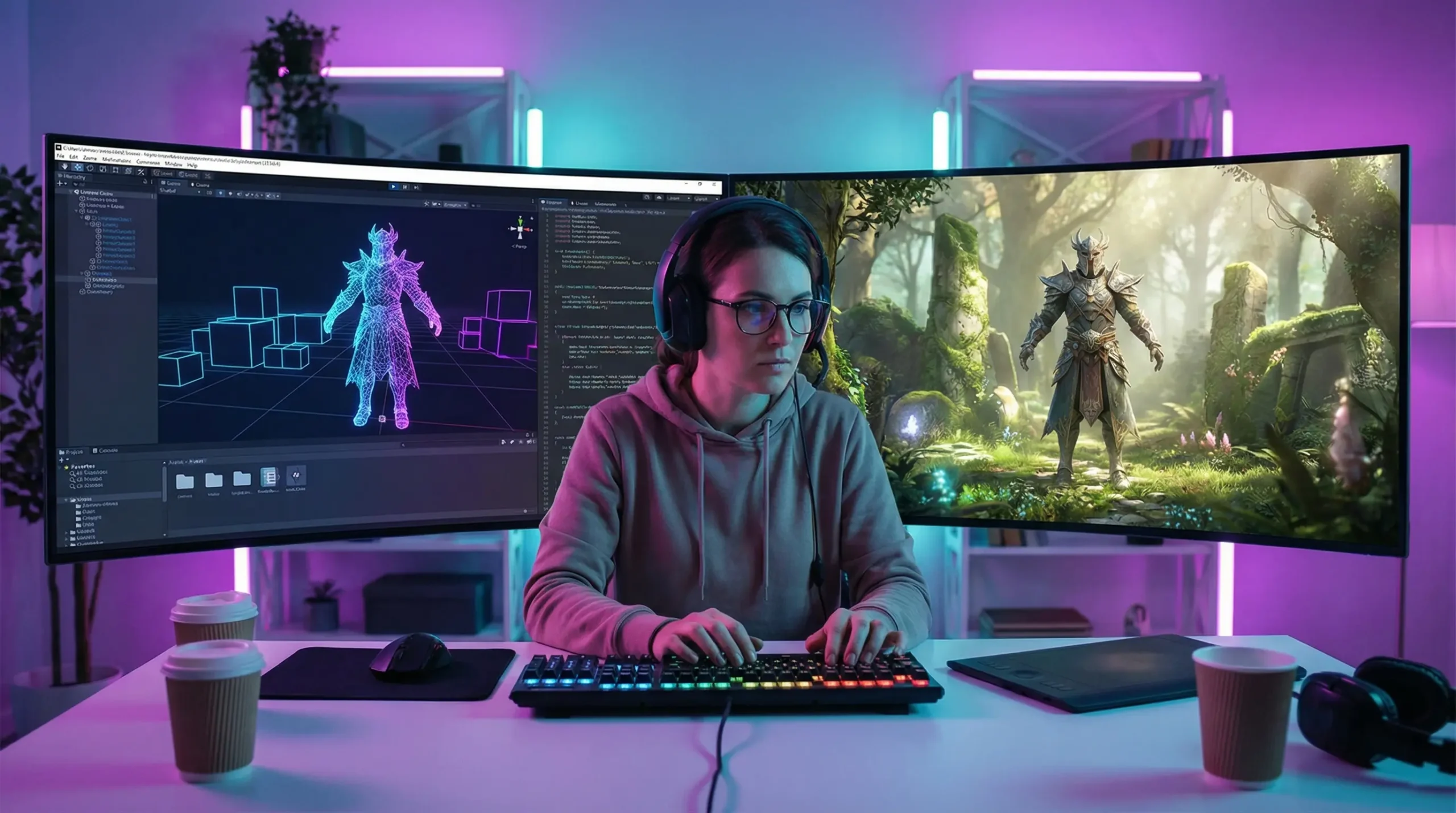
🎮 AI in game development is no longer optional — it’s the new baseline. This guide covers how 90% of developers are using AI in 2026, which tools leading studios rely on, and what the “gameslop” crisis taught the industry about doing this right.
Last Updated: June 2, 2026
AI in game development has crossed a decisive threshold in 2026. According to a Google Cloud survey conducted by The Harris Poll — spanning 615 developers across the United States, South Korea, Norway, Finland, and Sweden — 90% of game developers now integrate AI into their workflows, and 97% believe generative AI is fundamentally reshaping the industry. This is not a future projection. It is the current production reality at studios of every size, from solo indie developers to AAA publishers managing teams of hundreds. If you are searching for what AI in game development means in practice in 2026, the answer begins with three numbers: 90%, 50%, and 70–90% — the adoption rate, the studio activation rate, and the asset creation time reduction that AI tools are delivering right now.
The BCG 2026 Global Gaming Report confirms that approximately 50% of game studios now actively use AI in development — not just experimenting, but shipping games with AI in the pipeline. The GDC 2026 State of the Game Industry survey of over 2,300 professionals adds critical nuance: 36% of game industry professionals personally use generative AI tools as part of their job, with ChatGPT leading adoption at 74%, followed by Google Gemini at 37% and Microsoft Copilot at 22%. The gap between those numbers — 90% workflow integration vs. 36% hands-on use — reflects a mature adoption pattern where AI is embedded in pipelines even when individual developers do not touch it directly. For context on how this compares to the broader creative industry, see our guide to AI in entertainment and media.
This guide covers everything studios and developers need to understand about AI in game development in 2026: the key use cases driving adoption, the tools leading the market, the explosive growth of AI-powered NPCs, the hard lessons from the “gameslop” crisis, and a practical decision framework for studios of every size. The AI gaming market was valued at $4.37 billion in 2023 and is projected to reach $28.9 billion by 2030 at a CAGR of 26.1% — and a separate estimate from Persistence Market Research puts the broader AI in gaming market at $10.1 billion in 2026 alone, growing to $75.1 billion by 2033. Whether you are a solo developer trying to stretch your budget or an executive deciding how to modernize your studio’s pipeline, this guide will show you exactly where AI creates value — and where it creates risk.
📖 New to AI terminology? Visit the AI Buzz AI Glossary — 65+ essential AI terms explained in plain English, each linking to a full in-depth guide.
🎮 1. AI in Game Development in 2026: The State of the Industry in Three Numbers
The 2026 Game Development Reality: 90% of game developers now use AI in their workflows. AI tools reduce asset creation time by 70–90% and cut development costs by $100K–$500K per title. The question studios are asking in 2026 is not whether to use AI — it is how to use it without producing mediocrity at scale.
The three numbers that define AI in game development in 2026 are 90%, 50%, and 70–90%. Ninety percent of developers integrate AI into workflows. Fifty percent of studios actively use AI in production — not pilot programs, not conference demos, but shipped games. And AI tools reduce asset creation time by 70–90% compared to traditional pipelines, with average development cost savings of $100K–$500K per game title. These are not speculative projections — they represent current production reality confirmed by the BCG 2026 Global Gaming Report and the GDC 2026 State of the Game Industry survey of 2,300+ professionals.
The market context reinforces just how structural this transformation is. The AI game assets generator market alone is valued at $2.08 billion in 2026 and is projected to grow to $10.73 billion by 2035 — a fivefold expansion driven by demand across every game type and budget level. Meanwhile, 83% of gaming executives identify AI as a “top priority” for their three-year strategy. This is no longer speculative positioning; executives are committing capital and organizational change to AI adoption because the competitive disadvantage of not doing so is now measurable in development timelines and cost structures.
The productivity data tells a compelling story at the AAA level. Studios using AI tools in their full development pipeline are reporting that major updates ship weekly rather than monthly — a 10x acceleration in live-service content velocity. AAA studios save an average of $10M per title through AI-assisted QA, localization, NPC behavior, and asset generation. AI can reduce overall game development cycles from 24 months to 12 months in AAA contexts. These gains do not come from removing teams — they come from redirecting team effort from repetitive production work toward creative direction, quality control, and the distinctly human work of building games that connect with players. The same pattern is emerging across creative industries where AI handles production volume and humans handle direction.
🏭 2. How Studios Use AI in Game Development: Key Use Cases and 2026 Benchmarks
AI in game development is not a single tool or a single workflow — it spans the entire production pipeline from pre-production concept art to post-launch analytics. Understanding where AI creates the most value requires looking at each use case separately, because the ROI figures and adoption rates vary significantly by discipline. The GDC 2026 survey found that AI usage is most common for research and brainstorming (81% of AI-using professionals), daily workflow tasks and code assistance (47% each), and prototyping (35%). Asset generation, procedural generation, and player-facing features remain less common — at 19%, 10%, and 5% respectively — which tells a critical story about where the industry’s trust in AI currently sits.
Asset Creation and Concept Art: Fifty percent of game artists use AI tools like Midjourney for concept art brainstorming. Forty-five percent of UI/UX designers use AI for layout and icon prototyping. Forty-nine percent of studios use AI for asset optimization and texture compression. The practical impact: what previously required a full concept art department for weeks of iteration can now produce initial directions in hours. Unity Muse generated over one million assets in its first quarter of availability — confirming demand at scale. Importantly, the most effective studios use AI to multiply their artists’ output, not replace them: the human art director makes the decisions; AI generates the volumes of variations needed to support those decisions.
Quality Assurance and Bug Detection: AI bug detection tools found 85% more issues pre-release in Unity projects compared to traditional QA processes. This is one of the clearest ROI stories in game development because QA is historically labor-intensive and expensive, and bugs that escape to launch cause measurable reputational and revenue damage. AI-powered QA does not replace human testers — it handles the repetitive regression passes, the edge-case detection across thousands of asset combinations, and the anomaly flagging that frees human testers to focus on player-experience assessment that requires genuine judgment. For AAA studios shipping games at scale, the cost savings here alone can justify an AI tooling investment.
Voice, Localization, and Audio: AI voice synthesis tools like ElevenLabs are reducing localization costs by approximately 40% for multi-language releases. Replica Studios AI voices reduced voice recording sessions by 90% in projects where they have been deployed. Thirty-one percent of developers use AI for sound effect generation and Foley work. For studios releasing games across six or more language markets, the traditional localization pipeline — recording studios, voice talent, direction, re-recording — was a significant budget line and a timeline constraint. AI voice synthesis does not fully replace professional voice acting for hero characters and key narrative moments, but it has transformed the economics of background dialogue, ambient character lines, and localization variations.
🤖 3. AI-Powered NPCs: The Most Visible Transformation in 2026
The NPC Revolution: In 2026, 62% of new RPG and adventure games feature AI-powered NPCs — up from just 8% in 2024. Characters can now hold natural conversations, remember past player interactions, and respond in ways that were never pre-written. Static dialogue trees are becoming a signal of an underfunded game.
The most visible consumer-facing change in AI in game development in 2026 is the transformation of non-player characters. In 2024, just 8% of new RPG and adventure games featured AI-powered NPCs capable of dynamic conversation. In 2026, that figure has risen to 62% — one of the most dramatic adoption curves in game development history. This shift is being driven by tools like Inworld AI, which enables characters to hold natural conversations, maintain persistent memory of past player interactions, and respond in genuinely unscripted ways that no dialogue tree could anticipate. NPCs and Digital Humans now represent the largest single application segment in the AI gaming market, holding approximately 28.6% of market share in 2026 according to Persistence Market Research.
The player experience data confirms this shift is delivering real engagement value. AI-enhanced NPCs increased immersion scores by 40% in player feedback surveys. Personalized AI-driven story responses boosted average session times by 28% in RPG titles. Player retention in AI-procedural games is 3x higher after six months compared to games with static content. These are not marginal improvements — they represent a fundamental change in why players stay in a game. When an NPC remembers that you helped their family three sessions ago and references it unprompted, the game world stops feeling like a scripted stage set and starts feeling like a living environment. That emotional shift is what drives the long-term retention numbers.
NVIDIA Omniverse has played a significant role in advancing NPC development at the AAA level, with its AI training environment reducing NPC development time by 70% for studios using it for physics simulation and agent behavior modeling. The combination of faster NPC development and more engaging NPC behavior is compressing what was previously a multi-year luxury — building genuinely reactive characters — into a capability accessible to mid-size studios. The result is a visible quality gap opening between games with AI-powered characters and those still relying on traditional dialogue trees. Reviews in 2026 increasingly call out static NPC behavior as a negative — which was not a common criticism before AI-powered alternatives became widespread.
🌍 4. Procedural Generation and World Building With AI in 2026
Procedural world generation is one of the oldest applications of algorithmic thinking in games — but AI has transformed its ambition and output quality dramatically in 2026. Traditional procedural generation was rule-based and predictable: algorithms followed fixed parameters to produce content that often felt mechanical and repetitive. AI-driven procedural generation uses generative models trained on vast quantities of real game environments to produce content that feels authored rather than generated. Automated terrain generation tools can now create 100km-wide maps in under an hour — content that would require months of manual environment art work to produce at equivalent quality.
Fifty-one percent of developers intend to use AI for level design in the next two years, according to GDC 2026 survey data — a figure that reflects both the maturity of the tools and the confidence developers have built through early production deployments. Houdini SideFX AI tools are delivering level generation speeds 5x faster than traditional methods, making AAA-scale world building accessible to studios with AA budgets. The implications for open-world and live-service games are particularly significant: AI can generate content continuously at a pace that keeps up with player consumption, removing the bottleneck that has historically forced studios to ship incomplete worlds or pad content artificially.
Twenty-eight percent of studios now use generative AI to draft initial game design documents — using AI to generate initial structure, quest frameworks, and narrative threads that human designers then refine and develop. This is the “AI as first draft” workflow that is proving most durable: the AI produces at volume and speed, the human designer applies judgment and vision, and the output is better than either could produce alone. Integrating procedural content generation with reinforcement learning has, in some cases, doubled level creation speed for leading publishers — a figure that translates directly into shorter development cycles and lower production costs.
🛠️ 5. Best AI Tools for Game Development Studios in 2026: Compared
The AI game development tool landscape has matured into distinct categories in 2026: NPC intelligence, asset generation, code assistance, voice synthesis, QA automation, and analytics. The GDC 2026 survey confirms that ChatGPT leads adoption at 74% among game industry professionals who use AI, followed by Google Gemini at 37% and Microsoft Copilot at 22%. For a direct comparison of these general-purpose AI assistants, see our Claude vs ChatGPT vs Gemini comparison guide. But the most transformative tools in the gaming space are the specialized platforms built specifically for game development workflows — and these are where serious studios are focusing their investment in 2026.
Specialized tools like Inworld AI for NPC dialogue, ElevenLabs for voice synthesis, and NVIDIA Omniverse for NPC training and physics simulation are becoming standard in AAA pipelines. Unity’s AI ecosystem — particularly Unity Muse — is significant for the 30% of studios building on Unity: Muse generated over one million assets in its first quarter and integrates directly into the Unity editor, meaning AI tools are available in the environment developers already work in rather than requiring a separate workflow. Unity Muse AI tools represent the “AI embedded in your engine” approach that both Unreal and Unity are pursuing as their core AI strategy for 2026.
For indie and solo developers, the economics of AI tooling are particularly transformative. Buildbox AI’s no-code development tools enabled 20,000 new games in 2023 — a figure that demonstrates how AI is creating an entirely new category of developer who could not have shipped a game without these tools. Solo developers using a combination of Midjourney for concept art, ElevenLabs for voice, ChatGPT for scripting and dialogue, and Unity Muse for assets can now produce content that previously required departments. AI tool budgets range from $50–$100/month for solo developers to $200–$500/month for small studios — costs that are negligible relative to the production value they unlock.
| Tool | Category | Key Capability | Best For | Pricing Tier |
|---|---|---|---|---|
| Inworld AI | NPC Intelligence | Natural conversations, persistent memory, fully unscripted NPC responses | ✅ AAA studios building adaptive open-world NPCs | Enterprise pricing |
| NVIDIA Omniverse | Physics + NPC Training | Reduced NPC dev time 70%; AI physics simulation at AAA scale | ✅ AAA studios with GPU infrastructure | Enterprise / RTX GPU required |
| Unity Muse | In-Engine Asset Generation | 1M+ assets in Q1 2024; integrated directly into Unity editor | ✅ Unity developers at all studio sizes | Unity subscription ecosystem |
| ElevenLabs | Voice Synthesis | Multi-language synthesis; reduces recording sessions by 90%; 40% localization cost reduction | ✅ Studios shipping in multiple languages | From free tier / ~$11/month |
| Midjourney | Concept Art | Used by 50% of game artists for concept brainstorming; rapid style iteration | ✅ Art directors and concept artists at all levels | From $10/month |
| Buildbox AI | No-Code Development | Enabled 20K+ games in 2023; drag-and-drop AI-assisted game building | ✅ Solo developers and first-time creators | From free tier |
| ChatGPT (GPT-5.x) | General Dev AI | Coding, scripting, documentation, brainstorming; 74% adoption among AI-using game professionals | ✅ Across all game disciplines and studio sizes | Free / $20/month Pro |
| Houdini SideFX AI | Procedural Generation | Level generation 5x faster than traditional; terrain, environment, and world-building | ✅ AA/AAA environment artists and world builders | Pro / Indie pricing tiers |
Pricing as of June 2026 — verify before purchasing. Enterprise pricing requires direct vendor contact.
🏭 Exploring AI in your industry? Browse the AI Buzz Industry Guide — 35+ in-depth sector guides covering how AI is transforming healthcare, finance, HR, legal, retail, manufacturing, and more.
⚠️ 6. The “Gameslop” Problem: AI Ethics and Quality Control in 2026
The Gameslop Lesson: AI without skilled human curation produces mediocrity at scale. The studios succeeding with AI in 2026 are those who use it to amplify what their teams create — not those who use it to replace the teams entirely.
“Gameslop” is the term that emerged in 2025 for low-effort games assembled primarily from AI-generated assets with minimal human curation, creative direction, or design investment. Over 7,000 Steam titles disclosed AI use in 2025 — representing roughly one-third of all releases on the platform. A significant proportion of these were gameslop: games that used AI generation to produce surface-level content at speed without the human creative work that makes games meaningful. Player backlash was immediate and measurable: negative reviews, storefront curation pressure, and growing calls for stricter disclosure requirements. The consequence is a reputational shadow that now sits over AI-assisted development broadly — even for studios doing the work thoughtfully.
The GDC 2026 data captures the scale of industry concern. 52% of game industry professionals now believe generative AI is having a negative impact on the game industry — up from 30% in 2025 and just 18% the year before that. Workers in visual and technical art (64%), game design and narrative (63%), and game programming (59%) hold the most unfavorable views. Only 7% believe AI is having a positive impact on the industry, down from 13% in the GDC 2025 report. These figures reflect not abstract fear but direct, observed experience of what uncurated AI production looks like when it floods a market. The copyright implications for AI-generated game content have added further concern: the US Copyright Office confirmed that AI-generated content without meaningful human creative contribution cannot be protected by copyright — creating genuine legal uncertainty for studios whose pipelines depend heavily on AI generation without documented human direction.
The lesson the industry drew from the gameslop crisis is precise: AI is infrastructure, not an author. Ubisoft’s internal AI tool Ghostwriter illustrates the model that serious studios are adopting. Ghostwriter generates large volumes of incidental dialogue lines automatically — the kind of repetitive ambient character speech that would take writers months to produce manually. Human writers then review, select, refine, and direct. The creative work stays with the humans; the AI handles the production volume. This is the AI-assisted workflow that is producing quality results and earning player trust in 2026. Studios that treat AI as a replacement for human creativity are producing gameslop. Studios that treat AI as a multiplier for human creativity are producing the most ambitious games in development history. The difference is human direction — and according to enterprise AI in media and entertainment research from IBM, organizations that invest in AI governance and human oversight consistently outperform those deploying AI without structured oversight frameworks.
The job market is also shifting in response. According to Lorien Global’s analysis of GDC 2026 hiring data, “adaptability to AI tools is becoming a hiring prerequisite” in game development. Studios in 2026 are looking for professionals who can critically review AI-generated content, steer it toward a defined creative vision, and make confident decisions about what to keep and what to discard. Fluency with AI-assisted workflows is now as expected as fluency with the game engine itself. Understanding AI hallucinations and quality control — how AI systems can confidently produce plausible but wrong or low-quality outputs — is a directly applicable skill for any developer curating AI-generated game assets.
🎯 7. Game Engines in 2026: Where AI Integration Stands
The choice of game engine has always shaped what a developer can build. In 2026, it is also shaping what AI capabilities a developer can access. The GDC 2026 survey confirms that Unreal Engine leads primary engine adoption at 42%, followed by Unity at 30%, with proprietary in-house engines at 19% and Godot making notable gains among indie developers at approximately 5–11% depending on the survey. Both dominant commercial engines — Unreal and Unity — are integrating AI assistance directly into their core toolsets, meaning that AI support is increasingly built into the environment developers already work in rather than requiring a separate workflow layer.
Epic Games has extended Unreal Engine’s Blueprint system with AI plugins including MetaHuman Creator and an AI-Assisted Animation suite. These tools bring character creation and animation — historically among the most time-intensive elements of AAA development — into an AI-accelerated workflow inside the engine. Unity ML-Agents enables developers to embed reinforcement-learning agents directly into real-time 3D environments, and Unity Muse AI tools extend this with generative capabilities for textures, sprites, and animations. The practical effect is that a Unity or Unreal developer in 2026 has AI tools available at the point of creation rather than having to interrupt their workflow to access them externally.
Godot’s growing traction among indie developers reflects a broader shift in the economics of game development. With 35% of studios now relying primarily on self-funding (86% for solo developers) according to GDC 2026, cost constraints are directing developers toward free and open-source options. Godot’s AI tooling ecosystem is less mature than Unreal’s or Unity’s, but its community is building integrations rapidly, and the engine’s accessibility means that developers who cannot afford Unity or Unreal licensing costs are not excluded from AI-assisted development. Cloud infrastructure has also played a role: scalable compute now allows smaller studios to run complex AI models in real time without the GPU infrastructure investment that previously limited AI adoption to well-funded organizations.
🤖 8. AI Game Development Decision Framework: Which Tools Should Your Studio Use in 2026?
The right AI tool stack for game development depends on studio size, game genre, budget, and the specific production bottlenecks the studio faces. There is no universal answer — but there are clear patterns. Solo developers benefit most from AI in asset creation, voice, and code assistance, where a single person with AI tools can now produce content previously requiring full departments. Indie studios (2–10 people) find the highest ROI in concept art iteration, localization, and QA automation. AA studios use AI most effectively in NPC behavior, procedural world generation, and analytics. AAA studios are deploying AI as full pipeline infrastructure — with the savings at this scale averaging $10M per title.
The hybrid approach is the 2026 consensus across all studio sizes. No serious studio is replacing its entire production team with AI generators — the gameslop crisis demonstrated clearly what that produces. What successful studios are doing is identifying the specific workflow stages where AI creates the most value and deploying it with human oversight at those points. The 80/20 rule is common: AI generates 80% of background assets, props, variations, and item descriptions; human artists create the 20% of hero content that defines the game’s visual identity. This approach captures most of the time and cost savings while preserving the quality and distinctiveness that players respond to. Before selecting vendors, reviewing an AI Vendor Due Diligence Checklist is strongly recommended — especially for studios handling player data or integrating AI into customer-facing features.
The decision is also shaped by where your studio’s AI literacy currently sits. GDC 2026 found that upper management uses AI tools at 47% adoption, while individual contributors are at 29% — a gap that suggests many studios have leadership enthusiasm for AI without the team-level fluency to execute it well. The most important single investment a studio can make before adopting AI tooling is ensuring the team understands how to evaluate AI output, direct AI toward a defined creative vision, and recognize quality failures before they reach the game. Studios that invest in this AI literacy — not just in the tools — are the ones producing the results that the productivity data reflects.
| Studio Type | Primary AI Use Case | Recommended Tools | Expected Savings / Gain |
|---|---|---|---|
| Solo Developer | Asset generation, code assistance, voice synthesis | Midjourney, ChatGPT, ElevenLabs, Buildbox AI | ✅ 70–90% reduction in asset creation time; $50–100/month tool cost |
| Indie Studio (2–10) | Concept art, scripting, localization, QA | Midjourney, ChatGPT, Unity Muse, ElevenLabs | ✅ $100K–$500K development cost reduction per title |
| AA Studio (11–50) | NPC behavior, procedural worlds, analytics, bug detection | Inworld AI, Houdini SideFX, Unity Muse, ChatGPT | ✅ 10x faster update shipping cycle; 85% more bugs caught pre-release |
| AAA Studio (50+) | Full pipeline: QA, NPC AI, physics, localization, analytics | NVIDIA Omniverse, Inworld AI, ElevenLabs, proprietary tools | ✅ Average $10M savings per title; dev cycle from 24 to 12 months |
| Publisher / Marketing | Content creation, campaign analytics, social media | ChatGPT (74% adoption), Gemini, Microsoft Copilot | ✅ 35% higher ROI on marketing spend with AI analytics |
Tool recommendations as of June 2026. Actual savings depend on pipeline, team size, and implementation quality.
📊 9. The Numbers Studios Need to Know: AI in Gaming Market Data 2026
The market data for AI in gaming in 2026 tells a story of structural transformation rather than cyclical hype. The AI in gaming market is valued at $10.1 billion in 2026 according to Persistence Market Research, and is projected to grow to $75.1 billion by 2033 at a CAGR of 33.2%. A broader estimate from Grand View Research puts the AI in gaming market at $4.37 billion in 2023, growing to $28.9 billion by 2030 at 26.1% CAGR. Both projections confirm the same trajectory: this is a multi-decade structural shift in how games are built and how players experience them, not a software trend that will plateau in two years.
The AI game assets generator market specifically — covering the tools that produce textures, models, sprites, terrain, and other production assets — is valued at $2.08 billion in 2026 and is projected to reach $10.73 billion by 2035. This sub-market is particularly significant because asset creation has historically been the largest single cost category in game development, accounting for approximately 40% of total development time according to industry pipeline analysis. If AI reduces asset creation time by 70–90% as the data suggests, the financial implications for studio economics over the next decade are transformative. The global games market itself reached approximately $188.8 billion in 2025 according to Newzoo, confirming the scale of the industry in which these AI productivity gains are operating.
The investment side confirms strategic seriousness. Eighty-three percent of gaming executives identify AI as a top priority for their three-year strategy, and global spending on AI tools for gaming is growing at 23% per year. Strategic collaborations between AI research labs and game studios are producing proprietary tools that lower entry barriers for smaller studios. Google AI’s research into game development applications and the broader partnership ecosystem between technology companies and studios is accelerating tool development in ways that are compressing the capability gap between what AAA studios can build and what indie teams can access.
🏁 10. What AI in Game Development Means for the Next Era of Gaming
The studios that will define the next five years of gaming are not necessarily the ones with the largest budgets. They are the ones that understand how to deploy AI with skilled human direction — using AI to remove the production bottlenecks that have historically prevented talented teams from realizing their creative ambitions, while preserving the human judgment that makes games meaningful. The 2026 data confirms that AI in game development has moved from experiment to operational reality. The question is no longer whether to adopt AI — it is whether your studio can out-execute competitors who are already using it.
The gameslop crisis delivered a useful clarification. AI is a tool that amplifies what a team brings to it. Skilled teams using AI produce more and better work than they could without it. Teams without creative vision using AI produce volume without quality. This means the fundamentals of great game development — compelling design, strong narrative, distinctive art direction, genuine player empathy — have not been devalued by AI. They have become more important, because they are the differentiator that separates AI-amplified quality from AI-generated mediocrity. The studios investing in both AI tooling and human creative excellence are the ones positioned to lead. For those looking to evaluate specific tools, consulting an AI Vendor Due Diligence Checklist before committing to new vendors will help ensure that the tools your studio adopts meet the security, privacy, and contractual standards that protect both your IP and your players’ data.
📌 Key Takeaways
| Takeaway | |
|---|---|
| ✅ | 90% of game developers integrate AI into workflows in 2026, and 50% of studios actively use AI in production — confirmed by the BCG 2026 Global Gaming Report and Google Cloud/Harris Poll survey of 615 developers. |
| ✅ | AI tools reduce game asset creation time by 70–90% and cut development costs by $100K–$500K per title on average — with AAA studios saving an average of $10M per title across the full pipeline. |
| ✅ | 62% of new RPG and adventure games now feature AI-powered NPCs in 2026, up from just 8% in 2024 — making static dialogue trees increasingly rare and increasingly criticized in player reviews. |
| ✅ | ChatGPT is the most widely used AI tool among game professionals at 74% adoption, followed by Google Gemini at 37% and Microsoft Copilot at 22%, according to the GDC 2026 State of the Game Industry survey. |
| ✅ | The AI in gaming market is valued at $10.1 billion in 2026 and projected to reach $75.1 billion by 2033 at a 33.2% CAGR — confirming structural transformation rather than a short-term trend. |
| ✅ | The “gameslop” phenomenon — over 7,000 Steam titles disclosing AI use in 2025, many low-effort — caused measurable player backlash and is driving the 2026 consensus that AI requires skilled human curation to produce quality content. |
| ✅ | The US Copyright Office confirmed that AI-generated content without human creative contribution cannot be copyrighted — creating real legal risk for studios with AI-dependent pipelines that lack documented human creative direction. |
| ✅ | 52% of game industry professionals believe generative AI harms the industry (GDC 2026) — making human creative oversight, quality curation, and transparent AI disclosure the essential differentiators for studios that want to build player trust. |
🔗 Related Articles
- 📖 AI in Entertainment: How AI Is Changing Media and Creativity
- 📖 AI and Copyright: What Creators Should Know About AI-Generated Content
- 📖 Claude vs ChatGPT vs Gemini: Which AI Assistant Wins for Business in 2026?
- 📖 AI Hallucinations Explained: Why Chatbots “Make Things Up” and How to Reduce It
- 📖 AI Vendor Due Diligence Checklist: How to Evaluate AI Tools Before You Share Data
❓ Frequently Asked Questions: AI in Game Development
1. What percentage of game studios are using AI in 2026?
According to BCG’s 2026 Global Gaming Report, 50% of game studios now actively use AI in development. A broader Google Cloud/Harris Poll survey found 90% of developers integrate AI into workflows. The GDC 2026 State of the Game Industry puts personal generative AI use at 36% of professionals. For comparison across creative industries, see our AI in entertainment and media guide.
2. What is “gameslop” and how does it affect serious game developers?
Gameslop refers to low-effort games assembled primarily from AI-generated assets with minimal human curation. Over 7,000 Steam titles disclosed AI use in 2025 — many were gameslop. Player backlash and negative sentiment has made AI disclosure a reputational risk for all studios. Serious studios now emphasize human creative direction over AI generation. Our AI and copyright guide covers the copyright implications for AI-generated game content.
3. Can AI help indie developers compete with AAA studios?
Yes — this is the most significant shift in game development in 2026. AI tools reduce asset creation time by 70–90% and cut costs by $100K–$500K per title, enabling small teams to produce content previously requiring full departments. Solo developers using Midjourney, ElevenLabs, and Buildbox AI now create games that were previously impossible without a full studio. The AI in entertainment overview covers similar democratization trends across creative fields.
4. What AI tools are most popular among game developers in 2026?
ChatGPT is the most used AI tool in the game industry at 74% adoption, followed by Google Gemini at 37% and Microsoft Copilot at 22% (GDC 2026). Specialized tools include Inworld AI for NPC dialogue, NVIDIA Omniverse for physics and NPC training, Unity Muse for in-engine asset generation, and ElevenLabs for voice synthesis. Compare the general-purpose assistants in our Claude vs ChatGPT vs Gemini guide.
5. Does AI-generated game content qualify for copyright protection?
The US Copyright Office confirmed that AI-generated content without meaningful human creative contribution cannot be protected by copyright. Studios with AI-dependent pipelines face real legal uncertainty unless human creative direction is clearly documented throughout development. The AI generates; the human directs, curates, and owns. See our AI and copyright guide for the full legal breakdown including what “human creative contribution” means in practice.
📧 Get the AI Buzz Weekly Digest
Weekly AI insights, tools, and strategies — delivered every Monday. Free.




Leave a Reply