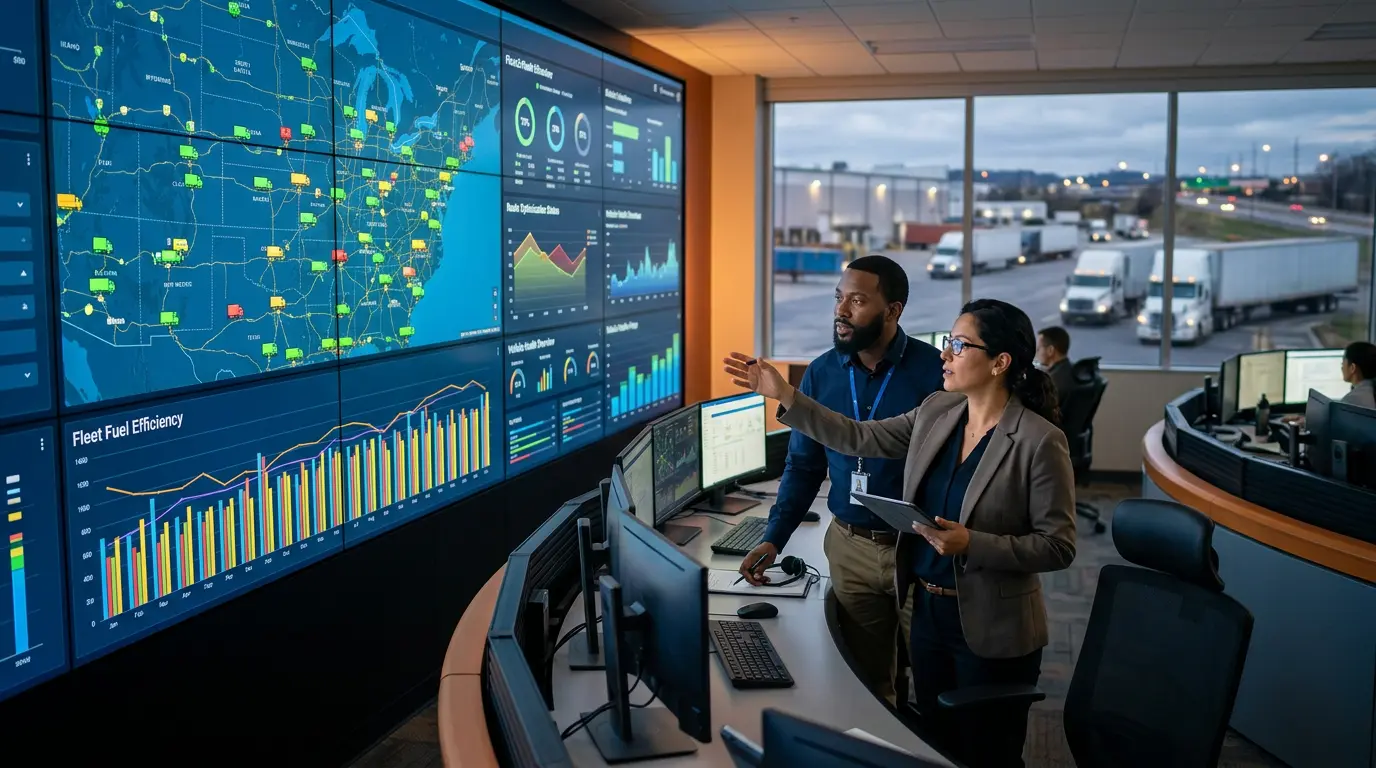
🚛 AI predictive maintenance catches 75% of fleet failures before they happen — yet 73% of fleets still run reactive maintenance programs that cost 3–5x more than planned repairs. This guide covers what AI does across every fleet function in 2026, the top platforms compared with verified pricing, EV fleet AI, and the ROI data every fleet operator needs.
Last Updated: June 6, 2026
AI in fleet management has moved from competitive advantage to operational baseline in 2026. McKinsey’s logistics research confirms that leading organizations achieve 10:1 to 30:1 ROI ratios within 12–18 months of AI fleet deployment — and the global AI fleet management market reached $32.2 billion in 2026, growing at 16.9% CAGR toward $122 billion by 2035. Yet only 5.6% of fleets have deployed AI across multiple functions simultaneously, and 73% still run reactive maintenance programs that cost 3–5x more than AI-assisted planned repairs. The gap between early adopters and the rest of the market is widening every quarter — and the competitive disadvantage of inaction is now measurable in dollars per vehicle per year. AI’s role in logistics and last-mile delivery provides the broader supply chain context for the fleet-specific applications covered in this guide.
This guide gives fleet operators, transport managers, and logistics leaders the complete 2026 picture of AI in fleet management. You will find a function-by-function breakdown of what AI does at each stage of fleet operations, a verified comparison of the six leading AI fleet management platforms with June 2026 pricing, a dedicated section on AI for EV fleets — the fastest-growing sub-category in the space — and the real ROI data that helps fleet operators build the business case for AI investment. Whether you manage 15 service vans or 5,000 long-haul trucks, the framework is the same: start with your highest-pain use case, deploy in 30–90 days, and expand from a proven ROI foundation. For the broader supply chain and logistics context in which fleet AI operates, our guide to AI in supply chains and logistics covers the end-to-end picture.
The 2026 fleet AI landscape is defined by three simultaneous shifts: capability maturation (AI now predicts component failures 20–45 days in advance with 85–95% accuracy after 6 months of learning), EV acceleration (the EV fleet management market is projected to reach $32.25 billion by 2030, with Amazon, DHL, FedEx, and UPS deploying thousands of electric vehicles supported by AI charge and route optimization), and platform consolidation (over 90% of new commercial vehicles now ship with factory-embedded telematics, making AI platforms accessible without hardware replacement). The fleet operator’s challenge in 2026 is not whether to adopt AI — that conversation is over. It is choosing which platform, starting with which use case, and building the governance framework to scale from there. Our guide to AI in transportation and smart cities covers the broader infrastructure context that shapes how fleet AI integrates with urban mobility systems.
📖 New to AI terminology? Visit the AI Buzz AI Glossary — 65+ essential AI terms explained in plain English, each linking to a full in-depth guide.
🚛 1. AI Fleet Management Use Cases — What AI Does Across Every Function
Fleet managers think in operational categories — not technology features. The table below maps AI capabilities directly onto the seven fleet management functions that account for the majority of operational cost and management time. It is followed by deeper dives on the three functions where AI is producing the most measurable impact in 2026 deployments.
| Fleet Function | What AI Does | Key Benefit (2026 Data) | Leading Tool |
|---|---|---|---|
| Predictive Maintenance | Continuously analyzes 200+ sensor data points per vehicle — engine temp, oil pressure, vibration patterns, fault codes — to predict component failures 20–45 days before they occur | ✅ 75% of failures caught before they happen; 25–35% reduction in maintenance costs; 70–85% fewer unplanned breakdowns; 3–6 month ROI payback | Samsara, Geotab, Motive, Fleetio ($5–10/vehicle/month) |
| Route Optimisation | Dynamically adjusts routes in real time using live traffic, weather, delivery window constraints, vehicle weight limits, and driver HOS; sequences stops for minimum distance while respecting all constraints | ✅ 10–15% fuel savings; 15–20% more stops per day; delivery window accuracy to 15 minutes; UPS ORION saves 100M+ miles/year and 10M gallons of fuel annually | Samsara, Geotab, Verizon Connect, dedicated routing tools (OptimoRoute, Route4Me) |
| Driver Behaviour Monitoring | AI dashcams and in-cab sensors score braking harshness, rapid acceleration, speeding, tailgating, phone use, and fatigue signals; generates automated coaching alerts and driver scorecards in real time | ✅ 73% crash rate reduction over 30 months (Samsara 2025, 2,600+ fleets); 52% fewer total accidents; 80% drop in distracted driving incidents within 90 days of AI dashcam deployment | Samsara (AI dashcams), Motive AI Dashcam Plus, Lytx (specialist video safety), Geotab GoTalk |
| Fuel Consumption Management | ML models correlate fuel usage with routes, driver behaviour, vehicle condition, and load weight to identify inefficient patterns; detects fuel theft via GPS-verified transaction anomalies; IFTA reporting automation | ✅ 15–25% fuel savings after full implementation; IFTA reporting automation saves 160–240 hours/year for OTR fleets; fuel theft detection typically recovers 2–5% of fuel spend | Motive Card (integrated fuel management + AI fraud detection), Samsara, Geotab, Intangles |
| Compliance and HOS Tracking | Automates FMCSA hours-of-service logging, DVIR inspection workflows, DOT compliance documentation, and regulatory report generation; proactively alerts drivers approaching HOS limits before violations occur | ✅ What took 4–8 hours of manual HOS administration now takes 30 minutes; near-elimination of logbook violations for AI-managed fleets; automatic DVIR documentation as a byproduct of daily operations | Motive (strongest ELD heritage), Samsara, Verizon Connect, Geotab — all FMCSA-certified ELD providers |
| Cargo and Load Optimisation | AI matches cargo loads with vehicle capacity profiles, plans efficient load distributions to minimize deadhead miles, flags under-utilisation and overloading risks, and optimises revenue per mile across the fleet | ✅ 10–20% improvement in asset utilisation; reduction in deadhead miles; 40% first-time-fix improvement when vehicles pre-loaded with predicted job-required parts based on dispatch AI | Samsara, TMS-integrated AI (Oracle, SAP TM), specialist load optimisation tools |
| EV Battery Management | AI monitors battery health and degradation trajectories; optimises charging schedules to balance grid demand costs, fleet readiness, and battery longevity; generates accurate real-world range predictions accounting for temperature, load, and route elevation | ✅ Smart charging reduces energy costs 40–60% vs unmanaged charging; AI extends battery pack lifespan 15–25%; range anxiety eliminated for 80–150 mile daily delivery routes with overnight depot charging | Geotab EVSA (EV Suitability Assessment), Samsara EV, Motive EV management, dedicated EV platforms (Vool, Polestar Fleet) |
The function table reveals the pattern that drives the highest AI fleet ROI in 2026: the use cases with the fastest payback are those with the highest frequency of measurable events — predictive maintenance alerts, route adjustments, driver behaviour incidents — where AI can act on data that human managers cannot process at scale. A fleet manager overseeing 100 vehicles cannot monitor 20,000+ daily data points per truck simultaneously. AI can. The fleets achieving 200–500% annual ROI on their AI deployments are typically deploying three to five of these capabilities simultaneously, with each reinforcing the others: a driver who is coached to reduce harsh braking also reduces brake pad wear and fuel consumption, which feeds directly into both the safety ROI and the maintenance ROI from the same underlying intervention.
The compliance and HOS tracking function deserves specific attention for its immediate, high-certainty ROI. Fleet operators subject to FMCSA regulations are legally required to maintain accurate HOS records. The choice is between manual paper logs (which require 4–8 hours of weekly administrative work per driver and are prone to error and violation risk) and AI-automated ELD compliance (which handles logging automatically, generates reports on demand, and alerts drivers before they approach violation thresholds). This is not optional for regulated carriers — it is a mandatory compliance cost where AI-assisted automation produces both time savings and regulatory risk reduction simultaneously. For fleet operators also managing warehouse and manufacturing operations, our guide to AI in manufacturing covers how AI-driven logistics and AI-driven production planning can be coordinated across the supply chain.
🛠️ 2. Top AI Fleet Management Platforms Compared (2026)
The fleet management platform market in 2026 has a clear structure: three enterprise platforms (Samsara, Geotab, Verizon Connect) compete for large fleet contracts, two mid-market specialists (Motive, Fleet Complete) serve trucking and compliance-heavy operators, and one value-focused option (Azuga, now owned by Bridgestone) serves cost-conscious fleets prioritizing driver scoring. The critical pricing caveat for this market: four of the six platforms below do not publish pricing on their websites, and all require sales calls for quotes. The figures below are sourced from third-party review platforms (G2, Capterra), published government contracts, and independent pricing surveys conducted through March–May 2026. Always verify current pricing directly with each vendor — and scrutinize contract term lengths and early termination penalties before signing.
The 2026 Fleet Platform Contract Reality: Samsara requires a 36-month minimum contract with full remaining balance due on early termination. A 100-vehicle fleet at $33/vehicle/month exiting after year one owes approximately $79,200 in early termination penalties. Review contract exit terms as carefully as feature lists before any enterprise fleet platform commitment.
| Platform | Best For | Key AI Feature | Fleet Size | Starting Price (June 2026) | Contract Term |
|---|---|---|---|---|---|
| Samsara | Mid-to-large fleets (50+ vehicles) needing AI dashcams, ELD, and unified platform with broad asset tracking | AI dash cameras with real-time distracted driving, phone use, and drowsiness detection; “Coach” AI-powered driver coaching system; AI predictive vehicle diagnostics; EV suitability tools | 50–5,000+ | $27–33/vehicle/month (GPS basic); $40–60/vehicle/month with AI dashcams (3-year contract). Hardware: $99–148/vehicle GPS + $200–400/vehicle AI dashcam | ⚠️ 36-month minimum; full balance on early exit |
| Geotab | Data-driven fleets needing deep analytics, open API ecosystem, and EV fleet transition planning; government and enterprise fleets | Open platform with 3,800+ marketplace integrations; EV Suitability Assessment (EVSA) identifying which routes and vehicles are viable for electrification; deepest telematics data per vehicle; 4.7M+ vehicles tracked globally | Any size; sold via resellers | $20–35/vehicle/month (varies by reseller; hardware $100–200/vehicle). Lower cost entry than Samsara but configuration time higher | ⚠️ Varies by reseller — verify before signing |
| Verizon Connect | SMB to enterprise fleets needing carrier-grade infrastructure and the broadest ERP/TMS integration ecosystem | Strong route optimisation and dispatch AI; broadest third-party system integrations; carrier-backed network reliability; FMCSA-certified ELD; solid HOS compliance automation | 10–5,000+ | $25–40/vehicle/month; hardware $150–300/vehicle. Lowest floor price but lowest satisfaction scores (3.8/5 G2) | ⚠️ Multi-year contracts standard |
| Motive (KeepTruckin) | Trucking and logistics fleets prioritizing ELD compliance, driver safety, and integrated fleet card spend management | Strongest ELD heritage in the category; AI Dashcam Plus detects lane swerving, unsafe lane changes, and smoking (capabilities Samsara lacks); Motive Card integrates telematics + spend management + AI fraud detection with $250K fraud guarantee | Owner-operators to large enterprise | $25–35/vehicle/month; more flexible contract options than Samsara (annual + month-to-month available). ROI reported 40% faster than Samsara in customer data | ✅ More flexible — annual / multi-year with month-to-month available |
| Fleet Complete | Mid-market Canadian and North American fleets needing compliance-first management with strong HOS and DVIR workflows | Compliance-focused AI with automated inspection workflows; solid ELD for Canadian/US dual-jurisdiction fleets; integrated asset tracking beyond vehicles (equipment, trailers); AI driver scoring | 15–500 vehicles | Custom pricing (contact for quote); mid-market positioning places it below Samsara enterprise rates. Hardware bundled | ⚠️ Multi-year standard; verify terms |
| Azuga (Bridgestone) | Cost-conscious SMB fleets wanting driver scoring with gamification elements; the most flexible contract terms in the category | Driver scoring with rewards and gamification to improve behaviour through positive reinforcement rather than just alerts; solid GPS tracking; the only major platform with publicly confirmed starting price ($25/vehicle/month for CompleteFleet) and most flexible cancellation terms | 5–200 vehicles | $25/vehicle/month (publicly confirmed CompleteFleet). Most transparent pricing in the category | ✅ Most flexible — no long-term contract lock-in for standard plans |
Pricing sourced from G2, Capterra, published customer reports, and independent fleet tracking pricing surveys (March–May 2026). Samsara, Motive, Verizon Connect, and Fleet Complete do not publish pricing on their websites — contact each vendor to confirm current rates for your fleet size. All figures are directional; real-world costs vary significantly by fleet size, feature set, and negotiation. Verify contract terms and early termination penalties before signing.
The platform selection framework that consistently produces the best outcomes in 2026 fleet AI deployments is use-case-first, not feature-first. If AI video safety is your primary requirement — you need to document accidents, reduce insurance premiums, and coach drivers on specific unsafe behaviors — Samsara leads on camera capability, with Motive as the closest alternative with more flexible contract terms. If data depth and EV transition planning are the priority — you need to identify which vehicles and routes are viable for electrification and build a multi-year transition roadmap — Geotab’s EVSA capability and open platform architecture are the strongest choice. If ELD compliance and integrated fleet card spend management are central — you are a trucking operator managing HOS, DVIR, and fuel fraud simultaneously — Motive’s purpose-built trucking heritage and Motive Card integration produce the fastest time-to-value. For the governance framework to evaluate any of these vendors before committing to a multi-year contract, our AI vendor due diligence checklist covers the security, data governance, and contractual controls that enterprise fleet operators must review.
🏭 Exploring AI in your industry? Browse the AI Buzz Industry Guide — 35+ in-depth sector guides covering how AI is transforming healthcare, finance, HR, legal, retail, manufacturing, and more.
⚡ 3. AI for EV Fleets — The New Priority in 2026
Electric vehicle fleet management is the fastest-growing sub-category in fleet AI in 2026, driven by three simultaneous forces: accelerating EV adoption by major logistics operators, escalating energy cost complexity that makes AI-optimised charging economically essential, and the fundamental operational difference between managing an EV fleet and managing a diesel fleet. The EV fleet management market is projected to grow from $9.1 billion in 2025 to $32.25 billion by 2030, with transportation and logistics commanding an 18% market share. Amazon, DHL, FedEx, and UPS are deploying thousands of electric delivery vehicles specifically because last-mile delivery economics favor EVs — short routes, frequent stops, and return-to-depot patterns that enable overnight charging at 100% capacity every morning, eliminating mid-route charging requirements for typical 80–150 mile daily delivery windows. Managing these vehicles effectively without AI-specific EV fleet management tools is, as one industry specialist put it, “like managing a diesel fleet without GPS — technically possible, operationally painful.”
AI battery health monitoring and degradation prediction is the EV equivalent of predictive maintenance for combustion engine vehicles — and it is significantly more complex. EV battery packs degrade in ways that depend not just on mileage but on charging patterns, temperature exposure, depth-of-discharge cycles, and the specific chemistry of the battery cells. AI models monitoring these parameters continuously can predict battery degradation trajectories with sufficient accuracy to guide both operational decisions (which vehicle to assign to a range-critical route today) and capital planning decisions (which vehicles will need battery replacement in the next 18 months, and at what projected cost). Geotab’s EVSA capability, which assessed over 230,000 vehicles across Enterprise Fleet Management’s customer base to identify which 41% of light-duty vehicles could be economically electrified with average TCO savings of $15,900 per vehicle over the ownership lifecycle, represents the current state of the art in AI-powered EV transition planning.
AI-optimised charging schedule management is where the economic case for EV fleet AI is most immediately compelling. Unmanaged charging — plugging every vehicle in at shift end when it arrives at the depot — creates simultaneous demand spikes that trigger utility demand charges that can double the effective cost of electricity. AI charging management systems stagger charging schedules across the fleet to flatten the demand curve, prioritize charging for vehicles with the earliest next dispatch, reduce energy consumption during peak tariff windows, and coordinate with utility smart grid signals to exploit overnight off-peak rates. The result: smart charge scheduling reduces energy costs 40–60% compared to unmanaged charging — a saving that compounds across every vehicle in the fleet for every operating day. AI models that factor in temperature, load weight, route elevation, traffic patterns, and real battery health to generate accurate real-world range predictions also eliminate the operational uncertainty — “range anxiety” — that historically made fleet managers cautious about EV assignment to important routes. When the AI can tell a dispatcher with confidence that Vehicle 47 has 143 miles of real-world range available in current weather and load conditions, the decision to assign it to a 120-mile route is no longer a source of operational risk.
The companies leading EV fleet AI deployment in 2026 are also the largest fleet operators globally. Amazon has committed to deploying 100,000 electric delivery vehicles from Rivian across its US delivery network, supported by AI-driven route optimisation and charging management. DHL is deploying electric vehicles across its European and US last-mile networks, using AI to optimise route-level charge assignments and manage mixed EV/diesel fleet scheduling. UPS’s ORION AI routing system — which already saves 100 million miles driven and 10 million gallons of fuel annually — has been extended to handle EV-specific range and charging constraints for its growing EV delivery fleet. For fleet operators earlier in their EV transition journey, Geotab’s EVSA tool provides the data-driven framework to identify which specific routes, vehicle types, and operational patterns in your existing fleet are viable for electrification today — and which require infrastructure investment before conversion becomes economically justified.
📊 4. What ROI Can Fleet Operators Expect from AI?
The ROI case for AI in fleet management in 2026 is among the most well-documented in enterprise technology. Unlike many AI applications where outcomes depend heavily on implementation quality and change management, fleet AI ROI is driven primarily by measurable physical events — prevented breakdowns, avoided accidents, reduced fuel burn — that are straightforwardly quantifiable in dollar terms. The benchmarks below are drawn from documented 2025–2026 fleet deployments and industry research, not vendor marketing projections.
Predictive Maintenance ROI. McKinsey research confirms that leading organizations achieve 10:1 to 30:1 ROI ratios within 12–18 months of AI predictive maintenance deployment. Documented fleet outcomes include: 25–35% reduction in overall maintenance costs; 70–85% fewer unplanned breakdowns; and 10–40% lower downtime hours. In one documented case, a 35-vehicle construction fleet reduced annual maintenance spend from $620,000 to $410,000 — a $210,000 saving that paid for the AI system three times over in year one. A 250-vehicle fleet achieved $1.8 million in annual savings combining a 30% maintenance cost reduction with a 45% downtime decrease. The mechanism is straightforward: AI predicts failures 20–45 days in advance, enabling planned workshop repairs at standard shop rates rather than emergency roadside repairs with premium labor, towing costs, and rental vehicle replacements. Maintenance now accounts for 27% of fleet lifecycle costs — the highest share in a decade — making this the single highest-ROI AI use case for most fleet operators. Year-two ROI typically runs 30–40% higher than year one as the AI model accumulates fleet-specific failure history and reaches peak prediction accuracy.
Fuel Savings ROI. Route optimisation and driver behaviour monitoring are the two complementary mechanisms through which AI reduces fuel costs. Industry benchmarks consistently place average fleet fuel savings between 15% and 25% after implementing active monitoring, driver coaching, idling reduction, and route optimisation. Given that fuel accounts for 30–40% of total fleet operating costs, a 15% fuel reduction on a 100-vehicle fleet spending $800,000 annually on diesel produces $120,000 in annual fuel savings — before accounting for reduced tyre wear, brake wear, and maintenance costs from the driver behaviour improvements that accompany fuel optimisation. UPS ORION’s documented outcome — saving over 100 million miles driven and 10 million gallons of fuel per year — demonstrates the scale achievable with enterprise-level AI route optimisation. For smaller fleets, Iron Range Express, a 72-truck long-haul carrier, achieved 22% fuel optimisation saving over $347,000 in their first year with AI fuel management.
Safety and Insurance ROI. AI video telematics and driver coaching programs produce the most dramatic percentage improvements of any fleet AI use case. Fleets using full AI safety solutions — dual-facing dashcams, in-cab alerts, and driver coaching — achieved a 73% crash rate reduction over 30 months, according to Samsara’s 2025 industry report based on data from over 2,600 fleets and billions of miles driven. AI video telematics delivers 52% fewer total accidents, and distracted driving incidents drop 80% within the first 90 days of AI dashcam deployment. The insurance premium impact of documented accident rate reductions is significant: most carriers offer 10–25% premium reductions to fleets that can demonstrate AI-managed driver scoring programs with documented safety improvement trajectories. For a 100-vehicle fleet paying $3,000 per vehicle in annual insurance premiums, a 20% reduction saves $60,000 per year — which alone often justifies the AI platform cost. Motive documented a 30% year-over-year reduction in accident and damage event frequency and a 35% reduction in accident and vehicle damage spend across a deployment of 4,500 vehicles for one operator.
The 2026 Fleet AI ROI Standard: A 50-vehicle fleet deploying AI predictive maintenance, route optimisation, and driver safety monitoring should conservatively expect $40,000–$70,000 in annual combined savings from fuel reduction, maintenance cost reduction, insurance premium reduction, and accident cost avoidance — against a first-year platform investment of $15,000–$30,000 for software and hardware. That is a 2:1 to 4:1 first-year ROI, compounding as AI models improve with fleet-specific learning in years two and three. 65% of maintenance teams plan AI adoption by end of 2026; the 27% already using it are reporting 45% fewer breakdowns and 25% lower maintenance costs.
🤖 5. AI Fleet Management Decision Framework: Where to Start
The most common mistake fleet operators make when approaching AI adoption is trying to deploy across all seven functions simultaneously. The fleets achieving the highest ROI in 2026 consistently deploy one use case first, measure results rigorously within 30–90 days, build organizational trust in the AI recommendations, and then expand to adjacent capabilities. The decision framework below is designed to identify the highest-ROI starting point for your specific fleet profile.
| ✅ | Your Fleet Profile | Start With | Expected First-Quarter Result |
|---|---|---|---|
| 1 | High breakdown rate; reactive maintenance is your biggest cost and operational pain point | Predictive maintenance (Fleetio $5–10/vehicle/month or Samsara/Geotab diagnostics layer) | First actionable failure predictions within 72 hours; measurable reduction in emergency repairs within 30 days; documented cost savings vs baseline by day 90 |
| 2 | High at-fault accident rate; insurance premiums rising; driver behaviour is a safety and cost concern | AI dashcams + driver coaching (Samsara or Motive AI Dashcam Plus) | 80% reduction in distracted driving incidents within 90 days; documented safety improvement for insurance negotiation; driver score improvement across fleet |
| 3 | Trucking operator; ELD compliance, HOS management, and DVIR are primary regulatory obligations | Motive (strongest ELD heritage; FMCSA-certified; AI HOS management + Motive Card for fuel fraud detection) | HOS administration from 4–8 hours/week to 30 minutes/week immediately; near-zero logbook violations; fuel fraud detection active within first billing cycle |
| 4 | High fuel costs; drivers have inconsistent behaviour across routes; no current fuel analytics visibility | Route optimisation + fuel monitoring (Samsara, Geotab, or dedicated routing tools) | 10–15% fuel savings visible within first quarter; driver fuel efficiency rankings enable targeted coaching; idle time reduction measurable from week one |
| 5 | Transitioning to or planning EV fleet deployment; need to identify which vehicles/routes to electrify first | Geotab EVSA (EV Suitability Assessment) — identifies viable electrification candidates and models TCO savings per vehicle before capital commitment | Data-driven EV transition roadmap identifying which vehicles deliver maximum ROI from electrification; estimated TCO savings per vehicle for procurement planning |
| 6 | Small fleet (5–50 vehicles); budget is the primary constraint; need real AI capability without enterprise pricing or 3-year contracts | Azuga ($25/vehicle/month, most flexible contracts) or Fleetio ($5–10/vehicle/month, maintenance-first) | Core GPS, driver scoring, and maintenance tracking operational within days; meaningful ROI on first prevented breakdown or accident; no long-term contract risk |
The framework above reflects a consistent finding from 2026 fleet AI deployments: the highest ROI implementations start narrow, prove value fast, and then expand systematically. Fuel savings from route optimisation typically emerge within weeks. Maintenance cost reductions require 2–3 months as predictive models build vehicle-specific baseline patterns. Safety improvements appear within 30–90 days of AI dashcam deployment. Organizations that begin with the use case most directly connected to their biggest current operational pain point consistently achieve faster adoption, higher staff trust in AI recommendations, and stronger first-year ROI than those that attempt comprehensive deployment across all capabilities simultaneously.
🏁 6. Conclusion
The case for AI in fleet management in 2026 is built on documented outcomes rather than vendor promises. A 35-vehicle construction fleet reducing annual maintenance spend by $210,000 in year one. A 72-truck carrier saving $347,000 in fuel in its first year with AI fuel management. A 4,500-vehicle operator achieving 30% year-over-year reduction in accident frequency. These are not projections — they are the baseline results that fleets implementing AI predictive maintenance, route optimisation, and AI-assisted driver coaching are consistently achieving. The 73% of fleets still running reactive maintenance programs are, by the industry’s own data, paying $3,500–$6,200 per vehicle annually in excess costs compared to competitors who have adopted AI. That gap compounds every quarter.
The starting point in 2026 is straightforward: identify your fleet’s single highest-cost operational pain point, deploy an AI tool that addresses that specific function, measure results against your pre-AI baseline within 90 days, and expand from a proven ROI foundation. Over 90% of new commercial vehicles now ship with factory-embedded telematics — the data infrastructure required for AI fleet management is already present in most modern fleets, requiring software integration rather than hardware replacement. The platforms have matured. The ROI data is documented. The only remaining question is when your organisation will close the gap between where AI fleet management is today and where your competitors are already operating.
📌 Key Takeaways
| ✅ | Takeaway |
|---|---|
| ✅ | AI predictive maintenance catches 75% of fleet failures before they happen and delivers 25–35% maintenance cost reduction; 73% of fleets still run reactive maintenance programs that cost 3–5x more than AI-assisted planned repairs (Fleet Benchmark Report 2026). |
| ✅ | AI route optimisation delivers 10–15% fuel savings and 15–20% more stops per day; UPS ORION saves over 100 million miles driven and 10 million gallons of fuel annually — and industry benchmarks place total fuel savings from AI at 15–25% after full implementation. |
| ✅ | AI dashcam and driver coaching programs achieve 73% crash rate reduction over 30 months (Samsara 2025, 2,600+ fleets, billions of miles); 80% drop in distracted driving incidents within 90 days — the fastest-demonstrating ROI category in fleet AI. |
| ✅ | Samsara leads on AI camera capability and unified platform ($27–60/vehicle/month; 36-month contract); Geotab leads on data depth, open integrations, and EV transition planning ($20–35/vehicle/month); Motive leads on ELD compliance heritage, trucking-specific AI, and contract flexibility ($25–35/vehicle/month). |
| ✅ | The EV fleet management market is projected to grow from $9.1 billion in 2025 to $32.25 billion by 2030; AI smart charging reduces energy costs 40–60% versus unmanaged charging; Geotab’s EVSA analysis of 230,000 vehicles identified 41% as viable for electrification with average TCO savings of $15,900/vehicle. |
| ✅ | A 50-vehicle fleet deploying AI predictive maintenance, route optimisation, and driver safety monitoring should conservatively expect $40,000–$70,000 in annual combined savings against a $15,000–$30,000 first-year platform investment — a 2:1 to 4:1 first-year ROI, improving in years two and three. |
| ✅ | Review Samsara’s 36-month minimum contract and full remaining balance early termination penalty before committing at scale. Motive and Azuga offer more flexible contract terms for fleets that want AI capability without multi-year lock-in risk. |
🔗 Related Articles
- 📖 AI in Logistics: How Companies Are Using AI to Optimise Routes, Manage Fleets, and Run Smarter Warehouses
- 📖 AI in Supply Chains and Logistics: How AI Improves Demand Forecasting, Inventory, and Delivery
- 📖 AI in Transportation and Smart Cities: Shaping the Future of Mobility
- 📖 AI in Manufacturing: How AI Powers Smart Factories and Predictive Maintenance
- 📖 AI Vendor Due Diligence Checklist: How to Evaluate AI Tools Before You Share Data
❓ Frequently Asked Questions: AI in Fleet Management
1. What is the ROI of AI fleet management in 2026?
Documented outcomes show 10:1 to 30:1 ROI ratios within 12–18 months for predictive maintenance alone (McKinsey research). A 50-vehicle fleet should conservatively expect $40,000–$70,000 in annual combined savings from maintenance cost reduction (25–35%), fuel savings (10–15%), and accident cost reduction — against a first-year platform investment of $15,000–$30,000. Most fleets see positive ROI within 3–6 months, with payback often occurring on the first prevented major breakdown. Our AI in logistics guide covers how fleet AI integrates with broader supply chain optimization.
2. Which is better for fleet management — Samsara or Geotab in 2026?
Choose Samsara if AI dashcam safety, unified platform breadth, and quick setup are your priority ($27–60/vehicle/month; 36-month contract with strict exit terms). Choose Geotab if deep data analytics, open platform integrations (3,800+ marketplace integrations), EV suitability planning, and lower per-vehicle cost are your priority ($20–35/vehicle/month via resellers). For trucking fleets where ELD compliance and HOS are the primary concern, Motive’s purpose-built trucking heritage and more flexible contract terms often produce faster ROI. Use our AI vendor due diligence checklist before signing any multi-year fleet management contract.
3. How is AI used in EV fleet management?
AI manages four distinct EV-specific challenges: battery health monitoring (tracking degradation trajectories to predict when packs need replacement); charging schedule optimisation (staggering charging to reduce demand charges and exploit off-peak rates — saving 40–60% on energy costs vs unmanaged charging); real-world range prediction (factoring temperature, load, elevation, and battery health for accurate range estimates that eliminate range anxiety); and EV transition planning (Geotab’s EVSA tool assesses which routes and vehicles in your existing fleet are viable for electrification with documented TCO savings). See our AI in transportation and smart cities guide for the urban infrastructure context.
4. What does AI fleet management software cost in 2026?
Fleet management software costs between $20 and $60 per vehicle per month in 2026, depending on features and provider. Entry-level GPS tracking with basic AI: $8–25/vehicle/month (Azuga at $25/vehicle/month is the most price-transparent major platform). Mid-tier with AI dashcams and maintenance: $35–45/vehicle/month (Samsara, Motive). Full enterprise AI suite with dashcams, ELD, and analytics: $45–60/vehicle/month. Hardware adds $100–400/vehicle upfront. Most enterprise platforms do not publish pricing — budget $25,000–$54,000 over 3 years for a 25-vehicle Samsara deployment (software only; before hardware and installation). Always verify contract terms before committing.
5. How quickly does AI predictive maintenance start working?
AI predictive maintenance platforms typically build vehicle baselines within 24 hours of connection and generate first actionable failure predictions within 72 hours. Measurable reductions in emergency repair frequency typically appear within 30 days. Full maintenance cost ROI — where cost savings exceed platform cost — is typically visible within the first quarter for high-utilization fleets. Model accuracy improves continuously: expect 70–75% accuracy in month one, improving to 85–92% by month three as the AI learns your fleet’s specific patterns. Over 90% of new commercial vehicles now ship with factory telematics — no hardware replacement is typically required to start. See our AI in supply chains guide for how fleet predictive maintenance integrates with broader supply chain planning.
📧 Get the AI Buzz Weekly Digest
Weekly AI insights, tools, and strategies — delivered every Monday. Free.




Leave a Reply