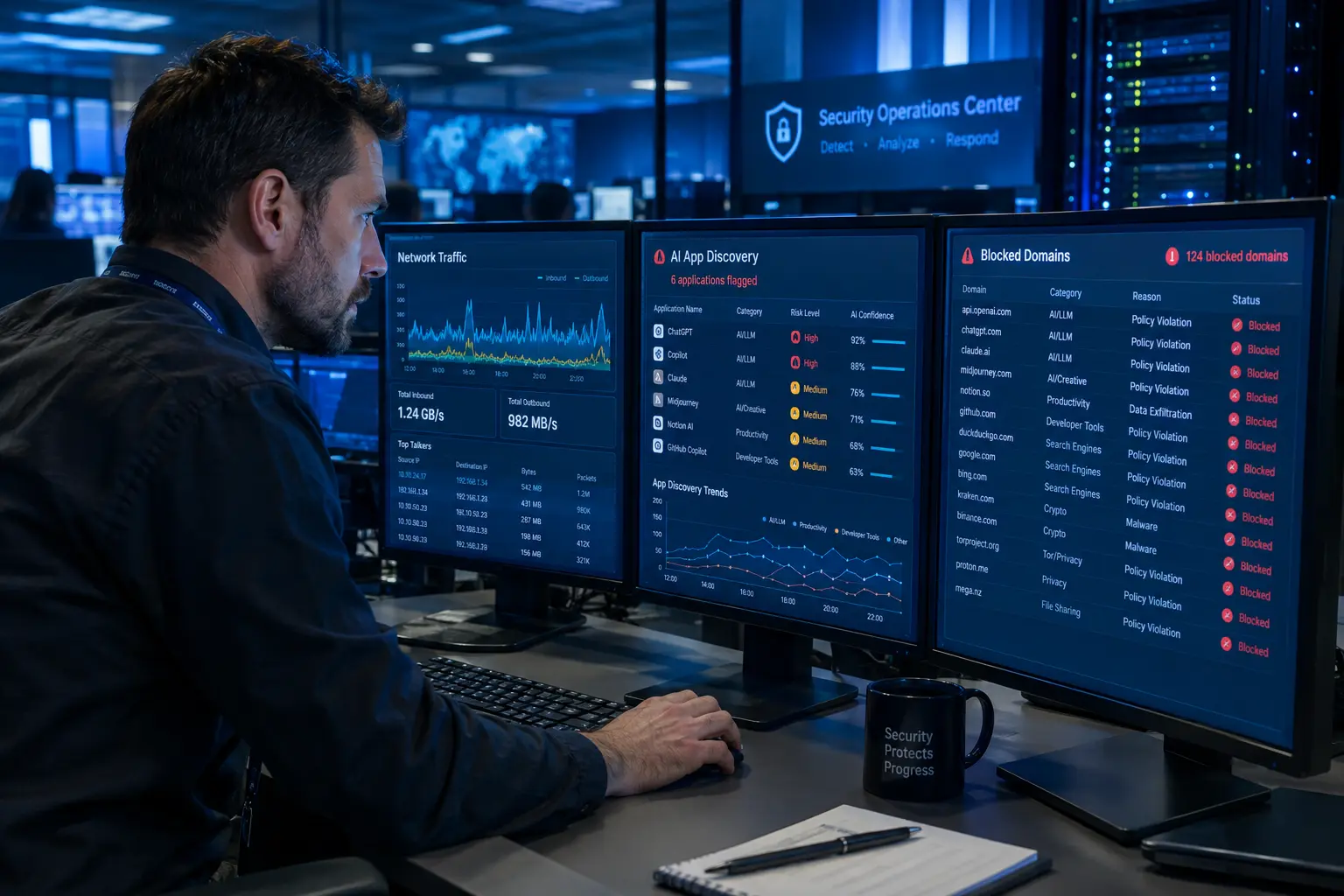
Start Here: This is an operational runbook, not a general overview. It assumes your organisation already understands what shadow AI is. If you need a foundation first, read our complete Shadow AI guide before working through this runbook.
Last Updated: November 20, 2026
Shadow AI is not a theoretical problem. The 2026 Verizon Data Breach Investigations Report found that 45% of employees use AI on corporate devices, up from 15% a year earlier, and 67% of that access runs through personal, non-corporate accounts. That means the majority of your exposure sits in a blind spot that your existing tooling was never built to see. The question is no longer whether your employees are using unapproved AI — they are. The question is whether you can find out exactly which tools, which users, and which data before an examiner, an auditor, or an incident does it for you.
The fundamental challenge is that shadow AI does not behave like traditional shadow IT. Traditional shadow IT leaves recognisable signatures: known SaaS domains, predictable API patterns, and catalogued app fingerprints that CASB tools can flag. Shadow AI traffic routes through API endpoints to AI providers, often over HTTPS, blending into legitimate browser traffic. That routing behaviour is what makes a single-tool detection approach so dangerous — each tool sees one slice of the problem and nothing more.
This runbook gives your IT security team a structured, week-by-week discovery programme. It covers all five detection signal families — network and DNS, CASB, DLP, browser telemetry, and OAuth/identity grants — explains precisely what each layer sees and misses, and delivers a 30-60-90 day enforcement progression that moves from visibility to governance without triggering the employee resistance that blanket-block policies consistently produce. By the end, you will have a named AI tool inventory, a risk-tiered application register, and a policy enforcement posture calibrated to your data classification framework.
New to AI security terminology?
Our AI Glossary covers 100+ essential AI terms — including CASB, DLP, non-human identity, and agentic AI — in plain language.
1. 🧩 Why Standard CASB and DLP Miss Most Shadow AI
Before configuring a single policy, your team needs an accurate model of what each detection layer actually sees. Miscalibrated confidence in CASB or DLP alone is the most common reason shadow AI discovery programmes stall after the first 30 days.
Shadow AI detection is a layered problem. Network and CASB tools reveal which AI destinations traffic flows to. DLP engines inspect what content is leaving. Neither tells the full story on its own.
The specific blind spots are predictable and consistent across vendor implementations. A CASB sees traffic to known AI domains and sanctioned apps, and EDR sees AI apps and processes running on a device. Neither sees what data went into a prompt on a personal account, and neither sees an AI agent acting through an OAuth grant or a human’s browser session. This is the gap that most discovery programmes underestimate.
The browser extension problem compounds the CASB blind spot further. Browser extensions for AI tools like Grammarly, Compose AI, and Otter.ai operate inside the browser context and can read page content, clipboard data, and form inputs before your CASB proxy ever sees them. This happens entirely outside your CASB visibility window.
CASB API connectors have an additional structural limitation that is worth understanding precisely. A CASB API connector reports on SaaS applications you have already sanctioned and connected, typically hours after the activity. It cannot see an unsanctioned AI tool an employee opened this morning, and it has no visibility into desktop apps or CLI tools. Use it to govern approved apps, not to discover unapproved ones.
The scale of what standard tooling misses is documented. Browser-session data typically reveals two to three times the shadow AI volume that DLP telemetry surfaces. This is not a marginal gap — it means that an organisation relying purely on DLP telemetry is likely operating with less than half the picture. The table below maps each detection layer to what it sees, what it misses, and what tooling category addresses it.
| Detection Layer | What It Sees | What It Misses | Representative Tools |
|---|---|---|---|
| CASB (inline proxy) | Traffic to known AI domains on managed devices via corporate network | Personal accounts on approved domains; off-network devices; browser extensions; desktop/CLI agents | Netskope, Zscaler Internet Access, Microsoft Defender for Cloud Apps |
| Network / DNS Logs | AI provider domain queries; traffic volume and frequency; after-hours patterns | Prompt content; personal account vs. corporate account; cellular/off-network access | Existing SIEM, Palo Alto DNS Security, Cisco Umbrella |
| Endpoint / Network DLP | File uploads and copy-paste events to known AI destinations; classified data egress | Prompt content typed directly; newly launched AI tools not yet in DLP catalogs; in-browser activity | Microsoft Purview, Forcepoint, Symantec DLP |
| Browser Telemetry | Prompt content; paste events; AI site visits; extension installs; personal vs. corporate account context | Unmanaged/personal devices; desktop apps and CLI tools running outside the browser | Harmonic Security, LayerX, Cyberhaven, Nightfall AI, Strac |
| OAuth / Identity Grants | AI apps holding access to corporate mail, calendar, files, or APIs via delegated OAuth grants | Free tools accessed without OAuth; local model installs; browser-only usage with no OAuth grant | Nudge Security, Reco, Microsoft Entra ID audit logs |
2. 🗺️ The Five Detection Signal Families
A production-grade shadow AI discovery programme does not pick one detection layer and optimise it. The best practice is to layer the sensors rather than pick one — combining network and DNS monitoring, CASB, DLP, endpoint discovery, browser telemetry, and OAuth-grant monitoring. Each family below is described with its configuration starting point and the specific query or policy that produces actionable output within the first 30 days.
Family 1 — Network and DNS Telemetry
DNS query logs are the fastest win for most organisations because the data already exists in your SIEM or network monitoring platform. Even without a full CASB deployment, security teams can mine existing telemetry. Frequency spikes and after-hours usage patterns often indicate workflow-embedded tools rather than casual experimentation. Query your DNS logs for the previous 90 days, filtering on a seed list of known AI provider domains: openai.com, anthropic.com, gemini.google.com, perplexity.ai, mistral.ai, cohere.com, huggingface.co, and replicate.com. Sort by unique user count and request volume. The top 20 domains are your initial shadow AI hotlist.
Family 2 — CASB and SSE Platform Data
Cloud Access Security Brokers provide visibility into sanctioned and unsanctioned SaaS applications, including unauthorised AI tools. Modern CASB solutions maintain updated catalogues of AI service domains and can detect access patterns to ChatGPT, Claude, Gemini, Perplexity, and hundreds of specialised AI tools. The critical configuration step is to ensure your CASB is categorising AI-specific application traffic separately from general SaaS — most default configurations do not do this out of the box. Cato Networks, for example, introduced generative AI security controls for Cato CASB including a shadow AI dashboard covering more than 950 generative AI applications, granular access policies, and real-time data loss prevention for prompts. Set your CASB to alert mode (not block) for the first 30 days to build a baseline before enforcement begins.
Family 3 — DLP Engine Signals
Endpoint and browser telemetry, ideally with a content-aware DLP or browser-governance extension, catches the prompt itself and the data being pasted. Configure your DLP policies to watch for uploads and paste events to the AI domain list from Family 1. What this approach misses: mobile access via cellular, personal device usage, newly launched AI tools not yet in CASB catalogues, and AI features embedded in already-approved SaaS platforms. Document these gaps explicitly — they inform the browser telemetry layer that follows.
Family 4 — Browser-Level Telemetry
Browser-level telemetry is the only detection method that catches AI tools accessed through personal accounts, free tiers, and browser extensions that other methods miss. This is your highest-value sensor for a reason: browser-level monitoring detects when employees visit AI service domains, interact with AI-powered browser extensions, or upload data to AI platforms. Browser-based detection is the broadest and most effective discovery method because it catches AI tools that bypass every other detection layer. Deploy a managed browser extension (Harmonic, LayerX, Cyberhaven, or native Chrome/Edge enterprise policy) on all corporate-managed endpoints. The extension should capture site visits, paste events, and installed AI extensions. Personal account context — distinguishing a corporate-licensed ChatGPT Enterprise session from a personal free-tier session on the same domain — is the data point that justifies this layer above all others.
Family 5 — OAuth and Identity Grant Audits
AI agents present a detection challenge that network and browser tools cannot solve alone: they operate through delegated OAuth grants, which means an AI tool authorised by an employee last quarter may still hold active read/write access to corporate email, calendar, or file systems today. Nudge Security specialises in identity and OAuth-based discovery of AI services, but you can run a manual audit using Microsoft Entra ID or Google Workspace admin logs without additional tooling. Pull all OAuth grants issued in the last 12 months and filter for grants issued to non-Microsoft, non-Google third-party applications with mail, files, or calendar scopes. Any AI application in that list that is not in your approved register is a live exposure.
3. 📋 The 30-60-90 Day Discovery Runbook
The runbook below is structured as a phased programme. Days 1–30 focus exclusively on visibility — no blocking, no enforcement. Days 31–60 introduce risk tiering and proportionate controls. Days 61–90 establish the continuous monitoring cadence that keeps the inventory current as new AI tools emerge weekly.
Days 1–30: Visibility and Inventory
The goal of this phase is a complete, named AI tool inventory with per-user attribution and a corporate-versus-personal account breakdown. No enforcement actions are taken during this phase. Blocking before you have an accurate inventory consistently produces shadow AI migration — employees switch to less detectable tools — rather than elimination.
In this phase: deploy CASB monitoring for AI service domains in alert mode (not blocking), review DNS logs for the last 90 days to identify historical shadow AI patterns, and launch an anonymous employee survey asking what AI tools are being used and why. The survey serves two purposes: it surfaces tools your telemetry missed, and it tells you why employees chose unapproved tools — which is the data you need to build a sanctioned alternative catalogue that reduces demand for shadow tools.
| Week | Task | Owner | Output |
|---|---|---|---|
| Week 1 | Pull 90-day DNS and CASB logs; filter on AI domain seed list; sort by unique user count | IT Security / SOC | Raw AI tool hotlist (top 50 domains) |
| Week 1 | Enable CASB AI-category discovery policy in alert mode | Cloud Security / CASB Admin | CASB AI app discovery dashboard live |
| Week 2 | Deploy browser telemetry extension to all managed endpoints (Chrome/Edge enterprise policy) | Endpoint / IT Ops | Browser-level AI usage baseline |
| Week 2 | Run OAuth grant audit in Entra ID / Google Workspace Admin; flag AI apps with mail/files/calendar scope | Identity & Access Management | Live OAuth exposure list |
| Week 3 | Launch anonymous employee AI tool survey; cross-reference responses with telemetry | IT Security + HR | Disclosed tool list; use-case data |
| Week 4 | Consolidate all five signal families into master AI tool inventory; begin risk tiering | IT Security Lead | Version 1 AI tool register (named, attributed, risk-tiered) |
Days 31–60: Risk Tiering and Proportionate Enforcement
By Day 31 you have a named inventory. The next phase applies risk tiers and enforces controls proportionate to the data exposure risk each tool presents. Classify AI tools as: Approved (enterprise licensing with data processing agreement, no training on submitted content — such as ChatGPT Enterprise, Claude for Enterprise, Microsoft Copilot under M365 E3/E5); or Blocked (AI tools with opaque data handling practices, no enterprise agreements available, or explicit training on submitted content). A third tier — Conditional — covers tools approved only for use with public or low-sensitivity data.
The configuration approach differs between Netskope and Zscaler, but the policy logic is the same: allow approved AI tools under data controls, block unapproved tools for specific data classifications, and log everything for incident response. For Zscaler: create a custom URL category named “Shadow AI Tools,” populate it with your Blocked tier domains, and apply a block policy to all users outside your designated AI Pilot group. For Netskope: use the Cloud App Policy engine to create a block rule on the Shadow AI category with an allow exception for your Approved tier applications.
The most effective approach combines selective blocking for high-risk scenarios, alerting and education for medium-risk cases, and approved alternatives that replace rather than simply remove unapproved AI tools. An amnesty window — typically two weeks — during which employees can self-disclose usage and request access to an approved alternative without penalty, consistently produces better inventory completeness than enforcement alone.
Days 61–90: Continuous Monitoring Cadence
Shadow AI is not a one-time discovery problem. New AI tools launch weekly, free tiers of approved tools attract personal-account usage, and agentic AI introduces a new class of non-human identity exposure through OAuth grants and API keys that require ongoing monitoring separate from browser-based detection. Establish the following recurring cadences to maintain inventory accuracy:
- Weekly: Review CASB AI-category alerts for newly detected domains. Add confirmed AI tools to the register with a risk tier within 5 business days of detection.
- Monthly: Re-run OAuth grant audit. Revoke grants from tools in the Blocked tier. Review expense reports for personal AI subscriptions billed to corporate cards.
- Quarterly: Re-run the full 90-day DNS and browser telemetry sweep. Compare against previous quarter. Document delta. Update the AI Acceptable Use Policy to reflect tier changes.
- On-event: Any DLP alert triggering on a Blocked-tier AI domain requires same-day incident review and account-level revocation if sensitive data classification is confirmed.
4. 🔧 CASB Configuration Reference
This section provides the specific configuration steps for the two most common CASB platforms in enterprise deployments: Netskope and Zscaler Internet Access. The policy logic is identical; the navigation paths differ. Both configurations assume you have completed the Day 1–30 visibility phase and have a finalised Approved / Conditional / Blocked tier list ready to load.
Netskope Configuration
- Navigate to Policies > Real-time Protection
- Create a new rule: Action = Block, App Category = Generative AI, Exception = your Approved tier app list
- For Approved-tier apps: create a separate rule above the block rule with Action = Allow with DLP Inspection, inline scan profile = your sensitive data classification policy
- Enable User and Entity Behaviour Analytics (UEBA) for the Generative AI category to surface anomalous volume or after-hours usage patterns
- Set alert frequency to real-time for Blocked-tier access attempts; daily digest for Conditional-tier alerts
Zscaler Internet Access Configuration
- Navigate to Policy > URL Categories; create a custom category named Shadow AI Tools
- Populate with your Blocked-tier AI domains; CASB solutions can identify traffic to AI service providers by destination IP range and hostname. You can block specific consumer AI endpoints while allowing traffic to enterprise-licensed AI endpoints — for example api.openai.com for enterprise contracts, or claude.ai for Claude for Enterprise.
- Navigate to Policy > Cloud App Control; create a new rule: Action = Block, Category = Shadow AI Tools, applied to all users except your AI Pilot group
- For Conditional-tier tools: set Action = Caution Page with a redirect to your AI request portal
- Enable SSL Inspection on the Generative AI category — without SSL inspection, Zscaler sees domain-level traffic only, not upload content
Explore the full AI Governance & Security Hub
This runbook is part of a broader library of governance and security guides. Browse all articles in our AI Governance & Security hub — including frameworks for agentic AI risk, EU AI Act compliance, and enterprise AI policy.
5. 🛡️ Browser Telemetry: Configuration and Coverage Considerations
Point solutions that address one layer of detection — whether network monitoring, identity analysis, or DLP — leave gaps that shadow AI exploits. Connected platforms that layer browser-level telemetry with identity monitoring, network analysis, and enforcement provide the coverage needed to keep pace with how quickly AI is entering the enterprise. Browser telemetry is the layer that closes the most significant gap, so it warrants its own configuration guidance.
The core deployment decision is managed browser extension versus enterprise browser policy. For organisations running Microsoft Edge or Google Chrome under enterprise management, native browser policies can capture AI site visit telemetry and extension installs without deploying a third-party agent. This is the fastest path to browser-level visibility and the least likely to trigger employee privacy concerns. The tradeoff is that native browser policies do not capture prompt content or paste events — that requires a content-aware extension such as Harmonic Security, LayerX, or Cyberhaven.
Coverage Gaps to Document and Disclose
No browser telemetry deployment achieves 100% coverage. The gaps below must be documented in your discovery programme scope statement and disclosed in any inventory that is presented to auditors or examiners:
- Personal / BYOD devices: Browser extension coverage equals your managed device install footprint. Employees accessing AI tools from personal devices on personal accounts generate zero telemetry in your programme. This is a data governance risk that must be addressed through acceptable use policy, not technology alone.
- Desktop applications and CLI tools: Local model installations (Ollama, LM Studio) and AI coding assistants running as desktop applications or IDE plugins (GitHub Copilot, Cursor, Codeium) are invisible to browser telemetry. Endpoint scanning and developer self-reporting are the detection vectors for this layer.
- MCP servers and agentic workflows: Shadow AI detection includes not just AI tools but agents, MCP servers, and extensions running in your organisation that were never sanctioned or inventoried. These require identity and OAuth grant monitoring as a separate detection stream.
6. 📊 Building and Maintaining Your AI Tool Register
The output of this runbook is not a one-time report — it is a living register. The AI tool register is the operational record that underpins your enforcement posture, your acceptable use policy, your vendor risk assessments, and your regulatory disclosure obligations. Shadow AI detection is the practice of continuously discovering the AI tools your workforce uses without sanction, by correlating five signal families. No single tool sees all five, so a real detection programme blends categories — CASB, DLP, SSPM, browser governance, and purpose-built AI security — rather than buying one box.
The register must capture seven fields for each identified AI tool, at a minimum:
| Register Field | Description | Source Signal |
|---|---|---|
| Tool Name & Domain | Canonical name and primary domain(s) of the AI application | CASB discovery, DNS logs, employee survey |
| Risk Tier | Approved / Conditional / Blocked — with rationale and review date | Vendor risk assessment, data processing agreement review |
| User Count | Number of distinct corporate identities observed accessing the tool | CASB, browser telemetry, DNS per-user attribution |
| Account Type | Corporate account / Personal account / Unknown — per user where determinable | Browser telemetry (account context), OAuth audit |
| Data Classification Exposure | Highest data classification observed in DLP or browser telemetry events for this tool | DLP engine alerts, browser-layer content classification |
| OAuth Grant Status | Active / Revoked / Not applicable — with scopes granted if active | Entra ID / Google Workspace OAuth audit |
| Last Review Date | Date the risk tier was last reviewed and confirmed or changed | Programme governance log |
Crowdsourced AI inventory — allowing employees to self-report tools — builds trust and helps you understand why employees chose unapproved tools, which informs your sanctioned AI tools strategy. Pair the technical register with an employee-facing approved AI catalogue that is updated at least quarterly. Employees use unauthorised tools because approved tools do not meet their needs. An approved catalogue that actively answers the use cases driving shadow adoption reduces the demand side of the problem far more effectively than enforcement alone.
7. ⚠️ Agentic Shadow AI: The Detection Gap That CASB Cannot Close
The 2026 shadow AI landscape includes a category that CASB, DLP, and browser telemetry were not designed to detect: employee-built AI agents. These are automated workflows constructed in tools like Zapier, Make, n8n, or Microsoft Power Automate that call external AI APIs — including consumer-tier endpoints — to process business data without IT review. Unlike browser-based shadow AI, these agents operate without a human in the loop during execution. They run on a schedule, process data in bulk, and generate no browser telemetry whatsoever.
The detection vectors for agentic shadow AI require a separate programme track from the browser-and-CASB stack described above. The mandatory starting point is a non-human identity audit: a full inventory of all API keys, service accounts, OAuth client credentials, and automation tokens that have been issued against your identity platform. Any credential holding access to external AI provider APIs — OpenAI, Anthropic, Google AI, Mistral, Cohere — that was not provisioned through your IT request process is a live agentic shadow AI exposure.
“The hardest shadow AI to find is the kind that never opens a browser. An employee’s Zapier workflow calling the OpenAI API with a personal API key leaves no browser telemetry, no CASB alert, and no DLP event — only an API call in a log file that nobody is watching.”
The practical detection steps for the agentic layer are: (1) audit all Zapier, Make, and Power Automate connections in your SaaS estate for external AI API destinations; (2) review code repositories for hardcoded AI API keys using a secrets scanning tool (Trufflehog, GitGuardian, or GitHub Advanced Security); (3) query your cloud provider’s egress logs for traffic to AI provider API endpoints on non-standard ports or from service accounts that have no documented owner.
8. 🏁 From Discovery to Governance: What Comes Next
Shadow AI discovery is the prerequisite to everything else in your AI governance programme. You cannot risk-tier what you have not inventoried. You cannot enforce policy on tools you have not detected. And you cannot have a productive conversation with employees about approved AI alternatives until you understand what they are actually using and why.
The five detection signal families in this runbook — network and DNS, CASB, DLP, browser telemetry, and OAuth/identity grants — are designed to be layered, not selected from. Each fills a gap the others leave open. Organisations that run only a CASB have visibility into network-layer AI usage but are blind to a significant share of actual shadow AI activity. The same is true of any single-layer approach. The 30-60-90 day programme gives you a structured path from zero visibility to a named, risk-tiered, continuously monitored AI tool register in 90 days.
Once your register is live, the next workstream is governance: policy enforcement tiers, an employee-facing approved AI catalogue, a vendor risk assessment process for new AI tool requests, and integration with your broader AI risk management framework. That workstream is covered in our complete Shadow AI governance guide.
📌 Key Takeaways
| Topic | Key Point |
|---|---|
| CASB Limitation | CASB API connectors only report on apps already sanctioned and connected — they cannot discover unsanctioned AI tools in real time and have no visibility into desktop or CLI tools. |
| Browser Telemetry Priority | Browser-level telemetry is the only detection method that catches AI tools accessed through personal accounts and free tiers — it typically surfaces 2–3x the shadow AI volume that DLP alone captures. |
| Five Signal Families | Effective discovery requires layering network/DNS, CASB, DLP, browser telemetry, and OAuth/identity grant monitoring — no single layer sees the full picture. |
| 30-Day Rule: Alert Before Block | Deploy all detection layers in alert mode for the first 30 days. Blocking before you have a named inventory drives shadow AI migration to less detectable tools, not elimination. |
| Agentic AI Gap | Employee-built agents in Zapier, Make, or n8n calling external AI APIs generate no browser telemetry and no CASB alert. Non-human identity audits and secrets scanning are the detection vectors for this layer. |
| AI Tool Register | The register must capture tool name, risk tier, user count, account type, data classification exposure, OAuth grant status, and last review date at a minimum. This is a living document, not a one-time report. |
| Demand-Side Reduction | Employees use unapproved AI tools because approved tools do not meet their needs. An employee survey during discovery identifies the use cases driving shadow adoption — which informs a sanctioned alternative catalogue that reduces demand more effectively than enforcement alone. |
🔗 Related Articles
📧 Get the AI Buzz Weekly Digest
Weekly AI insights, tools, and strategies — delivered every Monday. Free.




Leave a Reply