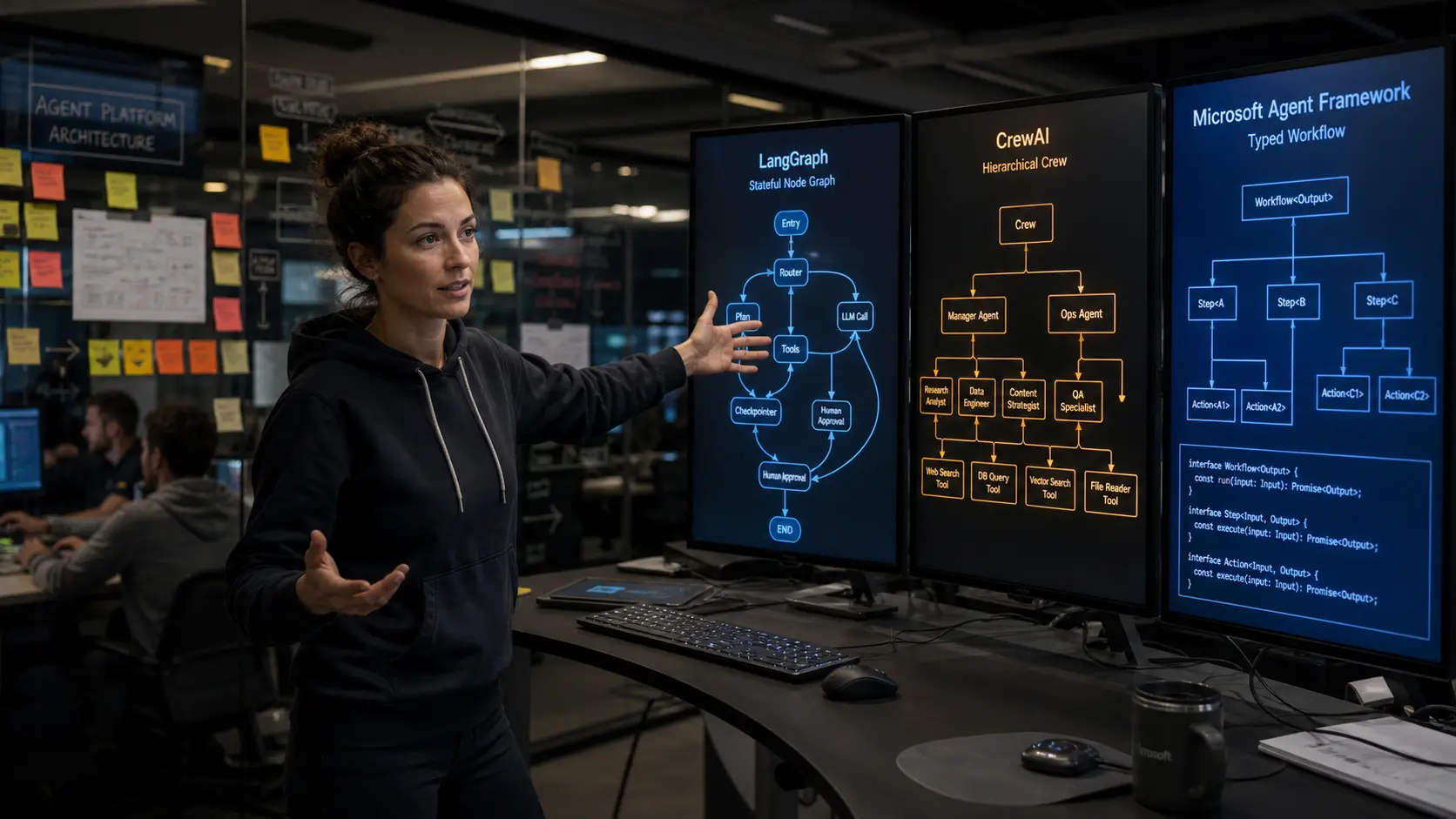
🤖 The AI agent framework landscape changed permanently in 2026. AutoGen is in maintenance mode, Microsoft has shipped a production-grade successor, and LangGraph has emerged as the enterprise standard for deterministic control. This guide tells you exactly which framework to pick — and why the wrong choice is a business risk, not just a technical one.
Last Updated: November 3, 2026
In 2026, the question of which AI agent framework to use has become one of the most consequential decisions a development team can make. The phrase “AI agent frameworks explained” attracts enormous search volume for a simple reason: the landscape has shifted dramatically, and the guides written 12 months ago are now actively misleading. AutoGen — once the most starred agent framework on GitHub with over 60,000 stars — officially entered maintenance mode in late 2025. Microsoft redirected all enterprise investment into its new Microsoft Agent Framework (MAF), which reached General Availability on April 3, 2026. Meanwhile, LangGraph matured into the dominant standard for production-grade systems, and CrewAI evolved from a rapid-prototyping tool into a platform with enterprise hosting, SOC 2 compliance, and a growing A2A interoperability story.
According to the McKinsey 2026 State of AI report, 44% of organizations are now scaling AI enterprise-wide, with 23% specifically piloting or deploying agentic workflows. The frameworks powering those workflows — LangGraph, CrewAI, and now MAF — are not interchangeable. Each embodies a fundamentally different philosophy about how agents should be built, orchestrated, and controlled. Choosing the wrong one means rewriting your architecture when the first real production failure occurs, often at significant cost in time, money, and trust.
This guide cuts through the noise of outdated comparisons. We cover the confirmed 2026 status of all three frameworks, their architectures in plain English, their true costs (including the hidden economics of agentic execution), their honest limitations, and a practical decision framework that tells you exactly which one fits your team. By the end, you will know which framework to choose — and which ones to avoid — for your specific situation in 2026.
📘 New to AI agent terminology? Before diving into framework architectures, make sure you have the vocabulary covered. Our AI Glossary defines 100+ essential AI terms — from “stateful orchestration” to “Model Context Protocol” — in plain English.
1. 🗺️ The 2026 Agent Framework Landscape: What Actually Changed
To evaluate LangGraph, CrewAI, and MAF fairly, you need to understand the seismic shifts that occurred between late 2025 and mid-2026. This is not an incremental update story — it is a structural reorganization of the entire framework ecosystem.
The AutoGen Maintenance Mode Event
In October 2025, Microsoft quietly moved AutoGen into maintenance mode. This means the framework continues to receive critical security patches and bug fixes, but receives no new features and no active development from Microsoft. As confirmed by the official AutoGen GitHub repository, AutoGen “will not receive new features or enhancements and is community managed going forward.” Existing users are encouraged to migrate using the official AutoGen-to-MAF migration guide. For any team considering AutoGen for a new project in late 2026, this status is disqualifying — you would be building on a framework whose parent organization has officially abandoned active development.
The AG2 Fork: The Open-Source Community’s Answer
The open-source community that loved AutoGen’s conversational flexibility did not simply accept Microsoft’s pivot. The AG2 fork emerged as an MIT-licensed, community-managed continuation of AutoGen’s original design philosophy. AG2 maintains the conversational group-chat model, the multi-party conversation patterns, and the iterative code execution capabilities that made AutoGen popular in research settings. For teams that want AutoGen’s DNA without the Microsoft cloud dependency, AG2 remains a viable path — but with the caveats that community support is slower, enterprise SLAs do not exist, and the gap between AG2 and MAF’s feature set will widen over time.
Microsoft Agent Framework: The Official Successor
Microsoft Agent Framework (MAF) 1.0 reached General Availability on April 3, 2026. As confirmed by Microsoft’s official announcement, MAF is “the direct successor, created by the same teams” that built both Semantic Kernel and AutoGen. It merges Semantic Kernel’s enterprise features — session state management, type safety, filters, telemetry, and extensive model support — with AutoGen’s multi-agent orchestration patterns, under a single unified API surface supporting both .NET and Python. As of October 2026, MAF sits at version 1.26, with Foundry Hosted Agents reaching GA on August 3, 2026, adding durable execution, governed connectors to GitHub Copilot, and native MCP and A2A protocol support.
LangGraph’s Rise to Production Dominance
While the Microsoft ecosystem reorganized, LangGraph quietly became the most widely used framework for production agentic systems. IBM’s research on enterprise AI agents consistently identifies state persistence and human-in-the-loop controls as the two most critical requirements for production deployment — and LangGraph is the only framework in this comparison that delivers both natively. LangGraph processes approximately 38.8 million PyPI downloads per month as of 2026, roughly 30 times AutoGen’s download volume, reflecting real-world production adoption rather than academic star counts.
The 2026 Agent Framework Reality: AutoGen is in maintenance mode. MAF is Microsoft’s supported successor. LangGraph leads production deployments by download volume. CrewAI leads in speed-to-value for role-based workflows. Picking the right one requires understanding all four of these facts simultaneously.
2. 🗄️ LangGraph Explained: The Production Standard for Stateful Agents
LangGraph is not a new product — it is the orchestration layer that LangChain built after discovering that linear “chains” were fundamentally insufficient for complex agent behavior. The core insight was this: agents need to loop, retry, branch, and maintain memory over time. A linear chain cannot do this reliably. A directed graph can.
The Graph Architecture in Plain English
LangGraph models an agent’s workflow as a graph of nodes (individual actions or LLM calls) connected by edges (decisions about what to do next). Unlike a simple chatbot that processes one input and generates one output, a LangGraph agent has a defined “state object” — a structured record of everything the agent knows and has done. Every node reads from the state, does something, and writes back to it. This creates a complete, auditable record of every decision the agent made at every step.
The most important architectural feature is support for cycles. In a traditional chain, execution flows from left to right: step 1, step 2, step 3, done. In a graph, the agent can decide after step 3 that its result was unsatisfactory and return to step 1 with new information. This “reflection” capability is what allows LangGraph agents to self-correct — but it also requires explicit maximum iteration limits in your code to prevent infinite loops, one of the framework’s most important and most overlooked operational requirements.
Durable State and Checkpointing
LangGraph’s built-in checkpointing is arguably its most commercially important feature. When a long-running agent workflow fails at step 28 of a 30-step process, you do not need to restart from step 1. LangGraph can resume from the last successful checkpoint node. This matters enormously for real production systems where LLM API timeouts, rate limits, and transient errors are not edge cases but regular operational realities. NIST’s AI Risk Management Framework identifies recoverability as a core reliability requirement for enterprise AI systems — LangGraph is the only framework in this guide that delivers it natively and without third-party tooling.
Human-in-the-Loop: Native Approval Gates
One of the most significant differentiators between LangGraph and its competitors is the native implementation of human-in-the-loop (HITL) controls. In LangGraph, you can configure an “interrupt” at any node in the graph, forcing the agent to pause and wait for a human decision before executing the next action. This is not a workaround — it is a first-class architectural pattern. For applications where the agent might send a wire transfer, delete a database record, or send an email to a customer list, this capability is not optional. It is the difference between an AI assistant and an AI liability.
Observability Through LangSmith
LangGraph integrates natively with LangSmith, providing token-level tracing of every agent run. Development teams can see exactly which node made a decision, which prompt was used, what the model returned, and where the agent “went wrong.” Independent benchmarks from 2026 confirm that attaching OpenTelemetry spans to each graph node is significantly easier in LangGraph than in CrewAI or AutoGen, where role abstraction can cause silent failures in production that are difficult to diagnose after the fact.
The Honest LangGraph Trade-Off
LangGraph’s power comes at a cost: it is the steepest learning curve in this comparison. Developers must understand graph theory concepts, manage explicit state objects in code, and handle the complexity of typed state schemas. Setup takes days, not hours. For a solo founder trying to ship an MVP by end of week, LangGraph is almost certainly overkill. For a team building a system that handles financial transactions, healthcare data, or regulated compliance workflows, it is the only defensible choice.
3. 🤝 CrewAI Explained: The Fastest Path to Role-Based Multi-Agent Value
If LangGraph is an engineering blueprint, CrewAI is a management structure. Where LangGraph asks you to think in graphs, CrewAI asks you to think in teams. You define agents with roles, assign them goals and backstories, give them tools, and CrewAI handles the collaboration and hand-offs automatically.
The Role-Based Architecture
CrewAI’s fundamental abstraction is the “crew” — a group of AI agents with distinct roles working toward a shared objective. A typical crew might include a “Senior Research Analyst” agent responsible for gathering information, a “Content Strategist” responsible for structuring it, and a “Quality Assurance Editor” responsible for reviewing the final output. Each agent has a natural-language role description, a backstory that shapes its reasoning persona, and a defined goal. CrewAI manages the sequential or hierarchical hand-offs between them automatically, without requiring the developer to map out explicit state transitions.
Sequential and Hierarchical Flows
CrewAI supports two primary orchestration modes. In sequential mode, agents execute in order — agent A completes its task, passes the result to agent B, and so on. In hierarchical mode, a designated “Manager Agent” oversees the process, deciding which specialist agent should act next based on the task at hand. This manager-agent model closely mirrors how actual business teams operate, which is a significant reason why CrewAI resonates quickly with non-engineering stakeholders who are seeing agent demos for the first time.
CrewAI’s Flows layer adds LangGraph-style deterministic control when a Crew alone is not sufficient. Event-driven decorators — @start, @listen, and @router — allow developers to add top-level control flow around their crews, bridging the gap between CrewAI’s speed and LangGraph’s precision for hybrid use cases.
Model Agnosticism and Cost Optimization
One of CrewAI’s most practically important features in 2026 is its ability to mix and match models across agents within a single crew. A team can use an inexpensive model — such as GPT-4o-mini — for research and data gathering agents, while reserving a premium model like Claude Sonnet 4.5 for the final synthesis and quality review agent. This mix-and-match approach can reduce LLM API costs by 60–70% on content pipeline workflows without meaningfully reducing output quality, a finding consistent with multiple 2026 practitioner reports.
CrewAI Pricing: The Real 2026 Picture
The CrewAI Python framework is MIT-licensed and entirely free to use — there are no licensing fees to run agents locally. The CrewAI cloud platform (app.crewai.com) operates on a freemium model. As of October 2026, the Basic plan provides 50 workflow executions per month at no cost, with additional executions charged at $0.50 each. Enterprise pricing is custom-quoted and not publicly disclosed; industry estimates based on comparable enterprise AI platforms range from $60,000 to $120,000 per year for high-execution enterprise deployments. Crucially, LLM API costs are entirely separate from platform costs and can become the dominant cost factor at scale — at 30,000 monthly executions, API costs alone can reach $180,000–$360,000 annually depending on model selection.
📊 Exploring AI tools and platforms? Our AI Tools & Software Reviews Hub covers the full stack — from agent frameworks to enterprise copilots — with honest assessments grounded in real-world implementation data.
4. 🏢 Microsoft Agent Framework (MAF) Explained: AutoGen’s Enterprise Successor
For teams already operating in the Microsoft ecosystem — Azure, Entra ID, .NET, Microsoft 365 — MAF is not just an option. It is the logical, supported, first-party path for building production agents in 2026. Understanding what it is and how it relates to AutoGen is essential before making any framework decision involving Microsoft tooling.
What MAF Is and What It Replaced
MAF 1.0 GA (April 3, 2026) is the official unification of two frameworks that Microsoft previously maintained separately: Semantic Kernel and AutoGen. Semantic Kernel was Microsoft’s enterprise orchestration SDK — rich in plugin support, type safety, and enterprise-grade middleware — but limited in multi-agent coordination. AutoGen was Microsoft’s multi-agent research framework — excellent for conversational agent patterns and group chats — but not production-hardened. MAF merges both, combining Semantic Kernel’s enterprise features with AutoGen’s multi-agent orchestration under a single API surface. As Microsoft stated explicitly at launch: “The Agent Framework is the direct successor, created by the same teams.”
Key MAF Architecture Features
MAF adopts a typed-graph workflow model rather than AutoGen’s conversational-first approach. This is a deliberate architectural shift. Where AutoGen defaulted to open-ended group chats between agents, MAF requires developers to define explicit workflow structures with typed inputs and outputs. This constraint increases initial development time but dramatically improves production reliability, auditability, and the ability to integrate with Azure’s enterprise compliance tooling.
The framework’s enterprise differentiators in 2026 include: native OpenTelemetry tracing through the DevUI browser-based debugger (shipped in the April 1.0 release), native MCP tool discovery for agent-to-tool interoperability, A2A cross-runtime agent communication, Python and .NET runtime parity, and deep integration with Azure AI Foundry for hosted agent deployment. Security professionals building agent systems that interact with sensitive organizational data should also note that MAF integrates directly with Microsoft’s Non-Human Identity governance framework — a critical consideration that we cover in our deep-dive on Non-Human Identity for AI Agents.
The AG2 Community Fork vs. MAF
It is important to distinguish AG2 from MAF. They are not the same product and serve different audiences. AG2 is the community-managed open-source fork that continues AutoGen’s original conversational agent philosophy — useful for research, experimentation, and teams that want the AutoGen API surface without Azure dependency. MAF is Microsoft’s officially supported, enterprise-production-hardened successor. AG2 is free with zero platform cost; MAF’s hosting features are available through Azure consumption billing. For new enterprise projects in 2026, MAF is the correct choice. AG2 is appropriate for teams with strong internal infrastructure capability, cost sensitivity, or a philosophical preference for avoiding cloud lock-in.
5. ⚖️ Framework Comparison Matrix: LangGraph vs. CrewAI vs. MAF (November 2026)
The table below synthesizes the confirmed 2026 status, architectural characteristics, and practical trade-offs of all three frameworks. Use this as your reference point, not as a final decision tool — the decision framework in Section 6 will guide your selection based on your specific situation.
| Dimension | LangGraph | CrewAI | Microsoft Agent Framework |
|---|---|---|---|
| 2026 Status | Active — GA since Oct 2025 (v1.0+) | Active — v1.10+ with enterprise tier | GA since April 3, 2026 (v1.26 Oct 2026) |
| Core Model | Stateful directed graph | Role-based crew orchestration | Typed-graph workflow (AutoGen + SK unified) |
| Learning Curve | Steep (expert-level Python) | Lowest — YAML config, hours not days | Moderate — .NET/Python, Azure familiarity needed |
| State Persistence | Native — checkpoint resume built in | Via Enterprise tier checkpointing | Native — durable execution (Azure) |
| Human-in-the-Loop | Native — first-class interrupt pattern | Via Flows layer and task callbacks | Via Azure governance and Harness brake |
| Observability | Best-in-class via LangSmith | Via CrewAI Enterprise tools or Langfuse | Native OpenTelemetry via DevUI |
| Token Efficiency | Best — ~2,000 tokens/task | Moderate — ~3,500 tokens/task | Variable — typed workflows reduce waste |
| Best Ecosystem Fit | Python-first, cloud-agnostic | Python-first, model-agnostic | Azure / .NET / Microsoft 365 |
| Framework Cost | MIT — free; LangSmith from $39/mo | MIT — free; Enterprise custom-quoted | MIT — free; Azure hosting consumption-billed |
| MCP / A2A Support | MCP via LangChain integrations | Native A2A support added 2026 | Native MCP + A2A (GA August 2026) |
6. 💰 The Hidden Economics of Agentic AI: What the Pricing Pages Don’t Tell You
One of the most underestimated risks of deploying agentic AI systems in 2026 is the cost model. Unlike a single chatbot API call, a multi-agent system makes 10 to 50 model calls per task. At scale, the compound effect of these calls creates cost structures that are radically different from what teams expect when they read a framework’s pricing page.
Platform Costs vs. Token Costs: Understanding the Two Bills
Every agentic deployment carries two separate cost streams. The first is the platform or hosting fee — what you pay to LangSmith, CrewAI Cloud, or Azure for running and monitoring your agents. The second is the LLM token cost — what you pay to OpenAI, Anthropic, or Google for every model call your agents make. Most teams optimize for one and forget the other.
Consider a concrete 2026 scenario: a CrewAI-based content pipeline that runs 1,000 times per day. At $0.50 per execution for overages beyond the Basic tier’s 50 free monthly executions, that’s approximately $15,000 per month in platform fees alone. Before your team pays a single dollar for model tokens. If each run consumes an average of 10,000 tokens on GPT-5 at current pricing, you add another $50,000+ per month in API costs. Total monthly cost: $65,000+. This is not hypothetical — it reflects actual practitioner-reported cost surprises from 2026 AI operations teams.
The Agentic Cost Reality: At 30,000 monthly executions, CrewAI Enterprise estimates LLM API costs alone at $180,000–$360,000 annually — before platform licensing. Token efficiency is not a technical nice-to-have. It is the single most important financial decision in your framework selection.
Token Efficiency by Framework
Token efficiency varies significantly between frameworks, and the difference is structural rather than incidental. For a benchmark task — “Research and summarize recent AI news” — independent 2026 testing shows LangGraph consuming approximately 2,000 tokens due to its focused, node-specific prompts. CrewAI consumes approximately 3,500 tokens because agent backstories and role descriptions add persistent overhead to every call. Traditional AutoGen consumed approximately 8,000 tokens due to its conversational back-and-forth pattern. MAF’s typed workflow model reduces waste compared to AutoGen but adds some overhead compared to LangGraph. For token-conscious production deployments, LangGraph’s 2,000-token baseline delivers a 43% cost reduction compared to CrewAI and a 75% reduction compared to AutoGen for equivalent tasks.
The Model Context Protocol (MCP): Why Framework Choice Affects Vendor Lock-In
The Model Context Protocol (MCP) is an open standard that allows agents built in one framework to use tools designed for another. As of 2026, CrewAI and MAF both support MCP and A2A natively, while LangGraph accesses MCP tooling through LangChain integrations. When evaluating frameworks, MCP support is a vendor lock-in question, not just a technical one. A framework that traps your agents in a proprietary tool ecosystem will increase your switching costs exponentially as your agent library grows. Prioritize MCP-native frameworks for any agent that will need to consume tools from third-party vendors over a multi-year lifespan. Our comparison of the Microsoft Copilot ecosystem provides additional context on how MCP is changing enterprise AI integration.
7. ⚠️ Honest Limitations: What Your Framework Vendor Won’t Tell You
Every framework comparison that only lists features is doing you a disservice. The limitations are where real production failures happen. Here is an honest, named assessment of what each framework gets wrong — based on 2026 practitioner experience.
LangGraph Limitations
The infinite loop problem is real and yours to solve. LangGraph’s cyclical execution model is its greatest strength and its most dangerous failure mode. Agents that “reflect” on their own outputs can enter loops where they endlessly revise without converging. LangGraph does not automatically prevent this — the developer must implement explicit maximum iteration counters and hard token limits at the code level. Teams that skip this step in production will eventually have an agent that burns thousands of dollars in API costs overnight on a single stuck workflow. Additionally, LangGraph’s steep learning curve is not just a time cost. It is a hiring constraint. The pool of developers who can confidently debug a complex stateful graph in production is significantly smaller than the pool who can work with CrewAI’s higher-level abstractions.
CrewAI Limitations
Role abstraction creates silent production failures. CrewAI’s elegant role-based design — the very thing that makes it easy to build — can make it genuinely difficult to debug when something goes wrong in production. When an agent “fails silently” (returns a plausible-sounding but wrong output without raising an error), the role abstraction layer obscures which specific decision or prompt caused the failure. Independent developer accounts from 2026 consistently describe cases where CrewAI “completed 54% of complex tasks, occasionally faltering when rigid role instructions encountered unexpected API failures.” This is not a knock on CrewAI’s quality — it is an architectural reality of high-abstraction frameworks. Additionally, enterprise pricing opacity is a procurement problem. CrewAI removed its published Professional tier in May 2026, leaving only a free tier and custom-quoted Enterprise. Teams cannot budget for scale without a sales conversation, which creates friction in enterprise procurement cycles.
Microsoft Agent Framework Limitations
Azure lock-in is the price of first-party integration. MAF’s deepest features — durable execution, Foundry Hosted Agents, DevUI debugging, and governance integrations — are Azure-native. Teams operating in multi-cloud environments or with a philosophical or contractual obligation to avoid Azure dependency will find that MAF outside Azure is a significantly less compelling product than MAF within it. Additionally, while MAF supports Python, its deepest tooling and the most mature examples in the official documentation are .NET-first. Python teams should expect to encounter documentation gaps and API asymmetries between the .NET and Python surfaces, particularly for newer preview features. For a broader view of how AI models compare across the market — including whether Azure OpenAI is the right model gateway for your agents — see our Claude vs. ChatGPT vs. Gemini comparison.
8. 🎯 Decision Framework: Which AI Agent Framework Should You Use in 2026?
The following decision framework is designed for real teams making real decisions, not for abstract architectural idealism. Answer the questions in order — the first matching condition determines your recommendation.
Choose LangGraph If:
Your system handles irreversible or high-risk actions (financial transactions, data deletion, regulatory submissions). You need a complete, auditable trail of every agent decision. Your team includes developers who are comfortable with graph theory and stateful programming. You are operating at a scale where token efficiency is a meaningful cost lever. You require human approval gates that cannot be bypassed by the agent under any circumstances. LangGraph processes 38.8 million monthly PyPI downloads in 2026 for a reason — production teams that have tried alternatives consistently migrate back to it for systems where failure is not an option.
Choose CrewAI If:
You need to deliver a working multi-agent system within days, not weeks. Your workflow is naturally modeled as a team of specialists with defined roles (researcher, writer, reviewer, analyst). You want model-agnostic flexibility to mix cheap and premium models per agent. Your use case is process-driven: content pipelines, lead research, sales automation, automated reporting. You are comfortable with enterprise pricing opacity and have a procurement relationship with CrewAI. CrewAI’s 1.3 million monthly PyPI installs in 2026 reflect genuine adoption in automation workflows where role clarity and speed of delivery outweigh the need for granular control.
Choose Microsoft Agent Framework If:
Your entire infrastructure stack runs on Azure. Your security and identity management is through Microsoft Entra ID. Your team writes primarily in .NET or C#. You are migrating from existing Semantic Kernel or AutoGen deployments. You need enterprise governance, SOC 2, and Microsoft’s commercial SLA. You want native MCP and A2A support with Microsoft’s long-term product commitment. For more on integrating agentic AI with Microsoft’s data platform, see our guide on What Is Microsoft Fabric.
What About AutoGen and AG2?
Avoid AutoGen for new projects. Its maintenance mode status is confirmed and unambiguous. For teams with an existing AutoGen codebase, Microsoft provides an official migration guide to MAF — use it. For teams that love AutoGen’s conversational flexibility but reject Azure lock-in, AG2 is a viable community-maintained alternative with zero platform cost. Be clear-eyed about the trade-offs: AG2 offers no enterprise SLA, limited support channels, and a feature gap that will widen every quarter relative to MAF.
9. 🏁 Verdict: The Agent Framework Landscape in Late 2026
The agent framework decision in 2026 is not a question of which framework is “best” in the abstract. It is a question of which framework is best for your specific risk tolerance, team capability, existing infrastructure, and time-to-value requirements. LangGraph wins on production reliability, auditability, and token efficiency — but demands experienced developers and significant setup time. CrewAI wins on speed to value and role-based workflow clarity — but demands careful cost modeling and a tolerance for observability limitations. MAF wins on enterprise governance and Azure integration — but demands Azure commitment and is most mature on .NET.
The frameworks that will define AI-powered organizations in 2027 are the ones being chosen and built upon today. The wrong choice does not just create technical debt — it creates organizational debt, as teams build processes, documentation, and hiring pipelines around a framework they will eventually need to replace. Choose with the same deliberation you would apply to any foundational infrastructure decision. The agent framework you select today is, in every meaningful sense, the operating system for your future digital workforce. For teams navigating the broader AI governance and security questions that surround agentic deployments, our resources on AI Governance Frameworks and Non-Human Identity for AI Agents provide the compliance and security context that no framework vendor will give you.
📌 Key Takeaways
| Key Takeaway | |
|---|---|
| ✅ | AutoGen is in confirmed maintenance mode as of October 2025 — do not start new projects on AutoGen. Use MAF (enterprise) or AG2 (open-source community) instead. |
| ✅ | Microsoft Agent Framework (MAF) 1.0 reached GA on April 3, 2026, unifying Semantic Kernel and AutoGen under a single, enterprise-supported API for .NET and Python. |
| ✅ | LangGraph leads production deployments with approximately 38.8 million monthly PyPI downloads — 30x AutoGen’s volume — due to its native checkpointing and human-in-the-loop controls. |
| ✅ | Token efficiency varies dramatically by framework: LangGraph uses ~2,000 tokens per equivalent task; CrewAI ~3,500; AutoGen-style conversational agents ~8,000 — a 4x cost multiplier at scale. |
| ✅ | CrewAI’s Python framework is MIT-licensed and free; its hosted platform offers 50 free executions per month with Enterprise pricing custom-quoted — the $25 Professional tier was removed in May 2026. |
| ✅ | At 30,000 monthly agent executions, LLM API costs alone can reach $180,000–$360,000 annually — often exceeding platform licensing costs by a factor of 3x or more. |
| ✅ | MCP (Model Context Protocol) and A2A (Agent-to-Agent) protocol support are vendor lock-in indicators — CrewAI and MAF both support both natively as of mid-2026; prioritize these for multi-year agent deployments. |
| ✅ | All three frameworks (LangGraph, CrewAI, MAF) are MIT-licensed at the core, meaning framework cost is zero — the real cost decisions are hosting, observability tooling, and LLM API consumption. |
🔗 Related Articles
- 📖 Non-Human Identity for AI Agents: The Security Layer Every Agentic Deployment Needs
- 📖 Microsoft Copilot Review 2026: Pricing, Plans + Is It Worth It?
- 📖 What Is Microsoft Fabric? The Data Foundation for Agentic AI in 2026
- 📖 AI Governance Frameworks: Managing Autonomous Agent Risk in 2026
- 📖 Claude vs. ChatGPT vs. Gemini: The 2026 Model Comparison for Agent Builders
🤖 Frequently Asked Questions: AI Agent Frameworks
1. Is LangChain still relevant in 2026, or has it been fully replaced by LangGraph?
LangChain remains the integration library — providing LLM wrappers, document loaders, and tool connectors. LangGraph is the orchestration layer built on top of it. Most production teams use both: LangChain for integrations, LangGraph for agent control flow. See our AI Glossary for a plain-English breakdown of how these layers relate.
2. What exactly does “AutoGen maintenance mode” mean for my existing project?
It means AutoGen will receive critical security patches but no new features, no architectural improvements, and no active Microsoft development. Existing projects will continue to function, but you are accumulating technical debt. Microsoft provides an official migration guide to Microsoft Agent Framework; begin planning that migration now rather than after a forced breaking change.
3. Can I use LangGraph, CrewAI, or MAF with local models like Llama 4 or Mistral?
Yes. All three frameworks support local model deployment through Ollama or vLLM, and all three are model-agnostic at the framework level. Running a local model for sensitive data processing can eliminate API costs entirely for those workflows. CrewAI and LangGraph both support any model accessible through a LangChain-compatible integration.
4. Which AI agent framework is best for a solo founder or small startup?
For most solo founders and small startups, CrewAI is the correct starting point. Its YAML-based agent configuration, intuitive role abstractions, and lowest learning curve mean you can have a working multi-agent prototype running in hours rather than days. Upgrade to LangGraph when your workflows require auditable state, complex branching, or human approval gates.
5. Does the choice of agent framework affect AI security and compliance posture?
Significantly. Frameworks differ in observability, human-in-the-loop capability, identity management, and audit trail completeness — all of which are relevant to enterprise AI governance and emerging regulatory requirements. For a full treatment of the security implications of agentic architectures, our guide to Non-Human Identity for AI Agents is the required reading before any production deployment decision.
📧 Get the AI Buzz Weekly Digest
Weekly AI insights, tools, and strategies — delivered every Monday. Free.



Leave a Reply