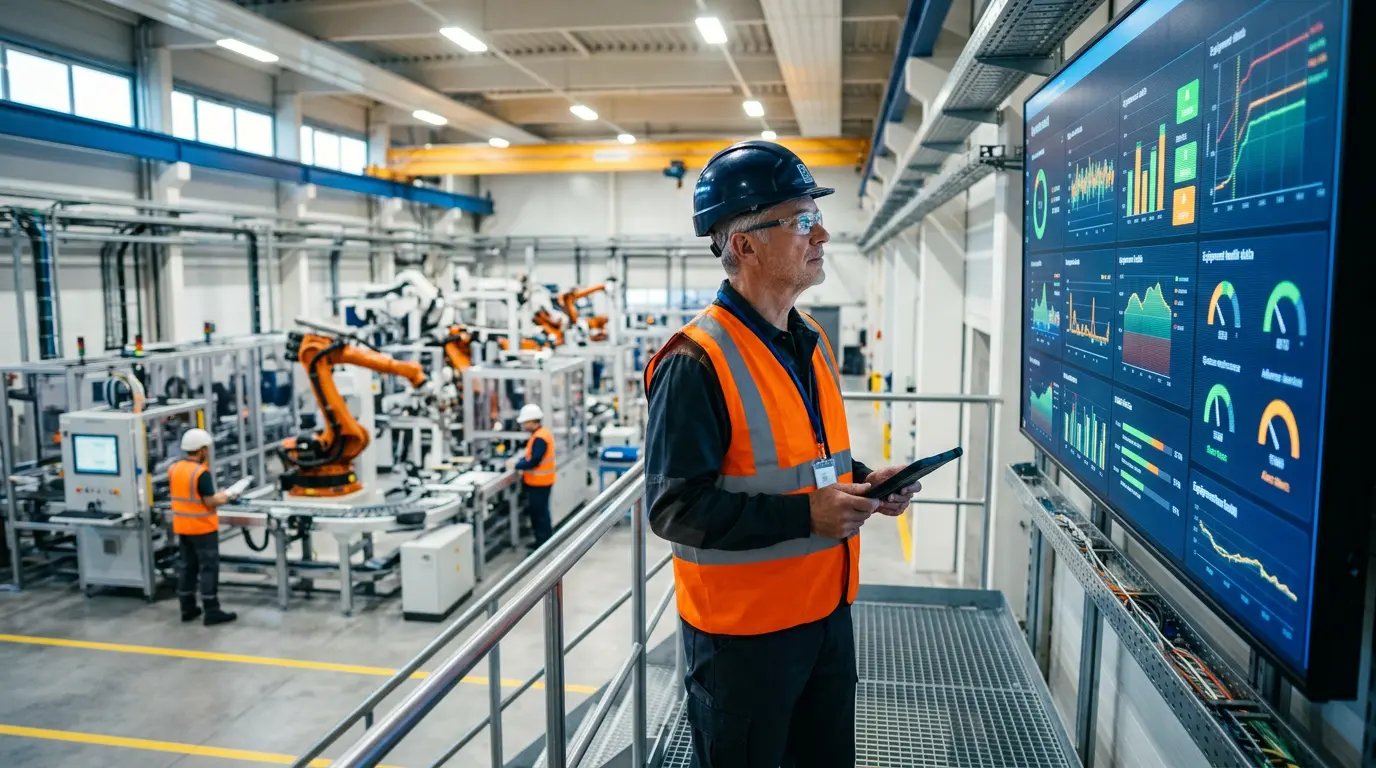
🏭 Unplanned downtime costs manufacturers an average of $260,000 per hour — and AI is the only tool that prevents it before it starts. This guide covers the 10 best AI tools for manufacturing in 2026: real pricing by tool category, honest trade-offs, ROI benchmarks, and a decision framework for operations leaders and plant managers.
Last Updated: June 29, 2026
If you’re searching for the best AI tools for manufacturing in 2026, the stakes are quantifiable in a way that almost no other industry can match. Unplanned downtime costs industrial manufacturers an average of $260,000 per hour across all sectors — rising to $2 million per hour in automotive and heavy industrial environments. McKinsey’s 2026 Industrial IoT research confirms that AI predictive maintenance delivers 20–40% reductions in unplanned downtime in documented production deployments — meaning a mid-sized plant losing $1 million annually to unplanned stoppages can recover $200,000–$400,000 per year from a single AI tool deployment. The ROI case for manufacturing AI is not theoretical in 2026. It is measured in prevented stoppages, defect rates, and maintenance cost lines on real balance sheets.
This guide covers the 10 best AI tools for manufacturing organized by workflow category — predictive maintenance, computer vision quality control, production planning, connected workforce, and supply chain AI — with real 2026 pricing where publicly available, honest assessments of what works in production versus what is still in pilot stage, and the critical data readiness check that most tool guides skip. You’ll find a decision framework that matches the right tool to your plant’s primary operational constraint and data infrastructure level. This article is the companion tools guide to our AI in Manufacturing strategy overview, which covers smart factories, predictive maintenance strategy, and Industry 4.0 at the strategic level. For the supply chain and logistics AI tools that pair with manufacturing platforms, see our AI in Supply Chains and Logistics guide.
The market numbers validate the investment thesis. Fortune Business Insights estimates the global AI in manufacturing market at $9.85 billion in 2026, projected to reach $128.81 billion by 2034 at a 37.9% CAGR. According to the National Association of Manufacturers, 51% of manufacturers now use AI in some form — but according to Deloitte’s 2026 Manufacturing Industry Outlook, worker access to AI rose 50% in 2025 while only one-third of organizations have scaled AI beyond pilot programs. That gap — between initial AI adoption and full-scale value delivery — is the central challenge for operations leaders in 2026, and choosing the right tool for the right workflow stage is the primary factor that determines which side of that gap your plant ends up on.
📖 New to AI terminology? Visit the AI Buzz AI Glossary — 65+ essential AI terms explained in plain English, each linking to a full in-depth guide.
📊 1. The State of Manufacturing AI in 2026: What the Data Actually Shows
The manufacturing sector has produced the clearest ROI data of any industry deploying AI in 2026, because factory operations provide something most sectors cannot: quantifiable baselines, continuous data streams, and direct cost-to-savings mappings that make financial outcomes measurable within months rather than years. AI ROI in manufacturing averages 200% across deployed use cases — the highest of any sector tracked — with foundation use cases like predictive maintenance reaching 400–500% over three years. The median payback period across all manufacturing AI deployments is eight months. These are not vendor projections. They are aggregated results from production deployments documented by Capgemini, Deloitte, and PwC.
The documented ROI figures by use case establish a clear deployment priority hierarchy for 2026. Predictive maintenance delivers 30–50% downtime reduction and 25–40% maintenance cost reductions. AI computer vision quality control cuts defect escape rates by 80–90% and delivers vision-based quality system payback in 6–9 months for most high-volume applications — down from 18–24 months just two years ago. AI demand forecasting improves accuracy by 27% over comparable manual processes, directly reducing overstock, stockouts, and inventory carrying costs. And AI production planning tools generate 30–50% faster planning cycles for manufacturers that have unified their data infrastructure sufficiently to support them.
The 2026 Manufacturing AI Reality: The consistent finding across successful manufacturing AI deployments is that data readiness and IT-OT integration determine outcomes more than platform capability. Buying a Level 4 AI platform when your plant is at Level 1 data maturity is how AI projects fail. The honest path: digitize the shop floor, unify the data, then layer on predictive and prescriptive AI. Platform selection matters — but data infrastructure is the prerequisite.
The 2026 agentic AI shift is reshaping the category. Agentic AI is no longer a pilot concept in manufacturing — 20–30% of manufacturers are deploying autonomous AI systems that manage routine decisions within defined guardrails without human approval per trigger. Autonomous replenishment agents generate and approve purchase orders for C-class inventory items. Self-healing supply chain agents detect supplier delays, evaluate alternatives, and place replacement orders within four hours. Prescriptive maintenance agents move beyond “predict failures” to “prescribe actions” — generating work orders, scheduling parts procurement, and booking technician time before the intervention window closes. For the governance framework that applies when AI agents operate with these autonomous permissions, see our guide on Non-Human Identity for AI Agents.
🗂️ 2. The 5 Categories of Manufacturing AI Tools — and the One Question That Determines Your Priority
Before comparing individual tools, identifying your plant’s primary operational constraint determines which tool category to evaluate first. The five categories of manufacturing AI address different operational problems — and an excellent predictive maintenance platform will do nothing for a plant whose primary constraint is quality defect escape rate. The manufacturing AI software market in 2026 is split across four distinct functional areas: visual inspection, predictive maintenance, production scheduling, and connected workforce — and buyers are best served by selecting the platform that addresses their primary operational constraint rather than the one with the broadest feature set.
The one question that determines your priority: what is your most expensive operational failure mode in the last 12 months? Pull your operational loss data — unplanned downtime costs, scrap and rework costs, quality escape costs, and planning variance costs — and rank them. The category that addresses your largest loss is your first deployment priority. This sounds obvious, but most manufacturing AI purchase decisions are driven by vendor demonstrations and industry conference exposure rather than plant-specific loss analysis. The result is a category mismatch that explains why so many AI investments stall at the pilot stage: the tool is working correctly — it’s solving the wrong problem.
| Category | Primary Problem Solved | Top 2026 Tools | Documented ROI | Payback Period |
|---|---|---|---|---|
| Predictive Maintenance | Unplanned equipment downtime | Augury, IBM Maximo, Factory AI | 30–50% downtime reduction | 3–12 months |
| Computer Vision / QC | Defect escape rate, inspection speed | Landing AI, Cognex ViDi | 35% defect rate reduction | 6–9 months |
| Production Planning | Scheduling variance, capacity waste | Rockwell Plex, o9 Solutions | 20–40% efficiency gains | 12–18 months |
| Connected Workforce | Paper-based processes, operator errors | Tulip, Siemens Copilot | 60% code gen speed-up | 6–12 months |
| Supply Chain AI | Demand forecasting, inventory variance | o9 Solutions, C3 AI, Kinaxis | 27% forecast accuracy gain | 12–24 months |
🛠️ 3. The 10 Best AI Tools for Manufacturing in 2026: Reviewed by Category
The tools below represent the most deployed platforms across US and global manufacturing environments in 2026. Pricing reflects verified data from current product pages and industry sources as of June 2026. Enterprise contract terms vary significantly — always confirm directly with vendors before purchasing. Where pricing is not publicly disclosed, the category cost range from industry sources is provided.
Augury — Best AI Predictive Maintenance for Enterprise Rotating Equipment
Augury is the category standard for enterprise-grade predictive maintenance of rotating machinery — motors, bearings, pumps, fans, and compressors. Augury’s platform provides a full-stack predictive maintenance solution: proprietary sensors covering vibration, acoustic, and temperature monitoring; cloud analytics; and AI-driven diagnostics with a human expert layer alongside its AI models, with certified reliability engineers reviewing alerts to reduce false positives before they reach maintenance teams. This “Machine Health as a Service” model delivers near-perfect diagnostic accuracy for rotating equipment — and the human validation layer is what distinguishes it from software-only alternatives.
The key differentiator is consistency. Every Augury installation uses the same sensors with the same configuration, which produces highly consistent diagnostic results across an entire installed base. The AI models are continuously updated from a global failure database, meaning each customer benefits from patterns detected across Augury’s entire network of deployed assets. The honest limitation: Augury’s “hardware tax” is real. You cannot use Augury software with non-Augury sensors, which creates vendor lock-in and limits integration flexibility for plants with diverse existing sensor infrastructure. Augury is the right choice for large enterprises with dedicated reliability teams, significant equipment estates of rotating machinery, and budgets that support multi-year enterprise contracts.
Augury in one line: The gold standard for vibration-based predictive maintenance of rotating equipment at enterprise scale — near-perfect diagnostic accuracy with a human expert validation layer — with the honest trade-off of proprietary hardware lock-in and pricing that is positioned for Fortune 500 maintenance budgets rather than mid-market operations.
Pricing (June 2026): Per-asset subscription model: $500–$2,000/asset/year. Enterprise contracts require multi-year commitments. Setup and sensor installation costs additional. (Pricing as of June 2026 — verify before purchasing.)
IBM Maximo Application Suite — Best Enterprise Asset Management Platform with AI
IBM Maximo Application Suite (MAS) is the most comprehensive enterprise asset management platform available in 2026, covering predictive maintenance, visual inspection, reliability-centred maintenance planning, and digital twin capabilities in a single integrated system. For global organizations managing 50+ sites with complex supply chains, IBM MAS is less of a tool and more of an ecosystem — integrating Asset Performance Management with inventory, procurement, safety, and maintenance workflows across the enterprise. In 2026, its digital twin capabilities allow manufacturers to simulate entire factory floors before making physical changes, reducing capital project risk substantially.
IBM MAS is purpose-built for organizations with dedicated internal data science teams, existing IBM infrastructure, and multi-year transformation roadmaps. Its strength is breadth and enterprise integration depth — it connects to ERP systems, CMMS platforms, and OT systems across a complex industrial estate in ways that point solutions cannot. The trade-off is implementation complexity and cost: IBM MAS deployments typically require significant consulting investment and internal capability, with enterprise platform pricing starting in six figures annually and implementation adding $100,000–$500,000 or more. It is overkill for single-site operations and the right choice only for manufacturers where total enterprise asset visibility is the primary business objective. For a broad view of AI governance frameworks that apply to enterprise AI deployments of this scale, see our AI Governance 101 guide.
Pricing (June 2026): Enterprise platform pricing — custom quotes required. Typically six figures annually. Contact IBM for current licensing terms. (Pricing as of June 2026 — verify before purchasing.)
Factory AI — Best Predictive Maintenance for Mid-Market Brownfield Plants
Factory AI has emerged in 2026 as the leading alternative to Augury and IBM Maximo for mid-sized manufacturers operating mixed-age equipment estates without a dedicated data science team. Where Augury requires proprietary sensors and IBM MAS requires significant IT infrastructure, Factory AI is sensor-agnostic — it connects to existing PLCs, SCADA systems, and third-party sensors to unify data into a single no-code reliability hub without requiring equipment replacement or IT overhaul. Full deployment takes 14 days, compared to 6–12 months for legacy platforms.
The practical value proposition for operations directors: Factory AI eliminates the “connectivity gap” that prevents mid-market manufacturers from accessing enterprise-grade predictive insights. By ingesting data from existing infrastructure rather than requiring new hardware, it makes legacy machines IoT-ready without replacing or modifying them. Most Factory AI deployments achieve 3x to 5x return within the first year — driven by 20–30% reductions in unplanned downtime and 15% reductions in maintenance costs. The platform includes a built-in “Reliability Agent” that helps diagnose why vibration anomalies occur and recommends specific interventions, moving beyond alert generation into the prescriptive maintenance territory that most mid-market platforms don’t reach.
Pricing (June 2026): SaaS subscription — contact Factory AI for current pricing. Designed for mid-market affordability relative to enterprise platforms. Pilot deployments (5–10 assets) typically start under $25,000. (Pricing as of June 2026 — verify before purchasing.)
Landing AI (LandingLens) — Best AI Computer Vision Platform for Quality Control
Landing AI, founded by Stanford AI pioneer Andrew Ng, is the most flexible AI visual inspection platform for manufacturing quality control in 2026. LandingLens enables manufacturers to build custom inspection models using relatively small datasets — a critical advantage when defect types are varied and training data is limited, which is the norm rather than the exception in real-world production environments. The platform’s “data-centric AI” approach emphasises data quality over model complexity, making it practical for manufacturing deployments where perfect datasets don’t exist.
The practical output: AI vision systems that detect surface defects, verify weld quality, confirm component placement, and perform dimensional checks at speeds and accuracy levels that human inspection cannot match. The documented impact is substantial — AI-enabled quality inspection solutions have shown a 90% improvement in production consistency, and AI-driven computer vision cuts defect escape rates by 80–90% in documented deployments. Vision-based quality systems now pay for themselves in 6–9 months for most high-volume applications. Landing AI is the strongest cross-industry option for manufacturers that need flexible model training across diverse defect types. Instrumental leads for electronics manufacturing specifically, and Cognex ViDi offers the strongest performance for structured inspection with high-volume standardized parts. For manufacturers already using BMW’s approach as a benchmark — the BMW Group uses AI to evaluate component images from its production line, identifying deviations from standards in real time — Landing AI’s architecture is the closest commercial parallel.
Pricing (June 2026): Custom pricing based on deployment scope and defect type volume. Contact Landing AI for current rates. (Pricing as of June 2026 — verify before purchasing.)
Siemens Industrial Copilot — Best Generative AI Assistant for Engineering and Shop Floor Teams
Siemens Industrial Copilot is the most significant new tool category in manufacturing AI in 2026 — a generative AI assistant built in partnership with Microsoft and running on Azure OpenAI Service, designed specifically for the industrial environment. At CES 2026, Siemens announced nine new AI-powered copilots across its software portfolio — covering Teamcenter, Polarion, and Opcenter — and expanded its partnership with NVIDIA to build what the companies are calling the “Industrial AI Operating System.” More than 120,000 engineers now leverage Siemens’ copilots across the industrial value chain.
The shop floor impact is measurable. Siemens’ Industrial Copilot speeds up PLC code generation by an estimated 60% while minimizing errors and reducing the need for specialized knowledge. Operators see machine error codes translated into plain language with suggested fixes based on historical data. Maintenance teams get AI-assisted troubleshooting that pulls from technical documentation and past incident records. Industrial copilots can minimize unplanned downtime by up to 60% in documented deployments. The platform is best suited to manufacturers already running Siemens automation infrastructure — TIA Portal, Teamcenter, Opcenter — where the copilot integrates natively rather than requiring custom connector development. Manufacturers without existing Siemens infrastructure face meaningful integration work before the full feature set is accessible.
Pricing (June 2026): Available on the Siemens Xcelerator Marketplace. Contact Siemens for current licensing. Enterprise contracts required for full suite access. (Pricing as of June 2026 — verify before purchasing.)
🛠️ Looking for the right AI tool? Browse the AI Buzz Tools & Reviews Hub — expert reviews, side-by-side comparisons, and buying guides for the best AI tools across productivity, writing, coding, and enterprise platforms.
Tulip — Best No-Code Platform for Connected Workforce and Shop Floor Digitization
Tulip is the strongest no-code platform for digitizing paper-based shop floor processes — work instructions, quality checks, operator logs, and training workflows — without a large IT project or a development team. In 2025, 43,000 Tulip apps enabled the work of 60,000 frontline workers across 1,000 customer sites in 45 countries. Tulip was recognized as a Leader in the IDC MarketScape for Discrete MES, and in January 2026, the company raised a $120M Series D at a $1.3B valuation, with Mitsubishi Electric as a strategic investor. Customers include AstraZeneca, Stanley Black & Decker, DMG Mori, and Richemont.
The key practical differentiator: operators can build Tulip apps themselves using a drag-and-drop interface, eliminating the typical bottleneck of IT-dependent digitization projects. If your operators still work from printed instructions and log quality checks on clipboards, Tulip is the modernization path that achieves adoption because frontline workers build the tools themselves rather than having them imposed from above. Tulip is broad but deliberately not deep — its predictive maintenance capability is weaker than Augury’s, its analytics are less sophisticated than Sight Machine’s, and its supply chain features are minimal. It is the right first tool for plants at data maturity Level 1 or 2 that need to digitize before they can deploy more sophisticated AI. As the research confirms: digitize the shop floor first, then layer on predictive AI.
Pricing (June 2026): Subscription SaaS, starting around $500/month per site, scaling with users and connected devices. Significantly more accessible than enterprise-only platforms. (Pricing as of June 2026 — verify before purchasing.)
Rockwell Automation Plex — Best Cloud MES with Embedded AI for Mid-to-Large Manufacturers
Rockwell Automation’s Plex platform combines cloud MES, ERP, supply chain planning, and quality management with embedded AI capabilities in a single platform designed for manufacturers who want AI built in rather than bolted on. The AI-driven Plex Finite Scheduler aggregates data from materials, tooling, and maintenance schedules to create optimised production plans in real time — adjusting to machine availability changes, material shortages, and demand shifts without manual re-scheduling. FactoryTalk Analytics VisionAI adds AI-powered visual inspection that goes beyond pass/fail to understand product quality patterns across production runs.
Plex is the strongest choice for manufacturers wanting a single platform covering production execution, quality, and planning with AI embedded across the workflow — particularly manufacturers that are already Rockwell shops with Allen-Bradley hardware, where the integration depth is native rather than requiring custom connector development. The trade-off versus specialist tools is depth: Plex’s predictive maintenance is less specialized than Augury’s, and its computer vision is less flexible than Landing AI’s. But for manufacturers prioritizing operational simplicity and unified data over best-in-class performance at any single workflow stage, Plex eliminates the integration complexity of a multi-vendor AI stack.
Pricing (June 2026): Enterprise platform — custom quotes required. Contact Rockwell Automation for current pricing. (Pricing as of June 2026 — verify before purchasing.)
Sight Machine — Best AI Data Unification Platform for Multi-Line, Multi-Plant Operations
Sight Machine addresses the problem that prevents every other manufacturing AI tool from delivering full value: fragmented, siloed operational data. Sight Machine connects to existing manufacturing systems — historians, PLCs, SCADA — to create a unified data layer across production lines and plants, providing a single AI-powered analytics environment where production performance, quality metrics, and energy consumption are visible across the entire operation in real time. Customers include AstraZeneca, Stanley Black & Decker, DMG Mori, and Richemont.
The category position for Sight Machine is distinct from the other tools in this guide. It is not primarily a predictive maintenance tool, a quality control tool, or a scheduling tool — it is the foundation layer that makes all of those tools more effective. As the field assessment confirms: Sight Machine is the tool you need when data fragmentation is holding back every other AI initiative. If your plant data is already clean and unified, you probably don’t need it. If it isn’t, nothing else works well without solving this first. For manufacturers running multiple production lines or multiple plants where production data lives in incompatible formats across different systems, Sight Machine delivers immediate value by making the data legible before any AI model is trained on it.
Pricing (June 2026): Enterprise platform — custom quotes required. Contact Sight Machine for current pricing. (Pricing as of June 2026 — verify before purchasing.)
o9 Solutions — Best AI Supply Chain Planning Platform for Manufacturing
o9 Solutions is the strongest AI supply chain planning platform for large manufacturers needing integrated demand forecasting, production planning, and supply chain optimization in a single AI-native environment. o9’s LLM composite agents, launched in July 2024 and moving to production deployment in 2026, allow supply chain planners to query their entire data environment in plain language — asking “what is our inventory exposure if our Tier 2 semiconductor supplier delays by three weeks?” — and receiving scenario-modelled answers in minutes rather than days. The platform generates 30–50% faster planning cycles for manufacturers that have the data infrastructure to support it.
The o9 platform is purpose-built for manufacturers with complex, multi-echelon supply chains where demand signal variability, supplier lead time uncertainty, and production capacity constraints interact across hundreds of SKUs and dozens of facilities. It is not the right tool for single-site manufacturers with straightforward supply chains — the implementation complexity and cost structure reflect an enterprise platform designed for global operations. For manufacturers at that scale, o9 competes directly with Kinaxis and Blue Yonder as a supply chain AI platform, and its LLM-based natural language planning interface is the clearest 2026 differentiator from both competitors. For the broader supply chain and logistics AI context, see our AI in Supply Chains and Logistics guide and our guide to Best AI Tools for Operations and IT Teams.
Pricing (June 2026): Enterprise contract pricing — custom quotes required. Contact o9 Solutions for current rates. (Pricing as of June 2026 — verify before purchasing.)
Microsoft Copilot for Manufacturing — Best Generative AI for Office-to-Floor Workflow Integration
Microsoft Copilot for Manufacturing — specifically the Factory Operations Agent launched in 2025 — brings generative AI to the intersection of Microsoft 365 and industrial operations data. The Factory Operations Agent connects Azure OpenAI capabilities to manufacturing data sources, allowing operations managers to query production performance, generate shift handover summaries, draft maintenance reports, and analyse quality trends using natural language inside the Microsoft 365 environment they already use daily. For manufacturers already on Microsoft 365 and Azure, this is the lowest-friction AI upgrade available — no new tool, no new login, no data migration.
The use cases most relevant to plant operations in 2026 are document-intensive workflows: generating root cause analysis reports from maintenance data, drafting engineering change requests from quality data, summarising production performance across shifts, and creating supplier communication drafts based on procurement alerts. Microsoft Copilot does not replace specialist tools for predictive maintenance or computer vision — it complements them by making the data those tools generate more accessible to the non-technical decision-makers who need to act on it. For manufacturers already running Siemens or Rockwell infrastructure alongside Microsoft 365, Copilot bridges the IT-OT data gap without requiring custom integrations. For the comparison of Microsoft Copilot against general AI assistants, see our Microsoft Copilot vs ChatGPT Enterprise guide.
Pricing (June 2026): Microsoft 365 Copilot add-on: $30/user/month (requires existing Microsoft 365 subscription). Factory Operations Agent: contact Microsoft for current enterprise pricing. (Pricing as of June 2026 — verify before purchasing.)
📋 4. Manufacturing AI Tools Comparison Table: 2026
| Tool | Category | Best For | Starting Price | Data Infra Req’d | Payback Period |
|---|---|---|---|---|---|
| Augury | Predictive Maint. | Enterprise rotating equipment, large budgets | $500–$2K/asset/yr | ⚠️ Proprietary sensors | ✅ 6–12 months |
| IBM Maximo | Enterprise EAM | Fortune 500, 50+ sites, IBM ecosystem | 6 figures+ / yr | ⚠️ High — IBM infra | ⚠️ 18–36 months |
| Factory AI | Predictive Maint. | Mid-market brownfield plants, mixed-age equipment | Custom — pilot from ~$25K | ✅ Sensor-agnostic | ✅ 3–6 months |
| Landing AI | Computer Vision | Flexible defect detection, varied defect types | Custom pricing | ⚠️ Camera infrastructure | ✅ 6–9 months |
| Siemens Copilot | Workforce AI | Siemens infrastructure users, engineering teams | Xcelerator Marketplace | ⚠️ Siemens ecosystem | ✅ 6–12 months |
| Tulip | Connected Workforce | Shop floor digitization, paper-based processes | ~$500/site/month | ✅ Low — no-code | ✅ 6–12 months |
| Rockwell Plex | Cloud MES + AI | Rockwell shops needing MES + QC + planning | Custom enterprise | ⚠️ Allen-Bradley infra | ⚠️ 12–18 months |
| Sight Machine | Data Unification | Multi-line, multi-plant data fragmentation | Custom enterprise | ✅ Connects to existing | ⚠️ 12–24 months |
| o9 Solutions | Supply Chain AI | Complex multi-echelon supply chains, global ops | Custom enterprise | ⚠️ High — ERP integration | ⚠️ 12–24 months |
| MS Copilot Mfg. | Gen AI Assistant | Microsoft 365 users needing AI across OT + IT | $30/user/month | ✅ M365 required | ✅ 3–6 months |
(Pricing as of June 2026 — verify directly with vendors before purchasing. Enterprise contract terms vary significantly from listed starting prices.)
⚖️ 5. Compliance, Safety, and AI Governance for Manufacturing Teams in 2026
AI tools deployed in manufacturing environments carry compliance and safety obligations that most tool comparison guides omit entirely. OSHA’s General Duty Clause applies to AI systems deployed in safety-critical manufacturing environments — if an AI system influences a decision that results in a workplace injury, and the employer failed to properly validate the system’s outputs or maintain human oversight, the employer bears liability regardless of which vendor’s software was running. This is not a theoretical risk. Automated decision systems that affect lockout/tagout procedures, equipment restart decisions, or hazard zone entry authorizations must include documented human oversight protocols and cannot operate in “set and forget” mode.
The Colorado AI Act (effective February 2026) extends AI governance requirements to high-risk AI systems used in employment decisions within manufacturing — including AI scheduling systems that affect shift assignments, overtime allocation, and performance monitoring. For manufacturers hiring in Colorado or employing workers subject to Colorado jurisdiction, documentation of how AI influences workforce decisions is now a legal requirement. The EU AI Act’s August 2026 enforcement deadline classifies AI systems used in safety-critical manufacturing processes as high-risk, requiring technical documentation, human oversight mechanisms, and conformity assessments for any manufacturer supplying to EU customers or operating EU facilities.
The practical governance requirement for manufacturing AI in 2026 is straightforward: no AI system should have the ability to autonomously execute a decision that affects safety-critical equipment status, worker safety zones, or product release decisions without a documented human review step. Agentic AI systems — the autonomous agents now managing routine decisions at 20–30% of manufacturing operations — need governed Non-Human Identities with documented permissions, access controls, and audit trails. Before deploying any autonomous manufacturing AI agent, review our guide on Non-Human Identity for AI Agents. For a comprehensive vendor evaluation before purchasing any manufacturing AI platform, see our AI Vendor Due Diligence Checklist.
🤖 6. Manufacturing AI Decision Framework: Which Tool Is Right for Your Plant in 2026?
The right manufacturing AI tool is determined by three factors in priority order: your plant’s data maturity level, your primary operational constraint, and your existing vendor ecosystem. The most common and most expensive mistake in manufacturing AI purchasing is skipping the data maturity assessment and moving directly to platform selection. Only 26% of global manufacturers have the internal capabilities required to scale AI beyond pilot initiatives. Plants at data maturity Level 1 or 2 — where production data lives in paper logs, disconnected spreadsheets, or incompatible historian formats — will not get value from predictive maintenance or supply chain AI platforms regardless of how capable those platforms are. The data infrastructure is the prerequisite, not the afterthought.
The 2026 consensus from operations directors, plant managers, and CTOs who have successfully scaled manufacturing AI is consistent: start with one tool that solves your most quantifiable operational loss, prove ROI within one quarter if possible, and expand the stack only after internal capability and data infrastructure have matured to support the next layer. Manufacturers scaling AI across 5+ use cases achieve 3.2x higher cumulative ROI than single-use-case deployers — but that compounding effect only materializes when each deployment is done sequentially on a solid data foundation, not simultaneously on a fragmented one.
| If This Describes Your Plant | Start Here | Then Add |
|---|---|---|
| Still using paper logs and clipboards | ✅ Tulip — digitize first | Sight Machine to unify data, then predictive AI |
| Primary loss: equipment downtime | ✅ Factory AI (mid-market) or Augury (enterprise) | Microsoft Copilot for report generation |
| Primary loss: defect escapes and quality cost | ✅ Landing AI — deploy on highest-escape line first | Rockwell Plex if scheduling is also a constraint |
| Siemens TIA Portal / Teamcenter installed | ✅ Siemens Industrial Copilot — native integration | Augury for predictive maintenance alongside |
| Rockwell Allen-Bradley hardware installed | ✅ Rockwell Plex — native MES + AI integration | Landing AI for quality control alongside |
| Microsoft 365 installed across the business | ✅ Microsoft Copilot for Manufacturing — immediate | Factory AI or Augury for predictive maintenance |
| Multi-plant data in incompatible formats | ✅ Sight Machine — unify before anything else | o9 Solutions for supply chain AI once data is clean |
| Global supply chain with demand uncertainty | ✅ o9 Solutions or Kinaxis for planning AI | Sight Machine for production data integration |
| Fortune 500, 50+ sites, $5M+ AI budget | ✅ IBM Maximo — total enterprise asset visibility | o9 for supply chain, Landing AI for quality |
| Best starting point for most manufacturers | ✅ Pilot on 5–10 critical assets — prove ROI first | Scale after demonstrating payback in first quarter |
🏁 7. Conclusion: Building the Right Manufacturing AI Stack in 2026
The best AI tools for manufacturing in 2026 are not the platforms with the most features or the largest vendor marketing budget — they are the tools that address your plant’s specific operational constraint, match your current data infrastructure maturity, and integrate with the systems your engineering and maintenance teams already use. The ROI data is compelling and consistent: 64% of industrial organizations report seeing positive ROI from AI investments within 12 months, and plants that scale AI across multiple use cases achieve 3.2x higher cumulative ROI than single-use-case deployers. The case for manufacturing AI is established. The variable is implementation quality, not tool selection.
The clearest recommendation from the 2026 data: pilot on 5–10 of your highest-value assets, prove the ROI within one quarter, and expand the stack on a solid data foundation. One prevented major breakdown — at an average cost of $50,000–$500,000 per event depending on your industry — typically covers the entire first year of platform cost. That is the investment case in its simplest form. The manufacturers who are winning in 2026 are those who started with a precise operational question — “what is our most expensive failure mode?” — selected one tool to address it, measured the outcome, and built from there. For the broader strategic picture of how AI is transforming manufacturing operations, see our AI in Manufacturing guide and our AI in Supply Chains and Logistics overview for the full Industry 4.0 context.
📌 Key Takeaways
| Key Takeaway | |
|---|---|
| ✅ | Unplanned downtime costs manufacturing plants an average of $260,000 per hour — rising to $2 million per hour in automotive — making predictive maintenance the highest-ROI first deployment for most manufacturers, with 30–50% downtime reduction documented in production deployments. |
| ✅ | The global AI in manufacturing market is valued at $9.85 billion in 2026 and projected to reach $128.81 billion by 2034 at a 37.9% CAGR — but only 26% of manufacturers currently have the internal capability to scale AI beyond pilot programs, making data infrastructure the true competitive differentiator. |
| ✅ | Augury ($500–$2,000/asset/year) is the enterprise gold standard for rotating equipment predictive maintenance; Factory AI is the strongest mid-market alternative — deploying in 14 days using existing sensors, with 3x–5x ROI in the first year for plants with mixed-age equipment estates. |
| ✅ | AI computer vision quality control — led by Landing AI’s data-centric approach — cuts defect escape rates by 80–90% and pays for itself in 6–9 months for most high-volume applications, down from 18–24 months just two years ago. |
| ✅ | Siemens unveiled nine new Industrial Copilots at CES 2026, with 120,000+ engineers now using the platform — the copilots speed up PLC code generation by 60% and can reduce unplanned downtime by up to 60% for manufacturers on Siemens’ Xcelerator ecosystem. |
| ✅ | The Colorado AI Act (February 2026) and OSHA’s General Duty Clause together require documented human oversight for AI systems that influence safety-critical manufacturing decisions — autonomous AI agents operating in production environments must have governed Non-Human Identities with documented access controls and audit trails. |
| ✅ | Plants still using paper-based workflows should start with Tulip (~$500/site/month) to digitize before deploying any predictive or prescriptive AI — buying a Level 4 platform when your plant is at Level 1 data maturity is the primary cause of manufacturing AI pilot failure. |
| ✅ | The optimal manufacturing AI deployment approach in 2026 is sequential not simultaneous: pilot on 5–10 critical assets, prove ROI within one quarter, then scale — manufacturers scaling across 5+ use cases achieve 3.2x higher cumulative ROI than single-use-case deployers, but only when each deployment is built on a solid data foundation. |
🔗 Related Articles
- 📖 AI in Manufacturing: How AI Powers Smart Factories, Predictive Maintenance, and Quality Control
- 📖 AI in Supply Chains and Logistics: How AI Improves Demand Forecasting, Inventory, and Delivery
- 📖 Best AI Tools for Operations and IT Teams in 2026
- 📖 AI Vendor Due Diligence Checklist: How to Evaluate AI Tools Before You Share Data
- 📖 Non-Human Identity for AI Agents: How to Prevent Privilege Abuse and Rogue Actions
🏭 Frequently Asked Questions: Best AI Tools for Manufacturing
1. What is the best AI tool for manufacturing in 2026?
The best manufacturing AI tool depends on your primary operational constraint. For predictive maintenance, Augury ($500–$2,000/asset/year) leads for enterprise rotating equipment; Factory AI is the strongest mid-market option, deploying in 14 days using existing sensors. For quality control, Landing AI delivers the most flexible computer vision. For shop floor digitization, Tulip (~$500/site/month) is the right first step. Start with the tool that addresses your plant’s highest-cost failure mode. Our AI in Manufacturing guide covers the full strategic framework.
2. What ROI can manufacturers expect from AI tools in 2026?
Documented manufacturing AI ROI averages 200% across all use cases — the highest of any sector tracked. Predictive maintenance delivers 30–50% downtime reduction and 25–40% maintenance cost savings. AI computer vision cuts defect escape rates by 80–90%. The median payback period across manufacturing AI deployments is eight months, with 64% of industrial organizations reporting positive ROI within 12 months. ROI is highest when AI is deployed on the operational problem with the largest quantifiable loss. Our AI in Supply Chains and Logistics guide covers the supply chain ROI data specifically.
3. Do small and mid-sized manufacturers need enterprise platforms to access AI benefits?
No. Cloud-based AI-as-a-Service has dramatically lowered barriers to entry. SMEs can start predictive maintenance pilots with investments of $20K–$100K using sensor-agnostic platforms like Factory AI. Tulip starts at approximately $500/month per site. Microsoft Copilot for Manufacturing is $30/user/month for organizations already on Microsoft 365. The key is starting with one tool on 5–10 critical assets rather than attempting enterprise-wide deployment. Our Best AI Tools for Operations and IT Teams covers additional tools accessible to mid-market operations teams.
4. What compliance requirements apply to AI tools used in manufacturing in 2026?
Three key frameworks apply. OSHA’s General Duty Clause requires human oversight for AI systems that influence safety-critical decisions — including equipment restart, lockout/tagout, and hazard zone entry. The Colorado AI Act (February 2026) requires documentation of AI influence on employment decisions including shift scheduling. The EU AI Act (August 2026 enforcement) classifies safety-critical manufacturing AI as high-risk, requiring conformity assessments for manufacturers supplying EU customers. The AI Vendor Due Diligence Checklist includes the specific compliance questions to ask manufacturing AI vendors before purchasing.
5. How should manufacturers govern autonomous AI agents operating on the factory floor?
Autonomous AI agents in manufacturing — those managing replenishment orders, scheduling maintenance interventions, or controlling production parameters — are system identities with real operational permissions. Each agent needs a documented Non-Human Identity with defined scope, access controls, human escalation rules, and regular audit cycles. A malfunctioning agent with overpermissioned access can trigger incorrect purchase orders, unsafe equipment restart sequences, or erroneous quality releases. The Non-Human Identity for AI Agents guide provides the governance framework for manufacturing agentic AI deployments. The AI Governance 101 guide covers the broader policy framework.
📧 Get the AI Buzz Weekly Digest
Weekly AI insights, tools, and strategies — delivered every Monday. Free.




Leave a Reply