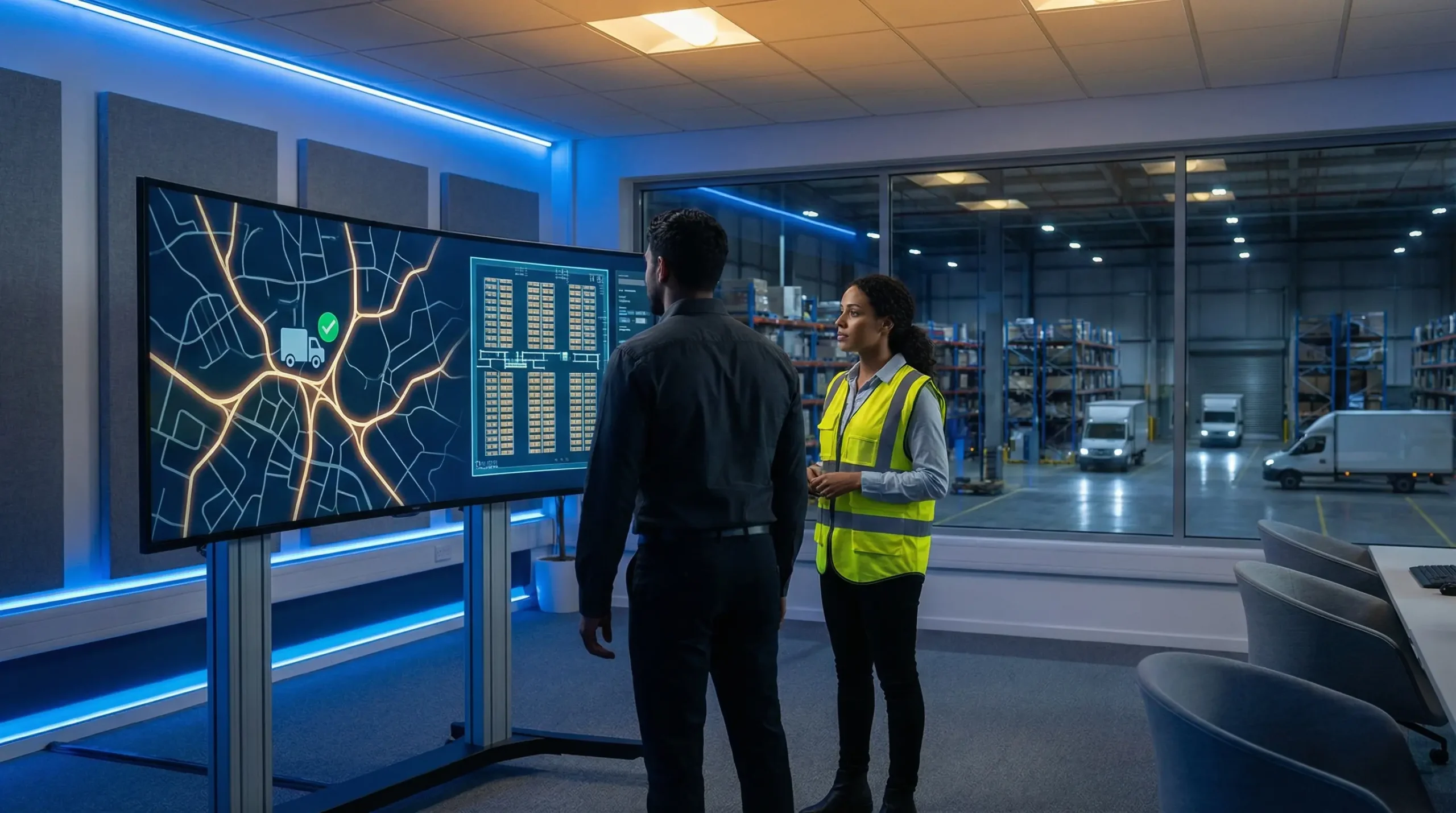
🚚 Last-mile delivery now accounts for 53% of total shipping costs — here is how AI is cutting that number for logistics operators in 2026. This guide covers real AI applications across route optimization, warehouse robotics, fleet management, and 3PL operations — with real tools, 2026 adoption data, and a decision framework for logistics managers evaluating their first AI investment.
Last Updated: June 13, 2026
The logistics industry in 2026 faces a pressure that no amount of additional headcount can solve: last-mile delivery now accounts for 53% of total shipping costs, yet 80% of consumers expect same-day delivery and 77% want their orders within two hours. This is the operational reality that AI in logistics is being asked to solve — not at the strategic level of supply chain planning, but at the execution level where routes get planned, vehicles get dispatched, packages get picked, and deliveries get made. The gap between what customers expect and what traditional logistics operations can deliver is where AI is having its most immediate, measurable impact in 2026.
This article covers how AI improves the day-to-day execution of logistics operations: routing decisions, fleet operations, warehouse automation, and third-party logistics (3PL) management. It focuses on the operational and tactical layer — the decisions logistics managers, fleet operators, and warehouse managers make every day. For the strategic layer — demand forecasting, supplier risk, inventory strategy, and end-to-end supply chain visibility — see our companion guide to AI in supply chains and logistics, which covers that territory in depth. These two articles are designed to work together: strategy in one, execution in the other.
The adoption data confirms that this is no longer an emerging technology question. McKinsey’s logistics technology research consistently identifies AI-powered route and load optimization as the highest-ROI technology investment available to logistics operators today. A 2025 survey of global transportation professionals found that 96% are already using AI within their operations, with the top three use cases being data entry automation (41%), route and load optimization (39%), and AI-driven freight management. The question for logistics operators in 2026 is not whether to adopt AI — it is which operational area to automate first, which tools fit their workflow, and how to measure the return.
📖 New to AI terminology? Visit the AI Buzz AI Glossary — 65+ essential AI terms explained in plain English, including Route Optimization, Autonomous Mobile Robot (AMR), Last-Mile Delivery, and Fleet Management AI.
🚚 1. What “AI in Logistics” Actually Means in 2026
The term “AI in logistics” covers a wide operational territory — which is why the first question worth answering is where, exactly, AI sits in the logistics operation and what it actually does at each layer. The clearest way to understand this is through the distinction between logistics AI and supply chain AI, because the two terms are frequently conflated in a way that leads organizations to buy the wrong tools for the wrong problems.
Supply chain AI operates at the strategic planning layer: it forecasts demand, manages supplier risk, optimizes inventory positioning across a network, and provides end-to-end visibility from raw material sourcing to distribution center. Logistics AI operates at the execution layer: it decides the most efficient route for a driver to take today, detects that a vehicle is likely to fail in the next 200 miles, directs a robot to the correct shelf in a warehouse, and coordinates 500 autonomous mobile robots working simultaneously in a fulfillment center. These are fundamentally different problems requiring different tools, different data inputs, and different organizational owners.
In 2026, the logistics AI layer operates across three distinct operational tiers. The routing layer uses real-time traffic, weather, delivery window, vehicle capacity, and driver hours data to continuously optimize delivery sequences — not just at the start of the day, but dynamically throughout the shift. The warehouse layer uses AI to orchestrate autonomous robots, direct human pickers to optimal locations, manage slotting and replenishment, and reduce the time between order placement and dispatch. The fleet layer uses machine learning trained on vehicle sensor data to predict maintenance failures, score driver behavior, optimize fuel consumption, and manage the emerging challenge of mixed EV/ICE fleet operations. AI-powered systems can improve fleet efficiency by roughly 45% through intelligent routing and predictive maintenance combined — a figure that explains why fleet and warehouse AI is the fastest-growing category in logistics technology spending.
The Operational Definition: AI in logistics is not about where products come from — that is supply chain AI. It is about how products move, where they are stored, and how they reach the final customer. Every tool, every decision, every ROI metric in this guide lives at the execution layer — where logistics managers, fleet operators, and warehouse supervisors make decisions every day.
| Supply Chain AI (Strategic) | Logistics Operations AI (Execution) |
|---|---|
| Demand forecasting | Route optimization |
| Supplier risk management | Last-mile delivery execution |
| Inventory strategy and positioning | Fleet management and maintenance |
| Procurement automation | Warehouse robotics and orchestration |
| End-to-end supply chain visibility | 3PL multi-client orchestration |
| Reads it: Supply chain directors, C-suite | Reads it: Logistics managers, fleet operators, warehouse supervisors |
📍 2. AI-Powered Route Optimization: Smarter Deliveries, Lower Costs
Route optimization is the highest-traffic AI use case in logistics — cited by 39% of logistics professionals as their top AI application in the 2025 global transportation survey — and it is the area where the ROI case is most directly measurable. Traditional route planning assigns stops in a fixed sequence at the start of the day and cannot adapt when a traffic incident, a failed delivery attempt, or a vehicle breakdown disrupts the plan. AI route optimization treats the delivery sequence as a continuously solvable problem, processing live traffic data, vehicle statuses, driver hours remaining, delivery window constraints, and vehicle capacity simultaneously — and re-optimizing the route every few minutes throughout the shift.
The performance gap between AI-optimized and manually planned routes is documented at scale. AI in last-mile delivery improves ETA accuracy from the industry baseline of 70–80% to 95–98%, continuously optimizes routes based on real-time conditions, and forecasts demand patterns to pre-position vehicles intelligently. Cost savings of 15–30% through optimized routing are consistently reported across fleet sizes from 10 vehicles to 10,000, with capacity gains of 20–35% more deliveries achievable with existing resources. Customer satisfaction improvement follows directly: 95–98% on-time delivery rates versus 75–85% without optimization represent the kind of service level difference that determines whether a logistics provider wins or loses major contracts in 2026.
The 2026 differentiation is dynamic re-routing versus static planning. First-generation route optimization tools planned a route at 7am and stuck to it. Current AI systems operate more like a continuous optimization engine — IBM’s AI in logistics research confirms that AI systems process live traffic data and vehicle statuses to anticipate delays and optimize routes in real time, reducing average delivery windows by 2–3 hours compared to static planning. For same-day and next-day delivery operations, this real-time optimization capability is not a feature upgrade — it is the operational foundation that makes the service level promise achievable.
Route Optimization Reality: AI route planning doesn’t just find the shortest path — it finds the most profitable path given traffic, driver hours, vehicle capacity, delivery windows, fuel cost, and customer priority simultaneously. That multi-variable optimization runs continuously throughout the shift, not just at the start of the day.
| Tool | Best For | Key AI Feature | Pricing (2026) | Fleet Size |
|---|---|---|---|---|
| Locus Dispatch | Enterprise last-mile | 180+ variable optimization including traffic, capacity, and driver hours | Custom | ✅ Large enterprise |
| Route4Me | SMB fleets | Drag-and-drop interface with AI optimization and real-time re-routing | From $40/mo | ✅ 5–100 vehicles |
| OptimoRoute | Mid-market fleets | Real-time re-routing with live driver tracking and customer notifications | From $35/mo | ✅ 10–500 vehicles |
| Onfleet | Last-mile e-commerce | Driver app with AI dispatch, real-time analytics, and customer ETA updates | From $500/mo | ✅ 10–200 vehicles |
| FarEye | Retail and e-commerce | Predictive ETA with customer experience layer and carrier network AI | Custom | ✅ Mid to enterprise |
| Circuit | Small delivery teams | Simple AI route planning with driver app and proof-of-delivery capture | From $20/mo | ✅ 1–20 vehicles |
Pricing as of June 2026 — verify before purchasing. Enterprise platforms (Locus, FarEye) require direct vendor engagement for accurate per-vehicle or per-delivery pricing.
🏭 3. AI in Warehouse Operations: From Picking to Packing
Warehouse operations are where AI is delivering its most visible, most capital-intensive transformation in 2026 — and where the business case has shifted from “interesting pilot” to “competitive necessity” for operators running at scale. The autonomous mobile robots (AMR) market is valued at $2.75 billion in 2026, projected to reach $7.07 billion by 2032 at a 14.4% CAGR, with logistics and 3PL registering the highest growth rate of any sector. The acceleration is not driven by declining robot costs alone — it is driven by the maturation of the AI orchestration layer that allows hundreds or thousands of robots to work collaboratively in a shared space with human workers.
In January 2026, U.S. warehouse automation providers accelerated adoption of multi-agent AI robotics platforms, integrating fleet orchestration systems for thousands of autonomous mobile robots working collaboratively — a milestone that marks the transition from single-robot pilots to enterprise-scale deployment. The operational impact is significant: Symbotic’s warehouse robots pick individual cases from pallets five times faster than human workers. In January 2026, Symbotic acquired Walmart’s Advanced Systems and Robotics division for $200 million, with Walmart simultaneously investing $520 million in Symbotic to deploy AI-powered robotics across its distribution network — the largest single warehouse automation commitment in U.S. retail history.
The economic model that is driving mid-market adoption is Robotics-as-a-Service (RaaS). Instead of the $1 million-plus capital expenditure that warehouse robotics previously required, operators can now subscribe to robot fleets on monthly contracts — adding units during peak season and scaling down after. More than 1.3 million robotics-as-a-service deployments are expected globally by the end of 2026. The differentiator in 2026 is not the robot itself — it is the orchestration layer: the AI software that coordinates humans, robots, and existing warehouse management systems into a coherent workflow that improves as it learns the facility’s specific patterns.
| Feature | Autonomous Mobile Robot (AMR) | Automated Guided Vehicle (AGV) |
|---|---|---|
| Navigation | ✅ AI-driven — maps and navigates environment independently | ⚠️ Fixed tracks or magnetic strips — cannot deviate |
| Flexibility | ✅ High — adapts to layout changes without re-programming | ❌ Low — any layout change requires track modification |
| Setup Time | ✅ Days to weeks | ⚠️ Weeks to months |
| Cost (2026) | ⚠️ $30K–$150K per unit (or RaaS subscription) | ✅ $20K–$100K per unit — lower hardware cost |
| Best For | ✅ Dynamic picking, e-commerce fulfillment, 3PL | ✅ Fixed repetitive transport — pallet moving, assembly lines |
| Human Collaboration | ✅ Designed for shared human-robot workflows | ⚠️ Limited — safety separation typically required |
| Scalability | ✅ High — add units to existing fleet easily | ⚠️ Complex — track changes required for capacity additions |
🚛 4. AI in Fleet Management: Smarter Vehicles, Safer Drivers
Fleet management AI operates at the intersection of vehicle health, driver behavior, fuel economics, and regulatory compliance — and it is the area where logistics operators most consistently underestimate the ROI available before investing. The traditional fleet management model is reactive: vehicles break down, drivers are coached after incidents, fuel costs are reviewed monthly, and compliance violations are discovered during audits. AI fleet management inverts this model entirely — making it predictive, continuous, and automated rather than reactive and periodic.
Predictive vehicle maintenance is the highest-ROI AI capability for most fleet operators, and the one with the most immediately quantifiable return. AI models trained on vehicle sensor data — engine temperature, brake wear, transmission behavior, oil pressure, and hundreds of other data points — can identify the behavioral signatures of components likely to fail 14–30 days before the failure occurs. For a fleet operator running 50 vehicles, preventing two roadside breakdowns per month at an average cost of $750 per incident (towing, emergency repair, driver downtime, missed deliveries) pays for a mid-market fleet AI subscription within the first quarter. Our dedicated AI in fleet management guide covers the predictive maintenance use case in full depth — including platform-specific ROI benchmarks and implementation timelines.
The EV fleet management challenge is creating a new demand for AI capability in 2026. With EV adoption rising rapidly among urban logistics operators, carbon tracking mandatory in several EU jurisdictions, and consumers increasingly favoring demonstrably eco-friendly delivery brands, mixed EV and internal combustion engine fleets have become the norm rather than the exception for many operators. AI charging optimization — scheduling charge cycles to avoid peak tariff windows, predicting range requirements for the next day’s routes, and managing charging infrastructure across multiple depot locations — has emerged as a distinct AI capability category. Optimized routing and consolidated deliveries using AI reduce fleet emissions by 10–40% compared to unoptimized operations, making the environmental case and the cost case simultaneously compelling.
Fleet Manager Reality Check: Predictive maintenance AI doesn’t replace your fleet manager — it gives them a 30-day warning before a breakdown instead of a breakdown on a Monday morning. The decision-making stays human. The data that informs it becomes vastly better.
| Tool | Best For | Key AI Feature | Pricing (2026) | Fleet Size |
|---|---|---|---|---|
| Samsara | Large mixed fleets | Predictive maintenance + AI dashcam safety scoring + ELD compliance | Custom | ✅ 50–10,000+ vehicles |
| Motive (ex-KeepTruckin) | Trucking and HGV | Driver safety AI + ELD + real-time coaching and violation alerts | From $35/vehicle/mo | ✅ 5–5,000+ vehicles |
| Geotab | Enterprise fleets | Fuel optimization AI + compliance management + EV fleet integration | Custom | ✅ 100–100,000+ vehicles |
| Verizon Connect | SMB fleets | Route + maintenance AI with driver behavior scoring | Custom | ✅ 5–500 vehicles |
| Azuga | Mid-market fleets | AI driver coaching with gamification + predictive maintenance alerts | From $25/vehicle/mo | ✅ 10–1,000 vehicles |
| Fleetio | Maintenance-focused | AI predictive service scheduling with parts inventory management | From $4/vehicle/mo | ✅ 5–500 vehicles |
📦 5. AI for 3PL Operators: Managing Multiple Clients at Scale
Third-party logistics operators face a fundamentally different AI challenge than single-brand logistics operations: they must manage multiple clients, multiple inventory profiles, multiple SLA commitments, and multiple billing structures simultaneously — in the same warehouse, using the same workforce and robot fleet. This multi-client orchestration complexity is precisely why 3PL is the fastest-growing segment in warehouse robotics software deployment, and why agentic AI is having its most transformative early impact in logistics at the 3PL layer rather than in single-operator facilities.
To sustain growth in an increasingly competitive market, 3PL providers are moving beyond traditional fulfillment models and investing heavily in automation, AI, and advanced analytics. At the center of this shift is the rise of the agentic logistics operation — warehouses that are no longer reactive storage and distribution sites but intelligent execution hubs capable of real-time autonomous decision-making. Agentic AI in logistics means systems that analyze data from warehouse management systems, transportation platforms, labor management tools, and IoT devices, then autonomously orchestrate operations — prioritizing client orders by SLA urgency, dynamically re-slotting fast-moving SKUs, and adjusting robot task assignments without waiting for supervisor approval.
The humanoid robot layer is beginning to emerge at the leading edge of 3PL operations in 2026. As of early 2026, Agility Robotics is scaling production to 10,000 Digit humanoid units annually following successful pilot deployments at Amazon and GXO Logistics. These are not warehouse-specific robots — they are general-purpose bipedal robots that can perform tasks across the full range of warehouse workflows, from unloading containers to picking individual items, without the fixed infrastructure that AMRs and AGVs require. The commercial scale deployment of humanoid robots in 3PL facilities is still 18–24 months from mainstream adoption, but the pilots confirm that the capability is real and the economics are improving rapidly.
🏭 Exploring AI in your industry? Browse the AI Buzz Industry Guide — 35+ in-depth sector guides covering how AI is transforming healthcare, finance, HR, legal, retail, manufacturing, and more.
🛠️ 6. AI Logistics Tools: What to Use in 2026 by Operation Type
The logistics AI tool market in 2026 is organized by operational function rather than company size — the same route optimization platform that works for a 10-vehicle courier operation works at a different tier for a 1,000-vehicle national carrier, and the warehouse robotics platforms that serve Amazon-scale distribution centers have mid-market equivalents available on RaaS subscription models. The decision framework is not “which tool is the best” — it is “which operational bottleneck is costing my operation the most right now.” The table below maps the leading platforms to the specific logistics operation type they serve best.
| Tool | Operation Type | AI Capability | Best For | Pricing (2026) |
|---|---|---|---|---|
| Locus Dispatch | Route optimization | 180+ variable AI routing with real-time re-optimization | Enterprise last-mile carriers | Custom |
| Samsara | Fleet management | Predictive maintenance + AI safety dashcam | Large mixed fleets | Custom |
| Symbotic | Warehouse robotics | Full facility AI automation — 5x human pick speed | Large distribution centers | Custom (enterprise) |
| Locus Robotics | AMR warehouse | AI picking orchestration + multi-robot fleet coordination | 3PL fulfillment centers | RaaS model |
| Onfleet | Last-mile delivery | Real-time tracking + driver AI + customer ETA | E-commerce brands | From $500/mo |
| project44 | Visibility platform | Predictive ETAs + disruption alerts across carriers | Multi-carrier operations | Custom |
| FarEye | Delivery management | Customer experience AI + dynamic delivery windows | Retail logistics operators | Custom |
| Geotab | Fleet telematics | Fuel + compliance AI with EV fleet management | Enterprise fleets | Custom |
| Motive | HGV and trucking | Driver safety AI + ELD + real-time violation alerts | Long-haul fleets | From $35/vehicle/mo |
Pricing as of June 2026 — verify before purchasing. RaaS pricing for warehouse robotics varies by unit count, facility size, and contract length. Always request a total cost of ownership breakdown including integration and implementation costs.
⚠️ 7. Risks and Challenges of AI in Logistics Operations
The logistics operators that struggle with AI in 2026 are rarely struggling with the AI itself — they are struggling with the data infrastructure the AI depends on. Route optimization AI trained on inaccurate address data produces worse routes than a human dispatcher. Predictive maintenance AI fed sensor data from poorly calibrated vehicle hardware misses the failures it was designed to catch. Warehouse orchestration AI managing inventory with poor data hygiene misroutes robots and creates picking errors that manual operations would have avoided. Data quality is not a prerequisite that vendors mention prominently in demos — but it is the single biggest determinant of whether AI deployments deliver the promised results in the first six months.
Integration with legacy transportation management systems (TMS) and warehouse management systems (WMS) is the second major deployment challenge. Most logistics operations run on TMS and WMS platforms that are 5–15 years old, built on architecture that predates API-first integration. Connecting a modern AI route optimization platform to a legacy TMS often requires custom integration work that adds 3–6 months to the deployment timeline and $50,000–$200,000 to the implementation cost. Before committing to any AI logistics platform, map your current TMS and WMS architecture and ask every vendor for a specific integration reference — not a general claim of compatibility, but a named customer running the same TMS/WMS combination.
The cybersecurity risk in AI-connected logistics networks is an increasingly urgent concern that most logistics operators have not yet fully addressed. Connected fleets, warehouse IoT networks, and real-time logistics visibility platforms create an expanded attack surface that threat actors are actively targeting — freight data theft, route manipulation, and ransomware attacks on warehouse management systems are all documented threat vectors in 2026. Understanding cybersecurity risks in AI-connected operations is now a practical requirement for logistics operators, not just a concern for the IT department. The human-in-the-loop governance model is also critical for logistics AI decisions with significant safety or financial consequences — autonomous re-routing, autonomous vehicle dispatch, and AI-driven pricing decisions all benefit from defined human approval checkpoints that prevent the over-automation failures that have damaged operations at several high-profile logistics deployments in 2024–2025.
Implementation Reality: The companies that struggle with logistics AI in 2026 are rarely struggling with the AI itself — they are struggling with the data infrastructure the AI depends on. Clean address data, accurate vehicle sensor calibration, and reliable TMS/WMS integration are the prerequisites that determine whether AI produces results or expensive disappointment.
📌 Key Takeaways
| ✅ | Takeaway |
|---|---|
| ✅ | Last-mile delivery accounts for 53% of total shipping costs — AI route optimization cuts this by 15–30% while increasing delivery capacity by 20–35% with the same vehicle fleet. |
| ✅ | AI improves last-mile ETA accuracy from the industry baseline of 70–80% to 95–98% — a service level improvement that directly determines contract wins and renewals for logistics operators. |
| ✅ | 96% of logistics professionals are already using AI in their operations — route and load optimization (39%) is the top use case, followed by AI-driven freight management (2025 global transportation survey). |
| ✅ | The AMR market is valued at $2.75 billion in 2026, growing to $7.07 billion by 2032 — 3PL is the fastest-growing deployment segment, driven by multi-client AI orchestration platforms and the RaaS subscription model. |
| ✅ | Robotics-as-a-Service now allows mid-market operators to access warehouse robotics without $1M+ capital investment — over 1.3 million RaaS deployments are expected globally by end of 2026. |
| ✅ | Agentic AI is transforming 3PL operations — warehouses are becoming autonomous execution hubs that orchestrate humans, robots, and WMS data simultaneously without waiting for supervisor approval on routine decisions. |
| ✅ | AI-optimized routing and consolidated deliveries reduce fleet emissions by 10–40% — making the environmental and the cost case simultaneously compelling for operators facing carbon reporting mandates in 2026. |
| ✅ | The key differentiator in 2026 warehouse AI is not the robot — it is the orchestration layer. Symbotic’s robots pick 5x faster than humans; the AI that coordinates 500 robots in a shared space with human workers is the capability that creates the competitive gap. |
🔗 Related Articles
- 📖 AI in Supply Chains and Logistics: How AI Improves Demand Forecasting, Inventory, and Delivery
- 📖 AI in Fleet Management: Predictive Maintenance, Fuel Optimization, and Driver Safety
- 📖 Autonomous AI Agents Explained: How Agentic AI Plans, Acts, and Completes Tasks Without You
- 📖 Human-in-the-Loop (HITL) Explained: How to Use AI Safely with Approval Gates and Clear Accountability
- 📖 AI in Manufacturing: How AI Powers Smart Factories, Predictive Maintenance, and Quality Control
❓ Frequently Asked Questions: AI in Logistics
1. How is AI used in logistics operations in 2026?
AI in logistics operates across three execution layers: routing (real-time route optimization and dynamic re-routing), warehouse (autonomous mobile robots, AI picking orchestration, and warehouse management AI), and fleet (predictive maintenance, driver safety scoring, and fuel optimization). 96% of logistics professionals already use AI in their operations. See our AI in supply chains guide for the strategic planning layer that complements these operational tools.
2. What is the ROI of AI route optimization for logistics companies?
AI route optimization delivers cost savings of 15–30% through optimized routing, capacity gains of 20–35% more deliveries with existing resources, and ETA accuracy improvement from 70–80% to 95–98% on-time delivery rates. Fleet efficiency improves by roughly 45% when AI routing is combined with predictive maintenance. These returns are consistent across fleet sizes from 10 to 10,000 vehicles. Our AI in fleet management guide covers the fleet-specific ROI data in depth.
3. What are Autonomous Mobile Robots (AMRs) and how are they different from AGVs?
AMRs use AI to navigate warehouse environments independently — mapping their surroundings and adapting to layout changes without fixed tracks. AGVs follow fixed magnetic strips or tracks and cannot deviate from pre-set paths. AMRs are more flexible, faster to deploy (days vs. weeks), and better suited to dynamic picking and 3PL environments. The AMR market is valued at $2.75 billion in 2026. Robotics-as-a-Service now makes AMR deployment accessible without $1M+ capital investment. Our AI Glossary explains AMR, AGV, and related warehouse automation terms in plain English.
4. How is AI changing 3PL operations in 2026?
3PL operators are deploying agentic AI systems that autonomously orchestrate multi-client warehouse operations — analyzing WMS, transportation platform, and IoT data simultaneously to prioritize orders by SLA urgency, re-slot fast-moving SKUs, and adjust robot task assignments without human approval on routine decisions. 3PL is the fastest-growing segment in warehouse robotics software. See our agentic AI guide for how autonomous AI decision-making works at the operational level.
5. What are the biggest risks of using AI in logistics operations?
The three most common failure points are: (1) data quality — AI route and warehouse tools are only as good as the address data, sensor calibration, and inventory data they receive; (2) legacy TMS/WMS integration — connecting modern AI platforms to older systems adds 3–6 months and $50K–$200K to deployment; and (3) cybersecurity — connected fleet and warehouse networks are active attack targets in 2026. See our guides on cybersecurity in AI operations and human-in-the-loop governance for the risk mitigation framework.
📧 Get the AI Buzz Weekly Digest
Weekly AI insights, tools, and strategies — delivered every Monday. Free.




Leave a Reply