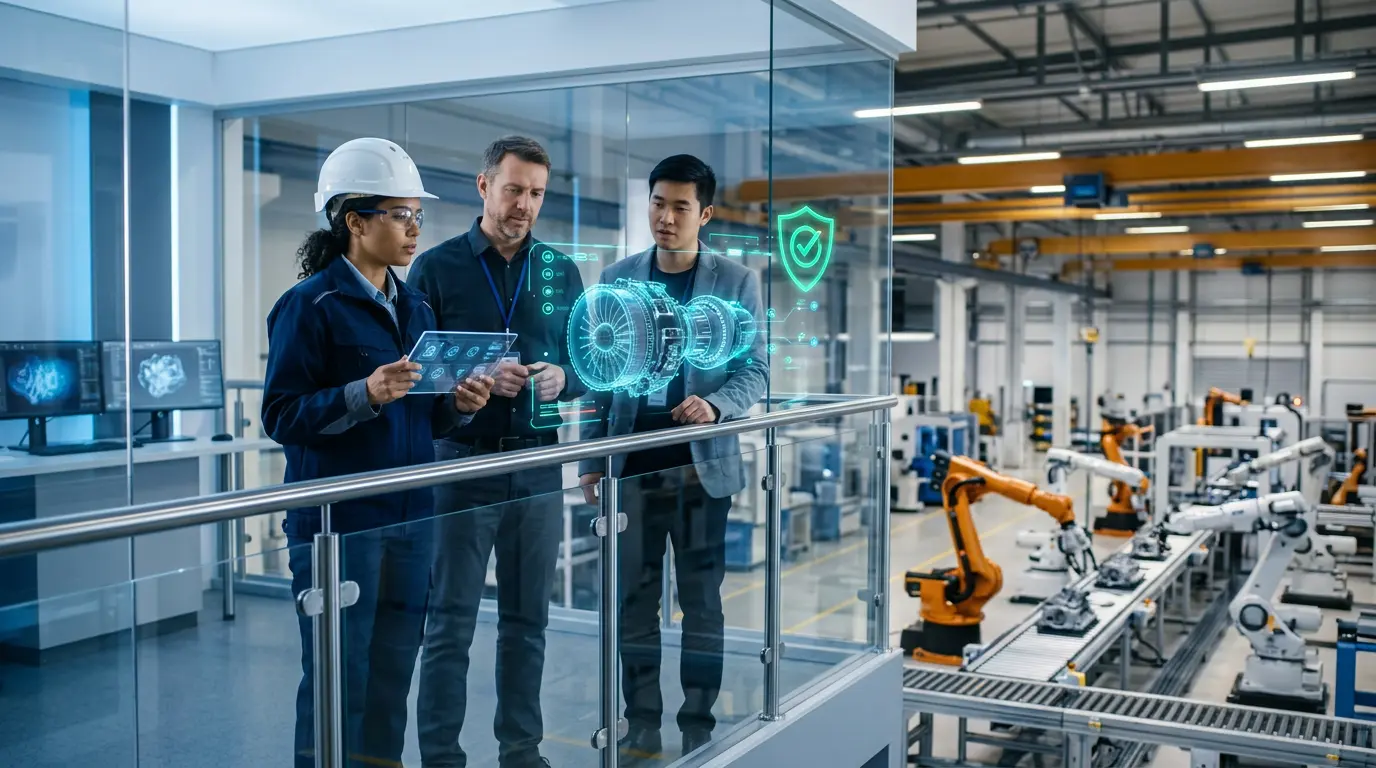
🏭 Manufacturing loses an average of $253 million annually to unplanned equipment failures — and AI predictive maintenance is already cutting that by 50% with 10:1 to 30:1 ROI within 12–18 months. This guide covers what AI does across every manufacturing function in 2026, the real ROI data, and the industrial platforms powering smart factories globally.
Last Updated: June 6, 2026
AI in manufacturing has reached its production-scale inflection point in 2026. The global AI in manufacturing market is projected to grow from $17.44 billion in 2025 to $115.76 billion by 2030 — a 46% CAGR that reflects not technology enthusiasm, but documented operational results. McKinsey’s 2025 research on scaling AI in manufacturing documents one facility deploying multiple high-impact AI use cases in parallel that increased Overall Equipment Effectiveness by ten percentage points while halving unplanned downtime — and is now on target to more than double its production volume in under three years. These are not pilot results. They are production outcomes from manufacturers that made the transition from Industry 4.0 experimentation to operationally embedded AI at scale. The manufacturers that made this transition in 2024–2025 are compounding their advantage every quarter.
Industry 5.0 — the framework that builds on Industry 4.0’s connectivity and automation with a human-centric, resilient, and sustainable focus — defines the 2026 manufacturing AI conversation. Where Industry 4.0 asked “how do we connect machines and generate data?”, Industry 5.0 asks “how do we use AI to act on that data in ways that benefit both production efficiency and worker capability?” The practical answer involves predictive maintenance systems that flag failures before they happen, computer vision quality inspection that operates 24/7 without fatigue, AI production scheduling that dynamically adjusts to demand changes and supply disruptions, and worker augmentation tools that give frontline employees access to AI-driven insights without requiring data science expertise. This guide covers all of these applications with the 2026 ROI data that every operations leader and COO needs to build the business case. For the supply chain context that connects factory-level AI to the broader logistics network, our guide to AI in supply chains and logistics covers the end-to-end picture.
The competitive landscape in 2026 is defined by two categories: manufacturers who have moved beyond pilots to enterprise-scale AI deployment across multiple functions simultaneously, and those still running isolated proof-of-concept programs that have not generated organizational impact. Deloitte’s manufacturing AI research consistently finds that manufacturers who deploy AI across three or more functions simultaneously achieve compounding ROI — because quality improvements reduce rework costs that feed directly into maintenance planning efficiency, which reduces energy waste from unplanned overtime, which improves production scheduling accuracy. The use cases are not independent value streams; they are interconnected elements of a manufacturing intelligence architecture. Edge AI — the ability to run AI models directly on factory floor hardware without cloud round-trips — has been the enabling technology shift of 2025–2026, making real-time inference at machine speed viable for the first time at industrial scale.
📖 New to AI terminology? Visit the AI Buzz AI Glossary — 65+ essential AI terms explained in plain English, each linking to a full in-depth guide.
🏭 1. What AI Does in Manufacturing — Core Applications in 2026
Manufacturing was among the first industries to apply machine learning at scale — sensor data, production logs, and quality records create the dense, structured datasets that AI models require. In 2026, the application landscape has broadened significantly beyond the original predictive maintenance and quality control use cases. AI now operates across design, production scheduling, supply chain integration, worker safety, energy management, and end-of-line logistics. The use cases that drive the most immediate ROI are those where the problem involves pattern recognition across high-volume data streams — exactly the category where AI outperforms human analysis at every scale.
Predictive Maintenance remains the highest-ROI and most widely deployed AI application in manufacturing in 2026. AI models continuously analyze 200+ sensor data points per machine — vibration signatures, temperature profiles, acoustic emissions, oil analysis, power draw patterns — to identify deviation from normal operating conditions that precedes component failure. The output is a failure probability score and a predicted failure window, typically 20–45 days in advance. This shifts maintenance from reactive (fix it when it breaks) to predictive (fix it before it breaks during a planned maintenance window), eliminating emergency repair costs, production disruption costs, and the extended downtime of unscheduled stoppages. Prediction accuracy improves from 70–80% in early deployment to 85–95% within 12–18 months as models accumulate facility-specific failure history.
Computer Vision Quality Inspection is the application area showing the fastest adoption growth in 2025–2026, driven by falling hardware costs and the maturation of deep learning models trained on manufacturing defect datasets. AI vision systems inspect 100% of products at production line speeds that are physically impossible for human inspectors — analyzing for dimensional tolerances, surface defects, assembly errors, and foreign material contamination simultaneously, across multiple camera angles, at throughput rates of thousands of units per hour. The systems flag defective items in real time, triggering immediate line stops or automated rejection, and log every inspection result with image evidence for quality traceability and compliance documentation.
AI Production Scheduling and Demand Planning addresses the core operational challenge of balancing production capacity, material availability, workforce scheduling, and delivery commitments simultaneously — a combinatorial optimization problem that traditional ERP scheduling systems approximate but do not solve optimally. AI scheduling systems process real-time signals — machine status, workforce availability, material inventory levels, live demand signals, supply variability — to generate production schedules that maximize throughput while minimizing changeover waste, energy consumption during off-peak periods, and overtime costs. IDC’s 2026 Manufacturing Industry FutureScape predicts that more than 40% of manufacturers will adopt AI tools for scheduling systems within the next year, with over 65% doing so by 2030 — reflecting the operational case that has been established by early adopters. For the energy management dimension of AI-optimized manufacturing, our guide to AI in energy and utilities covers how AI-driven energy optimization applies to both manufacturing facilities and the grid infrastructure that powers them.
📊 2. AI in Manufacturing — ROI and Results Data (2026)
The most common reason COOs stall on AI manufacturing investments is not technical — it is the inability to build a compelling business case with specific, auditable ROI figures. The data that follows is drawn from documented 2025–2026 industrial deployments and industry research from McKinsey, IBM, and sector-specific benchmarking studies. These are not vendor marketing projections; they are the baseline results that manufacturers at various implementation maturity levels are achieving from their current AI deployments.
Predictive Maintenance ROI. Manufacturing plants lose an average of $253 million annually to unplanned equipment failures (industry benchmark, 2026), with a single hour of unexpected downtime costing $125,000 in lost production, emergency repairs, and quality issues. IBM’s predictive maintenance research and independent 2026 analysis consistently document: 30–50% reduction in unplanned downtime; 25–40% reduction in overall maintenance costs; and 10:1 to 30:1 ROI within 12–18 months of full deployment. A mid-sized manufacturing facility with 200–300 critical assets and $125K average downtime cost per hour can expect initial investment of $150K–$400K generating $1.5–$4.15 million in annual savings — a 10:1 to 27:1 first-year return that improves as models learn facility-specific failure patterns. Automotive plants achieve 30% maintenance cost reduction and 40% equipment uptime improvement. A chemical manufacturer documented $2 million in annual savings from decreased equipment failures after digital twin predictive maintenance deployment. The Siemens-owned Senseye platform claims 55% improvement in maintenance efficiency with ROI visible within three months.
Quality Control ROI. A McKinsey analysis estimates that AI-driven quality control can reduce manufacturing costs by up to 20% — reflecting the compounding savings from eliminated scrap, reduced rework, lower warranty claims, and faster throughput on high-yield production runs. AI quality inspection infrastructure provides 200–300% ROI through significant defect reduction and faster inspection cycles. AI quality inspection cuts scrap rates by 30% — reducing both raw material waste and the energy and labor embedded in products that cannot be sold. Computer vision systems achieve detection accuracy for surface and dimensional defects that consistently exceeds human inspection performance, particularly for high-speed production lines and micro-defect categories that are physically difficult for human inspectors to identify consistently. Semiconductor manufacturers leverage AI-generated defect images to build more robust inspection models, reducing the need for thousands of real-world examples and enabling faster deployment of new product inspection capabilities.
The 2026 Manufacturing AI ROI Standard: According to McKinsey’s research on scaling AI in manufacturing, one documented deployment increased Overall Equipment Effectiveness by ten percentage points while halving unplanned downtime — and is now on target to more than double production volume in under three years. Industry-wide, manufacturers implementing AI at scale are achieving average returns of 3.5x within two years (WifiTalents 2026, verified against multiple benchmark sources). The manufacturers compounding returns across three or more simultaneous AI applications achieve significantly higher ROI than those deploying single-use-case pilots.
| AI Application | Typical ROI (2026) | Payback Timeframe | Industry Example / Source |
|---|---|---|---|
| Predictive Maintenance | ✅ 10:1 to 30:1 first-year ROI; 50% unplanned downtime reduction; 25–40% maintenance cost reduction | 6–14 months to full payback; initial savings visible within 90 days | Automotive plants: 30% maintenance cost reduction, 40% uptime improvement; Chemical manufacturer: $2M annual savings; Senseye (Siemens): 55% maintenance efficiency improvement in 3 months |
| Quality Control (Computer Vision) | ✅ 200–300% ROI; 30% scrap rate reduction; up to 20% manufacturing cost reduction (McKinsey) | 6–18 months; defect rate improvement visible within first production quarter | Semiconductor manufacturers: AI defect detection replacing thousands of manual test images; automotive and electronics: 100% inspection at production speed vs sampling-based human inspection |
| Production Scheduling Optimisation | ✅ 10–25% throughput improvement; 15–20% reduction in changeover waste; OEE improvement of 5–25 percentage points (McKinsey: 10-point OEE gain documented) | 3–9 months; schedule improvement visible from first production cycle | SQM (lithium mining, McKinsey case study): AI scheduling optimizing output while minimizing water and energy use; IDC: 40%+ of manufacturers adopting AI scheduling tools within 1 year |
| Energy Management | ✅ 10–20% energy cost reduction; 20% improvement in energy consumption with intelligent optimization; McKinsey: manufacturing AI improves “yield, energy, and throughput” | 12–24 months to full ROI; off-peak scheduling savings begin immediately | AI production scheduling shifts energy-intensive processes to off-peak tariff windows; digital twin energy models identify hidden consumption inefficiencies across production lines |
| Supply Chain Integration | ✅ 150–250% ROI; 30% improvement in forecast accuracy (BCG); 50–80% reduction in delays and disruption impact | 9–18 months to full ROI; demand forecast accuracy improvement in first forecasting cycle | BCG: AI supply chain simulation improves forecast accuracy 30% and reduces delays 50–80%; P&G: AI + IoT to automate warehouse and distribution center operations |
| Worker Safety Monitoring | ✅ 25–40% reduction in safety incidents; significant insurance premium reduction; regulatory compliance cost reduction | 3–6 months; safety incident reduction visible within first quarter of deployment | Computer vision PPE compliance monitoring; AI-powered proximity detection for cobot-human collaboration zones; ergonomic risk identification from wearable and camera data |
ROI figures from documented 2025–2026 industrial deployments and industry research (McKinsey, IBM, BCG, Augury, OxMaint). Individual results vary significantly by facility size, existing data infrastructure maturity, and implementation approach. Full-payback timelines reflect complete program investment including hardware, software, and implementation costs.
The ROI gap between organizations that have scaled AI and those that have not is widening. McKinsey’s manufacturing AI research identifies the key differentiator between manufacturers achieving 3–5x ROI and those stuck in pilot purgatory: the high performers have fundamentally redesigned individual workflows around AI — not added AI as an additional tool within existing processes. This workflow redesign is the pattern that translates a 50% downtime reduction at the machine level into a 10-point OEE improvement at the facility level and a production volume doubling at the business level. For fleet and mobile asset management within manufacturing environments, our guide on AI in fleet management covers how predictive maintenance AI applies to the vehicle assets that move goods within and between manufacturing facilities.
🏭 Exploring AI in your industry? Browse the AI Buzz Industry Guide — 35+ in-depth sector guides covering how AI is transforming healthcare, finance, HR, legal, retail, manufacturing, and more.
🛠️ 3. Leading Industrial AI Platforms in 2026 — What Manufacturers Are Actually Using
The industrial AI platform landscape in 2026 has consolidated into three distinct categories, as documented by independent manufacturing technology research. OT-rooted automation vendors with embedded AI (Siemens, Rockwell, PTC) serve organizations already deeply embedded in those equipment ecosystems — they provide the tightest native integration with existing automation infrastructure. AI-native industrial platforms (C3.ai, Sight Machine, Augury) were built from the ground up for industrial data analytics at scale, offering deeper AI capability with broader equipment compatibility. Cloud platform providers (Microsoft Azure IoT, AWS IoT SiteWise) provide the infrastructure backbone for organizations building custom AI manufacturing applications or consolidating data from multiple plant systems into a unified analytics layer.
The platform selection decision is primarily ecosystem-driven, not feature-driven. A Siemens-equipped facility benefits enormously from Siemens Industrial Copilot’s native integration with Siemens PLCs, SCADA, and digital twin infrastructure — the data already flows through Siemens systems, and the AI models are pre-trained on Siemens equipment operational data. A plant running Allen-Bradley equipment will find Rockwell FactoryTalk’s native integration similarly compelling. For plants with mixed equipment from multiple vendors — the most common brownfield manufacturing reality — vendor-neutral platforms and cloud-native approaches provide better flexibility. Before committing to any enterprise industrial AI platform on a multi-year contract, the structured evaluation process in our AI vendor due diligence checklist covers the data governance, security, and integration controls that industrial deployments specifically require.
| Platform | Best For | Key AI Capability | Optimal Scale / Context |
|---|---|---|---|
| Siemens Industrial Copilot (Xcelerator) | Large manufacturers already in the Siemens ecosystem — automotive, electronics, aerospace, discrete and process manufacturing | Nine industrial copilots across the full value chain; NVIDIA-partnered Industrial AI Operating System; Digital Twin Composer for simulation; Insights Hub (formerly MindSphere) for cloud analytics; Edge AI via Industrial Edge platform. Siemens + NVIDIA are building the world’s first fully AI-driven adaptive manufacturing site in Erlangen, Germany, as a 2026 blueprint | Enterprise and large manufacturing; full lifecycle from design through operations; deepest native integration for Siemens-equipped facilities; $50K–$100K+/year starting point for mid-size deployments |
| IBM Maximo Application Suite | Asset-intensive industries prioritizing AI-driven maintenance management — energy, utilities, oil and gas, heavy industry, aerospace | AI-powered asset performance management; predictive maintenance with IoT integration; remote monitoring; lifecycle optimization; strong CMMS (Computerized Maintenance Management System) capabilities with AI anomaly detection layered on asset sensor data | Enterprise asset-intensive operations with complex regulatory compliance requirements; strong in US, Germany, UK, Japan; partnering with edge computing providers for plant-floor deployment; typically part of broader IBM enterprise stack |
| Rockwell Automation FactoryTalk | Plants running Allen-Bradley PLC infrastructure; North American discrete and batch manufacturers needing connected factory analytics with native OT integration | AI analytics natively connected to Allen-Bradley control systems; production monitoring, OEE tracking, and anomaly detection; FactoryTalk Analytics and IntelliTrack for AI-powered operational intelligence; Industry 5.0 workforce augmentation tools | Mid-to-large Allen-Bradley installed base; automotive, food and beverage, life sciences, and CPG; North America primary market; reseller ecosystem for mid-market deployment |
| GE Vernova Proficy (formerly GE Digital) | Energy and process industries — power generation, oil and gas, renewable energy, water treatment, and chemical processing | AI-powered historian (Proficy Historian) for industrial time-series data; predictive asset analytics for power and process equipment; Plant Applications for production KPI management; strong in energy transition use cases as GE Vernova focuses on decarbonization-aligned manufacturing | Process industries and energy transition operators; legacy GE Digital installed base in utilities and heavy industry; best-in-class for turbine and power plant predictive analytics |
| PTC ThingWorx | Organizations building custom IIoT and AI manufacturing applications requiring maximum development platform flexibility | Deepest development platform for custom IIoT applications; low-code / no-code app builder for shop floor; Windchill PLM integration for AI-connected design-to-manufacturing workflows; AR-guided maintenance with Vuforia; strong digital thread capability | Complex, customized manufacturing environments where off-the-shelf solutions are insufficient; note: PTC’s pending sale to TPG private equity introduces transition uncertainty for long-term commitments — verify current status before procurement |
| Microsoft Azure IoT + Copilot for Manufacturing | Microsoft 365 and Azure-native organizations wanting cloud-first manufacturing AI with native Dynamics 365, Power BI, and Teams integration | Azure IoT SiteWise for industrial data ingestion; AI-powered analytics via Azure Machine Learning; Copilot for Manufacturing integrating shop floor data with enterprise systems; pay-as-you-go pricing ($500–$5,000/month for small-to-mid deployments); best Dynamics 365 and Power BI integration of any platform | Microsoft-ecosystem manufacturers of any size; cloud-native approach suits mid-market manufacturers without large OT teams; enterprise integration across ERP, CRM, and operations in one cloud; scales from pilot to full-plant deployment on pay-as-you-go basis |
Platform capabilities as of June 2026. Enterprise industrial software (Siemens, Rockwell, IBM, GE Vernova, PTC) is typically quoted on request — pricing varies significantly by deployment scale, feature scope, and contract terms. Microsoft Azure IoT uses consumption-based pricing ($500–$5,000/month for small plants, scaling with data volume and asset count). Always conduct a structured evaluation before committing to a multi-year industrial platform contract.
The platform selection framework for 2026 manufacturing AI deployments is ecosystem-first: if your plant runs Siemens automation, Siemens Industrial Copilot and Xcelerator provide the most efficient path to integrated AI because the data architecture is already in place. If your maintenance team is already running IBM Maximo as a CMMS, adding the AI Asset Performance Management layer is faster and more effective than deploying a separate predictive maintenance tool that requires new data pipelines. Energy management AI integrates closely with manufacturing scheduling optimization — the platforms that handle both functions natively (Siemens, GE Vernova, Microsoft Azure) produce better outcomes than those requiring separate energy and production systems to be manually reconciled.
🔒 4. AI Safety, Governance, and Industry 5.0 in Manufacturing
Industry 5.0 — the European Commission’s framework that extends Industry 4.0 with explicit human-centric, resilient, and sustainable requirements — has introduced governance dimensions to manufacturing AI that did not exist in earlier technology adoption cycles. The European Commission’s Industry 5.0 framework explicitly positions AI as a tool for augmenting human worker capability rather than replacing it, prioritizing resilient supply chains and sustainable production alongside traditional efficiency metrics. For manufacturers operating in EU markets or supplying EU customers, this framework is increasingly shaping procurement requirements: customers want evidence not just of AI capability, but of responsible AI governance that protects workers, maintains supply chain resilience, and addresses environmental impact.
Worker safety monitoring is the Industry 5.0 application that has seen the fastest adoption growth in 2025–2026. AI computer vision systems monitor PPE compliance, proximity of workers to hazardous machinery, ergonomic risk from repetitive motion patterns, and real-time detection of unsafe conditions — generating alerts before incidents occur rather than documenting them afterward. Collaborative robots (cobots) equipped with AI perception enable human-robot collaboration in tasks previously requiring either full automation or manual handling, with AI managing the safety boundaries of the human-robot interaction in real time. The result is measurable: 25–40% reduction in safety incidents at facilities with deployed AI worker safety monitoring, with compounding benefits from reduced insurance premiums, regulatory compliance cost reduction, and the retention of experienced workers whose skills are preserved rather than displaced.
The cybersecurity dimension of manufacturing AI deserves specific attention in 2026. AI systems in manufacturing expand the attack surface of industrial networks: a compromised AI model can manipulate quality inspection outputs, generate false predictive maintenance alerts, or introduce production scheduling decisions that cause physical harm. McKinsey’s research on scaling manufacturing AI specifically identifies IT/OT infrastructure and cybersecurity as the most underinvested foundations — with COOs giving the lowest prioritization to exactly these elements. This is the most dangerous investment pattern in industrial AI: organizations deploying AI capabilities on top of inadequately secured OT networks are creating new vulnerabilities faster than they are generating new value. The security architecture for manufacturing AI requires the same rigor as the safety architecture, and both need to be in place before production AI deployment — not after the first incident reveals the gap.
🏁 5. Conclusion: Building Manufacturing AI Capability in 2026
The manufacturing AI evidence base in 2026 is definitive: 10:1 to 30:1 ROI on predictive maintenance, 200–300% ROI on quality inspection infrastructure, 3.5x average return across AI applications within two years, and 10-percentage-point OEE improvements at facilities that have moved from pilots to scaled production deployment. The gap between the manufacturers who have achieved these results and those still evaluating them is not primarily a technology gap — the platforms are proven, the hardware is affordable, and the data already exists in most modern manufacturing facilities. It is a workflow and governance gap: the organizations achieving the best results have redesigned their production workflows around AI-first decision making, invested in workforce capability alongside technology capability, and built the data quality and IT/OT security infrastructure that makes AI deployment safe and sustainable at scale.
The practical starting point for manufacturing leaders in 2026 is the same one that produces the fastest ROI across every industry: identify the single most expensive operational problem, assess whether adequate data exists to model it, and deploy a focused AI application against that specific problem with a 90-day success metric. For most manufacturers, that problem is unplanned downtime — and the ROI case for predictive maintenance is documented well enough to build a compelling board-level business case before a single sensor is installed. Once that first application is delivering documented results, the organizational confidence, data infrastructure, and team capability are in place to expand to quality, scheduling, and energy — and the compounding ROI that McKinsey documents at leading manufacturers begins to take hold.
📌 Key Takeaways
| ✅ | Takeaway |
|---|---|
| ✅ | Manufacturing plants lose an average of $253 million annually to unplanned equipment failures; AI predictive maintenance reduces unplanned downtime by 30–50% and achieves 10:1 to 30:1 ROI within 12–18 months, with initial savings visible within the first 90 days of deployment. |
| ✅ | McKinsey documents a manufacturing facility deploying multiple AI use cases simultaneously that increased OEE by ten percentage points while halving unplanned downtime — and is now on target to more than double production volume in under three years (McKinsey, December 2025). |
| ✅ | AI quality control delivers 200–300% ROI through defect reduction and faster inspection cycles; McKinsey estimates AI-driven quality control reduces manufacturing costs by up to 20%; AI computer vision cuts scrap rates by 30% and inspects 100% of products at production speeds impossible for human inspectors. |
| ✅ | Manufacturers implementing AI across multiple applications achieve average returns of 3.5x within two years (WifiTalents 2026 benchmark). IDC predicts 40%+ of manufacturers will adopt AI scheduling tools within one year — reflecting the operational case established by early adopters. |
| ✅ | Platform selection in 2026 is ecosystem-first: Siemens Industrial Copilot for Siemens-equipped facilities; Rockwell FactoryTalk for Allen-Bradley environments; IBM Maximo for asset-intensive industries; GE Vernova Proficy for energy and process industries; Microsoft Azure IoT for cloud-native flexibility and Microsoft 365 integration. |
| ✅ | Industry 5.0 — the European Commission framework extending Industry 4.0 with human-centric, resilient, and sustainable requirements — is shaping EU manufacturing procurement requirements: customers increasingly require evidence of responsible AI governance alongside operational capability. |
| ✅ | McKinsey identifies IT/OT infrastructure and cybersecurity as the most underinvested foundations in manufacturing AI — with COOs giving them the lowest prioritization despite being the most critical enablers of safe, scalable AI deployment. Deploying AI capabilities on inadequately secured OT networks creates vulnerabilities faster than value. |
🔗 Related Articles
- 📖 AI in Supply Chains and Logistics: How AI Improves Demand Forecasting, Inventory, and Delivery
- 📖 AI in Energy and Utilities: How AI Is Powering Smart Grids and Predictive Maintenance
- 📖 AI in Fleet Management: Maintenance, Fuel and Safety (2026)
- 📖 Edge AI Explained: How AI Works Without the Internet
- 📖 AI Vendor Due Diligence Checklist: How to Evaluate AI Tools Before You Share Data
❓ Frequently Asked Questions: AI in Manufacturing
1. What is the ROI of AI in manufacturing in 2026?
AI predictive maintenance delivers 10:1 to 30:1 first-year ROI, with initial savings visible within 90 days. AI quality inspection delivers 200–300% ROI through defect reduction and faster inspection cycles. McKinsey documents one facility deploying multiple AI use cases that increased OEE by ten percentage points while halving unplanned downtime. Manufacturers implementing AI across multiple applications achieve an average 3.5x return within two years. The starting ROI case is almost always predictive maintenance — a mid-sized facility with $125K/hour downtime costs can expect $1.5–$4M in annual savings from a $150K–$400K AI deployment. Our AI in supply chains guide covers how supply chain AI adds further ROI on top of factory-level applications.
2. What is the difference between Industry 4.0 and Industry 5.0 AI?
Industry 4.0 focuses on connectivity, automation, and data generation — connecting machines via IoT and using that data to improve operations. Industry 5.0 extends this with a human-centric, resilient, and sustainable framework: AI should augment human worker capability rather than just replace labor, production should be resilient against supply chain disruptions, and sustainability should be a first-class manufacturing metric alongside efficiency. In practice, Industry 5.0 AI adds worker safety monitoring, human-robot collaboration, and energy optimization to the predictive maintenance and quality control focus of Industry 4.0. EU manufacturers face increasing procurement requirements to demonstrate Industry 5.0 governance practices.
3. Which AI manufacturing platform is best in 2026?
Platform selection depends primarily on your existing equipment ecosystem. For Siemens-equipped facilities: Siemens Industrial Copilot and Xcelerator provide native integration with the tightest data connectivity. For Allen-Bradley environments: Rockwell FactoryTalk. For asset-intensive industries needing CMMS + AI: IBM Maximo Application Suite. For energy and process industries: GE Vernova Proficy. For Microsoft-native organizations: Azure IoT + Copilot for Manufacturing ($500–$5,000/month cloud pricing, scales on demand). Before committing to any multi-year industrial platform contract, use our AI vendor due diligence checklist to evaluate security, data governance, and integration requirements.
4. What is the biggest challenge in implementing AI in manufacturing?
McKinsey identifies three primary challenges: culture shift (cited by 50% of COOs), reskilling needs (cited by almost as many), and legacy processes that remain optimized for pre-AI ways of working. Technical barriers (data quality, system integration) are real but increasingly solvable. The deeper challenge is organizational: manufacturers that treat AI as a technology project rather than a workflow redesign initiative consistently underperform those that restructure work around AI-first decision making. Cybersecurity and IT/OT infrastructure are the most critically underinvested foundations — deploying AI on inadequately secured OT networks creates vulnerabilities faster than value.
5. How does edge AI apply to manufacturing?
Edge AI processes data directly on factory floor hardware — PLCs, sensors, cameras, and embedded processors — without sending data to the cloud for analysis. This enables real-time inference at machine speed: quality defect detection that reacts in milliseconds to reject parts before they leave the inspection station; predictive maintenance alerts generated from sensor data without internet connectivity; production scheduling adjustments triggered by real-time machine status without cloud round-trip latency. Edge AI is the enabling technology for the most time-critical manufacturing AI applications. Our edge AI explained guide covers the full technical and deployment picture.
📧 Get the AI Buzz Weekly Digest
Weekly AI insights, tools, and strategies — delivered every Monday. Free.




Leave a Reply