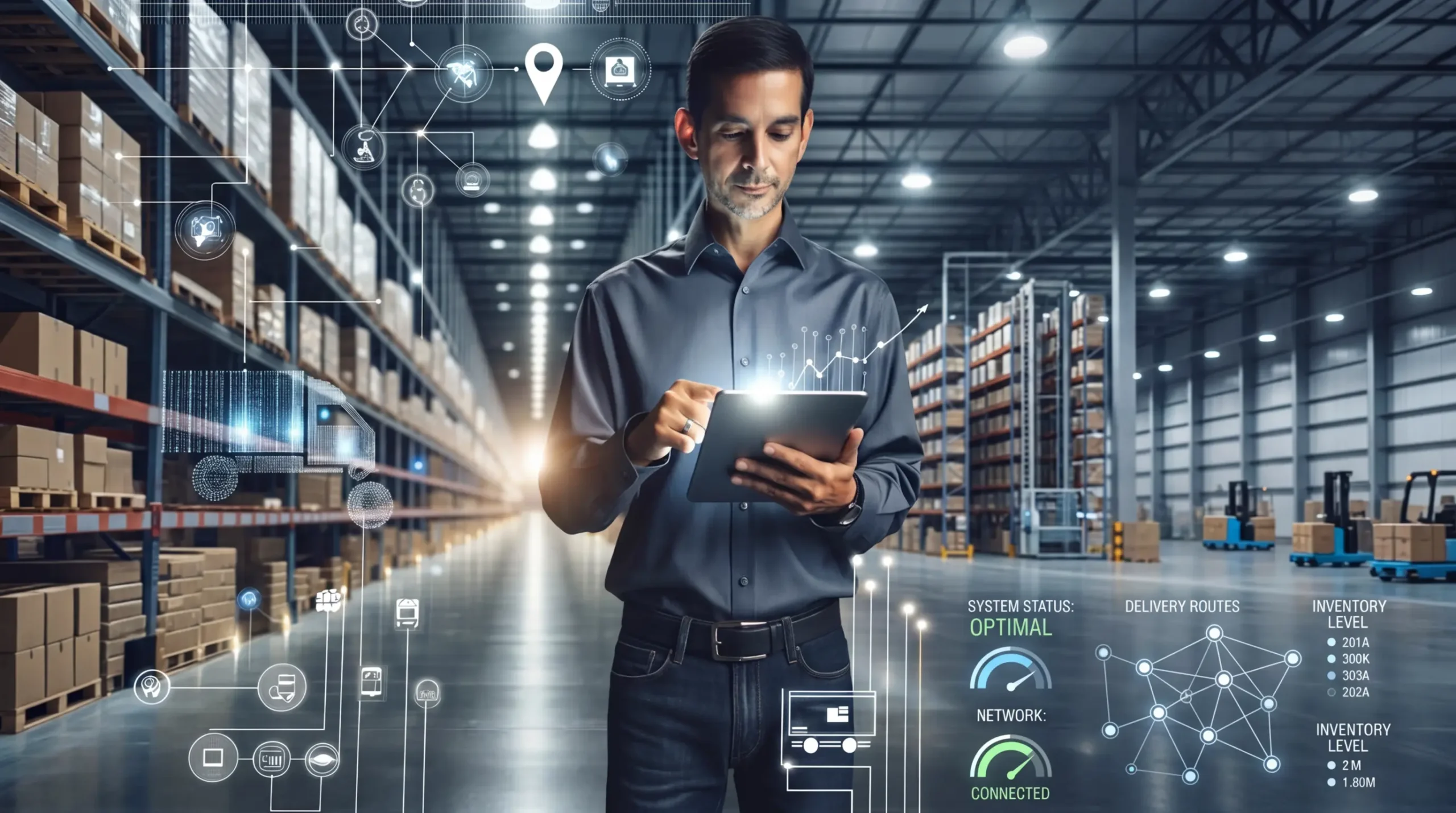
📊 The global AI in supply chain market hit $19.8 billion in 2026 — and companies with AI-mature supply chains are 23% more profitable than their peers. This complete guide covers what AI does across every supply chain function, the leading platforms compared, how AI is being used for disruption resilience, and the real ROI data supply chain leaders need to build the business case.
Last Updated: June 6, 2026
AI in supply chain and logistics has reached its accountability moment in 2026. Gartner forecasts that supply chain management software with agentic AI capabilities will grow from less than $2 billion in 2025 to $53 billion in spend by 2030 — and in March 2026, Gartner predicted that 60% of supply chain disruptions will be resolved without human intervention by 2031. The global AI in supply chain market hit $19.8 billion in 2026, up from $6.5 billion in 2022, a 45.3% CAGR that has nearly tripled market size in four years. Supply chain leaders are no longer asking whether to invest in AI — they are being asked by their CFOs to prove that AI investments are showing up on the P&L. McKinsey found that while 88% of organizations use AI, only 39% can point to EBIT impact. That accountability gap — between AI adoption and documented business results — is the defining challenge of 2026. Our AI in logistics guide covers the last-mile and warehouse automation dimension of this transformation; this article covers the full end-to-end supply chain picture.
This guide gives supply chain leaders, procurement directors, logistics operators, and operations executives the complete 2026 picture: what AI does at every stage of the supply chain in one function-by-function table, the leading enterprise platforms compared by capability and fit, how AI is being used to build resilience against the disruptions that are not going to stop — Everstream Analytics rates geopolitical fragmentation at a 97% threat level and extreme weather at 93% for 2026 — and the ROI benchmarks that help you build a credible business case. Whether you are evaluating your first AI supply chain investment or accelerating from pilots to enterprise-scale deployment, this article gives you the data and frameworks to do it well. For the manufacturing context that shapes upstream supply chain requirements, our guide to AI in manufacturing covers the factory-floor AI that drives supply chain demand signals.
The 2026 supply chain AI landscape is defined by three simultaneous shifts: agentic AI has entered production in supply chain contexts — project44 launched a full AI agent portfolio in April 2026, BCG projects 30% of routine supply chain decisions will be fully automated, and Gartner predicts 40% of enterprise applications will embed task-specific agents by year-end; resilience has overtaken efficiency as the primary strategic driver — Gartner surveyed 509 supply chain leaders in October 2025 and found that “changes in ways of working driven by advancements in AI and agentic AI” will be the most influential driver of future supply chain performance; and accountability is now non-negotiable — Gartner warns that 60% of supply chain digital adoption efforts will fail to deliver promised value by 2028 largely due to insufficient investment in change management. The organizations that manage all three dimensions simultaneously are the ones pulling ahead.
📖 New to AI terminology? Visit the AI Buzz AI Glossary — 65+ essential AI terms explained in plain English, each linking to a full in-depth guide.
📊 1. AI Across the Supply Chain — Use Cases by Function
Supply chain professionals think in operational functions — not AI categories. The table below maps AI capabilities to the eight supply chain functions that account for the majority of cost, risk, and customer impact. Each function is followed by a deeper look at the three where AI is producing the most measurable impact in 2026 deployments.
| Supply Chain Function | What AI Does | Key Benefit (2026 Data) | Leading Platform / Tool |
|---|---|---|---|
| Demand Forecasting | Analyzes historical data, seasonality, promotions, social media signals, weather, and macroeconomic indicators simultaneously to generate demand forecasts at SKU and location level | ✅ 20–50% forecast error reduction (McKinsey); Unilever improved forecast accuracy from 67% to 92%, cutting €300M in excess inventory; forecasting errors down 18% average with predictive AI (2026 survey) | Blue Yonder Luminate (demand sensing), o9 Solutions Digital Brain, Kinaxis Maestro, RELEX Solutions, SAP IBP |
| Inventory Optimisation | Determines optimal stock levels at each node in the distribution network; dynamically adjusts safety stock based on lead time variability, demand uncertainty, and service level targets | ✅ 20–30% inventory reduction (McKinsey); 20.3% inventory level reduction (McKinsey industry data); 35% better inventory accuracy from AI agents (2026 global enterprise survey); Deloitte: AI cuts working capital by 15% | RELEX Solutions (retail/grocery specialty), o9 Solutions, Kinaxis, SAP IBP, Manhattan Associates WMS |
| Supplier Risk Management | Monitors supplier financial health, geopolitical risk scores, ESG compliance, news signals, and operational performance indicators to predict supplier risk before it materialises | ✅ McKinsey: AI disruption detection reduces risk impact by 40%, mitigating $500B in annual losses; Nissan avoided 7-figure disruption costs in 6 months with proactive AI monitoring (Everstream) | Everstream Analytics, Resilinc, Coupa Supply Chain Design, o9, IBM Supply Chain Intelligence Suite |
| Transportation and Route Optimisation | Dynamically routes shipments for cost and speed, considering live traffic, carrier capacity, delivery windows, weight limits, and multi-modal options simultaneously | ✅ 12–15% logistics cost reduction (McKinsey; Accenture data: 12% freight expense decrease with 300% first-year ROI for logistics firms); 15% lower logistics costs from AI agents (2026 global enterprise survey) | project44 (visibility + AI agents), Blue Yonder TMS, Oracle Transportation Management AI, Locus (last-mile), Samsara |
| Warehouse Automation | Directs autonomous mobile robots (AMRs) and picking systems; optimises warehouse slotting to minimize travel time; predicts staffing needs from order volume forecasts | ✅ 14% labor cost savings via AI robotics (KPMG); 50% warehouse labor reduced through intelligent automation by 2025; Amazon, Ocado, DHL operating fully autonomous warehouse operations at scale | Manhattan Associates WMS + AI, Blue Yonder WMS, Symbotic, 6 River Systems, Geek+ AMRs, Körber |
| Last-Mile Delivery | Optimises delivery stop sequences and driver assignments dynamically; manages delivery window commitments; predicts and proactively manages exceptions in real time | ✅ UPS ORION: 100M+ miles/year eliminated, 10M gallons fuel saved annually; 25% faster disruption response (2026 enterprise survey); Ceva Logistics: AI enables intervention “before an incident becomes a loss” | project44, Locus Dispatch, UPS ORION, Bringg, Onfleet, DHL last-mile AI |
| Supply Chain Visibility | Consolidates data from multiple partners, modes, and systems into a single real-time view of inventory position, shipment status, and supply chain risk across the network | ✅ Gartner: 58% of leaders use AI for end-to-end visibility; 3x more resilient during COVID-19 for AI-visibility users vs those without (McKinsey); 32% faster disruption response with integrated IoT-AI (IDC) | project44, FourKites, Shippeo, o9 Solutions, Blue Yonder Luminate, SAP Integrated Business Planning |
| Returns Management | Predicts return rates by product, channel, and customer segment; automates reverse logistics routing; prioritises restocking vs. liquidation vs. refurbishment decisions for returned items | ✅ AI reduces returns processing costs 15–25%; improved return rate prediction reduces safety stock requirements; significant reduction in liquidation losses for retailers with AI-driven return routing | Blue Yonder (end-to-end including returns), Manhattan Associates, Optoro (retail returns AI), FedEx/UPS returns automation |
The function table reveals the pattern that separates the 39% of organizations seeing EBIT impact from the 61% who have deployed AI without measurable P&L results. The highest-ROI functions share two characteristics: abundant clean data (demand forecasting, route optimization, and inventory management all operate on data that most organizations have been collecting for years) and measurable physical outcomes (reduced inventory levels, eliminated miles, prevented stockouts). The functions that struggle to show ROI — supplier risk management, end-to-end visibility — are those where the data quality gap is largest and the causal chain from AI output to financial result is longest. McKinsey’s supply chain research is consistent: companies using AI in supply chains have already seen a 12.7% drop in logistics costs and a 20.3% reduction in inventory levels — but only those that invested in data quality and process harmonization before deploying AI.
Demand Forecasting in Depth. The most advanced demand forecasting AI in 2026 goes far beyond historical sales data. Blue Yonder’s Luminate platform — which Lenovo uses across demand planning, supply planning, and factory planning — “pulls in external, real-time datasets including local weather forecasts, social media trends, and macroeconomic indicators” rather than just analyzing last year’s sales. Lenovo achieved a 5% boost in forecast accuracy, 4% improvement in on-time delivery, and 10% higher delivery accuracy. Unilever’s more ambitious deployment improved forecast accuracy from 67% to 92% — a 25-percentage-point improvement that translated directly into €300 million in excess inventory elimination. The practical implication: organizations that are still running demand forecasting purely on historical ERP data are competing against organizations whose AI is reading today’s news, tomorrow’s weather, and real-time consumer sentiment signals simultaneously. That is not a marginal accuracy difference — it is a structural competitive gap.
Inventory Optimisation in Depth. Inventory optimization AI in 2026 operates at a level of multi-variable sophistication that statistical methods cannot match: simultaneously balancing service level targets, lead time variability, demand uncertainty, holding costs, stockout penalties, and the shelf-life constraints of perishable goods — across thousands of SKUs and hundreds of locations at once. The result is not incremental improvement over statistical safety stock models; it is a fundamentally different inventory architecture. For organizations managing vehicle fleets alongside inventory, the AI systems that optimize last-mile delivery and the ones that manage inventory replenishment are beginning to share data — enabling coordination between delivery capacity and inventory positioning that was previously impossible to manage in real time.
🛠️ 2. Leading Supply Chain AI Platforms Compared (2026)
The enterprise supply chain AI platform market in 2026 has consolidated around a clear structure. Four established planning suites (Blue Yonder, o9 Solutions, Kinaxis, SAP IBP) compete for large enterprise planning contracts. Two ERP-native platforms (SAP IBP, Oracle Fusion SCM AI) dominate organizations already in those ecosystems. One specialist visibility platform (project44) leads the real-time logistics intelligence category with its April 2026 AI agent portfolio launch. And procurement-focused design tools (Coupa) address network design and sourcing optimization. The critical insight from supply chain practitioners in 2026: platform selection that leads with feature comparison rather than ecosystem fit consistently underperforms. The organizations achieving the best ROI choose based on where their primary data already lives and where their biggest pain point is — not on which vendor’s AI claims are most impressive.
The 2026 Supply Chain Platform Reality: “A generic AI that doesn’t speak to the specific challenges, processes and content that an enterprise has is not really helping.” — Gartner VP Analyst Roberta Cozza. Buying AI tools from specialized supply chain vendors succeeds 67% of the time. Internal builds: one-third as often. Domain expertise baked into the model matters as much as the model itself. Enterprise supply chain AI platforms typically require $100,000 to $1,000,000+ annually — and most require 6–18 months to implement. Choose the ecosystem-fit first, the feature depth second.
| Platform | Best For | Key AI Capability | Typical Deployment Size | Category |
|---|---|---|---|---|
| Blue Yonder (Panasonic) | Retail, logistics, and consumer goods companies needing end-to-end planning-to-execution coverage including returns; the only platform covering all of demand forecast to warehouse pick-and-ship | Luminate Demand Sensing (external signal ingestion — weather, social, macroeconomic); ML-driven replenishment and inventory optimization; WMS and TMS execution integration; returns automation. G2 rating: 4.1★. Lenovo case study: 5% forecast accuracy boost, 10% higher delivery accuracy | Large enterprise (500M+ revenue); typical implementation: 12–18 months | End-to-end supply chain suite |
| o9 Solutions Digital Brain | Large global enterprises needing cross-functional IBP connecting finance and supply chain; organizations wanting digital twin architecture and advanced scenario modeling | Enterprise knowledge graph connecting supply chain, commercial, and financial data; AI-driven integrated business planning (IBP); demand sensing; digital twin; real-time scenario collaboration across functions. $150M ARR, $300M in funding (General Atlantic + Generation Investment). G2 rating: 4.2★ | Large enterprise; custom pricing (described as “prohibitive for smaller organizations”); implementation 9–12+ months | Integrated business planning and supply chain AI |
| Kinaxis Maestro (formerly RapidResponse) | Complex global manufacturers (aerospace, automotive, life sciences, electronics) where disruption response speed is critical and concurrent planning across all chain tiers simultaneously is required | Patented concurrent supply chain planning — links all nodes simultaneously so a 10,000-unit demand spike instantly recalculates constraints across raw materials, production, and shipping; Maestro AI agents autonomously detect anomalies and recommend corrective actions; real-time what-if scenario simulation. Users include P&G and Reckitt. G2 rating: 4.0★ | Mid-to-large enterprise; premium pricing; implementation 6–12+ months | Concurrent supply chain planning and disruption response |
| SAP IBP (Integrated Business Planning) | Organizations already running SAP S/4HANA that need planning tightly integrated with ERP execution; natural choice when data already lives in SAP and finance-operations alignment is the priority | Native S/4HANA integration connecting demand, supply, inventory, and finance in a single plan; GenAI natural language querying (“Why did logistics spend increase 12% in EMEA?”); demand sensing; inventory optimization; scenario simulation. G2 rating: 4.3★; enterprise pricing starts ~$100K+ annually | Large enterprise SAP shops; steep learning curve; implementation 9–18 months | ERP-native integrated planning |
| Oracle Fusion SCM AI | Oracle-native environments; modular organizations wanting to adopt SCM AI in stages without full suite commitment; strong international trade and compliance AI capabilities | Modular adoption model covering procurement, planning, inventory, and logistics; Oracle AI agents in “Advisor” mode for autonomous planning recommendations; strong procurement and compliance AI (20% customs clearance cost reduction via AI document processing, EY data); native integration with Oracle ERP and EPM | Mid-to-large enterprise Oracle shops; modular means faster initial deployment than full suites | ERP-native modular supply chain suite |
| Coupa Supply Chain Design | Organizations needing network design optimization, procurement risk assessment, and supply chain carbon footprint modeling; particularly strong for resilience scenario modeling and supplier diversification strategy | AI-powered supply chain network design (optimal facility location, inventory positioning, transportation network); procurement risk scoring; sustainability modeling; scenario comparison for resilience investment decisions; spend analytics and supplier intelligence | Mid-to-large enterprise; strength in design and procurement; requires supplementing with execution platforms | Supply chain design and procurement intelligence |
| project44 | Organizations needing real-time logistics visibility and proactive disruption management across all modes (ocean, air, road, rail); the dominant carrier intelligence network platform | World’s largest real-time logistics data graph (connected to 100,000+ carriers and logistics providers); April 2026 AI agent portfolio covering disruption management, exceptions resolution, slot booking, network operations, and stockout risk monitoring; Ceva Logistics: AI enables intervention “before an incident becomes a loss.” Automotive: stockout risk detection when downtime costs $27K/minute | Enterprise and large mid-market shippers; any industry with complex multi-modal logistics; implementation weeks not months | Real-time logistics visibility and AI disruption management |
Platform capabilities as of June 2026. Enterprise supply chain platforms (Blue Yonder, o9, Kinaxis, SAP IBP, Oracle) use custom pricing — expect $100,000–$1,000,000+ annually depending on modules and organization scale. project44 and Coupa use subscription pricing. Always conduct structured vendor evaluation before committing to a multi-year contract; use our AI vendor due diligence checklist for the governance and security evaluation criteria.
The implementation sequence that consistently produces the best outcomes in 2026 supply chain AI deployments is the visibility-first approach: start with project44 or a comparable visibility platform to get accurate real-time data on what is actually happening across your logistics network; use that clean, accurate data as the input to a planning platform (Blue Yonder, Kinaxis, or o9 depending on your primary use case); and then move toward autonomous execution as the AI proves its reliability. This three-stage architecture reflects the lesson that 95% of enterprise AI pilots deliver zero measurable return when deployed in data-poor environments (MIT NANDA study, July 2025). Visibility first is not cautious — it is the sequence that compresses the time to ROI by ensuring the AI has accurate data to reason on.
🏭 Exploring AI in your industry? Browse the AI Buzz Industry Guide — 35+ in-depth sector guides covering how AI is transforming healthcare, finance, HR, legal, retail, manufacturing, and more.
🛡️ 3. AI for Supply Chain Resilience — The 2026 Priority
Supply chain resilience has overtaken cost efficiency as the dominant strategic priority for CSCOs in 2026 — and for documented reason. Everstream Analytics rates geopolitical fragmentation at a 97% threat level and extreme weather at 93% for 2026. The pandemic supply chain disruptions of 2020–2022 proved that organizations without AI-powered disruption detection and response capability do not just experience delays — they experience existential operational crises. The infrastructure disruptions that cascade into supply chain events — port congestions, weather events, political instability affecting trade routes — are increasing in frequency and complexity. Gartner’s survey of 509 supply chain leaders from October 2025 confirmed that AI and agentic AI advancements are now viewed as the single most influential driver of future supply chain performance over the next two years. The organizations that built AI resilience infrastructure in 2024–2025 are demonstrating the capability Gartner forecasted: 60% of supply chain disruptions resolved without human intervention by 2031 — and some are already approaching that autonomy level for defined disruption categories today.
Real-Time Disruption Detection. The most advanced supply chain resilience AI in 2026 operates as a continuous monitoring system that scans thousands of external signals simultaneously — news feeds, weather forecasts, port congestion data, geopolitical event feeds, supplier financial news, social media signals, regulatory change notifications — and maps those signals to the specific nodes, lanes, and suppliers in your supply chain network in real time. project44’s Disruption Management Agent, launched April 2026, “scans global events in real time and maps their impact across the shipper’s network, initiating coordinated response actions before exceptions escalate.” Everstream Analytics documented Nissan avoiding 7-figure disruption costs in 6 months by deploying proactive AI risk monitoring. A January 2026 arXiv research paper documented an agentic AI system that performs full end-to-end supply chain disruption analysis in a mean of 3.83 minutes at $0.0836 per disruption — compared to industry benchmarks of multi-day, analyst-driven assessments. That is a three-order-of-magnitude reduction in response time, achieved through AI agent orchestration of multi-tier supplier network mapping, news signal classification, exposure assessment, and mitigation recommendation generation.
Multi-Tier Supplier Visibility. The structural vulnerability that COVID-19 exposed in global supply chains was not a failure of tier-1 supplier management — it was the complete invisibility of tier-2 and tier-3 suppliers. Organizations knew their direct suppliers. They had no visibility into who those suppliers depended on, which raw material sources were critical across multiple suppliers, or which single-source dependencies existed deep in the supply network. Traditional enterprise visibility platforms monitor only direct supplier relationships, leaving upstream tiers invisible. AI supplier risk platforms — Everstream Analytics, Resilinc, and the supplier intelligence modules within o9, Coupa, and Blue Yonder — address this by building digital models of the multi-tier supply network using public data, supplier-reported data, and inferred relationships from industry databases. The agentic AI research architecture documented in January 2026 achieves this by combining LLMs with deterministic tools that jointly detect disruption signals from unstructured news, map them to multi-tier supplier networks, evaluate exposure based on network structure, and recommend mitigations such as alternative sourcing options — with F1 accuracy scores between 0.962 and 0.991 across 30 test scenarios.
The 2026 Supply Chain Resilience Standard: “As more frequent and complex disruptions continue to test response capacity, organizations are moving toward AI that can sense and act in real time to improve the consistency and speed of decisions. CSCOs should focus on expanding autonomy in a controlled manner by starting with low-risk decisions and building the data and governance needed to grow automation capabilities responsibly.” — Julia von Massow, Director Analyst, Gartner Supply Chain Practice (March 2026). By 2031, 60% of supply chain disruptions will be resolved without human intervention. The organizations reaching 30–40% autonomous resolution today are those that began building the data and governance foundation in 2024–2025.
Scenario Modelling and Alternative Sourcing. AI scenario modeling has become the standard tool for supply chain resilience planning in 2026 — moving beyond traditional “what if our largest supplier fails” analysis to complex multi-variable scenarios that account for cascading effects across the network. Kinaxis Maestro’s concurrent planning architecture is specifically designed for this: when a disruption signal is detected, the AI instantly recalculates the constraint impact across the entire network simultaneously — raw material availability, production schedule impacts, transportation capacity effects, customer service level implications — rather than sequentially analyzing each tier. For a global automotive manufacturer where downtime costs $27,000 per minute, the difference between detecting a supplier risk and acting on it in minutes versus days is the difference between a manageable supply disruption and a production halt. AI-enabled alternative sourcing — identifying substitute suppliers, materials, or routes in real time based on risk exposure, qualification status, and cost — is the capability that converts disruption detection from early warning into early action. For the energy and utilities dimension of supply chain resilience planning, our guide to AI in energy and utilities covers how AI-managed energy infrastructure creates both risks and opportunities for supply chain operations.
📈 4. What ROI Are Organizations Seeing? Supply Chain AI Results Data
The ROI data for supply chain AI in 2026 is strong in aggregate and highly variable by implementation quality — a gap that defines the difference between the 39% of organizations reporting EBIT impact and the 61% that cannot. The benchmarks below are drawn from documented 2024–2026 deployments and research by McKinsey, Accenture, Deloitte, Capgemini, and Gartner. They represent what is achievable when implementation is done correctly — with clean data, adequate change management, and defined success metrics before deployment begins.
Inventory and Working Capital Results. McKinsey’s supply chain AI research documents a 20.3% reduction in inventory levels and a 12.7% drop in logistics costs for companies using AI in their supply chains. Deloitte projects that AI cuts working capital by 15%, freeing $200 billion globally. The Unilever case — forecast accuracy from 67% to 92%, €300 million in excess inventory eliminated — is the most documented single-deployment result at scale. AI-enabled distribution operations see 20–30% inventory reduction (McKinsey, 2024), and organizations with AI-mature supply chains achieve 22% higher EBITDA margins (McKinsey). Capgemini found that companies with a formal AI change management plan are 2.7 times more likely to achieve ROI within the first 12 months — confirming that the implementation approach matters as much as the technology choice.
Logistics Cost and Transportation Results. Route optimization AI delivers 12–15% logistics cost reduction in documented deployments (McKinsey; Accenture data: 12% freight expense decrease with 300% first-year ROI for logistics firms). AI agents across supply chain coordination reduce logistics costs by 15% and improve inventory accuracy by 35% (2026 global enterprise survey). The ROI on AI control towers — which integrate demand, supply, inventory, and logistics into a unified AI-managed view — reaches 307% achievable within 18 months, according to Gartner benchmarks, though 23% of control tower projects in 2025 stalled due to cross-functional alignment failures or poor real-time data ingestion. The lesson from both the successes and the failures is consistent: clean, unified, real-time data is the prerequisite for supply chain AI ROI, not the afterthought. Gartner’s research confirms that 74% of procurement leaders say their data is not AI-ready — and yet organizations that begin AI implementation despite imperfect data, using AI tools to improve data quality as a byproduct, are progressing faster than those waiting for perfect conditions.
Resilience and Revenue Protection Results. The ROI from resilience AI is harder to quantify than efficiency ROI, but the evidence is increasingly compelling. McKinsey estimates that AI disruption detection reduces risk impact by 40%, mitigating $500 billion in annual losses globally. Organizations using AI for supply chain coordination report 25% faster response to disruptions and 30% fewer manual interventions (2026 enterprise survey). Nissan avoided 7-figure disruption costs in 6 months with Everstream’s proactive monitoring. Organizations with higher AI-driven supply chain investment grew revenue 61% faster than peers (Ringly.io, aggregating Gartner, McKinsey, Deloitte data). And the businesses with AI-driven visibility capabilities were three times more likely than those without to report little operational impact during the COVID-19 pandemic (McKinsey Global Institute). That 3x resilience multiple is arguably the most important ROI data point in the entire supply chain AI research corpus — it represents not just cost savings but existential risk reduction.
🤖 5. The Agentic Supply Chain — What’s Happening in 2026
The shift to agentic AI in supply chains is the defining technology story of 2026 in this space. Project44’s April 2026 launch of a full AI agent portfolio — spanning disruption management, exception resolution, slot booking, network operations, and stockout risk monitoring — represents the production-scale deployment of autonomous supply chain agents at enterprise level. BCG projects 30% of routine supply chain decisions will be fully automated through AI agents by end of 2026. Gartner forecasts supply chain management software with agentic AI capabilities will grow from less than $2 billion in 2025 to $53 billion by 2030 — a 26x increase in five years. Kinaxis Maestro’s agentic evolution now includes embedded digital co-workers that autonomously detect anomalies and recommend corrective actions. Amazon, DHL, P&G, and Reckitt are all running production-scale autonomous supply chain agent systems for specific defined workflows.
The practical governance question for supply chain leaders in 2026 is not whether to deploy autonomous supply chain agents — it is which decisions to automate first, and what oversight architecture to maintain for decisions that carry irreversible consequences. Gartner’s March 2026 guidance from Julia von Massow is the practical standard: “Start with low-risk decisions and build the data and governance needed to grow automation capabilities responsibly.” In supply chain terms, this means automating: exception alerts and notifications (low risk, easy to review), routine replenishment within defined parameters (medium risk, easy to audit), and route optimization within carrier and cost guardrails (medium risk, measurable outcomes). Human oversight should be maintained for: strategic sourcing decisions, new supplier onboarding, crisis-level disruption response, and any decision that sets a precedent affecting long-term supplier or carrier relationships. The organizations that establish these governance guardrails before deploying autonomous agents are the ones building sustainable AI supply chain capability — not just temporary productivity gains that generate governance incidents when the agent makes a consequential error without oversight.
🏁 6. Conclusion: Building AI Supply Chain Capability in 2026
The data points that define the supply chain AI opportunity in 2026 are unambiguous: $19.8 billion market hitting $70 billion by 2030; 23% profitability premium for AI-mature supply chain organizations; 20–30% inventory reduction; 12–15% logistics cost reduction; 3x resilience advantage during disruptions; and Gartner’s forecast that 60% of supply chain disruptions will be resolved without human intervention by 2031. The gap between these possible outcomes and the reality that only 39% of organizations are achieving EBIT impact from their supply chain AI investments is almost entirely explained by three implementation failures: insufficient data quality investment before deployment, inadequate change management, and platform selection without clear use case definition.
The supply chain organizations that will look back on 2026 as their AI inflection point are those that closed these implementation gaps — investing as much in data, change management, and governance as they invest in technology. Start with the visibility layer. Build on clean, accurate, real-time data. Deploy planning AI against your single most expensive operational problem. Measure against defined success criteria. Expand from documented results. The platforms are mature, the ROI benchmarks are established, and the Gartner agentic AI forecast provides the strategic direction. The execution gap — between what is possible and what organizations are achieving — is the competitive opportunity for 2026.
📌 Key Takeaways
| ✅ | Takeaway |
|---|---|
| ✅ | The global AI in supply chain market hit $19.8 billion in 2026, growing at 45.3% CAGR, up from $6.5 billion in 2022. Gartner forecasts supply chain management software with agentic AI will grow to $53 billion by 2030. Companies with AI-mature supply chains are 23% more profitable than peers (Accenture/McKinsey 2025). |
| ✅ | McKinsey documents a 20.3% reduction in inventory levels and a 12.7% drop in logistics costs for companies using AI. Unilever’s AI demand forecasting improved accuracy from 67% to 92%, eliminating €300 million in excess inventory. AI agents reduce logistics costs by 15% and improve inventory accuracy by 35% (2026 global enterprise survey). |
| ✅ | Only 39% of organizations can demonstrate EBIT impact from supply chain AI investments despite 88% using AI (McKinsey). The implementation gap is explained by three failures: insufficient data quality investment, inadequate change management, and platform selection without defined use cases. Capgemini: formal AI change management plan makes organizations 2.7x more likely to achieve ROI within 12 months. |
| ✅ | Platform selection in 2026 is ecosystem-first: Blue Yonder for end-to-end retail/logistics from planning to execution; Kinaxis Maestro for disruption response speed in complex manufacturing; o9 Solutions for IBP connecting finance and supply chain; SAP IBP for SAP-native environments; project44 for multi-modal logistics visibility and AI disruption management. |
| ✅ | Gartner predicts 60% of supply chain disruptions will be resolved without human intervention by 2031 — March 2026. Everstream rates geopolitical fragmentation at 97% threat level for 2026. AI disruption detection reduces risk impact by 40%, mitigating $500 billion in annual losses globally (McKinsey). Organizations with AI visibility were 3x more resilient during COVID-19. |
| ✅ | project44 launched a full AI agent portfolio in April 2026 covering disruption management, exception resolution, slot booking, and stockout risk monitoring. Ceva Logistics: AI enables intervention “before an incident becomes a loss.” Automotive stockout risk monitoring critical when downtime costs $27,000 per minute. BCG projects 30% of routine supply chain decisions will be fully automated by end of 2026. |
| ✅ | The visibility-first implementation sequence consistently produces the best ROI: deploy real-time visibility (project44, FourKites) first to get clean data; then deploy planning AI (Blue Yonder, Kinaxis, o9) on clean inputs; then enable autonomous execution for low-risk decisions with human oversight maintained for consequential and irreversible supply chain decisions. |
🔗 Related Articles
- 📖 AI in Logistics: How Companies Are Using AI to Optimise Routes, Manage Fleets, and Run Smarter Warehouses
- 📖 AI in Manufacturing: Smart Factories and Predictive AI (2026)
- 📖 AI in Fleet Management: Maintenance, Fuel and Safety (2026)
- 📖 AI in Transportation and Smart Cities: Shaping the Future of Mobility
- 📖 AI Vendor Due Diligence Checklist: How to Evaluate AI Tools Before You Share Data
❓ Frequently Asked Questions: AI in Supply Chain and Logistics
1. What is the ROI of AI in supply chain management in 2026?
McKinsey documents a 12.7% drop in logistics costs and 20.3% inventory reduction for companies using AI. AI control towers can achieve 307% ROI within 18 months (Gartner). Companies with AI-mature supply chains are 23% more profitable than peers. However, only 39% of organizations achieve EBIT impact despite 88% using AI — the implementation gap is explained by data quality failures and inadequate change management, not technology limitations. Capgemini: a formal AI change management plan makes organizations 2.7x more likely to achieve ROI within 12 months. Our AI in manufacturing guide covers how factory-floor AI ROI connects to supply chain performance.
2. Which supply chain AI platform is best in 2026?
Platform selection depends on your ecosystem and primary use case. For end-to-end planning-to-execution in retail and logistics: Blue Yonder (Panasonic). For disruption response speed in complex global manufacturing: Kinaxis Maestro. For integrated business planning connecting finance and supply chain: o9 Solutions. For SAP-native environments: SAP IBP. For real-time logistics visibility and AI disruption management across all modes: project44. Enterprise supply chain platforms cost $100,000–$1,000,000+ annually and require 6–18 months to implement. Use our AI vendor due diligence checklist before committing to a multi-year contract.
3. How is AI being used for supply chain resilience in 2026?
AI resilience capabilities in 2026 operate across three layers: real-time disruption detection (scanning news, weather, geopolitical events, and port data continuously — project44’s April 2026 AI agent portfolio addresses this); multi-tier supplier visibility (mapping beyond tier-1 to identify hidden dependencies using graph networks and LLM-based signal detection); and scenario modeling with alternative sourcing (Kinaxis Maestro recalculates full network impact in minutes when a disruption signal is detected). Gartner predicts 60% of supply chain disruptions will be resolved without human intervention by 2031. Nissan avoided 7-figure disruption costs in 6 months with Everstream’s proactive AI monitoring. Our AI in transportation and smart cities guide covers the infrastructure-level disruptions that cascade into supply chain events.
4. What percentage of organizations are using AI in supply chains in 2026?
72% of supply chain organizations have deployed generative AI (Gartner 2025). 94% of supply chain companies plan to use AI or GenAI for decision support within two years (ABI Research 2025). 87% of supply chain AI-using organizations increased AI investment in the past year. However, only 23% have a formal AI strategy (Gartner) and only 39% can point to EBIT impact (McKinsey). The gap between adoption and impact — driven by data quality problems, lack of change management, and unclear ROI metrics — is the defining supply chain AI challenge of 2026.
5. What is the best starting point for AI in supply chain for a mid-market company?
Start with real-time visibility — the data foundation that makes every subsequent AI application work better. project44 for logistics visibility, or FourKites as an alternative, provides clean, accurate, real-time tracking data across your carrier network in weeks, not months. From there, AI demand forecasting delivers the fastest ROI for most mid-market companies: tools like RELEX Solutions for retail/grocery, or SAP IBP for SAP-native organizations, can begin showing inventory reduction results within one to two quarters. Avoid enterprise full-suite deployments (Blue Yonder, o9, Kinaxis) as a starting point — the implementation timelines (12–18 months) and cost thresholds are designed for organizations with significant existing AI maturity and data infrastructure. Our AI in logistics guide covers the warehouse automation and route optimization options that pair well with these starting points.
📧 Get the AI Buzz Weekly Digest
Weekly AI insights, tools, and strategies — delivered every Monday. Free.




Leave a Reply